
常见线程池 newScheduledThreadPool 定时执行任务的线程池 简单介绍
一 定时任务
package com.aaa.threaddemo;

import static java.util.concurrent.TimeUnit.NANOSECONDS;

import java.text.SimpleDateFormat;

import java.util.Date;

import java.util.concurrent.ExecutorService;

import java.util.concurrent.Executors;

import java.util.concurrent.ScheduledExecutorService;

import java.util.concurrent.ScheduledFuture;

import java.util.concurrent.ScheduledThreadPoolExecutor;

import java.util.concurrent.TimeUnit;

import javax.xml.crypto.Data;

/*

 * 一 newScheduledThreadPool 是个啥?

 *         1 是一个线程池

 *         2 可定时执行任务

 *         3 核心线程数是固定的

 *         4 非核心线程数 2147483647

 *

 *

     public static ScheduledExecutorService newScheduledThreadPool(int corePoolSize) {

        return new ScheduledThreadPoolExecutor(corePoolSize);

    }

    public ScheduledThreadPoolExecutor(int corePoolSize) {

        super(

        corePoolSize,

        Integer.MAX_VALUE,

        0,        //非核心线程的生存时间是 0 马上回收。

        NANOSECONDS,

        new DelayedWorkQueue());  //一个优先级的队列      阻塞的队列,因为它实现了BlockingQueue

    }

   DelayedWorkQueue() 优先级队列怎么用的?

        队列一般都是先进先出的,但是在定时/延时任务中,我们需要的是延迟时间短的任务先执行。

        为了解决这个问题,需要用到一种特殊的队列

        【优先级队列】

            对插入的数据进行优先级的排序,保证优先级高的数据先执行。和往队列中插入的顺序无关。

            没能深入调查。。。。

  二  提供了两个方法可以用

          schedule(command, delay, unit)

          schedule(

          task,                  需要执行的任务

          3,                       间隔的时间

          TimeUnit.SECONDS    时间单位   秒 分 时 。。。

 );

        scheduleAtFixedRate(

        command,

        initialDelay,         初次执行 间隔的时间

        period,              再次执行的相隔时间

        unit                 时间的单位

)

    【注意!】

        如果只有一次间隔时间,线程结束后关闭线程池即可。      schedule(command, delay, unit)

        但是当有二次间隔时间,是不能将线程池 shutdown的!   scheduleAtFixedRate(command, initialDelay, period, unit)

 *

 */

public class ScheduledThreadPoolDemo {

    public static void main(String[] args) {

        Integer integer = new Integer(0);

        int maxValue = integer.MAX_VALUE;

        System.out.println("[Integer.MAX_VALUE] = " + maxValue);

        SimpleDateFormat df2 = new SimpleDateFormat("yyyy-MM-dd HH:mm:ss");  //验证是否是在三秒后执行

        System.out.println(df2.format(System.currentTimeMillis()));

        ExecutorService scheduledPool = Executors.newScheduledThreadPool(1);  //创建定时的线程池 核心数量 2

        ScheduledThreadDemo thread = new ScheduledThreadDemo();

        Runnable task2 = new Runnable() {

            public void run() {

                System.out.println("开启任务 task2");

            }

        };

        ((ScheduledExecutorService) scheduledPool).schedule(thread,3,TimeUnit.SECONDS);        //1.对于thread  2. 延迟时间3后执行任务 3.单位TimeUnit.SECONDS 是 【秒】 三秒后执行

        ((ScheduledExecutorService) scheduledPool).schedule(task2,5,TimeUnit.SECONDS);        //延迟5秒后执行任务

        scheduledPool.shutdown();

    }

}

class ScheduledThreadDemo extends Thread{

    @Override

    public void run() {

        SimpleDateFormat df = new SimpleDateFormat("yyyy-MM-dd HH:mm:ss");

        System.out.println(df.format(System.currentTimeMillis()));

        System.out.println("我是线程1, 我在运行");

        System.out.println("正在运行的线程名字" + Thread.currentThread().getName());

    }

}
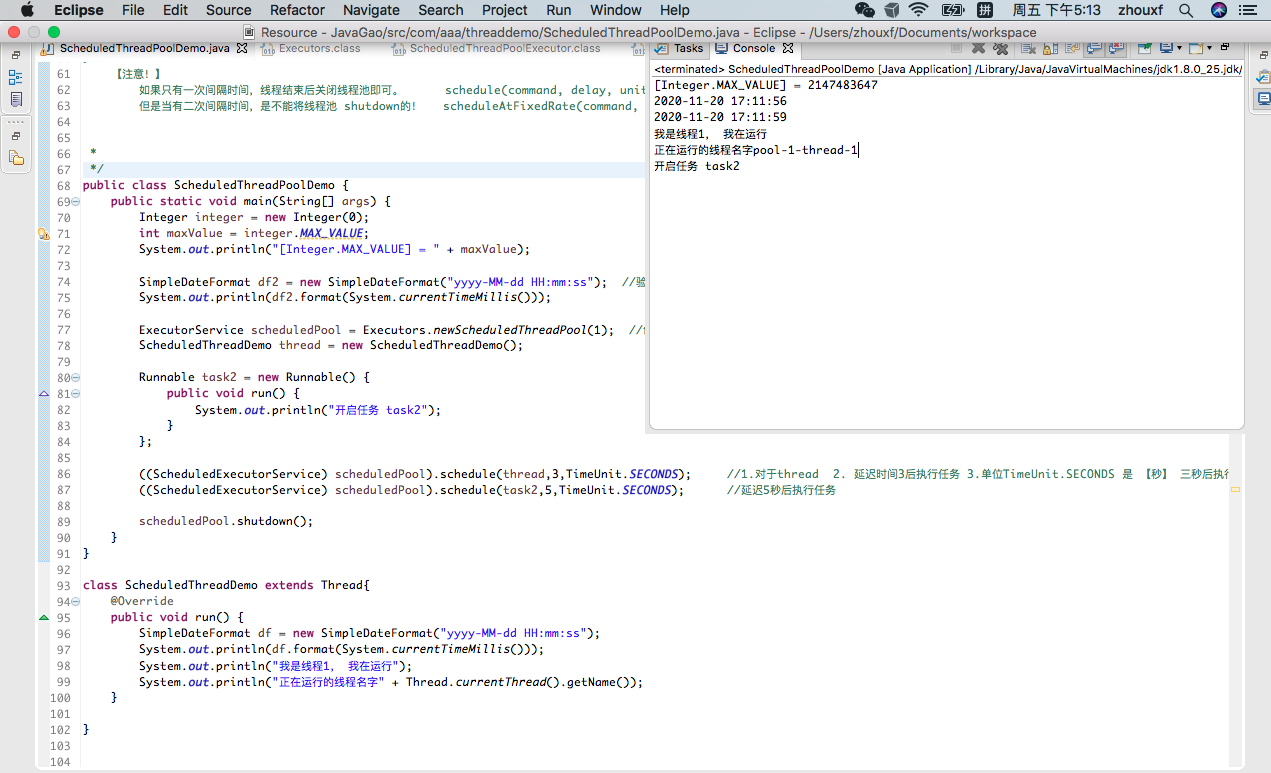
看结果
二 scheduleAtFixedRate ?
package com.aaa.threaddemo;

import static java.util.concurrent.TimeUnit.NANOSECONDS;

import java.text.SimpleDateFormat;

import java.util.Date;

import java.util.concurrent.ExecutorService;

import java.util.concurrent.Executors;

import java.util.concurrent.ScheduledExecutorService;

import java.util.concurrent.ScheduledFuture;

import java.util.concurrent.ScheduledThreadPoolExecutor;

import java.util.concurrent.TimeUnit;

import javax.xml.crypto.Data;

/*

 * 一 newScheduledThreadPool 是个啥?

 *         1 是一个线程池

 *         2 可定时执行任务

 *         3 核心线程数是固定的

 *         4 非核心线程数 2147483647

 *

 *

     public static ScheduledExecutorService newScheduledThreadPool(int corePoolSize) {

        return new ScheduledThreadPoolExecutor(corePoolSize);

    }

    public ScheduledThreadPoolExecutor(int corePoolSize) {

        super(

        corePoolSize,

        Integer.MAX_VALUE,

        0,        //非核心线程的生存时间是 0 马上回收。

        NANOSECONDS,

        new DelayedWorkQueue());  //一个优先级的队列      阻塞的队列,因为它实现了BlockingQueue

    }

   DelayedWorkQueue() 优先级队列怎么用的?

        队列一般都是先进先出的,但是在定时/延时任务中,我们需要的是延迟时间短的任务先执行。

        为了解决这个问题,需要用到一种特殊的队列

        【优先级队列】

            对插入的数据进行优先级的排序,保证优先级高的数据先执行。和往队列中插入的顺序无关。

            没能深入调查。。。。

  二  提供了两个方法可以用

          schedule(command, delay, unit)

          schedule(

          task,                  需要执行的任务

          3,                       间隔的时间

          TimeUnit.SECONDS    时间单位   秒 分 时 。。。

 );

        scheduleAtFixedRate(

        command,

        initialDelay,         初次执行 间隔的时间

        period,              再次执行的相隔时间

        unit                 时间的单位

)

    【注意!】

        如果只有一次间隔时间,线程结束后关闭线程池即可。      schedule(command, delay, unit)

        但是当有二次间隔时间,是不能将线程池 shutdown的!   scheduleAtFixedRate(command, initialDelay, period, unit)

 *

 */

public class ScheduledThreadPoolDemo {

    public static void main(String[] args) {

        SimpleDateFormat df2 = new SimpleDateFormat("yyyy-MM-dd HH:mm:ss");  //验证是否是在三秒后执行

        System.out.println(df2.format(System.currentTimeMillis()));

        ExecutorService scheduledPool = Executors.newScheduledThreadPool(1);  //创建定时的线程池 核心数量 2

        ScheduledThreadDemo thread = new ScheduledThreadDemo();

        Runnable task2 = new Runnable() {

            public void run() {

                System.out.println("开启任务 task2");

            }

        };

        Runnable task3 = new Runnable() {

            public void run() {

                System.out.println("开启任务 task3");

            }

        };

        ((ScheduledExecutorService) scheduledPool).schedule(thread,3,TimeUnit.SECONDS);        //1.对于thread  2. 延迟时间3后执行任务 3.单位TimeUnit.SECONDS 是 【秒】 三秒后执行

        ((ScheduledExecutorService) scheduledPool).schedule(task2,5,TimeUnit.SECONDS);        //延迟5秒后执行任务

        ((ScheduledExecutorService) scheduledPool).scheduleAtFixedRate(task3, 8, 3, TimeUnit.SECONDS);  //对于task3 程序启动 8秒后执行,中间间隔3秒执行一次。

//        scheduledPool.shutdown();

    }

}

class ScheduledThreadDemo extends Thread{

    @Override

    public void run() {

        SimpleDateFormat df = new SimpleDateFormat("yyyy-MM-dd HH:mm:ss");

        System.out.println(df.format(System.currentTimeMillis()));

        System.out.println("我是线程1, 我在运行");

        System.out.println("正在运行的线程名字" + Thread.currentThread().getName());

    }

}
查看结果

常见线程池 newScheduledThreadPool 定时执行任务的线程池 简单介绍的更多相关文章
- 9、java5线程池之定时任务线程池newScheduledThreadPool与newSingleThreadScheduledExecutor
JDK文档描述 newSingleThreadScheduledExecutor() 创建一个单线程执行程序,它可安排在给定延迟后运行命令或者定期地执行.(注意,如果因为在关闭前的执行期间出现失败而终 ...
- 常见线程池之 newCacheThreadPool 缓存线程池 简单使用
package com.aaa.threaddemo; import java.util.concurrent.BlockingQueue; import java.util.concurrent.E ...
- java多线程系类:JUC线程池:01之线程池架构
概要 前面分别介绍了"Java多线程基础"."JUC原子类"和"JUC锁".本章介绍JUC的最后一部分的内容--线程池.内容包括:线程池架构 ...
- 这么说吧,java线程池的实现原理其实很简单
好处 : 线程是稀缺资源,如果被无限制的创建,不仅会消耗系统资源,还会降低系统的稳定性,合理的使用线程池对线程进行统一分配.调优和监控,有以下好处: 1.降低资源消耗: 2.提高响应速度: 3.提高线 ...
- 线程池系列一:线程池作用及Executors方法讲解
线程池的作用: 线程池作用就是限制系统中执行线程的数量. 根据系统的环境情况,可以自动或手动设置线程数量,达到运行的最佳效果:少了浪费了系统资源,多了造成系统拥挤效率不高.用线程池控制线程数量 ...
- python基础-12 多线程queue 线程交互event 线程锁 自定义线程池 进程 进程锁 进程池 进程交互数据资源共享
Python中的进程与线程 学习知识,我们不但要知其然,还是知其所以然.你做到了你就比别人NB. 我们先了解一下什么是进程和线程. 进程与线程的历史 我们都知道计算机是由硬件和软件组成的.硬件中的CP ...
- Android线程管理之ThreadPoolExecutor自定义线程池
前言: 上篇主要介绍了使用线程池的好处以及ExecutorService接口,然后学习了通过Executors工厂类生成满足不同需求的简单线程池,但是有时候我们需要相对复杂的线程池的时候就需要我们自己 ...
- java多线程系类:JUC线程池:03之线程池原理(二)(转)
概要 在前面一章"Java多线程系列--"JUC线程池"02之 线程池原理(一)"中介绍了线程池的数据结构,本章会通过分析线程池的源码,对线程池进行说明.内容包 ...
- 从源码解读线程(Thread)和线程池(ThreadPoolExecutor)的状态
线程是比进程更加轻量级的调度执行单位,理解线程是理解并发编程的不可或缺的一部分:而生产过程中不可能永远使用裸线程,需要线程池技术,线程池是管理和调度线程的资源池.因为前不久遇到了一个关于线程状态的问题 ...
随机推荐
- RMQ(ST(Sparse Table))(转载)
1. 概述 RMQ(Range Minimum/Maximum Query),即区间最值查询,是指这样一个问题:对于长度为n的数列A,回答若干询问RMQ(A,i,j)(i,j<=n),返回数列A ...
- 「算法笔记」快速傅里叶变换(FFT)
一.引入 首先,定义多项式的形式为 \(f(x)=\sum_{i=0}^n a_ix^i\),其中 \(a_i\) 为系数,\(n\) 为次数,这种表示方法称为"系数表示法",一个 ...
- matplotlib 进阶之Customizing Figure Layouts Using GridSpec and Other Functions
目录 对Gridspec的一些精细的调整 利用SubplotSpec fig.add_grdispec; gs.subgridspec 一个利用Subplotspec的复杂例子 函数链接 matplo ...
- Java初学者作业——简单程序根据用户输入的会员类型以及购物金额,判断是否能够享受活动优惠
返回本章节 返回作业目录 需求说明: 超市周年庆举行购物满减活动,编写Java程序,根据用户输入的会员类型以及购物金额,判断是否能够享受活动优惠,会员类型的输入不限制大小写.具体获取规则:若为VIP会 ...
- Java中的构造方法「注意事项」
构造方法是专门用来创建对象的方法,当我们通过关键字new来创建对象时,其实就是调用构造方法. 语法: public 类名称(参数类型 参数名称){ 方法体 } 注意事项: 构造方法的名称必须和所在的类 ...
- Java面向对象笔记 • 【第4章 抽象类和接口】
全部章节 >>>> 本章目录 4.1 抽象类 4.1.1 抽象方法和抽象类 4.1.2 抽象类的作用 4.1.3 实践练习 4.2 final修饰符 4.2.1 final ...
- 编写Java程序,利用List实现报数游戏的实现思路
返回本章节 返回作业目录 需求说明: 利用List实现报数游戏 在控制台输入一个大于3的正整数,该整数表示有多少人,如在控制台输入10,表示有10个人,10个人围成一个圆圈,从序号1开始为这些人依次编 ...
- Linux查看RAM内存信息
1.查看/proc/meminfo文件 查看RAM使用情况最简单的方法是通过/proc/meminfo. 这个动态更新的虚拟文件列出了详细的内存使用情况. cat /proc/meminfo 命令输出 ...
- .net core的Swagger接口文档使用教程(一):Swashbuckle
现在的开发大部分都是前后端分离的模式了,后端提供接口,前端调用接口.后端提供了接口,需要对接口进行测试,之前都是使用浏览器开发者工具,或者写单元测试,再或者直接使用Postman,但是现在这些都已经o ...
- 论文翻译:2021_Semi-Blind Source Separation for Nonlinear Acoustic Echo Cancellation
论文地址:https://ieeexplore.ieee.org/abstract/document/9357975/ 基于半盲源分离的非线性回声消除 摘要: 当使用非线性自适应滤波器时,数值模型与实 ...