
Lesson17——NumPy 统计函数
NumPy 教程目录
1 NumPy 统计函数
NumPy 提供了很多统计函数,用于从数组中查找最小元素,最大元素,百分位标准差和方差等。 函数说明如下
1.1 统计
| method | description |
|---|---|
| amin(a[, axis, out, keepdims, initial, where]) | 返回数组的最小值或沿轴的最小值。 |
| amax(a[, axis, out, keepdims, initial, where]) | 返回数组的最大值或沿轴的最大值。 |
| nanmin(a[, axis, out, keepdims]) | 返回数组的最小值或沿轴的最小值,忽略任何 NaN。 |
| nanmax(a[, axis, out, keepdims]) | 返回数组的最大值或沿轴的最大值,忽略任何 NaN。 |
| ptp(a[, axis, out, keepdims]) | 沿轴的值范围(最大值 - 最小值)。 |
| percentile(a, q[, axis, out, …]) | 沿指定轴计算数据的第 q 个百分位数。 |
| nanpercentile(a, q[, axis, out, …]) | 计算沿指定轴的数据的第 q 个百分位数,同时忽略 nan 值。 |
| quantile(a, q[, axis, out, overwrite_input, …]) | 沿指定轴计算数据的第 q 个分位数。 |
| nanquantile(a, q[, axis, out, …]) | 沿指定轴计算数据的第 q 个分位数,同时忽略 nan 值。 |
1.2 平均值和方差
| method | description |
|---|---|
| median(a[, axis, out, overwrite_input, keepdims]) | 计算沿指定轴的中位数。 |
| average(a[, axis, weights, returned]) | 计算沿指定轴的加权平均值。 |
| mean(a[, axis, dtype, out, keepdims]) | 计算沿指定轴的算术平均值。 |
| std(a[, axis, dtype, out, ddof, keepdims]) | 计算沿指定轴的标准差。 |
| var(a[, axis, dtype, out, ddof, keepdims]) | 计算沿指定轴的方差。 |
| nanmedian(a[, axis, out, overwrite_input, …]) | 计算沿指定轴的中位数,同时忽略 NaN。 |
| nanmean(a[, axis, dtype, out, keepdims]) | 计算沿指定轴的算术平均值,忽略 NaN。 |
| nanstd(a[, axis, dtype, out, ddof, keepdims]) | 计算沿指定轴的标准差,同时忽略 NaN。 |
| nanvar(a[, axis, dtype, out, ddof, keepdims]) | 计算沿指定轴的方差,同时忽略 NaN。 |
1.3 相关系数
| method | description |
|---|---|
| corrcoef(x[, y, rowvar, bias, ddof]) | 返回 Pearson 积矩相关系数。 |
| correlate(a, v[, mode]) | 两个一维序列的互相关。 |
| cov(m[, y, rowvar, bias, ddof, fweights, …]) | 给定数据和权重,估计协方差矩阵。 |
1.4 直方图
| method | description |
|---|---|
| histogram(a[, bins, range, normed, weights, …]) | 计算一组数据的直方图。 |
| histogram2d(x, y[, bins, range, normed, …]) | 计算两个数据样本的二维直方图。 |
| histogramdd(sample[, bins, range, normed, …]) | 计算一些数据的多维直方图。 |
| bincount(x[, weights, minlength]) | 计算非负整数数组中每个值的出现次数。 |
| histogram_bin_edges(a[, bins, range, weights]) | 仅计算直方图函数使用的 bin 边缘的函数。 |
| digitize(x, bins[, right]) | 返回输入数组中每个值所属的 bin 的索引。 |
2 统计例子
2.1 numpy.amin()
numpy.amin() 用于计算数组中的元素沿指定轴的最小值。
Example:
a = np.array([[3,7,5],[8,4,3],[2,4,9]])

print(a)

print(np.amin(a)) #所有元素的最小值

print(np.amin(a,axis=0)) #每列元素的最小值

print(np.amin(a,axis=1))  #每行元素的最小值

"""

[[3 7 5]

 [8 4 3]

 [2 4 9]]

2

[2 4 3]

[3 3 2]

"""
2.2 numpy.amax()
numpy.amax() 用于计算数组中的元素沿指定轴的最大值。
Example:
a = np.array([[3,7,5],[8,4,3],[2,4,9]])

print(a)

print(np.amax(a)) #所有元素的最大值

print(np.amax(a,axis=0)) #每列元素的最大值

print(np.amax(a,axis=1))  #每行元素的最大值

"""

[[3 7 5]

 [8 4 3]

 [2 4 9]]

9

[8 7 9]

[7 8 9]

"""
2.3 numpy.nanmin()
numpy.nanmin(a, axis=None, out=None, keepdims=<no value>, initial=<no value>, where=<no value>) 返回数组的最小值或沿轴的最小值,忽略任何 NaN。 当遇到所有 NaN 切片时,会引发 RuntimeWarning 并为该切片返回 Nan。
Example:
a = np.array([[1, 2], [3, np.nan],[3, -np.nan]])

print(np.amin(a))

print(np.nanmin(a))

print(np.nanmin(a,axis=0))

print(np.nanmin(a,axis=1))

"""

nan

1.0

[1. 2.]

[1. 3. 3.]

"""
2.4 numpy.nanmax()
numpy.nanmax(a, axis=None, out=None, keepdims=<no value>, initial=<no value>, where=<no value>) 返回数组的最大值或沿轴的最大值,忽略任何 NaN。 当遇到所有 NaN 切片时,会引发 RuntimeWarning 并为该切片返回 NaN。
Example:
a = np.array([[1, 2], [3, np.nan],[3, -np.nan]])

print(np.amax(a))

print(np.nanmax(a))

print(np.nanmax(a,axis=0))

print(np.nanmax(a,axis=1))

"""

nan

3.0

[3. 2.]

[2. 3. 3.]

"""
2.5 numpy.ptp()
numpy.ptp(a, axis=None, out=None, keepdims=<no value>) 沿轴的值范围(最大值 - 最小值)。
Example:
x = np.array([[4, 9, 2, 10],

              [6, 9, 7, 12]])

print(np.ptp(x))

print(np.ptp(x,axis=0))

print(np.ptp(x,axis=1))

"""

10

[2 0 5 2]

[8 6]

"""
2.6 numpy.percentile()
numpy.percentile(a, q, axis=None, out=None, overwrite_input=False, method='linear', keepdims=False, *, interpolation=None) 百分位数是统计中使用的度量,表示小于这个值的观察值的百分比。
参数说明:
- a: 输入数组
- q:要计算的百分位数,在 0 ~ 100 之间
- axis: 沿着它计算百分位数的轴
首先明确百分位数:
第 $q$ 个百分位数是这样一个值,它使得至少有 q% 的数据项小于或等于这个值,且至少有 (100-q)% 的数据项大于或等于这个值。
举个例子:高等院校的入学考试成绩经常以百分位数的形式报告。比如,假设某个考生在入学考试中的语文部分的原始分数为 54 分。相对于参加同一考试的其他学生来说,他的成绩如何并不容易知道。但是如果原始分数54分恰好对应的是第70百分位数,我们就能知道大约70%的学生的考分比他低,而约30%的学生考分比他高。
Example:
a = np.array([[10, 7, 4], [3, 2, 1]])

print ('我们的数组是:')

print (a)

print ('调用 percentile() 函数:')

# 50% 的分位数,就是 a 里排序之后的中位数

print (np.percentile(a, 50))

# axis 为 0,在纵列上求

print (np.percentile(a, 50, axis=0))

# axis 为 1,在横行上求

print (np.percentile(a, 50, axis=1))

# 保持维度不变

print (np.percentile(a, 50, axis=1, keepdims=True))

"""

我们的数组是:

[[10  7  4]

 [ 3  2  1]]

调用 percentile() 函数:

3.5

[6.5 4.5 2.5]

[7. 2.]

[[7.]

 [2.]]

"""
2.7 numpy.quantile()
numpy.quantile(a, q, axis=None, out=None, overwrite_input=False, method='linear', keepdims=False, *, interpolation=None) 沿指定轴计算数据的第 q 个分位数。
Note
给定长度为 N 的向量V,V的第 q 个分位数是从最小到最大的方式的值 q 如果归一化排名与 q 的位置完全不匹配,则两个最近邻居的值和距离以及内插参数将确定分位数。如果 q = 0.5,此函数与中位数相同;如果 q = 0.0,此函数与最小值相同;如果 q = 1.0,则与最大值相同.
Example:
>>> a = np.array([[10, 7, 4], [3, 2, 1]])

>>> a

array([[10,  7,  4],

       [ 3,  2,  1]])

>>> np.quantile(a, 0.5)

3.5

>>> np.quantile(a, 0.5, axis=0)

array([6.5, 4.5, 2.5])

>>> np.quantile(a, 0.5, axis=1)

array([7.,  2.])

>>> np.quantile(a, 0.5, axis=1, keepdims=True)

array([[7.],

       [2.]])

>>> m = np.quantile(a, 0.5, axis=0)

>>> out = np.zeros_like(m)

>>> np.quantile(a, 0.5, axis=0, out=out)

array([6.5, 4.5, 2.5])

>>> m

array([6.5, 4.5, 2.5])

>>> b = a.copy()

>>> np.quantile(b, 0.5, axis=1, overwrite_input=True)

array([7.,  2.])

>>> assert not np.all(a == b)
3 平均值和方差
3.1 numpy.median()
numpy.median(a, axis=None, out=None, overwrite_input=False, keepdims=False) 计算沿指定轴的中位数。
Example:
a = np.array([[10, 7, 4], [3, 2, 1]])

print(a)

print(np.median(a))  #所有元素的中位数

print(np.median(a, axis=0))

print(np.median(a, axis=1))

"""

[[10  7  4]

 [ 3  2  1]]

3.5

[6.5 4.5 2.5]

[7.,  2.]

"""
Example:
m = np.median(a, axis=0)

out = np.zeros_like(m)

print(np.median(a, axis=0, out=m))

print(m)

b = a.copy()

print(np.median(b, axis=1, overwrite_input=True))

assert not np.all(a==b)

b = a.copy()

print(np.median(b, axis=None, overwrite_input=True))

assert not np.all(a==b)

"""

[6.5 4.5 2.5]

[6.5 4.5 2.5]

[7. 2.]

3.5

"""
3.2 numpy.average()
numpy.average(a, axis=None, weights=None, returned=False) 计算沿指定轴的加权平均值。
计算方式为:avg = sum(a * weights) / sum(weights)
Example:
data = np.arange(1, 5)

print(data)

print(np.average(data))

print(np.average(np.arange(1, 11), weights=np.arange(10, 0, -1)))

"""

[1 2 3 4]

2.5

4.0

"""
Example:
data = np.arange(6).reshape((3,2))

print(data)

print(np.average(data, axis=1, weights=[1./4, 3./4]))

"""

[[0 1]

 [2 3]

 [4 5]]

[0.75 2.75 4.75]

"""
3.3 numpy.mean()
numpy.mean(a, axis=None, dtype=None, out=None, keepdims=<no value>, *, where=<no value>) 计算沿指定轴的算术平均值。
Example:
a = np.array([[1, 2], [3, 4]])

print(np.mean(a))

print(np.mean(a, axis=0))

print(np.mean(a, axis=1))

"""

2.5

[2. 3.]

[1.5 3.5]

"""
3.4 numpy.std()
numpy.std(a, axis=None, dtype=None, out=None, ddof=0, keepdims=<no value>, *, where=<no value>) 计算沿指定轴的标准差。
Example:
a = np.array([[1, 2], [3, 4]])

print( np.std(a))

print(np.std(a, axis=0))

print(np.std(a, axis=1))

"""

1.118033988749895

[1. 1.]

[0.5 0.5]

"""
3.5 numpy.var()
numpy.var(a, axis=None, dtype=None, out=None, ddof=0, keepdims=<no value>, *, where=<no value>) 计算沿指定轴的方差。
Example:
a = np.array([[1, 2], [3, 4]])

print( np.var(a))

print(np.var(a, axis=0))

print(np.var(a, axis=1))

"""

1.25

[1. 1.]

[0.25 0.25]

"""
4 相关系数
4.1 numpy.corrcoef()
numpy.corrcoef(x, y=None, rowvar=True, bias=<no value>, ddof=<no value>, *, dtype=None) 返回 Pearson 积矩相关系数。
Example:
rng = np.random.default_rng(seed=42)

xarr = rng.random((3, 3))

print(xarr)

"""

[[0.77395605 0.43887844 0.85859792]

 [0.69736803 0.09417735 0.97562235]

 [0.7611397  0.78606431 0.12811363]]

"""

R1 = np.corrcoef(xarr)

print(R1)

"""

[[ 1.          0.99256089 -0.68080986]

 [ 0.99256089  1.         -0.76492172]

 [-0.68080986 -0.76492172  1.        ]]

"""
4.2 numpy.correlate()
numpy.correlate(a, v, mode='valid') 两个一维序列的互相关。
Example:
print(np.correlate([1, 2, 3], [0, 1, 0.5]))

print(np.correlate([1, 2, 3], [0, 1, 0.5], "same"))

print(np.correlate([1, 2, 3], [0, 1, 0.5], "full"))

"""

[3.5]

[2.  3.5 3. ]

[0.5 2.  3.5 3.  0. ]

"""
4.3 numpy.cov()
numpy.cov(m, y=None, rowvar=True, bias=False, ddof=None, fweights=None, aweights=None, *, dtype=None) 给定数据和权重,估计协方差矩阵。
Example:
m = np.arange(10, dtype=np.float64)

f = np.arange(10) * 2

a = np.arange(10) ** 2.

ddof = 1

w = f * a

v1 = np.sum(w)

v2 = np.sum(w * a)

m -= np.sum(m * w, axis=None, keepdims=True) / v1

cov = np.dot(m * w, m.T) * v1 / (v1**2 - ddof * v2)

print(cov)

"""

2.368621947484198

"""
Example:
x = np.array([[0, 2], [1, 1], [2, 0]]).T

print(x)

print(np.cov(x))

"""

[[0 1 2]

 [2 1 0]]

[[ 1. -1.]

 [-1.  1.]]

"""
5 直方图
5.1 numpy.histogram()
numpy.histogram(a, bins=10, range=None, normed=None, weights=None, density=None) 计算数据集的直方图。
Example:
print( np.histogram([1, 2, 1], bins=[0, 1, 2, 3]))

print( np.histogram(np.arange(4), bins=np.arange(5), density=True))

print( np.histogram([[1, 2, 1], [1, 0, 1]], bins=[0,1,2,3]))

"""

(array([0, 2, 1], dtype=int64), array([0, 1, 2, 3]))

(array([0.25, 0.25, 0.25, 0.25]), array([0, 1, 2, 3, 4]))

(array([1, 4, 1], dtype=int64), array([0, 1, 2, 3]))

"""
Example:
a = np.arange(5)

hist, bin_edges = np.histogram(a, density=True)

print(hist)

print(hist.sum())

print(np.sum(hist * np.diff(bin_edges)))

"""

[0.5 0.  0.5 0.  0.  0.5 0.  0.5 0.  0.5]

2.4999999999999996

1.0

"""
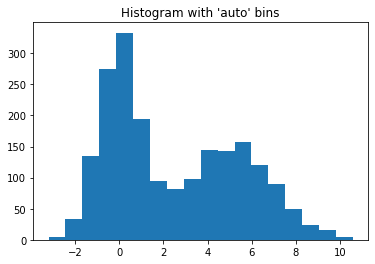
Example:
rng = np.random.RandomState(10)  # deterministic random data

a = np.hstack((rng.normal(size=1000),

               rng.normal(loc=5, scale=2, size=1000)))

_ = plt.hist(a, bins='auto')  # arguments are passed to np.histogram

plt.title("Histogram with 'auto' bins")

Text(0.5, 1.0, "Histogram with 'auto' bins")

plt.show()
输出结果:
Lesson17——NumPy 统计函数的更多相关文章
- NumPy 统计函数
NumPy 统计函数 NumPy 提供了很多统计函数,用于从数组中查找最小元素,最大元素,百分位标准差和方差等. 函数说明如下: numpy.amin() 和 numpy.amax() numpy.a ...
- NumPy统计函数
NumPy - 统计函数 NumPy 有很多有用的统计函数,用于从数组中给定的元素中查找最小,最大,百分标准差和方差等. 函数说明如下: numpy.amin() 和 numpy.amax() 这些函 ...
- 14、numpy——统计函数
NumPy 统计函数 NumPy 提供了很多统计函数,用于从数组中查找最小元素,最大元素,百分位标准差和方差等. 函数说明如下:(沿哪条轴执行,就是是最后结果的形式) 1.numpy.amin() 和 ...
- NumPy——统计函数
引入模块import numpy as np 1.numpy.sum(a, axis=None)/a.sum(axis=None) 根据给定轴axis计算数组a相关元素之和,axis整数或元组,不指定 ...
- 吴裕雄--天生自然Numpy库学习笔记:NumPy 统计函数
NumPy 提供了很多统计函数,用于从数组中查找最小元素,最大元素,百分位标准差和方差等. numpy.amin() 用于计算数组中的元素沿指定轴的最小值. numpy.amax() 用于计算数组中的 ...
- 数据分析 大数据之路 四 numpy 2
NumPy 数学函数 NumPy 提供了标准的三角函数:sin().cos().tan(import numpy as np a = np.array([0,30,45,60,90])print (' ...
- numpy学习笔记(三)
(1)numpy的位操作 序号 操作及描述 1. bitwise_and 对数组元素执行位与操作 2. bitwise_or 对数组元素执行位或操作 3. ...
- NumPy教程目录
NumPy Ndarray对象 NumPy数组属性 NumPy数据类型 NumPy数组创建例程 NumPy来自现有数据的数组 NumPy来自数值范围的数组 NumPy切片和索引 NumPy - 高级索 ...
- Python之Numpy详细教程
NumPy - 简介 NumPy 是一个 Python 包. 它代表 “Numeric Python”. 它是一个由多维数组对象和用于处理数组的例程集合组成的库. Numeric,即 NumPy 的前 ...
随机推荐
- debian8.4系统安装后的一些设置
1.添加软件源 su到root用户vi /etc/apt/sources.list 也可用gedit /etc/apt/sources.list (gnome下用,如果kde下则用 ...
- SYCOJ246螺旋矩阵
题目-螺旋矩阵 (shiyancang.cn) noip201403螺旋矩阵[普及组]数学算法 - 大本营 - 博客园 (cnblogs.com) 以下为搬运代码.一个为算圈数,另外一个是数学方法 思 ...
- JavaScript的执行过程(深入执行上下文、GO、AO、VO和VE等概念)
JavaScript的执行过程 前言 编写一段JavaScript代码,它是如何执行的呢?简单来说,JS引擎在执行JavaScript代码的过程中需要先解析再执行.那么在解析阶段JS引擎又会进行哪些操 ...
- sql多行合并一列
with a as( select * from( select 1 userId , '天津' province union select 1 userId , '北京' union select ...
- 详解__int128
前言 如果遇到 long long 开不下的情况,可以使用 __int128 来博一把! note :__int128 仅 \(64\) 位 \(GCC G++\) 支持,不在 \(C++\) 标准中 ...
- 【解决了一个小问题】golang go.mod中多了一个斜杠导致replace无效
replace github.com/sxxx/common_lib/src/ => ../../common_lib/src 修改成 replace github.com/sxxx/commo ...
- element 日期时间选择器type = "datetimerange",限制时间的选择范围
这里限制了只能选择一周的时间 pickerOptions:{ onPick(time){ // 如果选择了只选择了一个时间 i ...
- Autofac实现拦截器和切面编程
Autofac.Annotation框架是我用.netcore写的一个注解式DI框架,基于Autofac参考 Spring注解方式所有容器的注册和装配,切面,拦截器等都是依赖标签来完成. 开源地址:h ...
- python3 requests的content和text方法
text返回的是Unicode型的数据 content返回的是是二进制的数据. 也就是说,如果你想取文本,可以通过r.text. 如果想取图片,文件,则可以通过r.content >>&g ...
- JavaFx 软件重启功能实现
原文地址: JavaFx 软件重启功能实现 | Stars-One的杂货小窝 本篇使用Kotlin在TornadoFx中实践,没有Java代码的示例,各位自行参考,思路已在本文中提及 实现思路 主要思 ...