
Walls(floyd POJ1161)
| Time Limit: 1000MS | Memory Limit: 10000K | |
| Total Submissions: 7677 | Accepted: 3719 |
Description
it is necessary to go through a town or cross a great wall. For any two towns A and B, there is at most one great wall with one end in A and the other in B, and further, it is possible to go from A to B by always walking in a town or along a great wall. The
input format implies additional restrictions.
There is a club whose members live in the towns. In each town, there is only one member or there are no members at all. The members want to meet in one of the regions (outside of any town). The members travel riding their bicycles. They do not want to enter
any towns, because of the traffic, and they want to cross as few great walls as possible, as it is a lot of trouble. To go to the meeting region, each member needs to cross a number (possibly 0) of great walls. They want to find such an optimal region that
the sum of these numbers (crossing-sum, for short) is minimized.
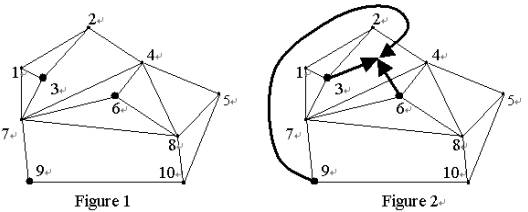
The towns are labeled with integers from 1 to N, where N is the number of towns. In Figure 1, the labeled nodes represent the towns and the lines connecting the nodes represent the great walls. Suppose that there are three members, who live in towns 3, 6, and
9. Then, an optimal meeting region and respective routes for members are shown in Figure 2. The crossing-sum is 2: the member from town 9 has to cross the great wall between towns 2 and 4, and the member from town 6 has to cross the great wall between towns
4 and 7.
You are to write a program which, given the towns, the regions, and the club member home towns, computes the optimal region(s) and the minimal crossing-sum.
Input
the number of club members L, 1 <= L <= 30, L <= N. The fourth line contains L distinct integers in increasing order: the labels of the towns where the members live.
After that the input contains 2M lines so that there is a pair of lines for each region: the first two of the 2M lines describe the first region, the following two the second and so on. Of the pair, the first line shows the number of towns I on the border of
that region. The second line of the pair contains I integers: the labels of these I towns in some order in which they can be passed when making a trip clockwise along the border of the region, with the following exception. The last region is the "outside region"
surrounding all towns and other regions, and for it the order of the labels corresponds to a trip in counterclockwise direction. The order of the regions gives an integer labeling to the regions: the first region has label 1, the second has label 2, and so
on. Note that the input includes all regions formed by the towns and great walls, including the "outside region".
Output
Sample Input
10

10

3

3 6 9

3

1 2 3

3

1 3 7

4

2 4 7 3

3

4 6 7

3

4 8 6

3

6 8 7

3

4 5 8

4

7 8 10 9

3

5 10 8

7

7 9 10 5 4 2 1
Sample Output
2
Source
以每一个区域为点建立图,然后暴力搜索最小的区域
#include <iostream>

#include <cstdio>

#include <cstring>

#include <cstdlib>

#include <algorithm>

using namespace std;

const int INF = 0x3f3f3f3f;

int m,n,L;

int man[300];//成员

int Area[250][300];//区域

int Dis[250][250];//区域之间的距离

int dis[40];//人到某个区域的距离

void floyd()//计算区域的最短路

{

    for(int k=1;k<=m;k++)

    {

        for(int i=1;i<=m;i++)

        {

            for(int j=1;j<=m;j++)

            {

                if(Dis[i][j]>Dis[i][k]+Dis[k][j])

                {

                    Dis[i][j]=Dis[i][k]+Dis[k][j];

                }

            }

        }

    }

}

int solve()//暴力枚举区域找最小的值

{

    int Min=INF;

    for(int i=1;i<=m;i++)

    {

        for(int j=1;j<=L;j++)

        {

            dis[j]=INF;

        }

        for(int j=1;j<=m;j++)

        {

            for(int k=1;k<=Area[j][0];k++)

            {

                if(man[Area[j][k]]>0&&dis[man[Area[j][k]]]>Dis[i][j])

                {

                    dis[man[Area[j][k]]]=Dis[i][j];

                }

            }

        }

        int temp=0;

        for(int j=1;j<=L;j++)

        {

            temp+=dis[j];

        }

        Min=min(Min,temp);

    }

    return Min;

}

int main()

{

    int a;

    while(~scanf("%d",&m))

    {

        scanf("%d %d",&n,&L);

        memset(man,0,sizeof(man));

        for(int i=1; i<=L; i++)

        {

            scanf("%d",&a);

            man[a]=i;//在那个点住着的成员编号

        }

       for(int i=1;i<=m;i++)//初始化

       {

           for(int j=i;j<=m;j++)

           {

               if(i==j)

               {

                   Dis[i][j]=0;

               }

               else

               {

                   Dis[i][j]=Dis[j][i]=INF;

               }

           }

       }

        for(int i=1; i<=m; i++)

        {

            scanf("%d",&Area[i][0]);

            for(int j=1; j<=Area[i][0]; j++)

            {

                scanf("%d",&Area[i][j]);//区域的点集,逆时针方向

            }

            Area[i][Area[i][0]+1]=Area[i][1];//闭合区域

            for(int j=1; j<=Area[i][0]; j++)//判断区域是不是相邻

            {

                for(int k=1; k<i; k++)

                {

                    for(int s=1; s<=Area[k][0]; s++)

                    {

                        if(Area[i][j+1]==Area[k][s]&&Area[i][j]==Area[k][s+1])//判断区域是不是邻接

                        {

                            Dis[i][k]=Dis[k][i]=1;

                        }

                    }

                }

            }

        }

        floyd();

        printf("%d\n",solve());

    }

    return 0;

}
Walls(floyd POJ1161)的更多相关文章
- POJ 1161 Walls ( Floyd && 建图 )
题意 : 在某国,城市之间建起了长城,每一条长城连接两座城市.每条长城互不相交.因此,从一个区域到另一个区域,需要经过一些城镇或者穿过一些长城.任意两个城市A和B之间最多只有一条长城,一端在A城市, ...
- 图论常用算法之一 POJ图论题集【转载】
POJ图论分类[转] 一个很不错的图论分类,非常感谢原版的作者!!!在这里分享给大家,爱好图论的ACMer不寂寞了... (很抱歉没有找到此题集整理的原创作者,感谢知情的朋友给个原创链接) POJ:h ...
- POJ 1161 Walls(Floyd , 建图)
题意: 给定n个城市, 然后城市之间会有长城相连, 长城之间会围成M个区域, 有L个vip(每个vip会处于一个城市里)要找一个区域聚会, 问一共最少跨越多少个长城. 分析: 其实这题难就难在建图, ...
- POJ 1161 Walls【floyd 以面为点建图】
题目链接:http://poj.org/problem?id=1161 题目大意: 1.给出m个区域,n个俱乐部点.接下来是n个俱乐部点以及各个区域由什么点围成.求一个区域到各个俱乐部点的距离之和最小 ...
- Floyd 求最短路(poj 1161)
Floyd-Warshall算法介绍: Floyd-Warshall算法的原理是动态规划. 设为从到的只以集合中的节点为中间节点的最短路径的长度. 若最短路径经过点k,则: 若最短路径不经过点k,则. ...
- poj 1161 Walls
https://vjudge.net/problem/POJ-1161 题意:有m个区域,n个小镇,有c个人在这些小镇中,他们要去某一个区域中聚会,从一个区域到另一个区域需要穿墙,问这些人聚到一起最少 ...
- floyd算法学习笔记
算法思路 路径矩阵 通过一个图的权值矩阵求出它的每两点间的最短路径矩阵.从图的带权邻接矩阵A=[a(i,j)] n×n开始,递归地进行n次更新,即由矩阵D(0)=A,按一个公式,构造出矩阵D(1):又 ...
- 最短路(Floyd)
关于最短的先记下了 Floyd算法: 1.比较精简准确的关于Floyd思想的表达:从任意节点A到任意节点B的最短路径不外乎2种可能,1是直接从A到B,2是从A经过若干个节点X到B.所以,我们假设maz ...
- 最短路径之Floyd算法
Floyd算法又称弗洛伊德算法,也叫做Floyd's algorithm,Roy–Warshall algorithm,Roy–Floyd algorithm, WFI algorithm. Floy ...
随机推荐
- hdu A Bug's Life
题目意思:给定一系列数对,例如a和b,表示a和b不是同一种性别,然后不断的给出这样的数对,问有没有性别不对的情况. 例如给定: 1 2 3 4 1 3 那这里就是说1和2不是同种性别 ...
- AOP 学习
学习 Spring.Net 的AOP 的时候,在做一个简单的测试例子的时候,配置文件和代码逻辑都是没问题的,但始终报这样一个异常: 无法将类型为“CompositionAopProxy_1e76f37 ...
- MySQL 5.7贴心参数之binlog_row_image
相信大家都了解mysql binlog的格式,那就是有三种,分别是STATEMENT,MiXED,ROW.各有优劣,具体的请大家自行查阅资料.在MySQL 5.7版本以前,虽然ROW格式有各种各样的好 ...
- js中cookie
document.cookie='address='+$("#address").val()+';path=/';
- sql 数据库 初级 个人学习总结(一)
数据库个人总结(初级)1.增删改查 insert into 表名 values ('条件','条件2') delete from 表名 where 条件 update 表名 set=条件值 where ...
- 4_STL设计理念_算法
STL算法,容器,迭代器的设计理念1.STL容器通过 类模板 技术,实现 数据类型 和 容器模型的分离:2.迭代器技术 实现了 遍历和操作容器的统一方法3.STL算法设计理念:通过预定义的函数对象和函 ...
- 示例-创建表格-指定行列&删除表格的行和列
<body> <script type="text/javascript"> /* *上面的方法和你麻烦. *既然操作的是表格, *那么最方便的方式就是使用 ...
- Python强化训练笔记(二)——元组元素的命名
对于一个元组如: >>> s1 = ('Jim', 21, 'boy', '5788236@qq.com') 我们要得到该对象的名字,年龄,性别及邮箱的方法为s1[0],s1[1], ...
- window.self ->window.top->window.parent
在应用有frameset或者iframe的页面时,parent是父窗口,top是最顶级父窗口(有的窗口中套了好几层frameset或者iframe),self是当前窗口, opener是用open方法 ...
- 【java基础学习】字符串
字符串 1. java内存区域(堆区.栈区.常量池) 2. String方法 获取长度 length(); 获取位置 indexOf(index); lastIndexOf(index) 获取子串 c ...