
自然语言17_Chinking with NLTK
sklearn实战-乳腺癌细胞数据挖掘(博主亲自录制视频教程)
https://study.163.com/course/introduction.htm?courseId=1005269003&utm_campaign=commission&utm_source=cp-400000000398149&utm_medium=share
https://www.pythonprogramming.net/chinking-nltk-tutorial/?completed=/chunking-nltk-tutorial/
代码
# -*- coding: utf-8 -*-

"""

Created on Sun Nov 13 09:14:13 2016

@author: daxiong

"""

import nltk

from nltk.corpus import state_union

from nltk.tokenize import PunktSentenceTokenizer

#训练数据

train_text=state_union.raw("2005-GWBush.txt")

#测试数据

sample_text=state_union.raw("2006-GWBush.txt")

'''

 Punkt is designed to learn parameters (a list of abbreviations, etc.)

 unsupervised from a corpus similar to the target domain.

 The pre-packaged models may therefore be unsuitable:

 use PunktSentenceTokenizer(text) to learn parameters from the given text

'''

#我们现在训练punkttokenizer(分句器)

custom_sent_tokenizer=PunktSentenceTokenizer(train_text)

#训练后,我们可以使用punkttokenizer(分句器)

tokenized=custom_sent_tokenizer.tokenize(sample_text)

'''

nltk.pos_tag(["fire"]) #pos_tag(列表)

Out[19]: [('fire', 'NN')]

'''

'''

#测试语句

words=nltk.word_tokenize(tokenized[0])

tagged=nltk.pos_tag(words)

chunkGram=r"""Chunk:{<RB.?>*<VB.?>*<NNP>+<NN>?}"""

chunkParser=nltk.RegexpParser(chunkGram)

chunked=chunkParser.parse(tagged)

#lambda t:t.label()=='Chunk' 包含Chunk标签的列

for subtree in chunked.subtrees(filter=lambda t:t.label()=='Chunk'):

    print(subtree)

'''

#文本词性标记函数

def process_content():

    try:

        for i in tokenized[0:5]:

            words = nltk.word_tokenize(i)

            tagged = nltk.pos_tag(words)

            chunkGram = r"""Chunk: {<.*>+}

                                    }<VB.?|IN|DT|TO>+{"""

            chunkParser = nltk.RegexpParser(chunkGram)

            chunked = chunkParser.parse(tagged)

            chunked.draw()

    except Exception as e:

        print(str(e))

process_content()
百度文库参考
http://wenku.baidu.com/link?url=YIrqeVS8a1zO_H0t66kj1AbUUReLUJIqId5So5Szk0JJAupyg_m2U_WqxEHqAHDy9DfmoAAPu0CdNFf-rePBsTHkx-0WDpoYTH1txFDKQxC
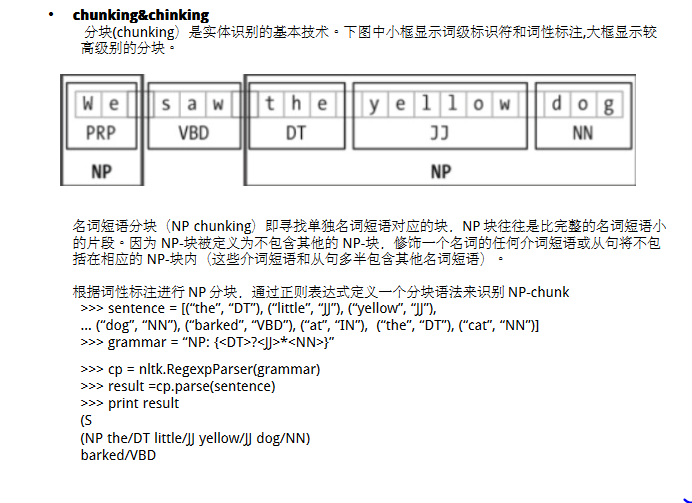

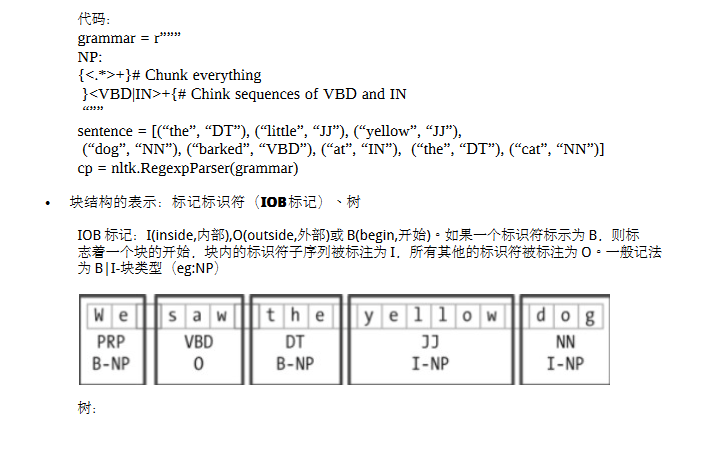
chinking可用于提取句子主干,去除不需要的修饰语
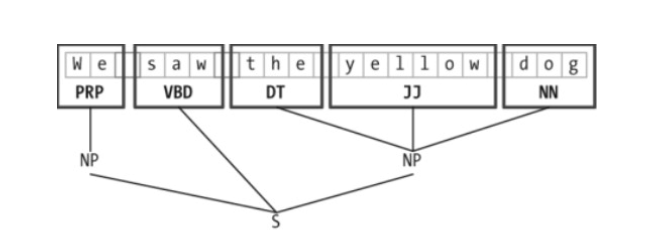
Chinking with NLTK
You may find that, after a lot of chunking, you have some words in
your chunk you still do not want, but you have no idea how to get rid
of them by chunking. You may find that chinking is your solution.
Chinking is a lot like chunking, it is basically a way for you to
remove a chunk from a chunk. The chunk that you remove from your chunk
is your chink.
The code is very similar, you just denote the chink, after the chunk, with }{ instead of the chunk's {}.
import nltk

from nltk.corpus import state_union

from nltk.tokenize import PunktSentenceTokenizer

train_text = state_union.raw("2005-GWBush.txt")

sample_text = state_union.raw("2006-GWBush.txt")

custom_sent_tokenizer = PunktSentenceTokenizer(train_text)

tokenized = custom_sent_tokenizer.tokenize(sample_text)

def process_content():

    try:

        for i in tokenized[5:]:

            words = nltk.word_tokenize(i)

            tagged = nltk.pos_tag(words)

            chunkGram = r"""Chunk: {<.*>+}

                                    }<VB.?|IN|DT|TO>+{"""

            chunkParser = nltk.RegexpParser(chunkGram)

            chunked = chunkParser.parse(tagged)

            chunked.draw()

    except Exception as e:

        print(str(e))

process_content()
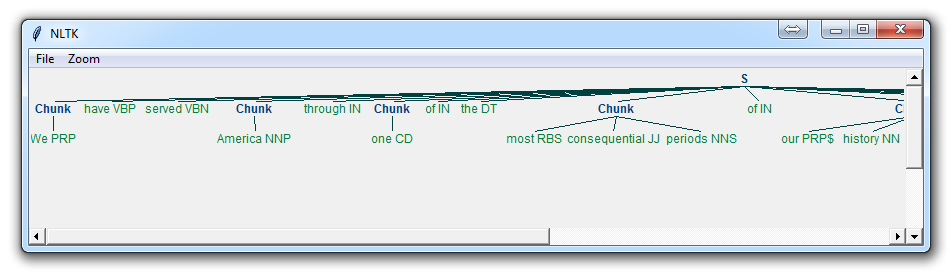
With this, you are given something like:
Now, the main difference here is:
}<VB.?|IN|DT|TO>+{
此句表示,我们移除一个或多个动词,介词,定冠词,或to
This means we're removing from the chink one or more verbs, prepositions, determiners, or the word 'to'.
Now that we've learned how to do some custom forms of chunking, and chinking, let's discuss a built-in form of chunking that comes with NLTK, and that is named entity recognition.
自然语言17_Chinking with NLTK的更多相关文章
- 转 --自然语言工具包(NLTK)小结
原作者:http://www.cnblogs.com/I-Tegulia/category/706685.html 1.自然语言工具包(NLTK) NLTK 创建于2001 年,最初是宾州大学计算机与 ...
- 自然语言22_Wordnet with NLTK
QQ:231469242 欢迎喜欢nltk朋友交流 https://www.pythonprogramming.net/wordnet-nltk-tutorial/?completed=/nltk-c ...
- 自然语言16_Chunking with NLTK
Chunking with NLTK 对chunk分类数据结构可以图形化输出,用于分析英语句子主干结构 # -*- coding: utf-8 -*-"""Created ...
- Python自然语言处理工具NLTK的安装FAQ
1 下载Python 首先去python的主页下载一个python版本http://www.python.org/,一路next下去,安装完毕即可 2 下载nltk包 下载地址:http://www. ...
- Python自然语言工具包(NLTK)入门
在本期文章中,小生向您介绍了自然语言工具包(Natural Language Toolkit),它是一个将学术语言技术应用于文本数据集的 Python 库.称为“文本处理”的程序设计是其基本功能:更深 ...
- Python NLTK 自然语言处理入门与例程(转)
转 https://blog.csdn.net/hzp666/article/details/79373720 Python NLTK 自然语言处理入门与例程 在这篇文章中,我们将基于 Pyt ...
- NLTK在自然语言处理
nltk-data.zip 本文主要是总结最近学习的论文.书籍相关知识,主要是Natural Language Pracessing(自然语言处理,简称NLP)和Python挖掘维基百科Infobox ...
- Python自然语言处理工具小结
Python自然语言处理工具小结 作者:白宁超 2016年11月21日21:45:26 目录 [Python NLP]干货!详述Python NLTK下如何使用stanford NLP工具包(1) [ ...
- 自然语言处理(NLP)入门学习资源清单
Melanie Tosik目前就职于旅游搜索公司WayBlazer,她的工作内容是通过自然语言请求来生产个性化旅游推荐路线.回顾她的学习历程,她为期望入门自然语言处理的初学者列出了一份学习资源清单. ...
随机推荐
- 1021mysql 全外连接
mysql 不支持全外连接,那么使用union all进行替换 -- 其他数据库 SELECT * FROM aa aFULL OUTER JOIN bb b ON a.col1=b.col1AND ...
- ThinkPHP上传返回 “文件上传保存错误!”
这个问题,最终的由于 Local.class.php中的iconv('utf-8', 'gb2312' ,$filename)的问题 因为我上传的文件名中有 "-" 这个符号. i ...
- iOS开发--QQ音乐练习,歌词的展示,歌词的滚动,歌词的颜色变化
一.歌词的展示 -- 首先歌词是在scrollView上,scrollView的大小是两个屏幕的宽度 scrollView滚动修改透明度的代码 ...
- Edge detection using LoG
intensity梯度值分布跟图片的大小有关, 比如将一张小图片放大后会变得很模糊, 原先清晰的edge, 即大的梯度值变得模糊. 但是原有的边缘通常还是肉眼可分辨的. 但用Sobel 算子可能就检测 ...
- oracle创建表之前判断表是否存在,如果存在则删除已有表
Mysql 创建表之前判断表是否存在,如果存在则删除已有表 DROP TABLE IF EXISTS sys_area; CREATE TABLE sys_area ( id int NOT NULL ...
- win10 google浏览器设置
在浏览器地址栏中输入命令: chrome://flags/ 撤销:chrome设置了禁止此页弹出提示框 chrome://settings/contentExceptions#popups
- 给自定义cell设置分隔线的不同做法
1.给cell添加一个UIView,设置UIView的高度为1,并设置这个UIView的左.下.右约束. 2.不需要给cell添加任何控件,重写cell的- (void)setFrame:(CGRec ...
- VirtualBox提示:错误,创建一个新任务失败,被召者解决办法
被召者 RC: REGDB_E_CLASSNOTREG (0x80040154) 目前有两种解决办法: 解决方法一: 打开命令窗口(快捷键:窗口键+R,输入cmd点击确定) 输入cd D:\Progr ...
- bzoj2565: 最长双回文串
manacher之后乱搞 #include <iostream> #include <cstdio> #include <cstring> #include < ...
- python 内建类型
''' 数值 numbers 字符串 strings 列表 lists 字典 dictionaries 元组 tuples 文件 files 集合 sets ''' 1.1 序列的操作 所有序列类型都 ...