
*POJ 1222 高斯消元
| Time Limit: 1000MS | Memory Limit: 10000K | |
| Total Submissions: 9612 | Accepted: 6246 |
Description
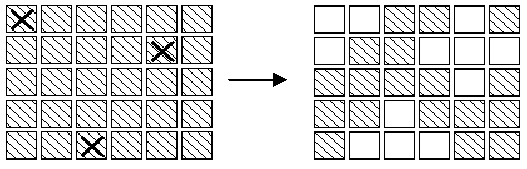
The aim of the game is, starting from any initial set of lights on
in the display, to press buttons to get the display to a state where all
lights are off. When adjacent buttons are pressed, the action of one
button can undo the effect of another. For instance, in the display
below, pressing buttons marked X in the left display results in the
right display.Note that the buttons in row 2 column 3 and row 2 column 5
both change the state of the button in row 2 column 4,so that, in the
end, its state is unchanged.
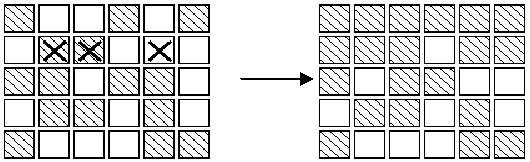
Note:
1. It does not matter what order the buttons are pressed.
2. If a button is pressed a second time, it exactly cancels the
effect of the first press, so no button ever need be pressed more than
once.
3. As illustrated in the second diagram, all the lights in the first
row may be turned off, by pressing the corresponding buttons in the
second row. By repeating this process in each row, all the lights in the
first
four rows may be turned out. Similarly, by pressing buttons in
columns 2, 3 ?, all lights in the first 5 columns may be turned off.
Write a program to solve the puzzle.
Input
first line of the input is a positive integer n which is the number of
puzzles that follow. Each puzzle will be five lines, each of which has
six 0 or 1 separated by one or more spaces. A 0 indicates that the light
is off, while a 1 indicates that the light is on initially.
Output
each puzzle, the output consists of a line with the string: "PUZZLE
#m", where m is the index of the puzzle in the input file. Following
that line, is a puzzle-like display (in the same format as the input) .
In this case, 1's indicate buttons that must be pressed to solve the
puzzle, while 0 indicate buttons, which are not pressed. There should be
exactly one space between each 0 or 1 in the output puzzle-like
display.
Sample Input
2

0 1 1 0 1 0

1 0 0 1 1 1

0 0 1 0 0 1

1 0 0 1 0 1

0 1 1 1 0 0

0 0 1 0 1 0

1 0 1 0 1 1

0 0 1 0 1 1

1 0 1 1 0 0

0 1 0 1 0 0
Sample Output
PUZZLE #1

1 0 1 0 0 1

1 1 0 1 0 1

0 0 1 0 1 1

1 0 0 1 0 0

0 1 0 0 0 0

PUZZLE #2

1 0 0 1 1 1

1 1 0 0 0 0

0 0 0 1 0 0

1 1 0 1 0 1

1 0 1 1 0 1
Source
题意:
有5行6列共30个开关,每按动一个开关,该开关及其上下左右共5个开关的状态都会改变,初始给你这30个开关的状态求按动那些开关能够使这些开关的状态都是0.
思路:因为每盏灯,如果操作两次就相当于没有操作,所以相当于(操作次数)%2,即异或操作。
考虑一个2*3的图,最后需要的状态是 : ,如果初始状态为:
 。对这两个矩阵的每个数字做异或操作可以得到线性方程组每个方程的答案。
总共6盏灯,0-5。那么可以列出6个方程。
对于第0盏灯,会影响到它的是第0, 1, 3盏灯,因此可以列出方程1*x0 + 1*x1 + 0*x2 + 1*x3 + 0*x4 + 0*x5= 0。
对于第1盏灯,会影响到它的是第0, 1, 2,4盏灯,因此可以列出方程1*x0 + 1*x1 + 1*x2 + 0*x3 + 1*x4 + 0*x5 = 1。
对于第2盏灯,会影响到它的是第1, 2, 5盏灯,因此可以列出方程0*x0 + 1*x1 + 1*x2 + 0*x3 + 0*x4 + 1*x5 = 0。
.....
所以最后可以列出增广矩阵: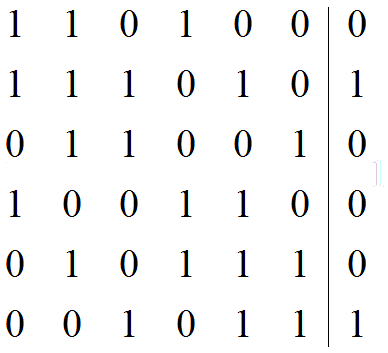
然后用高斯消元求这个矩阵的解就可以了。
30个变量30个方程组
代码:
 #include<iostream>

 #include<cstdio>

 #include<cstring>

 #include<cmath>

 using namespace std;

 const int MAX=;

 int a[MAX][MAX]; //增广矩阵

 int x[MAX];  //解集

 int equ,var;  //行数和列数

 void init()

 {

     equ=;var=;

     memset(a,,sizeof(a));

     for(int i=;i<;i++)      //t点和上下左右都改变

         for(int j=;j<;j++)

         {

             int t=*i+j;

             a[t][t]=;

             if(i>) a[*(i-)+j][t]=;

             if(i<) a[*(i+)+j][t]=;

             if(j>) a[t-][t]=;

             if(j<) a[t+][t]=;

         }

 }

 void gaos()

 {

     int maxr;

     for(int k=,col=;k<equ&&col<var;k++,col++)

     {

         maxr=k;                      /****变为行阶梯形矩阵***/

         for(int i=k+;i<equ;i++)

             if(abs(a[i][col])>abs(a[maxr][col]))

             maxr=i;

         if(maxr!=k)

         {

             for(int i=col;i<var+;i++)

                 swap(a[maxr][i],a[k][i]);

         }

         if(a[k][col]==)  //第k行后的第col列全部是0了,换下一列

         {

             k--;

             continue;

         }

         for(int i=k+;i<equ;i++)   //第k行减去第i行的值赋给第i行,变为行阶梯型矩阵,由于都是01型矩阵,不用找lcm直接减就行

         {

             if(a[i][col]!=)

             {

                 for(int j=col;j<var+;j++)

                     a[i][j]^=a[k][j];

             }

         }

         for(int i=var-;i>=;i--)   //算出解集

         {

             x[i]=a[i][var];

             for(int j=i+;j<var;j++) //该行第var列是1说明该行有且只有一个x取1,若为0说明没有取1的x.

                 x[i]^=(a[i][j]&x[j]);

         }

     }

 }

 int main()

 {

     int t,ca=;

     scanf("%d",&t);

     while(t--)

     {

         ca++;

         init();

         for(int i=;i<;i++)

             scanf("%d",&a[i][]);

         gaos();

         printf("PUZZLE #%d",ca);

         for(int i=;i<;i++)

         {

             if(i%==) printf("\n%d",x[i]);

             else printf(" %d",x[i]);

         }

         printf("\n");

     }

     return ;

 }
*POJ 1222 高斯消元的更多相关文章
- POJ 1222 高斯消元更稳
大致题意: 有5*6个灯,每个灯只有亮和灭两种状态,分别用1和0表示.按下一盏灯的按钮,这盏灯包括它周围的四盏灯都会改变状态,0变成1,1变成0.现在给出5*6的矩阵代表当前状态,求一个能全部使灯灭的 ...
- POJ 1222 POJ 1830 POJ 1681 POJ 1753 POJ 3185 高斯消元求解一类开关问题
http://poj.org/problem?id=1222 http://poj.org/problem?id=1830 http://poj.org/problem?id=1681 http:// ...
- POJ SETI 高斯消元 + 费马小定理
http://poj.org/problem?id=2065 题目是要求 如果str[i] = '*'那就是等于0 求这n条方程在%p下的解. 我看了网上的题解说是高斯消元 + 扩展欧几里德. 然后我 ...
- POJ 2065 高斯消元求解问题
题目大意: f[k] = ∑a[i]*k^i % p 每一个f[k]的值就是字符串上第 k 个元素映射的值,*代表f[k] = 0 , 字母代表f[k] = str[i]-'a'+1 把每一个k^i求 ...
- poj 2065 高斯消元(取模的方程组)
SETI Time Limit: 1000MS Memory Limit: 30000K Total Submissions: 1735 Accepted: 1085 Description ...
- POJ 1681 高斯消元 枚举自由变元
题目和poj1222差不多,但是解法有一定区别,1222只要求出任意一解,而本题需要求出最少翻转次数.所以需要枚举自由变元,变元数量为n,则枚举的次数为1<<n次 #include < ...
- POJ 1830 高斯消元
开关问题 Description 有N个相同的开关,每个开关都与某些开关有着联系,每当你打开或者关闭某个开关的时候,其他的与此开关相关联的开关也会相应地发生变化,即这些相联系的开关的状态如果原来为 ...
- POJ 1222 EXTENDED LIGHTS OUT(高斯消元)题解
题意:5*6的格子,你翻一个地方,那么这个地方和上下左右的格子都会翻面,要求把所有为1的格子翻成0,输出一个5*6的矩阵,把要翻的赋值1,不翻的0,每个格子只翻1次 思路:poj 1222 高斯消元详 ...
- Gym 100008E Harmonious Matrices 高斯消元
POJ 1222 高斯消元更稳 看这个就懂了 #include <bits/stdc++.h> using namespace std; const int maxn = 2000; in ...
随机推荐
- navicat 破解
首先上官网上下载LINUX版本: http://www.navicat.com/download 下载 navicat110_mysql_en.tar.gz 文件 下载后解压tar文件 tar -zx ...
- webstorm基础使用总结
webstorm基础使用总结(不仅仅是一堆快捷方式) 注:原文链接: 水车 : 本次写的内容是我想到那个就写那个,都是本人平时写代码的时候的一些习惯,未必是最好的,贵在交流! 1: shift+e ...
- JPA快速入门(自用)
该案例为JPA的实体映射案例,将该项目解压导入到myeclipse中即可使用,然后直接使用hibernate即可! 文件地址:files.cnblogs.com/mrwangblog/JPA-Hibe ...
- iOS支付宝支付总结
1.按照http://doc.open.alipay.com/doc2/detail?spm=0.0.0.0.SWdJgo&treeId=59&articleId=103676& ...
- LInux Shell 快捷键
CTRL 键相关的快捷键: Ctrl + a - Jump to the start of the lineCtrl + b - Move back a charCtrl + c - Terminat ...
- 配置oozie4.10+hadoop2.5.2
终于将这个神秘的寻象人 oozie 安装配置成功了,这个困扰我好几天, 当看到如下的画面, 我觉得值! 废话少说,看我如何编译和安装过程: (已经将hadoop2.5.2HA 的环境搭建起来了,hiv ...
- Awesome
DotNet 资源大全中文版(Awesome最新版) http://www.cnblogs.com/best/p/5876596.html Java资源大全中文版(Awesome最新版) http:/ ...
- 11g新特性-使用DNFS
NFS相信应该都很熟悉了,但是我们对它的性能一直有所诟病.Oracle在10g版本通过允许对数据库文件直接IO引入ASM.在11g版本中,Oracle对NFS提供了类似的增强,为了改进NFS的性能,开 ...
- 6 Candy_Leetcode
There are N children standing in a line. Each child is assigned a rating value. You are giving candi ...
- KeyedPriorityQueue
// <copyright file="KeyedPriorityQueue.cs" company="Microsoft">Copyright ( ...