
POJ2699:The Maximum Number of Strong Kings(枚举+贪心+最大流)
The Maximum Number of Strong Kings
| Time Limit: 1000MS | Memory Limit: 65536K | |
| Total Submissions: 2488 | Accepted: 1131 |
题目链接:http://poj.org/problem?id=2699
Description:
A tournament can be represented by a complete graph in which each vertex denotes a player and a directed edge is from vertex x to vertex y if player x beats player y. For a player x in a tournament T, the score of x is the number of players beaten by x. The score sequence of T, denoted by S(T) = (s1, s2, . . . , sn), is a non-decreasing list of the scores of all the players in T. It can be proved that S(T) = (s1, s2, . . . , sn) is a score sequence of T if and only if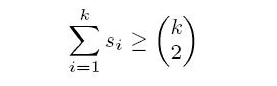
for k = 1, 2, . . . , n and equality holds when k = n. A player x in a tournament is a strong king if and only if x beats all of the players whose scores are greater than the score of x. For a score sequence S, we say that a tournament T realizes S if S(T) = S. In particular, T is a heavy tournament realizing S if T has the maximum number of strong kings among all tournaments realizing S. For example, see T2 in Figure 1. Player a is a strong king since the score of player a is the largest score in the tournament. Player b is also a strong king since player b beats player a who is the only player having a score larger than player b. However, players c, d and e are not strong kings since they do not beat all of the players having larger scores.
The purpose of this problem is to find the maximum number of strong kings in a heavy tournament after a score sequence is given. For example,Figure 1 depicts two possible tournaments on five players with the same score sequence (1, 2, 2, 2, 3). We can see that there are at most two strong kings in any tournament with the score sequence (1, 2, 2, 2, 3) since the player with score 3 can be beaten by only one other player. We can also see that T2 contains two strong kings a and b. Thus, T2 is one of heavy tournaments. However, T1 is not a heavy tournament since there is only one strong king in T1. Therefore, the answer of this example is 2. 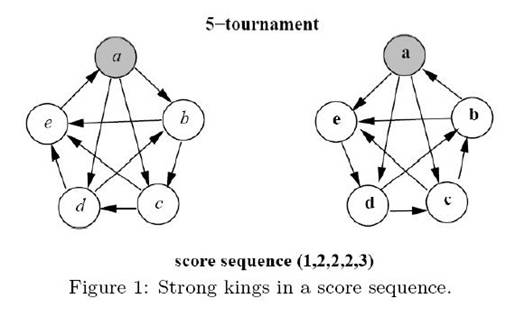
Input:
The first line of the input file contains an integer m, m <= 10, which represents the number of test cases. The following m lines contain m score sequences in which each line contains a score sequence. Note that each score sequence contains at most ten scores.
Output:
The maximum number of strong kings for each test case line by line.
Sample Input:
5

1 2 2 2 3

1 1 3 4 4 4 4

3 3 4 4 4 4 5 6 6 6

0 3 4 4 4 5 5 5 6

0 3 3 3 3 3
Sample Output:
2

4

5

3

5
题意:
多组数据,然后对于每组数据给出每个人击败的人数,为最多有多少人是强者。
强者的定义为:得到的分数最多 or 击败所有分数比他高的人。这里每击败一个人都可以得一分。
题解:
这题orz...没有想出来。但最后看了题解后发现就是个公平分配问题。
我们建图时比赛在左边,人在右边。每场比赛连两个人,代表这两个人在比赛,然后每场比赛只会分配1的流出去,代表哪个人获胜。
这就是我们建图的大体思路。
由于人数很少,所以我们可以枚举来确定强者,那么怎么确定呢,直接二进制表示的话复杂度太高。
通过证明可以发现,分数越高的人越有可能成为强者,简要证明过程如下:
假设分数为: ...i j k ......,这里i和k时强者,而j不是。如果i是强者,那么说明i打败了后面的所有人,而j不是强者,则说明他可能输给了后面的某几个人。
因为j的分数比i的分数高,说明j多欺负了几个弱者。那么现在我们让j赢回高分的人,让i去赢前面多欺负的那几个人,此时i可能会输给比他强的人,此时满足赢的数量和之前一样。相当于换了人去欺负那些弱者。这样j也可以变为强者了。
以上就是简略的一个证明,只要保证每个人的分数不变就ok。
然后我们从分数大开始枚举,在建图时,源点连接比赛,容量为1;人连接汇点,容量为他能赢的最多次数。
比赛连接两个人时,如果一个人是强者并且另一个人分数比他高,那么只能强者赢;否则哪个赢都可以。对赢的那个人连接容量为1的边。
最后跑个最大流看看比赛能否比完就行了(我这里是通过是否每个人的分数能够符合题意来判断的)。
代码如下:
#include <cstdio>

#include <cstring>

#include <algorithm>

#include <iostream>

#include <queue>

#define s 0

#define t 200

#define INF 0x3f3f3f3f

#define st n*(n-1)/2

using namespace std;

typedef long long ll;

const int N = ;

int T;

char str[N];

int a[N],vis[N],head[N],d[N];

int ans,tot,mx,n,sum;

struct Edge{

    int v,c,next;

}e[N*N];

void adde(int u,int v,int c){

    e[tot].v=v;e[tot].next=head[u];e[tot].c=c;head[u]=tot++;

    e[tot].v=u;e[tot].next=head[v];e[tot].c=;head[v]=tot++;

}

void build(){

    memset(head,-,sizeof(head));tot=;

    for(int i=;i<=st;i++) adde(s,i,);

    int fir = st+,last = st+;

    for(int i=;i<=st;i++){

        if(vis[fir]&&a[last-st]>a[fir-st]){

            adde(i,fir,);adde(i,last,);

        }else if(vis[last]&&a[last-st]<a[fir-st]){

            adde(i,fir,);adde(i,last,);

        }else{

            adde(i,fir,);adde(i,last,);

        }

        last++;

        if(last>st+n){

            fir++;last=fir+;

        }

    }

    for(int i=st+;i<=st+n;i++) adde(i,t,a[i-st]);

}

bool bfs(int S,int T){

    memset(d,,sizeof(d));d[S]=;

    queue <int > q;q.push(S);

    while(!q.empty()){

        int u=q.front();q.pop();

        for(int i=head[u];i!=-;i=e[i].next){

            int v=e[i].v;

            if(!d[v] && e[i].c>){

                d[v]=d[u]+;

                q.push(v);

            }

        }

    }

    return d[T]!=;

}

int dfs(int S,int a){

    int flow=,f;

    if(S==t || a==) return a;

    for(int i=head[S];i!=-;i=e[i].next){

        int v=e[i].v;

        if(d[v]!=d[S]+) continue ;

        f=dfs(v,min(a,e[i].c));

        if(f){

            e[i].c-=f;

            e[i^].c+=f;

            flow+=f;

            a-=f;

            if(a==) break;

        }

    }

    if(!flow) d[S]=-;

    return flow;

}

int Dinic(){

    int max_flow=;

    while(bfs(,t)) max_flow+=dfs(,INF);

    return max_flow;

}

int main(){

    cin>>T;

    getchar();

    while(T--){

        memset(vis,,sizeof(vis));

        gets(str);

        mx=n=sum=;ans=-;

        int len = strlen(str);

        for(int i=;i<len;i++)

            if(str[i]<='' && str[i]>='')

                a[++n]=str[i]-'',mx = max(mx,a[n]),sum+=a[n];

        for(int i=n;i>=;i--){

            if(a[i]==mx) continue ;

            vis[i+st]=;

            build();

            int max_flow=Dinic();

            if(max_flow<sum){

                ans=n-i;

                break ;

            }

        }

        if(ans==-) ans=n;

        cout<<ans<<endl;

    }

    return ;

}
POJ2699:The Maximum Number of Strong Kings(枚举+贪心+最大流)的更多相关文章
- POJ2699 The Maximum Number of Strong Kings
Time Limit: 1000MS Memory Limit: 65536K Total Submissions: 2102 Accepted: 975 Description A tour ...
- POJ2699 The Maximum Number of Strong Kings(最大流)
枚举所有Strong King的状态(最多1024种左右),然后判断是否合法. 判定合法用网络流,源点-比赛-人-汇点,这样连边. 源点向每场比赛连容量为1的边: 如果一场比赛,A和B,A是Stron ...
- poj 2699 The Maximum Number of Strong Kings 枚举 最大流
题目链接 题意 对于一个竞赛图(有向完全图),其顶点是选手,边是比赛,边\(e=(u,v)\)代表该场比赛中\(u\)战胜\(v\). 现定义选手的分数为其战胜的人的个数(即竞赛图中点的出度).并且定 ...
- 【POJ2699】The Maximum Number of Strong Kings(网络流)
Description A tournament can be represented by a complete graph in which each vertex denotes a playe ...
- POJ 2699 The Maximum Number of Strong Kings Description
The Maximum Number of Strong Kings Description A tournament can be represented by a complete graph ...
- 【POJ2699】The Maximum Number of Strong Kings(二分,最大流)
题意: 有n个队伍,两两都有比赛 知道最后每支队伍获胜的场数 求最多有多少队伍,他们战胜了所有获胜场数比自己多的队伍,这些队伍被称为SK N<=50 思路:把每个队伍和它们两两之间的比赛都当做点 ...
- POJ 2699 The Maximum Number of Strong Kings (最大流+枚举)
http://poj.org/problem?id=2699 题意: 一场联赛可以表示成一个完全图,点表示参赛选手,任意两点u, v之间有且仅有一条有向边(u, v)或( v, u),表示u打败v或v ...
- POJ - 2699 The Maximum Number of Strong Kings (最大流+枚举)
题意:有n(n<=10)个选手,两两之间打比赛,共有n*(n-1)/2场比赛,赢一场得1分.给出每个人最后的得分.求有多少个定义如下的strong king:赢了所有得分比自己高的人或本身就是分 ...
- poj 2699 The Maximum Number of Strong Kings【最大流+枚举】
因为n很小所以从大到小枚举答案.(从小到大先排个序,因为显然胜利场次越多越容易成为strong king.然后对于每个枚举出来的ans建图.点分别表示人和比赛.s向所有人连接流量为胜利场次的边,所有比 ...
随机推荐
- DedeCMS V5.7sp2最新版本parse_str函数SQL注入漏洞
织梦dedecms,在整个互联网中许多企业网站,个人网站,优化网站都在使用dede作为整个网站的开发架构,dedecms采用php+mysql数据库的架构来承载整个网站的运行与用户的访问,首页以及栏目 ...
- java web相对路径和绝对路径总结
java web 开发过程中很多地方涉及url路径的问题,比如jsp页面.servlet之间的跳转.其实,可以将url中的/xxx看成一级目录,然后像看待目录层级之间的关系那样去看待url路径.接下来 ...
- 区分Oracle的数据库,实例,服务名,SID
文章摘自:http://www.zhetao.com/content240 感谢分享O(∩_∩)O~ 在实际的开发应用中,关于Oracle数据库,经常听见有人说建立一个数据库,建立一个Instance ...
- jmeter插件下载
https://jmeter-plugins.org/wiki/Start/ 插件下载好后,将插件lib目录下的jar包放在jmeter安装目录下的lib里,插件ext目录下的jar包放在jmeter ...
- 设置socket接收和发送超时的一种方式
Linux环境设置Socket接收和发送超时: 须如下定义:struct timeval timeout = {3,0}; //设置发送超时setsockopt(socket,SOL_SOCKET, ...
- OpenCV入门:(四:混合两张图片)
1. 原理 对两张图片使用如下公式可以得到两张图片的混合图片, 其中f0(x),f1(x)分别是图片1和图片2同一位置的像素点. 2. OpenCV中的AddWeight函数 函数和参数说明: ) s ...
- 洛谷P2346四子连棋
题目描述 在一个4*4的棋盘上摆放了14颗棋子,其中有7颗白色棋子,7颗黑色棋子,有两个空白地带,任何一颗黑白棋子都可以向上下左右四个方向移动到相邻的空格,这叫行棋一步. 黑白双方交替走棋,任意一方可 ...
- kaldi常用文件查看指令
目录 1. ark特征文件 2. FST文件 3. mdl模型文件 4. 决策树文件 5. ali.gz对齐文件 资料来自kaldi官方文档. 转载注明出处. 1. ark特征文件 copy-feat ...
- Python之tornado框架实现翻页功能
1.结果如图所示,这里将html页面与网站的请求处理放在不同地方了 start.py代码 import tornado.ioloop import tornado.web from controlle ...
- term "JavaScript"
在Web浏览器上下文中理解的总称“JavaScript”包含几个非常不同的元素. 其中一个是核心语言(ECMAScript),另一个是Web API的集合,包括DOM(文档对象模型) JavaScri ...