
LeetCode 460. LFU Cache LFU缓存 (C++/Java)
题目:
Design and implement a data structure for Least Frequently Used (LFU)cache. It should support the following operations: get and put.
get(key) - Get the value (will always be positive) of the key if the key exists in the cache, otherwise return -1.put(key, value) - Set or insert the value if the key is not already present. When the cache reaches its capacity, it should invalidate the least frequently used item before inserting a new item. For the purpose of this problem, when there is a tie (i.e., two or more keys that have the same frequency), the least recently used key would be evicted.
Note that the number of times an item is used is the number of calls to the get and put functions for that item since it was inserted. This number is set to zero when the item is removed.
Follow up:
Could you do both operations in O(1) time complexity?
Example:
LFUCache cache = new LFUCache( 2 /* capacity */ );

cache.put(1, 1);

cache.put(2, 2);

cache.get(1);       // returns 1

cache.put(3, 3);    // evicts key 2

cache.get(2);       // returns -1 (not found)

cache.get(3);       // returns 3.

cache.put(4, 4);    // evicts key 1.

cache.get(1);       // returns -1 (not found)

cache.get(3);       // returns 3

cache.get(4);       // returns 4
分析:
设计并实现最不经常使用(LFU)缓存的数据结构。相比LRU,LFU增加了频率这一概念,在cache满了的时候,将会把最不经常使用的缓存清除掉,在本题则是以访问频率体现的。
利用hashmap来记录当前数据{key, value}和其出现次数之间的映射,我们可以把出现频率相同的key都放到一个list集合中,再使用一个hashmap建立频率和list之间的映射。为了能够在O(1)的时间内完成操作了,要快速的定位list中key的位置,我们再用一个hashmap来建立key和freq中key的位置之间的映射。最后当然我们还需要两个变量cap和minFreq,分别来保存cache的大小,和当前最小的频率。
我们假设容量为2,先put(1, 1)和put(2, 2),此时容器的存储情况如下:
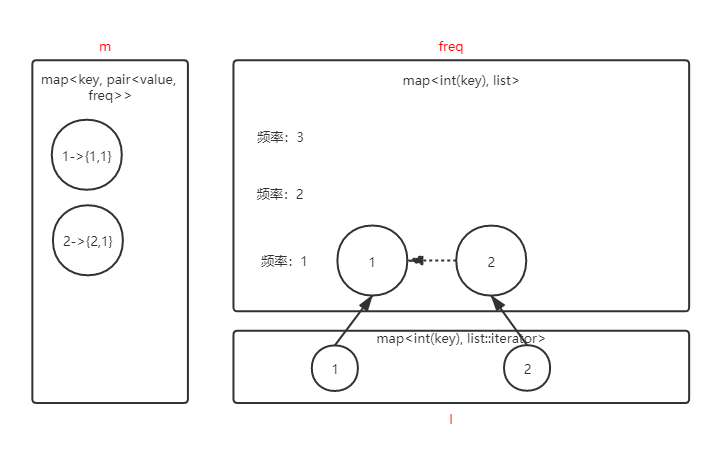
此时调用get(1,1),我们需要做的操作如下:
1.如果m中不存在key1,那么返回-1
2. 从freq中频率为1(从m中获取到的key对应的频率值)的list中将1删除
3. 将m中1对应的频率值自增1
4. 将1保存到freq中频率为2(当前频率加+1)的list的末尾
5. 在l中保存1在freq中频率为2的list中的位置
6. 如果freq中频率为minFreq的list为空,minFreq自增1
7. 返回m中1对应的value值
经过这些步骤后,我们再来看下此时内部容器情况:
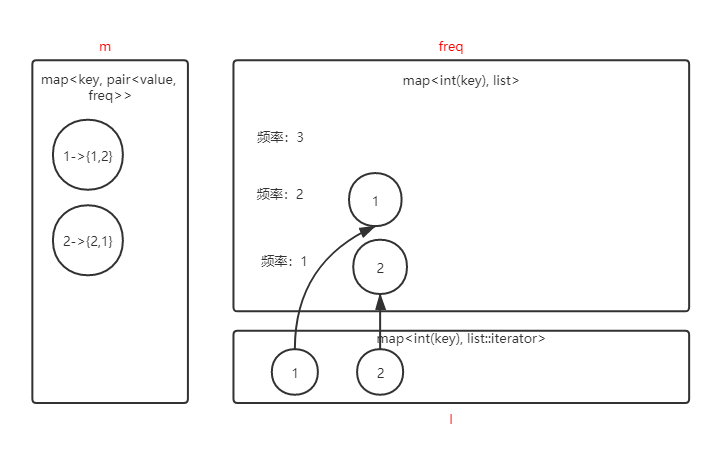
此时再put(3, 3),我们需要做的操作如下:
1. 先调用get(3)返回的结果不是-1,也就是说此时cache中已经存在3这块缓存了,我们可以直接将m中3对应的value更新为当前value,并返回。
2. 如果此时m的大小大于了cap,即超过了cache的容量,则:
a)在m中移除minFreq对应的list的首元素的key。
b)在l中清除3对应的纪录
c)在freq中移除minFreq对应的list的首元素。
3. 在m中建立3的映射,即 3 -> {value 3, frequent1}
4. 在freq中频率为1的list末尾加上3
5. 在l中保存3在freq中频率为1的list中的位置
6. minFreq重置为1
此时内部容器情况:

虚线表示此步骤删去的元素。
程序:
C++
class LFUCache {

public:

    LFUCache(int capacity) {

        cap = capacity;

    }

    int get(int key) {

        if(m.count(key) == 0)

            return -1;

        freq[m[key].second].erase(l[key]);

        m[key].second++;

        freq[m[key].second].push_back(key);

        l[key] = --freq[m[key].second].end();

        if(freq[minFreq].size() == 0)

            minFreq++;

        return m[key].first;

    }

    void put(int key, int value) {

        if(cap <= 0)

            return;

        if(get(key) != -1){

            m[key].first = value;

            return;

        }

        if(m.size() >= cap){

            m.erase(freq[minFreq].front());

            l.erase(freq[minFreq].front());

            freq[minFreq].pop_front();

        }

        m[key] = make_pair(value, 1);

        freq[1].push_back(key);

        l[key] = --freq[1].end();

        minFreq = 1;

    }

private:

    int cap, minFreq;

    unordered_map<int, pair<int, int>> m;

    unordered_map<int, list<int>> freq;

    unordered_map<int, list<int>::iterator> l;

};

/**

 * Your LFUCache object will be instantiated and called as such:

 * LFUCache* obj = new LFUCache(capacity);

 * int param_1 = obj->get(key);

 * obj->put(key,value);

 */
Java
public class LFUCache {

    public LFUCache(int capacity) {

        cap = capacity;

        map = new HashMap<>();

        freq = new HashMap<>();

        list = new HashMap<>();

        minFreq = 1;

    }

    public int get(int key) {

        if(!map.containsKey(key))

            return -1;

        int count = freq.get(key);

        list.get(count).remove(key);

        freq.put(key, count + 1);

        if(list.get(minFreq).size() == 0)

            minFreq++;

        if(!list.containsKey(count + 1)){

            LinkedHashSet<Integer> set = new LinkedHashSet<Integer>();

            set.add(key);

            list.put(count+1, set);

        }else{

            list.get(count+1).add(key);

        }

        return map.get(key);

    }

    public void put(int key, int value) {

        if(cap <= 0)

            return;

        if(get(key) != -1){

            map.put(key, value);

            return;

        }

        if(map.size() >= cap){

            Integer removeKey = list.get(minFreq).iterator().next();

            map.remove(removeKey);

            list.get(minFreq).remove(removeKey);

            freq.remove(removeKey);

        }

        //System.out.println(map.toString());

        map.put(key, value);

        freq.put(key, 1);

        if(!list.containsKey(1)){

            LinkedHashSet<Integer> set = new LinkedHashSet<Integer>();

            set.add(key);

            list.put(1, set);

        }else{

            list.get(1).add(key);

        }

        minFreq = 1;

    }

    private int cap;

    private int minFreq;

    private HashMap<Integer, Integer> map;

    private HashMap<Integer, Integer> freq;

    private HashMap<Integer, LinkedHashSet<Integer>> list;

}

/**

 * Your LFUCache object will be instantiated and called as such:

 * LFUCache obj = new LFUCache(capacity);

 * int param_1 = obj.get(key);

 * obj.put(key,value);

 */
LeetCode 460. LFU Cache LFU缓存 (C++/Java)的更多相关文章
- LeetCode:146_LRU cache | LRU缓存设计 | Hard
题目:LRU cache Design and implement a data structure for Least Recently Used (LRU) cache. It should su ...
- [LeetCode] 460. LFU Cache 最近最不常用页面置换缓存器
Design and implement a data structure for Least Frequently Used (LFU) cache. It should support the f ...
- [LeetCode] LFU Cache 最近最不常用页面置换缓存器
Design and implement a data structure for Least Frequently Used (LFU) cache. It should support the f ...
- leetcode 146. LRU Cache 、460. LFU Cache
LRU算法是首先淘汰最长时间未被使用的页面,而LFU是先淘汰一定时间内被访问次数最少的页面,如果存在使用频度相同的多个项目,则移除最近最少使用(Least Recently Used)的项目. LFU ...
- Leetcode: LFU Cache && Summary of various Sets: HashSet, TreeSet, LinkedHashSet
Design and implement a data structure for Least Frequently Used (LFU) cache. It should support the f ...
- LeetCode LFU Cache
原题链接在这里:https://leetcode.com/problems/lfu-cache/?tab=Description 题目: Design and implement a data str ...
- LeetCode之LRU Cache 最近最少使用算法 缓存设计
设计并实现最近最久未使用(Least Recently Used)缓存. 题目描述: Design and implement a data structure for Least Recently ...
- [LeetCode] 146. LRU Cache 最近最少使用页面置换缓存器
Design and implement a data structure for Least Recently Used (LRU) cache. It should support the fol ...
- LFU Cache
2018-11-06 20:06:04 LFU(Least Frequently Used)算法根据数据的历史访问频率来淘汰数据,其核心思想是“如果数据过去被访问多次,那么将来被访问的频率也更高”. ...
- LRU缓存实现(Java)
LRU Cache的LinkedHashMap实现 LRU Cache的链表+HashMap实现 LinkedHashMap的FIFO实现 调用示例 LRU是Least Recently Used 的 ...
随机推荐
- DC-1渗透靶场实战速通版
"感谢您阅读本篇博客!如果您觉得本文对您有所帮助或启发,请不吝点赞和分享给更多的朋友.您的支持是我持续创作的动力,也欢迎留言交流,让我们一起探讨技术,共同成长!谢谢!" 文章为速通 ...
- 【SQL】IN和EXISTS谁的效率更高
[SQL]IN和EXISTS谁的效率更高 总结: 索引设置好的情况下 子查询数据量大的,用exists 子查询数据量小的,用in 原文连接:https://zhuanlan.zhihu.com/p/4 ...
- 力扣1083(MySQL)-销售分析Ⅱ(简单)
题目: 编写一个 SQL 查询,查询购买了 S8 手机却没有购买 iPhone 的买家.注意这里 S8 和 iPhone 是 Product 表中的产品. 查询结果格式如下图表示: Product t ...
- 关于CDN的原理、术语和应用场景那些事
关于CDN,想必你一定看过很多官方的解释.今天,CDN百科第七期,将用一篇3844字的文章,来带你了解CDN的诞生.术语.原理.特征以及应用场景,看完这篇文章,相信你将会对CDN这项互联网基础设施有更 ...
- RDS PostgreSQL一键大版本升级技术解密
简介: 内容简要: 一.PostgreSQL行业位置 二.PostgreSQL版本升级背景 三.PostgreSQL版本升级解密 四.PostgreSQL版本升级成果 一.PostgreSQL行业位 ...
- dotnet 使用 CsWin32 库简化 Win32 函数调用逻辑
很多开发者,包括开发老司机们,在碰到需要调用 Win32 函数时,都有一个困扰,那就是我应该如何去调用.有两个主要的选项,第一就是自己写 PInvoke 代码,第二就是使用其他大佬给许多 Win32 ...
- dotnet 在国产 UOS 系统利用 dotnet tool 工具做文件传输
我在一台设备上安装了 UOS 系统,但是我如何在我的主开发设备上和 UOS 系统传输文件?通过 dotnet tool 工具可以完成大部分的工作,当然,使用 dotnet tool 不仅做文件传输,还 ...
- ChatGPT 眼中的程序员
1 你如何看待程序员这个行业 程序员这个行业在现代社会扮演着非常重要的角色.作为一个技术驱动的职业,程序员们负责开发.设计和维护软件和应用程序,这些技术改变了我们的生活方式.商业模式和社会互动方式. ...
- visual studio 2008的试用版评估期已结束(附无法使用产品密钥)的解决方法
visual studio 2008过了试用期后再次启动提示对话框:visual studio的试用版评估期已结束. 解决办法: 第一步,在"控制面板"中启动"添加删除程 ...
- js实现打字机效果(完整实例)
在上篇css高斯模糊的效果基础上用js实现一个打字机效果: 上图: 代码: <!DOCTYPE HTML> <html lang="en-US"> < ...