
【编译原理】c++实现自下而上语法分析器
写在前面:本博客为本人原创,严禁任何形式的转载!本博客只允许放在博客园(.cnblogs.com),如果您在其他网站看到这篇博文,请通过下面这个唯一的合法链接转到原文!
本博客全网唯一合法URL:http://www.cnblogs.com/acm-icpcer/p/9107838.html
基于C++语言实现的PL/0语言的算术表达式的自下而上的语法分析程序。该语言的其他语法实现思想与此一致,故不赘述。
运行此程序前,必须先将代码通过:【编译原理】c++实现词法分析器的词法分析,生成词法表(词法表是txt文件,为了语法分析成功,务必删除文件中最后空着的一行,即文件末尾不可以留空白行)。生成的该词法表为此程序的必要输入。
产生式:
S->X(AX)*|AX(AX)*
X->Y(MY)*
Y->I|N|(S)
A->+|-
M->*|/
C->=|#|<|<=|>|>=
进行自下而上的语法分析一定比自上而下要难。我们知道,做自下而上的语法的分析的核心在于“寻找可归约串”(即术语所说的“句柄”),而且要有一定的“向前展望性”,以防止在可以归约但却不应该归约的地方进行归约动作而不是继续移进下一个终结符或者非终结符。所以编译原理的语法分析做LR分析的核心目标就是能精确地控制计算机程序对待分析、编译的程序代码语句进行正确的、无二义的、符合编程者原目的的语法分析(在自下而上的语法分析中就是“归约”)。
那么知道了为什么要构造规范项目集族、构造确定的DFA、构造LR分析表后,对于上述产生式所代表的比较简单的算术表达式语句分析,我在本篇博客中就不使用传统的“构造规范项目集族、构造确定的DFA、构造LR分析表”这样一个套路来做自下而上语法分析了。
在本篇博客中,我使用比较简单易理解的模式匹配算法,结合面向对象程序设计思想中的“策略”设计模式来完成编程。
/*

this code was first initiated by TZ,COI,HZAU

contact email:xmb028@163.com

personal website:wnm1503303791.github.io

personal blogs:www.cnblogs.com/acm-icpcer/

this code has been posted on my personal blog,checking url:www.cnblogs.com/acm-icpcer/p/9107838.html

Copyright 2018/5/29 TZ.

All Rights Reserved.

*/

#include<cstdio>

#include<cstring>

#include<algorithm>

#include<iostream>

#include<string>

#include<vector>

#include<stack>

#include<bitset>

#include<cstdlib>

#include<cmath>

#include<set>

#include<list>

#include<deque>

#include<map>

#include<queue>

#include<fstream>

using namespace std;

//预处理函数

bool preproccess(char *a,char *b)

{

    int i1=,i2=;

    memset(b,,'\0');

    while(a[i2]!=',')

    {

        b[i1]=a[i2];

           ++i1,++i2;

    }

    b[i1]='\0';

    //cout<<b<<endl;

    return true;

}

fstream f2("stack.txt", ios::out);//打开文件,供写

static int mcount=;//存储打印次数

//当移进或者归约时打印栈内情况,以供分析

bool outf(int head,char data[][],fstream &f)

{

    f<<"times("<<mcount<<"),";

    f<<"head is:"<<head<<endl;

    for(int i=head;i>=;i--)

    {

        f<<data[i]<<endl;

    }

    mcount++;

    f<<endl;

}

//“策略”设计模式,面向对象方法

class presentation

{

private:

    char data[][];//栈

    fstream *infile;//词法分析表

    int head;//栈顶指针

public:

    //first initiated the object

    presentation(fstream *in_f)

    {

        this->infile=in_f;

        memset(data,sizeof(data),'\0');

        head=-;

    }

    bool push()

    {

        head++;

        infile->getline(data[head],);

        char t[];//存放字符标志

        preproccess(data[head],t);

        cout<<data[head]<<","<<t<<endl;

        memset(data[head],,'\0');

        strcpy(data[head],t);

    }

    /*

    S->X(AX)*|AX(AX)*

    X->Y(MY)*

    Y->I|N|(S)

    A->+|-

    M->*|/

    C->=|#|<|<=|>|>=

    */

    //归约函数

    bool reduce()

    {

        //S->X(AX)*|AX(AX)*

        if(    head>=&&

            (!strcmp(data[head],"X"))&&

              (!strcmp(data[head-],"plus")||!strcmp(data[head-],"minus"))&&

              (!strcmp(data[head-],"X"))&&

              (!strcmp(data[head-],"plus")||!strcmp(data[head-],"minus"))&&

              (!strcmp(data[head-],"X"))

          )

        {

            memset(data[head],,'\0');

            memset(data[head-],,'\0');

            memset(data[head-],,'\0');

            memset(data[head-],,'\0');

            memset(data[head-],,'\0');

            head=head-+;

            strcpy(data[head],"S");

            return true;

        }

        if(    head>=&&

            (!strcmp(data[head],"X"))&&

              (!strcmp(data[head-],"plus")||!strcmp(data[head-],"minus"))&&

              (!strcmp(data[head-],"X"))

          )

        {

            memset(data[head],,'\0');

            memset(data[head-],,'\0');

            memset(data[head-],,'\0');

            head=head-+;

            strcpy(data[head],"S");

            return true;

        }

        if(    head>=&&

            (!strcmp(data[head],"plus")||!strcmp(data[head],"minus"))&&

              (!strcmp(data[head-],"X"))&&

              (!strcmp(data[head-],"plus")||!strcmp(data[head-],"minus"))&&

              (!strcmp(data[head-],"X"))

          )

        {

            memset(data[head],,'\0');

            memset(data[head-],,'\0');

            memset(data[head-],,'\0');

            memset(data[head-],,'\0');

            head=head-+;

            strcpy(data[head],"S");

            return true;

        }

        if(    head>=&&

            (!strcmp(data[head],"plus")||!strcmp(data[head],"minus"))&&

            (!strcmp(data[head-],"X"))

          )

        {

            memset(data[head],,'\0');

            memset(data[head-],,'\0');

            head=head-+;

            strcpy(data[head],"S");

            return true;

        }

        //X->Y(MY)*

        if(    head>=&&

            (!strcmp(data[head],"Y"))&&

              (!strcmp(data[head-],"times")||!strcmp(data[head-],"slash"))&&

              (!strcmp(data[head-],"Y"))&&

              (!strcmp(data[head-],"times")||!strcmp(data[head-],"slash"))&&

              (!strcmp(data[head-],"Y"))

          )

        {

            memset(data[head],,'\0');

            memset(data[head-],,'\0');

            head=head-+;

            strcpy(data[head],"X");

            return true;

        }

        if(    head>=&&

            (!strcmp(data[head],"Y"))&&

              (!strcmp(data[head-],"times")||!strcmp(data[head-],"slash"))&&

              (!strcmp(data[head-],"Y"))

          )

        {

            memset(data[head],,'\0');

            memset(data[head-],,'\0');

            memset(data[head-],,'\0');

            head=head-+;

            strcpy(data[head],"X");

            return true;

        }

        if(    head>=&&(!strcmp(data[head],"Y"))

          )

        {

            memset(data[head],,'\0');

            head=head-+;

            strcpy(data[head],"X");

            return true;

        }

        //Y->I|N|(S)

        if(    head>=&&(!strcmp(data[head],"ident"))

          )

        {

            memset(data[head],,'\0');

            head=head-+;

            strcpy(data[head],"Y");

            return true;

        }

        if(    head>=&&(!strcmp(data[head],"number"))

          )

        {

            memset(data[head],,'\0');

            head=head-+;

            strcpy(data[head],"Y");

            return true;

        }

        if(    head>=&&

            (!strcmp(data[head],"rparen"))&&

            (!strcmp(data[head-],"S"))&&

            (!strcmp(data[head-],"lparen"))

          )

        {

            memset(data[head],,'\0');

            memset(data[head-],,'\0');

            memset(data[head-],,'\0');

            head=head-+;

            strcpy(data[head],"Y");

            return true;

        }

        return false;

    }

    //遍历栈

    bool visit_data()

    {

        cout<<"current stack:"<<endl;

        for(int i=head;i>=;i--)

        {

            cout<<data[i]<<endl;

        }

    }

    //主控函数

    bool mainf()

    {

        while(!infile->eof())

        {

            push();

            bool t=reduce();

            outf(head,data,f2);

            //每当移进结束时就检查一下是否有可规约串

            while(t)//防止规约嵌套

            {

                t=reduce();

                outf(head,data,f2);

            }

            //visit_data();

        }

        visit_data();

        bool flag=false;

        for(int i=head;i>=;i--)

        {

            if(!strcmp(data[i],"S"))

            {

                flag=true;

            }

            if(    strcmp(data[i],"S")&&

                strcmp(data[i],"X")&&

                strcmp(data[i],"A")&&

                strcmp(data[i],"Y")&&

                strcmp(data[i],"M")&&

                strcmp(data[i],"C")

              )

            {

                return false;

            }

        }

        return flag;

        /*

        while(head>0)

        {

            bool t=reduce();

            //每当移进结束时就检查一下是否有可规约串

            while(t)//防止规约嵌套

            {

                t=reduce();

            }

            //visit_data();

            outf(head,data,f2);

        }

        */

    }

};

int main()

{

    fstream f1;

    f1.open("lexical.txt", ios::in);//打开词法分析表,供读

    presentation* s1=new presentation(&f1);

    bool result=s1->mainf();

    if(result)

        cout<<"ACCEPTED!"<<endl;

    else

        cout<<"ERROR!"<<endl;

    f1.close();

    f2.close();

    return ;

}
当然了,对于不喜欢看面向对象设计模式的同学,我还写了另外一个面向过程的代码,这个更易理解。而且我在程序中已经将一张特定的词法分析表给出。
/*
this code was first initiated by TZ,COI,HZAU
contact email:xmb028@163.com
personal website:wnm1503303791.github.io
personal blogs:www.cnblogs.com/acm-icpcer/
this code has been posted on my personal blog,checking url:www.cnblogs.com/acm-icpcer/p/9107838.html
Copyright 2018/5/29 TZ.
All Rights Reserved.
*/
#include<cstdio>

#include<cstring>

#include<algorithm>

#include<iostream>

#include<string>

#include<vector>

#include<stack>

#include<bitset>

#include<cstdlib>

#include<cmath>

#include<set>

#include<list>

#include<deque>

#include<map>

#include<queue>

#include<fstream>

using namespace std;

char mdata[][]={

"ident",

"times",

"rparen",

"number",

"plus",

"ident",

"lparen"

/*

"lparen",

"ident",

"plus",

"number",

"rparen",

"times",

"ident"

*/

};

char data[][];

int head=;

bool reduce()

    {

        //S->X(AX)*|AX(AX)*

        if(    (!strcmp(data[head],"X"))&&

              (!strcmp(data[head-],"plus")||!strcmp(data[head-],"minus"))&&

              (!strcmp(data[head-],"X"))

          )

        {

            memset(data[head],,'\0');

            memset(data[head-],,'\0');

            memset(data[head-],,'\0');

            head=head-+;

            strcpy(data[head],"S");

            head++;

            return true;

        }

        if(    (!strcmp(data[head],"X"))&&

              (!strcmp(data[head-],"plus")||!strcmp(data[head-],"minus"))&&

              (!strcmp(data[head-],"X"))&&

              (!strcmp(data[head-],"plus")||!strcmp(data[head-],"minus"))&&

              (!strcmp(data[head-],"X"))

          )

        {

            memset(data[head],,'\0');

            memset(data[head-],,'\0');

            memset(data[head-],,'\0');

            memset(data[head-],,'\0');

            memset(data[head-],,'\0');

            head=head-+;

            strcpy(data[head],"S");

            head++;

            return true;

        }

        if(    (!strcmp(data[head],"X"))&&

              (!strcmp(data[head-],"plus")||!strcmp(data[head-],"minus"))

          )

        {

            memset(data[head],,'\0');

            memset(data[head-],,'\0');

            head=head-+;

            strcpy(data[head],"S");

            head++;

            return true;

        }

        if(    (!strcmp(data[head],"X"))&&

              (!strcmp(data[head-],"plus")||!strcmp(data[head-],"minus"))&&

              (!strcmp(data[head],"X"))&&

              (!strcmp(data[head-],"plus")||!strcmp(data[head-],"minus"))

          )

        {

            memset(data[head],,'\0');

            memset(data[head-],,'\0');

            memset(data[head-],,'\0');

            memset(data[head-],,'\0');

            head=head-+;

            strcpy(data[head],"S");

            head++;

            return true;

        }

        //X->Y(MY)*

        if(    (!strcmp(data[head],"Y"))&&

              (!strcmp(data[head-],"times")||!strcmp(data[head-],"slash"))&&

              (!strcmp(data[head],"Y"))

          )

        {

            memset(data[head],,'\0');

            memset(data[head-],,'\0');

            memset(data[head-],,'\0');

            head=head-+;

            strcpy(data[head],"X");

            head++;

            return true;

        }

        if(    (!strcmp(data[head],"Y"))&&

              (!strcmp(data[head-],"times")||!strcmp(data[head-],"slash"))&&

              (!strcmp(data[head-],"Y"))&&

              (!strcmp(data[head-],"times")||!strcmp(data[head-],"slash"))&&

              (!strcmp(data[head-],"Y"))

          )

        {

            memset(data[head],,'\0');

            memset(data[head-],,'\0');

            head=head-+;

            strcpy(data[head],"X");

            head++;

            return true;

        }

        //Y->I|N|(S)

        if(    (!strcmp(data[head],"ident"))

          )

        {

            memset(data[head],,'\0');

            head=head-+;

            strcpy(data[head],"Y");

            head++;

            return true;

        }

        if(    (!strcmp(data[head],"number"))

          )

        {

            memset(data[head],,'\0');

            head=head-+;

            strcpy(data[head],"Y");

            head++;

            return true;

        }

        if(    (!strcmp(data[head],"rparen"))&&

            (!strcmp(data[head-],"S"))&&

            (!strcmp(data[head-],"lparen"))

          )

        {

            memset(data[head],,'\0');

            memset(data[head-],,'\0');

            memset(data[head-],,'\0');

            head=head-+;

            strcpy(data[head],"Y");

            head++;

            return true;

        }

        return false;

    }

bool visit_data()

    {

        cout<<"current stack:"<<endl;

        for(int i=head;i>=;i--)

        {

            cout<<data[i]<<endl;

        }

    }

int main()

{

    int i=;

    while(i<=)

        {

            strcpy(data[head],mdata[i]);

            head++;

            bool t=reduce();

            //每当移进结束时就检查一下是否有可规约串

            while(t)//防止规约嵌套

            {

                t=reduce();

            }

            visit_data();

            i++;

        }

        visit_data();

        /*

    int i=0;

    while(i<=6)

    {

        strcpy(data[head],mdata[i]);

        head++;

        i++;

    }

    visit_data();

    */

}
运行示例:
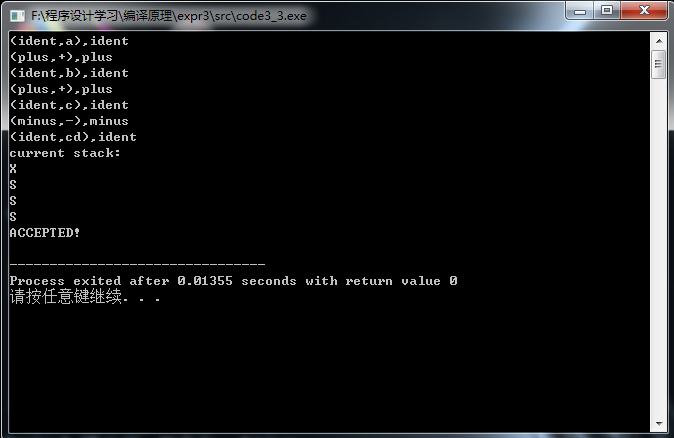
(1)合法的语句:
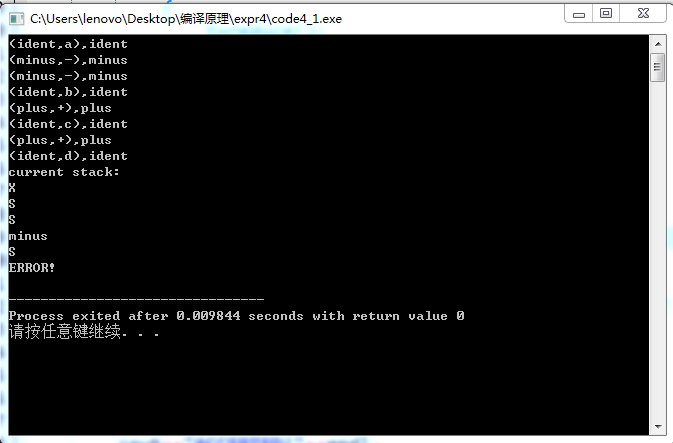
(2)不合法的语句:
tz@dormitory HZAU
2018/5/30
last updated@COI HZAU
2018/6/12
【编译原理】c++实现自下而上语法分析器的更多相关文章
- 【编译原理】LL1文法语法分析器
上篇文章[编译原理]语法分析--自上向下分析 分析了LL1语法,文章最后说给出栗子,现在补上去. 说明: 这个语法分析器是利用LL1分析方法实现的. 预测分析表和终结符以及非终结符都是针对一个特定文法 ...
- 【编译原理】c++实现自下而上语法分析及中间代码(四元式)生成
写在前面:本博客为本人原创,严禁任何形式的转载!本博客只允许放在博客园(.cnblogs.com),如果您在其他网站看到这篇博文,请通过下面这个唯一的合法链接转到原文! 本博客全网唯一合法URL:ht ...
- 编译原理_P1004
龙书相关知识点总结 //*************************引论***********************************// 1. 编译器(compiler):从一中语言( ...
- 编译原理简单语法分析器(first,follow,分析表)源码下载
编译原理(简单语法分析器下载) http://files.cnblogs.com/files/hujunzheng/%E5%8A%A0%E5%85%A5%E5%90%8C%E6%AD%A5%E7%AC ...
- <编译原理 - 函数绘图语言解释器(2)语法分析器 - python>
<编译原理 - 函数绘图语言解释器(2)语法分析器 - python> 背景 编译原理上机实现一个对函数绘图语言的解释器 - 用除C外的不同种语言实现 设计思路: 设计函数绘图语言的文法, ...
- 【编译原理】c++实现自上而下语法分析器
写在前面:本博客为本人原创,严禁任何形式的转载!本博客只允许放在博客园(.cnblogs.com),如果您在其他网站看到这篇博文,请通过下面这个唯一的合法链接转到原文! 本博客全网唯一合法URL:ht ...
- Compiler Theory(编译原理)、词法/语法/AST/中间代码优化在Webshell检测上的应用
catalog . 引论 . 构建一个编译器的相关科学 . 程序设计语言基础 . 一个简单的语法制导翻译器 . 简单表达式的翻译器(源代码示例) . 词法分析 . 生成中间代码 . 词法分析器的实现 ...
- 必要的软件架构师——编译原理·语法
最近软测试.我观看进程的视频! 发现里面有很多内容已经在自我不错的接触过程.而占80%比例! 但其中的一部分.我很奇怪的一部分.研究,在这里,将我研究的内容整理分享给大家! 编译原理: 首先,我第一眼 ...
- python实现算术表达式的词法语法语义分析(编译原理应用)
本学期编译原理的一个大作业,我的选题是算术表达式的词法语法语义分析,当时由于学得比较渣,只用了递归下降的方法进行了分析. 首先,用户输入算术表达式,其中算术表达式可以包含基本运算符,括号,数字,以及用 ...
随机推荐
- jquery ui autocomplete输入中文不自动完成的问题
因为输入法或浏览器的问题,在输入中文后并没有触发自动完成,要再按多一下键盘才触发,查看发现它是用keydown来实现.bind("keydown.autocomplete", fu ...
- Atitit 开发进度 开发效率提升解决方案
Atitit 开发进度 开发效率提升解决方案 1.1. 使用4gl语言 dsl语言尽可能 1 1.2. Ssd+高屏幕显示器,提升硬件 1 1.3. 汉字命名规范,可以大力提升可读性与效率 1 1. ...
- Atitit 数据库视图与表的wrap与层级查询规范
Atitit 数据库视图与表的wrap与层级查询规范 1.1. Join层..连接各个表,以及显示各个底层字段1 1.2. 统计层1 1.3. 格式化层1 1.1. Join层..连接各个表,以及显示 ...
- (转)解决类似 /usr/lib64/libstdc++.so.6: version `GLIBCXX_3.4.21' not found 的问题
转自:https://itbilu.com/linux/management/NymXRUieg.html 源码编译升级安装了gcc后,编译程序或运行其它程序时,有时会出现类似/usr/lib64/l ...
- 【Linux】深入理解Linux中内存管理
主题:Linux内存管理中的分段和分页技术 回顾一下历史,在早期的计算机中,程序是直接运行在物理内存上的.换句话说,就是程序在运行的过程中访问的都是物理地址. 如果这个系统只运行一个程序,那么只要这个 ...
- 【iCore4 双核心板_ARM】例程五:SYSTICK定时器 实验——定时点亮LED
实验原理: 通过STM32的三个GPIO口驱动三色LED的三个通道,设定GPIO为推挽输出模式,采 用灌电流方式与LED连接,输出高电平LED灭,输出低电平LED亮,通过系统定时器实现 1s定时,每秒 ...
- java中的数据加密4 数字签名
数字签名 它是确定交换消息的通信方身份的第一个级别.A通过使用公钥加密数据后发给B,B利用私钥解密就得到了需要的数据,问题来了,由于都是使用公钥加密,那么如何检验是A发过来的消息呢?上面也提到了一点, ...
- Java知多少(2)虚拟机(JVM)以及跨平台原理
相信大家已经了解到Java具有跨平台的特性,可以“一次编译,到处运行”,在Windows下编写的程序,无需任何修改就可以在Linux下运行,这是C和C++很难做到的. 那么,跨平台是怎样实现的呢?这就 ...
- 学习Mysql过程中拓展的其他技术栈:设置linux虚拟机的固定ip和克隆linux虚拟机
一.设置linux虚拟机的固定ip 1. 安装好虚拟机后在菜单栏选择编辑→ 虚拟网络编辑器,打开虚拟网络编辑器对话框,选择Vmnet8 Net网络连接方式,随意设置子网IP,点击NAT设置页面,查看子 ...
- C++ Release编译时如何对某段代码不进行优化
optimize#pragma optimize( "[optimization-list]", {on | off} ) Feature Only in Professional ...