
Memory Region
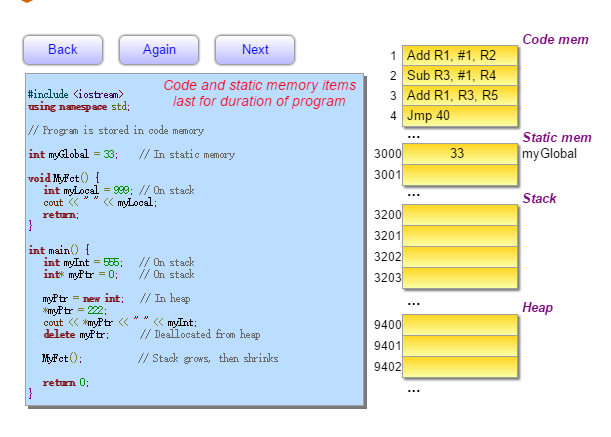
A program's memory usage typically includes four different regions:
- Code -- The region where the program instructions are stored.
- Static memory -- The region where global variables (variable defined outside any function) as well as static local variables (variables defined inside functions starting with the keyword "static") are allocated. The name "static" comes from these variables not changing (static means not changing); they are allocated once and last for the duration of a program's execution, their addresses staying the same.
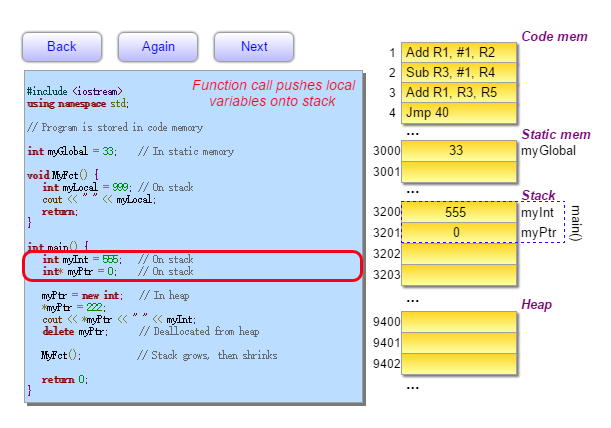
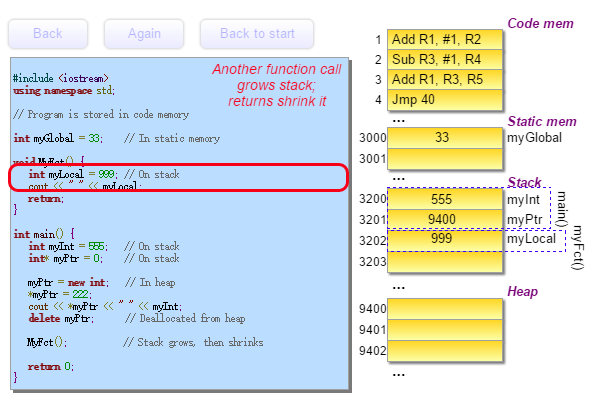
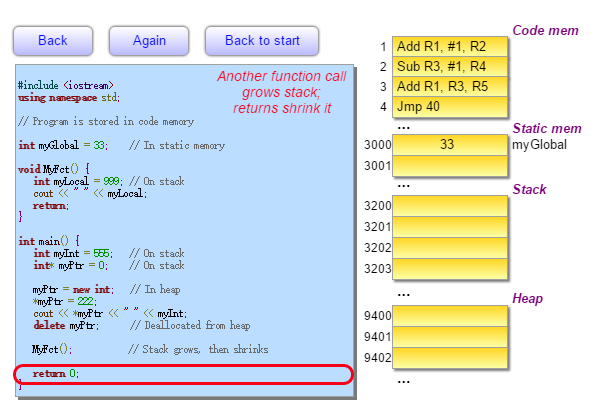
- The stack -- The region where a function's local variables are allocated during a function call. A function call adds local variables to the stack, and a return removes them, like adding and removing dishes from a pile; hence the term "stack." Because this memory is automatically allocated and deallocated, it is also called automatic memory.
- The heap -- The region where the "new" operator allocates memory, and where the "delete" operator deallocates memory. The region is also called free store
The Following shows how them work


Memory Region的更多相关文章
- PatentTips - Maintaining shadow page tables in a sequestered memory region
BACKGROUND Malicious code, known as malware, which includes viruses, worms, adware, etc., may attack ...
- Off-heap Memory in Apache Flink and the curious JIT compiler
https://flink.apache.org/news/2015/09/16/off-heap-memory.html Running data-intensive code in the J ...
- 程序空间(Program memory)
The computer program memory is organized into the following: Data Segment (Data + BSS + Heap) Stack ...
- Embedded之memory test
1 main.c #include "led.h" #define BASE_ADDRESS (volatile datum *) 0x10000000 #define NUM_B ...
- Linker scripts之MEMORY
1 MEMORY command The MEMORY command describes the location and size of blocks of memory in the targe ...
- Anatomy of a Program in Memory
Memory management is the heart of operating systems; it is crucial for both programming and system a ...
- qualcomm memory dump 抓取方法
Memory dump是系统出现crash时常用的分析故障原因的方法,qualcomm 各子系统运行时,为方便debug,都会开辟ram log和debug variable用于保存各系统运行信息及健 ...
- [转]Anatomy of a Program in Memory
Memory management is the heart of operating systems; it is crucial for both programming and system a ...
- Linux kernel Programming - Allocating Memory
kmalloc #include <linux/slab.h> void *kmalloc(size_t size,int flags); void kfree(void *addr); ...
随机推荐
- UI控件自定义tableView的分割线的样式
- (void)drawRect:(CGRect)rect { CGContextRef context = UIGraphicsGetCurrentContext(); CGContextSetFi ...
- JAVA中this用法小结[转]
Java关键字this只能用于方法方法体内.当一个对象创建后,Java虚拟机(JVM)就会给这个对象分配一个引用自身的指针,这个指针的名字就是 this.因此,this只能在类中的非静态方法中使用,静 ...
- 继网易博客后搜狐博客也增加了nofollow标签
继网易博客后搜狐博客也增加了nofollow标签 今天在搜狐博客发表了篇文章,在末端添加上我的版权,结果回头查看是发现,这个锚文本被加上了nofollow标签,也就是说这样的外链已经没有传递权重的作用 ...
- 自制单片机之二-----AT89S51ISP下载线的制做
最小系统板做好了,接下来就是做根ISP下载线了.否则程序怎么写到AT89S51芯片里呢? 先来认识一下AT89S51上ISP(在线编程)功能脚的定义 看上图的左边AT89S51引脚图的P1.5.P1. ...
- QQ截图时窗口自动识别的原理(WindowFromPoint, ChildWindowFromPoint, ChildWindowFromPointEx,RealChildWindowFromPoint)
新版的QQ在截图时加入了窗口自动识别的功能,能根据鼠标的位置自动画出下面窗口的轮廓.今天有人在论坛上问起这个问题,下面我们来探讨这个功能的实现原理. 首先我们要明白截图软件的基本原理,截图时实际上是新 ...
- Struts2标签库之iterator
传说中的第一种方式,这种在Struts2.1权威指南的例子中也木有说明白: <%@ page language="java" contentType="text/h ...
- UIView添加支持代码块的手势
UITapGestureRecognizer *tap = [[UITapGestureRecognizer alloc] initWithTarget:self action:@selector(a ...
- 运行tomcat7w.exe tomcat7.exe ,提示 指定的服务未安装 unable to open the service 'tomcat7'
运行tomcat7w.exe tomcat7.exe ,提示 指定的服务未安装 unable to open the service 'tomcat7'(用的是绿色的Tomcat7) 解决方法: 打开 ...
- 编写高质量代码改善python程序91个建议学习01
编写高质量代码改善python程序91个建议学习 第一章 建议1:理解pythonic的相关概念 狭隘的理解:它是高级动态的脚本编程语言,拥有很多强大的库,是解释从上往下执行的 特点: 美胜丑,显胜隐 ...
- Kali for Android
使用设备:小米平板1 材料:Complete Linux Installer(好像是这个名字,很多应用商店都能下载,所以我就不用送上链接了) 进入app之后,按照着提示做就是了.关于镜像,也是在app ...