
【数值分析】Python实现Lagrange插值
一直想把这几个插值公式用代码实现一下,今天闲着没事,尝试尝试。
先从最简单的拉格朗日插值开始!关于拉格朗日插值公式的基础知识就不赘述,百度上一搜一大堆。
基本思路是首先从文件读入给出的样本点,根据输入的插值次数和想要预测的点的x选择合适的样本点区间,最后计算基函数得到结果。直接看代码!(注:这里说样本点不是很准确,实在词穷找不到一个更好的描述。。。)
str2double
一个小问题就是怎样将python中的str类型转换成float类型,毕竟我们给出的样本点不一定总是整数,而且也需要做一些容错处理,比如多个+、多个-等等,也应该能识别为正确的数。所以实现了一个str2double方法。
import re

def str2double(str_num):

    pattern = re.compile(r'^((\+*)|(\-*))?(\d+)(.(\d+))?$')

    m = pattern.match(str_num)

    if m is None:

        return m

    else:

        sign = 1 if str_num[0] == '+' or '0' <= str_num[0] <= '9' else -1

        num = re.sub(r'(\++)|(\-+)', "", m.group(0))

        matchObj = re.match(r'^\d+$', num)

        if matchObj is not None:

            num = sign * int(matchObj.group(0))

        else:

            matchObj = re.match(r'^(\d+).(\d+)$', num)

            if matchObj is not None:

                integer = int(matchObj.group(1))

                fraction = int(matchObj.group(2)) * pow(10, -1*(len(matchObj.group(2))))

                num = sign * (integer + fraction)

        return num
我使用了正则表达式来实现,pattern = re.compile(r'^((\+*)|(\-*))?(\d+)(.(\d+))?$')可以匹配我上面提到的所有类型的整数和浮点数,之后进行匹配,匹配成功,如果是整数,直接return整数部分,这个用(int)强制转换即可;如果是浮点数,那么用(\d+)这个正则表达式再次匹配,分别得到整数部分和小数部分,整数部分的处理和上面类似,小数部分则用乘以pow(10, -小数位数)得到,之后直接相加即可。这里为了支持多个+或者-,使用re.sub方法将符号去掉,所以就需要用sign来记录数字的正负,在最后return时乘上sign即可。
binary_search
def binary_search(point_set, n, x):

    first = 0

    length = len(point_set)

    last = length

    while first < last:

        mid = (first + last) // 2

        if point_set[mid][0] < x:

            first = mid + 1

        elif point_set[mid][0] == x:

            return mid

        else:

            last = mid

    last =  last if last != length else last-1

    head = last - 1

    tail = last

    while n > 0:

        if head != -1:

            n -= 1

            head -= 1

        if tail != length:

            n -= 1

            tail += 1

    return [head+1, tail-1] if n == 0 else [head+1, tail-2]
这里point_set是全部样本点的集合,n是输入的插值次数,x是输入的预测点。返回合适的插值区间,即尽可能地把x包在里面。
因为要根据输入得到合适的插值区间,所以就涉及查找方面的知识。这里使用了二分查找,先对样本点集合point_set进行排序(升序),找到第一个大于需要预测点的样本点,在它的两侧扩展区间,直到满足插值次数要求。这里我的实现有些问题,可能会出现n=-1因为tail多加了一次,就在while循环外又进行了一次判断,n=-1时tail-2,这个实现的确不好,可能还会有bug。。。
最后,剩下的内容比较好理解,直接放上全部代码。
import re

import matplotlib.pyplot as plt

import numpy as np

def str2double(str_num):

    pattern = re.compile(r'^((\+*)|(\-*))?(\d+)(.(\d+))?$')

    m = pattern.match(str_num)

    if m is None:

        return m

    else:

        sign = 1 if str_num[0] == '+' or '0' <= str_num[0] <= '9' else -1

        num = re.sub(r'(\++)|(\-+)', "", m.group(0))

        matchObj = re.match(r'^\d+$', num)

        if matchObj is not None:

            num = sign * int(matchObj.group(0))

        else:

            matchObj = re.match(r'^(\d+).(\d+)$', num)

            if matchObj is not None:

                integer = int(matchObj.group(1))

                fraction = int(matchObj.group(2)) * pow(10, -1*(len(matchObj.group(2))))

                num = sign * (integer + fraction)

        return num

def preprocess():

    f = open("input.txt", "r")

    lines = f.readlines()

    lines = [line.strip('\n') for line in lines]

    point_set = list()

    for line in lines:

        point = list(filter(None, line.split(" ")))

        point = [str2double(pos) for pos in point]

        point_set.append(point)

    return point_set

def lagrangeFit(point_set, x):

    res = 0

    for i in range(len(point_set)):

        L = 1

        for j in range(len(point_set)):

            if i == j:

                continue

            else:

                L = L * (x - point_set[j][0]) / (point_set[i][0] - point_set[j][0])

        L = L * point_set[i][1]

        res += L

    return res

def showbasis(point_set):

    print("Lagrange Basis Function:\n")

    for i in range(len(point_set)):

        top = ""

        buttom = ""

        for j in range(len(point_set)):

            if i == j:

                continue

            else:

                top += "(x-{})".format(point_set[j][0])

                buttom += "({}-{})".format(point_set[i][0], point_set[j][0])

        print("Basis function{}:".format(i))

        print("\t\t{}".format(top))

        print("\t\t{}".format(buttom))

def binary_search(point_set, n, x):

    first = 0

    length = len(point_set)

    last = length

    while first < last:

        mid = (first + last) // 2

        if point_set[mid][0] < x:

            first = mid + 1

        elif point_set[mid][0] == x:

            return mid

        else:

            last = mid

    last =  last if last != length else last-1

    head = last - 1

    tail = last

    while n > 0:

        if head != -1:

            n -= 1

            head -= 1

        if tail != length:

            n -= 1

            tail += 1

    return [head+1, tail-1] if n == 0 else [head+1, tail-2]

if __name__ == '__main__':

    pred_x = input("Predict x:")

    pred_x = float(pred_x)

    n = input("Interpolation times:")

    n = int(n)

    point_set = preprocess()

    point_set = sorted(point_set, key=lambda a: a[0])

    span = binary_search(point_set, n+1, pred_x)

    print("Chosen points: {}".format(point_set[span[0]:span[1]+1]))

    showbasis(point_set[span[0]:span[1]+1])

    X = np.linspace(-np.pi, np.pi, 256, endpoint=True)

    S = np.sin(X)

    L = [lagrangeFit(point_set, x) for x in X]

    L1 = [lagrangeFit(point_set[span[0]:span[1]+1], x) for x in X]

    plt.figure(figsize=(8, 4))

    plt.plot(X, S, label="$sin(x)$", color="red", linewidth=2)

    plt.plot(X, L, label="$LagrangeFit-all$", color="blue", linewidth=2)

    plt.plot(X, L1, label="$LagrangeFit-special$", color="green", linewidth=2)

    plt.xlabel('x')

    plt.ylabel('y')

    plt.title("$sin(x)$ and Lagrange Fit")

    plt.legend()

    plt.show()
About Input
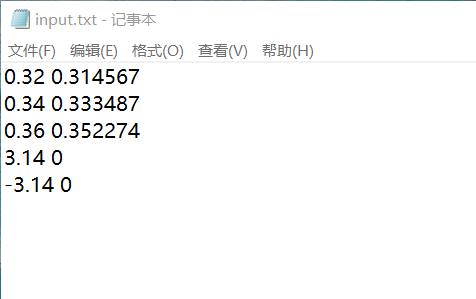
使用了input.txt进行样本点读入,每一行一个点,中间有一个空格。
结果
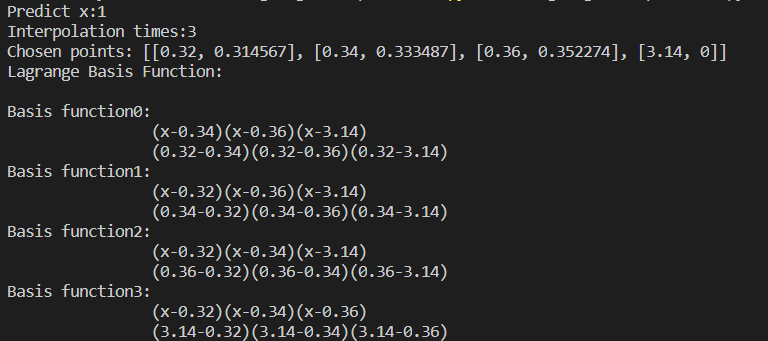
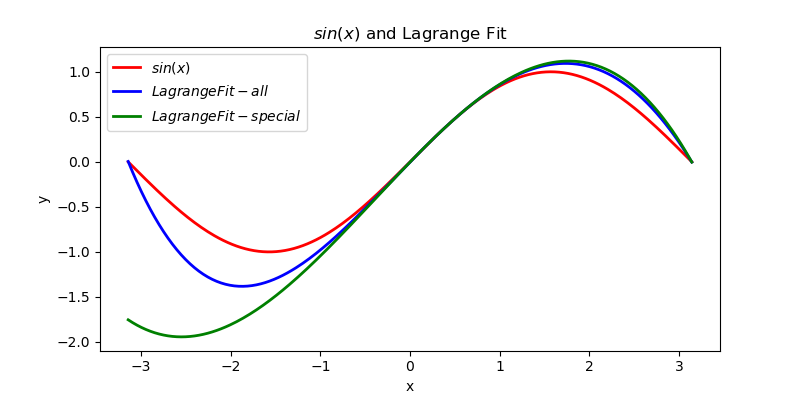
感觉挺好玩的hhh,过几天试试牛顿插值!掰掰!
【数值分析】Python实现Lagrange插值的更多相关文章
- Python实现Newton和lagrange插值
一.介绍Newton和lagrange插值:给出一组数据进行Newton和lagrange插值,同时将结果用plot呈现出来1.首先是Lagrange插值:根据插值的方法,先对每次的结果求积,在对结果 ...
- 数值分析案例:Newton插值预测2019城市(Asian)温度、Crout求解城市等温性的因素系数
数值分析案例:Newton插值预测2019城市(Asian)温度.Crout求解城市等温性的因素系数 文章目录 数值分析案例:Newton插值预测2019城市(Asian)温度.Crout求解城市等温 ...
- Python数值计算之插值曲线拟合-01
3 插值与曲线拟合 Interpolation and Curve Fitting 给定n+1个数据点(xi,yi), i = 0,1,2,…,n,评估y(x). 3.1 介绍(introdu ...
- Note -「Lagrange 插值」学习笔记
目录 问题引入 思考 Lagrange 插值法 插值过程 代码实现 实际应用 「洛谷 P4781」「模板」拉格朗日插值 「洛谷 P4463」calc 题意简述 数据规模 Solution Step 1 ...
- Lagrange插值C++程序
输入:插值节点数组.插值节点处的函数值数组,待求点 输出:函数值 代码如下:把printf的注释取消掉,能打印出中间计算过程,包括Lagrange多项式的求解,多项式每一项等等(代码多次修改,这些pr ...
- Python SciPy库——插值与拟合
插值与拟合 原文链接:https://zhuanlan.zhihu.com/p/28149195 1.最小二乘拟合 实例1 # -*- coding: utf-8 -*- import numpy a ...
- 数值计算方法实验之Lagrange 多项式插值 (Python 代码)
一.实验目的 在已知f(x),x∈[a,b]的表达式,但函数值不便计算,或不知f(x),x∈[a,b]而又需要给出其在[a,b]上的值时,按插值原则f(xi)= yi(i= 0,1…….,n)求出简单 ...
- 转Python SciPy库——拟合与插值
1.最小二乘拟合 实例1 import numpy as np import matplotlib.pyplot as plt from scipy.optimize import leastsq p ...
- OpenCASCADE Interpolation - Lagrange
OpenCASCADE Interpolation - Lagrange eryar@163.com Abstract. Power basis polynomial is the most simp ...
随机推荐
- Flask入门很轻松(三)—— 模板
Jinja2模板引擎 转载请在文章开头附上原文链接地址:https://www.cnblogs.com/Sunzz/p/10959471.html Flask内置的模板语言,它的设计思想来源于 Dja ...
- option触发及获取当前选中的option值
#标签 #<select id="city" class="select"> #JavaScript #$("#city").c ...
- JMeter性能测试,入门
原文转自:https://blog.csdn.net/lovesoo/article/details/78579547 Apache JMeter是一款纯java编写负载功能测试和性能测试开源工具软件 ...
- mysql数据库查询缓存总结
概述 查询缓存(Query Cache,简称QC),存储SELECT语句及其产生的数据结果.闲来无事,做一下这块的总结,也做个备忘! 工作原理 查询缓存工作原理如下: 缓存SELECT操作的结果集和S ...
- AD10生成Gerber文件详细步骤
参考:https://wenku.baidu.com/view/faf0363c195f312b3069a5d2.html
- AD-logon workstation
默认AD登录到限制为64个 原因 发生此问题的原因是User-Workstations属性的Range-Upper值为1,024个字符.使用Active Directory用户和计算机输入NetBIO ...
- 项目Beta冲刺(团队)——凡事预则立
项目Beta冲刺(团队)--凡事预则立 格式描述 课程名称:软件工程1916|W(福州大学) 作业要求:项目Beta冲刺(团队) 团队名称:为了交项目干杯 作业目标:Beta冲刺前对冲刺阶段的总体规划 ...
- postgres高可用学习篇三:haproxy+keepalived实现postgres负载均衡
环境: CentOS Linux release 7.6.1810 (Core) 内核版本:3.10.0-957.10.1.el7.x86_64 node1:192.168.216.130 node2 ...
- C# 反射(转)
什么是反射 Reflection,中文翻译为反射. 这是.Net中获取运行时类型信息的方式,.Net的应用程序由几个部分:‘程序集(Assembly)’.‘模块(Module)’.‘类型 ...
- 【Java】《Java程序设计基础教程》第六章学习
第六章 常用的工具包 6.1 java.lang包 6.1.1 Object类 Object类是一个超级类,是所有类的直接或间接父类. public boolean equals(Object obj ...