
Lua中对自定义二维表进行添加、修改、计算、删除、判断是否存在操作
引言:
最近刚稍微深入了解一下Lua,正好最近需要用到Lua中对表的操作,于是借助现有的了解实现了对一个简单的二维表进行添加、修改、计算、删除及判断存在的操作
表的创建及相关方法:
1. 创建表及自定义一个迭代器:
--1.当作这是一个操作类/表;该表为一个二维列表,每一个元素代表一个表

--2.每一个元素(表)中包含 id 和 num

operationList = {}

--1.列表元素迭代器,仅返回列表中每一个元素,改列表索引必须为连续的数字

function listIterator(list)

    local index = 0;

    local listLen = #list

    return function ()

        index = index + 1

        if index <= listLen then

            return list[index]

        end

    end

end
2. 向表中添加数据
--1.向操作类/表中添加数据,oId代表标识ID,onum代表值当前值

--2.当 oId 已在列表中存在时,不进行添加操作

--2.当 oId 为nil时,默认为 “1”,当 onum 为nil时,默认为 1

--3.oId 类型为string,oNum 类型为number

--4.添加成功返回 true,失败则返回 false

function operationList:add(oId, oNum)

    if not operationList:exist(oId) then

        table.insert(self, {id = oId or "1", num = oNum or 1})

        return true

    end

    return false

end
3. 修改表中数据
--1.修改operationList指定 ID 的值

--2.oId为指定ID,oNum为修改值,ifNum为指定ID的指定值,oCreate为是否新建值

--2.oId 类型为string,oNum 类型为number,ifNum类型为number,oCreate类型为boolean

--3.当该 ID 不存在时且参数 oCreate = true,则创建

--4.若当前 ID 存在, oNum 为 nil,ifNum 不存在,返回当前 ID 的 num 值

--5.若当前 ID 存在, oNum 不为 nil,ifNum 不存在,则为修改后的 num 值

--6.若当前 ID 存在, oNum 不为 nil,ifNum 存在,则为修改后的 num 值

--7.若当前 ID 存在, oNum 不为 nil,ifNum 不存在,返回当前 ID 的 num 值

--8.若当前 ID 不存在,且 oCreate = false 或 = nil,则返回数字 -1

--9.若当前 ID 不存在,且 ocreate = true,则创建对应 ID 和 num = 1 的新子列,再返回数字 0

function operationList:alter(oId, oNum, ifNum, oCreate)

    if not ifNum then

        for ol in listIterator(operationList) do

            if ol.id == oId then        --若与要修改的ID相同

                if oNum then            --若修改值不为nil

                    ol.num = oNum       --修改值

                end

                return ol.num           --返回当前值,若无修改值,则返回原来的值

            end

        end

    else

        for ol in listIterator(operationList) do

            if ol.id == oId then        --若与要修改的ID相同且 该ID的值 = 判定值

                if  ol.num == ifNum then

                    ol.num = oNum       --修改值

                end

                return ol.num           --返回当前值,若原来的值不等于ifNum的值,则返回原来的值

            end

        end

    end

    if not oCreate then                 --若列表不存在 oId,且 oCreate的值为false

        return -1                       --返回 -1

    end

    operationList:add(oId, 1)           --若列表不存在 oId,且 oCreate的值为true

    return 0                            --返回 0

end
3.1. 修改表略微修改版


--1.修改operationList指定 ID 的值

--2.oId为指定ID,oNum为修改值,ifNum为指定ID的指定值,oCreate为是否新建值

--2.oId 类型为string,oNum 类型为number,ifNum类型为number,oCreate类型为boolean

--3.当该 ID 不存在时且参数 oCreate = true,则创建

--4.若当前 ID 存在, oNum 为 nil,ifNum 不存在,返回当前 ID 的 num 值

--5.若当前 ID 存在, oNum 不为 nil,ifNum 不存在,则为修改后的 num 值

--6.若当前 ID 存在, oNum 不为 nil,ifNum 存在,则为修改后的 num 值

--7.若当前 ID 存在, oNum 不为 nil,ifNum 不存在,则返回 -2

--8.若当前 ID 不存在,且 oCreate = false 或 = nil,则返回数字 -1

--9.若当前 ID 不存在,且 ocreate = true,则创建对应 ID 和 num = 1 的新子列,再返回数字 0

function operationList:alter(oId, oNum, ifNum, oCreate)

    if not ifNum then

        for ol in listIterator(operationList) do

            if ol.id == oId then        --若与要修改的ID相同

                if oNum then            --若修改值不为nil

                    ol.num = oNum       --修改值

                end

                return ol.num           --返回当前值,若无修改值,则返回原来的值

            end

        end

    else

        for ol in listIterator(operationList) do

            if ol.id == oId then        --若与要修改的ID相同且 该ID的值 = 判定值

                if  ol.num == ifNum then

                    ol.num = oNum       --修改值

                    return ol.num       --返回修改后的值

                end

                return -2

            end

        end

    end

    if not oCreate then                 --若列表不存在 oId,且 oCreate的值为false

        return -1                       --返回 -1

    end

    operationList:add(oId, 1)           --若列表不存在 oId,且 oCreate的值为true

    return 0                            --返回 0

end
4. 计算表中值数据
--1.计算operationList指定 ID 的值

--2.oId为指定ID,computeNum为计算值,ifNum为指定ID的指定值,oCreate为是否新建值

--2.oId 类型为string,computeNum 类型为number,ifNum类型为number,oCreate类型为boolean

--3.当该 ID 不存在时且参数 oCreate = true,则创建

--4.若当前 ID 存在, computeNum 为 nil,ifNum 不存在,返回当前 ID 的 num + 1 值

--5.若当前 ID 存在, computeNum 不为 nil,ifNum 不存在,则为修改后的 num + computeNum 值

--6.若当前 ID 存在, computeNum 不为 nil,ifNum 存在,则为修改后的 num + computeNum 值

--7.若当前 ID 存在, computeNum 不为 nil,ifNum 不存在,则返回当前 ID 的 num 值

--8.若当前 ID 不存在,且 oCreate = false 或 = nil,则返回数字 -1

--9.若当前 ID 不存在,且 ocreate = true,则创建对应 ID 和 num = 1 的新子列,再返回数字 0

function operationList:compute(oId, computeNum, ifNum, oCreate)

    if not ifNum then                   --如果相等判定值不存在

        for ol in listIterator(operationList) do

            if ol.id == oId then

                if not computeNum then  --如果计算值为空,那么原值默认 + 1

                    ol.num = ol.num + 1

                else

                    ol.num = ol.num + computeNum    --计算值不为空,那么原值 + 计算值

                end

                return ol.num

            end

        end

    else

        for ol in listIterator(operationList) do

            if ol.id == oId then

                if ol.num == ifNum and computeNum then

                    ol.num = ol.num + computeNum

                end

                return ol.num

            end

        end

    end

    if not oCreate then                 --若列表不存在 oId,且 oCreate的值为false

        return -1                       --返回 -1

    end

    operationList:add(oId, 1)           --若列表不存在 oId,且 oCreate的值为true

    return 0

end
4.1. 计算表略微修改版
--1.计算operationList指定 ID 的值

--2.oId为指定ID,computeNum为计算值,ifNum为指定ID的指定值,oCreate为是否新建值

--2.oId 类型为string,computeNum 类型为number,ifNum类型为number,oCreate类型为boolean

--3.当该 ID 不存在时且参数 oCreate = true,则创建

--4.若当前 ID 存在, computeNum 为 nil,ifNum 不存在,返回当前 ID 的 num + 1 值

--5.若当前 ID 存在, computeNum 不为 nil,ifNum 不存在,则为修改后的 num + computeNum 值

--6.若当前 ID 存在, computeNum 不为 nil,ifNum 存在,则为修改后的 num + computeNum 值

--7.若当前 ID 存在, computeNum 不为 nil,ifNum 不存在,则返回 -2

--8.若当前 ID 不存在,且 oCreate = false 或 = nil,则返回数字 -1

--9.若当前 ID 不存在,且 ocreate = true,则创建对应 ID 和 num = 1 的新子列,再返回数字 0

function operationList:compute(oId, computeNum, ifNum, oCreate)

    if not ifNum then                   --如果相等判定值不存在

        for ol in listIterator(operationList) do

            if ol.id == oId then

                if not computeNum then  --如果计算值为空,那么原值默认 + 1

                    ol.num = ol.num + 1

                else

                    ol.num = ol.num + computeNum    --计算值不为空,那么原值 + 计算值

                end

                return ol.num

            end

        end

    else

        for ol in listIterator(operationList) do

            if ol.id == oId then

                if ol.num == ifNum and computeNum then

                    ol.num = ol.num + computeNum

                    return ol.num

                end

                return -2

            end

        end

    end

    if not oCreate then                 --若列表不存在 oId,且 oCreate的值为false

        return -1                       --返回 -1

    end

    operationList:add(oId, 1)           --若列表不存在 oId,且 oCreate的值为true

    return 0

end
5. 删除指定ID的数据
--1.从表移除指定 ID 的子列

--2.oId 类型为string

--3.移除成功返回 true,失败返回 false(只有当oId不存在时才会失败)

function operationList:remove(oId)

    local removeIndex

    for olI, olV in pairs(operationList) do

        if olV.id == oId then       --如果找到ID,则将对应索引传递给removeIndex

            removeIndex = olI

            break

        end

    end

    if not removeIndex then

        return false

    end

    table.remove(operationList, removeIndex)

    return true

end
6. 判断指定ID是否存在表中
--1.判断指定 ID 在operationList中是否存在

--2.oId 类型为string

function operationList:exist(oId)

    for ol in listIterator(operationList) do

        if ol.id == oId then

            return true

        end

    end

    return false

end
对以上方法进行测试:
1. 测试代码:
--下面是向表operation中插入数据及输出结果

operationList:add("test1", 100)

operationList:add("test2", 200)

operationList:add("test3", 300)

operationList:add("test4")

operationList:add(nil, 500)

--下面是操作表

operationList:remove("test3")                                   --移除数据

print(operationList:exist("11"))                                --判断 ID = 11 的子列是否存在,输出false

print(operationList:exist("1"))                                 --判断 ID = 1 的子列是否存在,输出true

print(tostring(operationList:alter("test3")))                   --通过修改值方法向列表添加新值,输出 -1

print(tostring(operationList:alter("test3", nil, nil, true)))   --通过修改值方法向列表添加新值,输出 0

print(tostring(operationList:alter("1")))                       --获取 ID = 1 的值,因为存在,输出当前 ID 的值

print(tostring(operationList:alter("11")))                      --获取 ID = 11 的值,因为不存在,输出 -1

print(tostring(operationList:alter("test1", 99)))               --修改 ID = test1 的值为 99,因为存在,输出修改后的值

print(tostring(operationList:alter("11", 99)))                  --修改 ID = 11 的值为 99,因为不存在,输出 -1

print(tostring(operationList:alter("test1", 999, 100)))         --修改 ID = test1 且当前值 = 100 的值为 999,因为ID存在 但 值判断值不相同,输出当前值

print(tostring(operationList:alter("test1", 999, 99)))          --修改 ID = test1 且当前值 = 99 的值为 999,因为ID存在 且 值判断值相同,输出修改后的值

print(tostring(operationList:alter("11", 666, 999)))            --修改 ID = 11 且当前值 = 999 的值为 666,因为ID不存在,输出 -1

print(tostring(operationList:compute("1")))                     --计算 ID = 1 的值,其他参数为空,获得原值 + 1

print(tostring(operationList:compute("1", -2)))                 --计算 ID = 1 的值,计算值 = -2,获得原值 - 2

print(tostring(operationList:compute("1", -2, 499)))            --计算 ID = 1 的值,计算值 = -2,且当前值 = 499 获得原值 - 2

print(tostring(operationList:compute("1", nil, 497)))           --计算 ID = 1 的值,计算值 = nil,且当前值 = 497 获得原值

print(tostring(operationList:compute("1", -2, 499)))            --计算 ID = 1 的值,计算值 = -2,但当前值 ~= 499 获得原值

print(tostring(operationList:compute("test6", -2, 499)))        --计算 ID = test6 的值,计算值 = -2,但当前值 ~= 499 且 oCreate = nil ,不创建新子列,获得返回值 -1

print(tostring(operationList:compute("test6", -2, 499, true)))  --计算 ID = test6 的值,计算值 = -2,但当前值 ~= 499 且 oCreate = true 创建新子列,获得返回值 0

--输出列表

print("\n")

for thisoL in listIterator(operationList) do

    print("this ID is "..thisoL.id.."\nthis Num is "..thisoL.num.."\n")

end
2. 测试结果图:
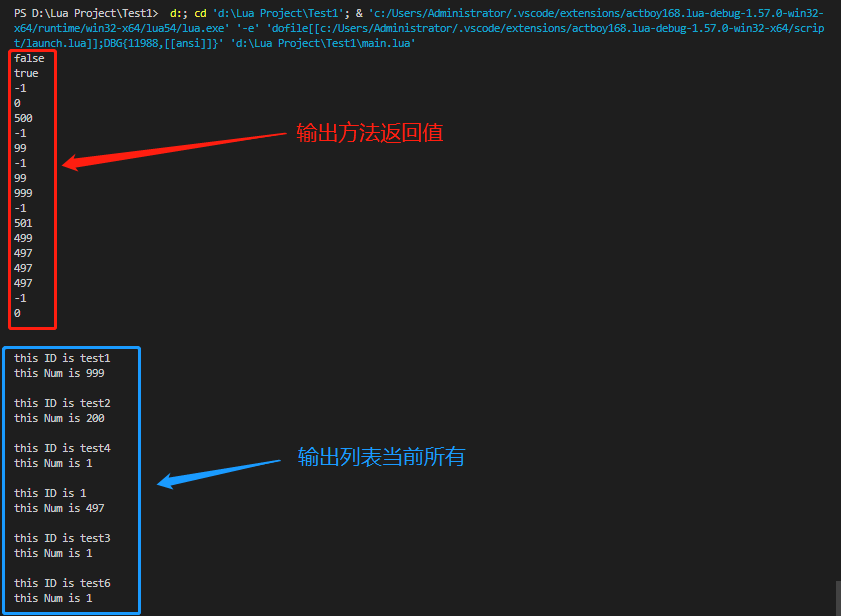
以上就是全部内容了
Lua中对自定义二维表进行添加、修改、计算、删除、判断是否存在操作的更多相关文章
- linux 进阶2--C++读取lua文件中的变量、一维表、二维表
lua 语言非常灵活,一般把lua 作为脚本文件,会用C++与之进行交互.最重要的是C++代码能读取到脚本中的变量.一维表.二维表. 这样有些参数就可以在lua文件进行更改,而不用重新更改C++代码. ...
- 议:如何将树形菜单形式的数据转化成HTML的二维表(相同内容需合并单元格)
一般做OA类管理系统,经常涉及到“组织架构”的概念,那么像这种有上下层级关系的数据一般会做成树形菜单的方式显示,底层代码必定会用到递归算法.这篇随笔的目的就是要谈谈除了用树形菜单来显示这种上下层级关系 ...
- Qt信号槽机制的实现(面试的感悟,猜测每一个类保存的一个信号和槽的二维表,实际使用函数指针 元对象 还有类型安全的检查设定等等)
因为面试时问了我这道题,导致我想去了解信号槽到底是如何实现的,于是贴着顺序看了下源码,大致了解了整个框架.网上关于信号槽的文章也很多,但是大部分都是将如何应用的,这里我就写一下我所理解的如何实现吧, ...
- java_web学习(四) 二维表的制作(初步接触MVC)
我们需要做一个jsp页面,动态显示信息表的内容. 一.需求分析 1. 做一个实体类:StudentInfo (包含4个字段) 2. 如图模拟生成3条数据,本质上就是new StudentInfo ...
- Android生成自定义二维码
前面说过两种二维码扫描方式,现在说如何生成自定义酷炫二维码.二维码生成需要使用Google开源库Zxing,Zxing的项目地址:https://github.com/ZBar/ZBar,我们只需要里 ...
- Excel:一维表和二维表 互转
一.一维表转二维表 数据源: 一份流水账式的值班表,为了便于打印张贴,现在需要使其变成这样的样式: 也就是从一维表变成传说中的二维表. 1.新建查询 依次单击[数据]→[新建查询] →[从文件]→[从 ...
- C 二维数组,以及自定义二维数组
C 二维数组,以及自定义二维数组 我们通常情况下是这样定义一个二维数组的: int a[10][15]; 我们分别查看一下a,a[0],*a 都是一样的值吧 我们可以这么理解: a是一个数组的数组 a ...
- Oracle【二维表管理:约束】
1.简单的表创建和字段类型最简单的方式去创建表(没有添加主键之类的约束条件)[Oracle的字段类型]number:数值类型--整数类型:number(a) 总长度a--小数类型:number(a,b ...
- Oracle【二维表的维护】
二维表的维护 --添加新的字段:alter table 表名 add 字段名 类型 [一般不加约束条件] ) 原表:新增字段后的表:修改原有的字段:[修改字段类型.修改字段名.删除字段] --修改字段 ...
- 数据可视化之PowerQuery篇(四)二维表转一维表,看这篇文章就够了
https://zhuanlan.zhihu.com/p/69187094 数据分析的源数据应该是规范的,而规范的其中一个标准就是数据源应该是一维表,它会让之后的数据分析工作变得简单高效. 在之前的文 ...
随机推荐
- win10上打包的qt程序放到win7上打不开的解决方法
在win 10 上编写并打包发布了qt5.12.3 msvc2017 32bit的qt程序,在其他win10 电脑上都能正常运行,但是放到win7电脑上,运行exe时依次出现缺少"msvcp ...
- lua module以及模块内的local function使用
在模块定义local function,使用local function时,需要在使用前就定义,不能通过self:localfunction 或者self.locakfunction 因为是模块内的局 ...
- 「SOL」JOISC2021 解题报告
JOIS(egment-Tree)C 1. 前言 很早之前教练让我们做这套题,我以为这套题应该挺简单,用几天的空余时间就能刷完,结果预想的短周期刷题变成了长周期刷题--(好像是整个团队里最后一个刷完的 ...
- containerd容器存储探究
ContainerD 容器目录结构探究 启动容器 作为开始,我们需要去启动一个容器. 你可以通过命令行的方式来启动一个容器,例如: ctr i pull docker.io/library/nginx ...
- react native 模拟机调试,debug菜单在哪
- 2023-03-02 TypeError: null is not an object (evaluating 'ImageCropPicker.openPicker')
问题描述:rn项目使用到了一个插件react-native-image-crop-picker,运行后报错. 原因:安装该插件的时候没有link到android包里. 解决方案: react-nati ...
- Generative Adversarial Network - Python实现
算法特征 ①. discriminator区别真假; ②. generator以假乱真 算法推导 Part Ⅰ: 熵之相关定义 entropy之定义如下, \[\begin{equation*} H( ...
- vue 项目中引入图片使用相对路径,图片不显示的问题
在 vue 项目中引入图片,路径为相对路径时,会显示 src="[object Module]" 采用 import 方式引入图片,再设置到 src 中 会正常显示 file-lo ...
- TIDB-DM数据迁移第三部(集群管理)
1.对现在 dm 集群进行缩容,将 free 状态的 worker 下线. tiup dm display dm-test 查看 free 状态节点 tiup dm scale-in dm 172.1 ...
- 实验1task3
<实验结论> #include <stdio.h> #include <stdlib.h> int main() { int a, b, t; a = 3; b = ...