
Rearrangement inequality
摘抄自: https://en.wikipedia.org/wiki/Rearrangement_inequality#Proof
In mathematics, the rearrangement inequality[1] states that
- {\displaystyle x_{n}y_{1}+\cdots +x_{1}y_{n}\leq x_{\sigma (1)}y_{1}+\cdots +x_{\sigma (n)}y_{n}\leq x_{1}y_{1}+\cdots +x_{n}y_{n}}

for every choice of real numbers
- {\displaystyle x_{1}\leq \cdots \leq x_{n}\quad {\text{and}}\quad y_{1}\leq \cdots \leq y_{n}}

and every permutation
- {\displaystyle x_{\sigma (1)},\dots ,x_{\sigma (n)}}
of x1, . . ., xn. If the numbers are different, meaning that
- {\displaystyle x_{1}<\cdots <x_{n}\quad {\text{and}}\quad y_{1}<\cdots <y_{n},}

then the lower bound is attained only for the permutation which reverses the order, i.e. σ(i) = n − i + 1 for all i = 1, ..., n, and the upper bound is attained only for the identity, i.e. σ(i) = i for all i = 1, ..., n.
Note that the rearrangement inequality makes no assumptions on the signs of the real numbers.
Proof[edit]
The lower bound follows by applying the upper bound to
- {\displaystyle -x_{n}\leq \cdots \leq -x_{1}.}

Therefore, it suffices to prove the upper bound. Since there are only finitely many permutations, there exists at least one for which
- {\displaystyle x_{\sigma (1)}y_{1}+\cdots +x_{\sigma (n)}y_{n}}

is maximal. In case there are several permutations with this property, let σ denote one with the highest number of fixed points.
We will now prove by contradiction, that σ has to be the identity (then we are done). Assume that σ is not the identity. Then there exists a j in {1, ..., n − 1} such that σ(j) ≠ j and σ(i) = i for all i in {1, ..., j − 1}. Hence σ(j) > j and there exists a k in {j + 1, ..., n} with σ(k) = j. Now
- {\displaystyle j<k\Rightarrow y_{j}\leq y_{k}\qquad {\text{and}}\qquad j<\sigma (j)\Rightarrow x_{j}\leq x_{\sigma (j)}.\quad (1)}

Therefore,
- {\displaystyle 0\leq (x_{\sigma (j)}-x_{j})(y_{k}-y_{j}).\quad (2)}

Expanding this product and rearranging gives
- {\displaystyle x_{\sigma (j)}y_{j}+x_{j}y_{k}\leq x_{j}y_{j}+x_{\sigma (j)}y_{k}\,,\quad (3)}

hence the permutation
- {\displaystyle \tau (i):={\begin{cases}i&{\text{for }}i\in \{1,\ldots ,j\},\\\sigma (j)&{\text{for }}i=k,\\\sigma (i)&{\text{for }}i\in \{j+1,\ldots ,n\}\setminus \{k\},\end{cases}}}
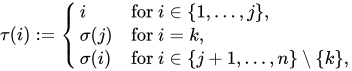
which arises from σ by exchanging the values σ(j) and σ(k), has at least one additional fixed point compared to σ, namely at j, and also attains the maximum. This contradicts the choice of σ.
If
- {\displaystyle x_{1}<\cdots <x_{n}\quad {\text{and}}\quad y_{1}<\cdots <y_{n},}
then we have strict inequalities at (1), (2), and (3), hence the maximum can only be attained by the identity, any other permutation σ cannot be optimal.
Generalization[edit]
A Generalization of the Rearrangement inequality states that for all real numbers {\displaystyle x_{1}\leq \cdots \leq x_{n}}

- {\displaystyle f'_{1}(x)\leq f'_{2}(x)\leq ...\leq f'_{n}(x)\quad \forall x\in [x_{1},x_{n}]}

the inequality
- {\displaystyle \sum _{i=1}^{n}f_{i}(x_{n-i+1})\leq \sum _{i=1}^{n}f_{i}(x_{\sigma (i)})\leq \sum _{i=1}^{n}f_{i}(x_{i})}

holds for every permutation {\displaystyle x_{\sigma (1)},\dots ,x_{\sigma (n)}}

Rearrangement inequality的更多相关文章
- INEQUALITY BOOKS
来源:这里 Bất Đẳng Thức Luôn Có Một Sức Cuốn Hút Kinh Khủng, Một Số tài Liệu và Sách Bổ ích Cho Việc Học ...
- cf536c——思路题
题目 题目:Lunar New Year and Number Division 题目大意:给定一个数字序列,可以任意分组(可调整顺序),但每组至少两个,求每组内数字和的平方的最小值 思路 首先,易证 ...
- hduoj 4710 Balls Rearrangement 2013 ACM/ICPC Asia Regional Online —— Warmup
http://acm.hdu.edu.cn/showproblem.php?pid=4710 Balls Rearrangement Time Limit: 6000/3000 MS (Java/Ot ...
- HDU 5933 ArcSoft's Office Rearrangement 【模拟】(2016年中国大学生程序设计竞赛(杭州))
ArcSoft's Office Rearrangement Time Limit: 2000/1000 MS (Java/Others) Memory Limit: 65536/32768 K ...
- HDU 4611Balls Rearrangement(思维)
Balls Rearrangement Time Limit: 9000/3000 MS (Java/Others) Memory Limit: 65535/32768 K (Java/Othe ...
- Balls Rearrangement(HDU)
Problem Description Bob has N balls and A boxes. He numbers the balls from 0 to N-1, and numbers the ...
- hdu4611 Balls Rearrangement
Balls Rearrangement Time Limit: 9000/3000 MS (Java/Others) Memory Limit: 65535/32768 K (Java/Others) ...
- 2013 多校联合 2 A Balls Rearrangement (hdu 4611)
Balls Rearrangement Time Limit: 9000/3000 MS (Java/Others) Memory Limit: 65535/32768 K (Java/Othe ...
- MM bound 与 Jensen's inequality
MM bound 与 Jensen's inequality 简森不等式 在使用最大似然估计方法求解模型最优解的时候,如果使用梯度下降(GD or SGD)或者梯度上升(GA or SGA),可能收敛 ...
随机推荐
- 初识JMM
目录 what is JMM? JMM变量存储结构 JMM三大特性 原子性 可见性 有序性 java 堆栈 静态存储 栈式存储 堆式存储 JVM是啥 参考<Inside JVM> what ...
- python-python爬取妹子图片
# -*- conding=utf-8 -*- import requests from bs4 import BeautifulSoup import io url = "https:// ...
- 从武侠中的兵器看待数据访问工具——Hibernate Spring.Data Mybatis
<泪痕剑>第31集,卓爷大谈自己的兵器,我从中摘录,觉得非常受用. “你错了,我们和武器之间的关系,就好像选择情人一样,不管是否擅长,都要用感情. 我少年时候用刀,青年时候仍用刀,不知道用 ...
- 第1章 Python基础
一.安装Python windows: 1.下载安装包 https://www.python.org/downloads/ 2.安装 默认安装路径:C:\python27 3.配置环境 ...
- redis利用key计时与计数
计时 Setex 命令为指定的 key 设置值及其过期时间.如果 key 已经存在, SETEX 命令将会替换旧的值 基本命令: redis 127.0.0.1:6379> SETEX KEY_ ...
- react native中state和ref的使用
react native中state和ref的使用 因props是只读的,页面中需要交互的情况我们就需要用到state. 一.如何使用state 1:初始化state 第一种方式: construct ...
- 关于JavaScript定时器我的一些小理解
因为自己在平时工作中,有些功能需要用到定时器,但是定时器并不像我们表边上看到的那样,所以这周末我看看书查查资料,深入研究了一下JavaScript中的定时器,那么废话不多说,下面进入我们今天的正题. ...
- 20172330 2017-2018-1 《Java程序设计》第十一周学习总结
20172330 2017-2018-1 <程序设计与数据结构>第十一周学习总结 教材学习内容总结 本周的学习内容为集合 Android简介 Android操作系统是一种多用户的Linux ...
- OOP 2.2 构造函数
1.概念 成员函数的一种 名字与类名相同,可以有参数,没有返回值(void也不行) 作用:对对象进行初始化,如给成员函数赋初始值 如果定义时没有构造函数,则编译器生成一个默认无参数的构造函数 默认构造 ...
- VK Cup 2015 - Round 2 (unofficial online mirror, Div. 1 only) B. Work Group 树形dp
题目链接: http://codeforces.com/problemset/problem/533/B B. Work Group time limit per test2 secondsmemor ...