
[Reinforcement Learning] Model-Free Control
上篇总结了 Model-Free Predict 问题及方法,本文内容介绍 Model-Free Control 方法,即 "Optimise the value function of an unknown MDP"。
在这里说明下,Model-Free Predict/Control 不仅适用于 Model-Free 的情况,其同样适用于 MDP 已知的问题:
- MDP model is unknown, but experience can be sampled.
- MDP model is known, but is too big to use, except by samples.
在正式介绍 Model-Free Control 方法之前,我们先介绍下 On-policy Learning 及 Off-policy Learning。
On-policy Learning vs. Off-policy Learning
On-policy Learning:
- "Learn on the job"
- Learn about policy \(\pi\) from experience sampled from \(\pi\)(即采样的策略与学习的策略一致)
Off-policy Learning:
- "Look over someone's shoulder"
- Learn about policy \(\pi\) from experience sampled from \(\mu\)(即采样的策略与学习的策略不一致)
On-Policy Monte-Carlo Learning
Generalized Policy Iteration
具体的 Control 方法,在《动态规划》一文中我们提到了 Model-based 下的广义策略迭代 GPI 框架,那在 Model-Free 情况下是否同样适用呢?
如下图为 Model-based 下的广义策略迭代 GPI 框架,主要分两部分:策略评估及基于 Greedy 策略的策略提升。
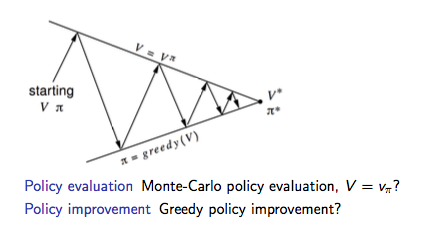
Model-Free 策略评估
在《Model-Free Predict》中我们分别介绍了两种 Model-Free 的策略评估方法:MC 和 TD。我们先讨论使用 MC 情况下的 Model-Free 策略评估。
如上图GPI框架所示:
- 基于 \(V(s)\) 的贪婪策略提升需要 MDP 已知:
\[\pi'(s) = \arg\max_{a\in A}\Bigl(R_{s}^{a}+P_{ss'}^{a}V(s')\Bigr)\] - 基于 \(Q(s, a)\) 的贪婪策略提升不需要 MDP 已知,即 Model-Free:
\[\pi'(s) = \arg\max_{a\in A}Q(s, a)\]
因此 Model-Free 下需要对 \(Q(s, a)\) 策略评估,整个GPI策略迭代也要基于 \(Q(s, a)\)。
Model-Free 策略提升
确定了策略评估的对象,那接下来要考虑的就是如何基于策略评估的结果 \(Q(s, a)\) 进行策略提升。
由于 Model-Free 的策略评估基于对经验的 samples(即评估的 \(q(s, a)\) 存在 bias),因此我们在这里不采用纯粹的 greedy 策略,防止因为策略评估的偏差导致整个策略迭代进入局部最优,而是采用具有 explore 功能的 \(\epsilon\)-greedy 算法:
\[
\pi(a|s) =
\begin{cases}
&\frac{\epsilon}{m} + 1 - \epsilon, &\text{if } a^*=\arg\max_{a\in A}Q(s, a)\\
&\frac{\epsilon}{m}, &\text{otherwise}
\end{cases}
\]
因此,我们确定了 Model-Free 下的 Monto-Carlo Control:
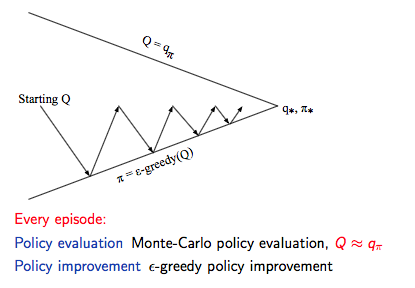
GLIE
先直接贴下David的课件,GLIE 介绍如下:
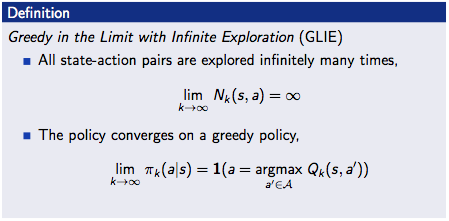
对于 \(\epsilon\)-greedy 算法而言,如果 \(\epsilon\) 随着迭代次数逐步减为0,那么 \(\epsilon\)-greedy 是 GLIE,即:
\[\epsilon_{k} = \frac{1}{k}\]
GLIE Monto-Carlo Control
GLIE Monto-Carlo Control:
- 对于 episode 中的每个状态 \(S_{t}\) 和动作 \(A_t\):
\[
N(S_t, A_t) ← N(S_t, A_t) + 1 \\
Q(S_t, A_t) ← Q(S_t, A_t) + \frac{1}{N(S_t, A_t)}(G_t - Q(S_t, A_t))
\] - 基于新的动作价值函数提升策略:
\[
\epsilon ← \frac{1}{k}\\
\pi ← \epsilon\text{-greedy}(Q)
\]
定理:GLIE Monto-Carlo Control 收敛到最优的动作价值函数,即:\(Q(s, a) → q_*(s, a)\)。
On-Policy Temporal-Difference Learning
Sarsa
我们之前总结过 TD 相对 MC 的优势:
- 低方差
- Online
- 非完整序列
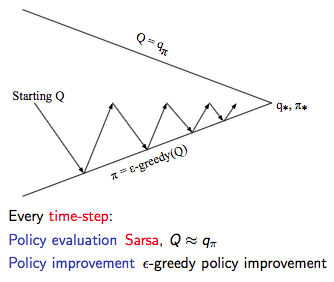
那么一个很自然的想法就是在整个控制闭环中用 TD 代替 MC:
- 使用 TD 来计算 \(Q(S, A)\)
- 仍然使用 \(\epsilon\)-greedy 策略提升
- 每一个 step 进行更新
通过上述改变就使得 On-Policy 的蒙特卡洛方法变成了著名的 Sarsa。
- 更新动作价值函数
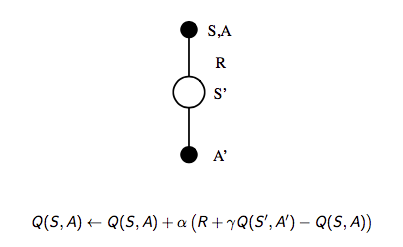
- Control
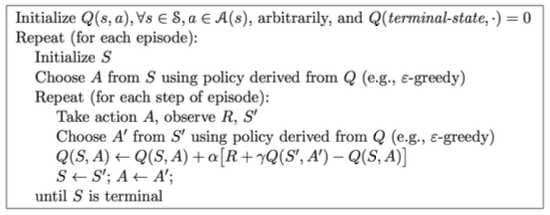
Sarsa算法的伪代码如下:
Sarsa(λ)
n-step Sarsa returns 可以表示如下:
\(n=1\) 时:\(q_{t}^{(1)} = R_{t+1} + \gamma Q(S_{t+1})\)
\(n=2\) 时:\(q_{t}^{(2)} = R_{t+1} + \gamma R_{t+2} + \gamma^2 Q(S_{t+2})\)
...
\(n=\infty\) 时:\(q_{t}^{\infty} = R_{t+1} + \gamma R_{t+2} + ... + \gamma^{T-1} R_T\)
因此,n-step return \(q_{t}^{(n)} = R_{t+1} + \gamma R_{t+2} + ... + \gamma^{n}Q(S_{t+n})\)
n-step Sarsa 更新公式:
\[Q(S_t, A_t) ← Q(S_t, A_t) + \alpha (q_t^{(n)} - Q(S_t, A_t))\]
具体的 Sarsa(λ) 算法伪代码如下:
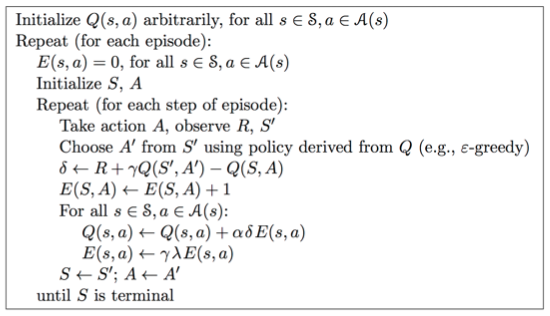
其中 \(E(s, a)\) 为资格迹。
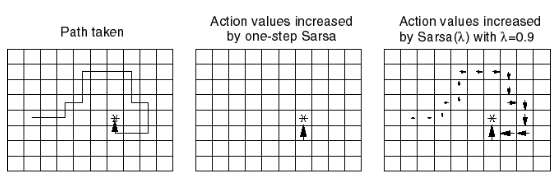
下图为 Sarsa(λ) 用于 Gridworld 例子的示意图:
Off-Policy Learning
Off-Policy Learning 的特点是评估目标策略 \(\pi(a|s)\) 来计算 \(v_{\pi}(s)\) 或者 \(q_{\pi}(s, a)\),但是跟随行为策略 \(\{S_1, A_1, R_2, ..., S_T\}\sim\mu(a|s)\)。
Off-Policy Learning 有什么意义?
- Learn from observing humans or other agents
- Re-use experience generated from old policies \(\pi_1, \pi_2, ..., \pi_{t-1}\)
- Learn about optimal policy while following exploratory policy
- Learn about multiple policies while following one policy
重要性采样
重要性采样的目的是:Estimate the expectation of a different distribution。
\[
\begin{align}
E_{X\sim P}[f(X)]
&= \sum P(X)f(X)\\
&= \sum Q(X)\frac{P(X)}{Q(X)}f(X)\\
&= E_{X\sim Q}[\frac{P(X)}{Q(X)}f(X)]
\end{align}
\]
Off-Policy MC 重要性采样
使用策略 \(\pi\) 产生的 return 来评估 \(\mu\):
\[G_t^{\pi/\mu} = \frac{\pi(A_t|S_t)}{\mu(A_t|S_t)} \frac{\pi(A_{t+1}|S_{t+1})}{\mu(A_{t+1}|S_{t+1})}...\frac{\pi(A_T|S_T)}{\mu(A_T|S_T)}G_t\]
朝着正确的 return 方向去更新价值:
\[V(S_t) ← V(S_t) + \alpha\Bigl(\color{Red}{G_t^{\pi/\mu}}-V(S_t)\Bigr)\]
需要注意两点:
- Cannot use if \(\mu\) is zero when \(\pi\) is non-zero
- 重要性采样会显著性地提升方差
Off-Policy TD 重要性采样
TD 是单步的,所以使用策略 \(\pi\) 产生的 TD targets 来评估 \(\mu\):
\[V(S_t) ← V(S_t) + \alpha\Bigl(\frac{\pi(A_t|S_t)}{\mu(A_t|S_t)}(R_{t+1}+\gamma V(S_{t+1}))-V(S_t)\Bigr)\]
- 方差比MC版本的重要性采样低很多
Q-Learning
前面分别介绍了对价值函数 \(V(s)\) 进行 off-policy 学习,现在我们讨论如何对动作价值函数 \(Q(s, a)\) 进行 off-policy 学习:
- 不需要重要性采样
- 使用行为策略选出下一步的动作:\(A_{t+1}\sim\mu(·|S_t)\)
- 但是仍需要考虑另一个后继动作:\(A'\sim\pi(·|S_t)\)
- 朝着另一个后继动作的价值更新 \(Q(S_t, A_t)\):
\[Q(S_t, A_t) ← Q(S_t, A_t) + \alpha\Bigl(R_{t+1}+\gamma Q(S_{t+1}, A')-Q(S_t, A_t)\Bigr)\]
讨论完对动作价值函数的学习,我们接着看如何通过 Q-Learning 进行 Control:
- 行为策略和目标策略均改进
- 目标策略 \(\pi\) 以greedy方式改进:
\[\pi(S_t) = \arg\max_{a'}Q(S_{t+1}, a')\] - 行为策略 \(\mu\) 以 \(\epsilon\)-greedy 方式改进
- Q-Learning target:
\[
\begin{align}
&R_{t+1}+\gamma Q(S_{t+1}, A')\\
=&R_{t+1}+\gamma Q\Bigl(S_{t+1}, \arg\max_{a'}Q(S_{t+1}, a')\Bigr)\\
=&R_{t+1}+\max_{a'}\gamma Q(S_{t+1}, a')
\end{align}
\]
Q-Learning 的 backup tree 如下所示:
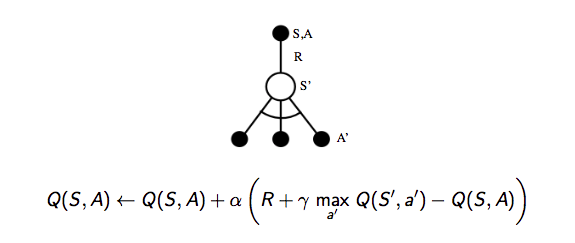
关于 Q-Learning 的结论:
Q-learning control converges to the optimal action-value function, \(Q(s, a)→q_*(s, a)\)
Q-Learning 算法具体的伪代码如下:
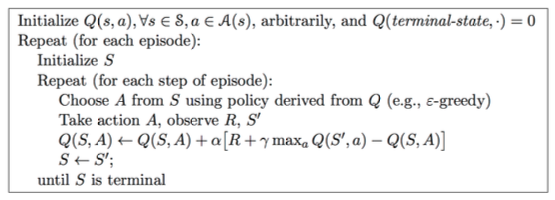
对比 Sarsa 与 Q-Learning 可以发现两个最重要的区别:
- TD target 公式不同
- Q-Learning 中下一步的动作从行为策略中选出,而不是目标策略
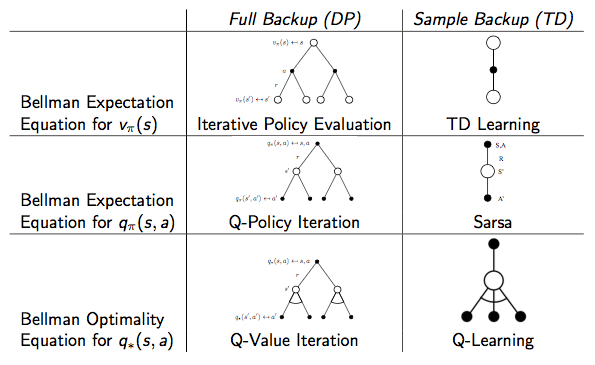
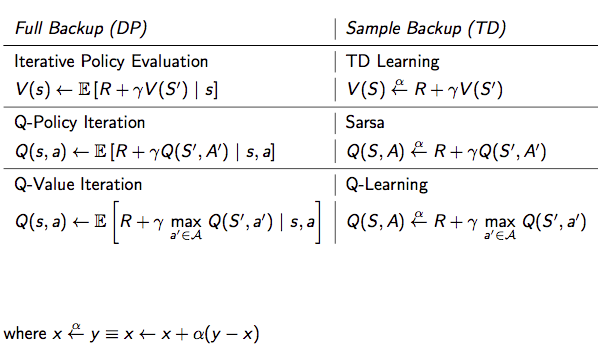
DP vs. TD
两者的区别见下表:
Reference
[1] Reinforcement Learning: An Introduction, Richard S. Sutton and Andrew G. Barto, 2018
[2] David Silver's Homepage
[Reinforcement Learning] Model-Free Control的更多相关文章
- DRL前沿之:Benchmarking Deep Reinforcement Learning for Continuous Control
1 前言 Deep Reinforcement Learning可以说是当前深度学习领域最前沿的研究方向,研究的目标即让机器人具备决策及运动控制能力.话说人类创造的机器灵活性还远远低于某些低等生物,比 ...
- A neural reinforcement learning model for tasks with unknown time delays
郑重声明:原文参见标题,如有侵权,请联系作者,将会撤销发布! Abstract 我们提出了一个基于生物学的神经模型,能够在复杂的任务中执行强化学习.该模型的独特之处在于,它能够在一个动作.状态转换和奖 ...
- (zhuan) Deep Reinforcement Learning Papers
Deep Reinforcement Learning Papers A list of recent papers regarding deep reinforcement learning. Th ...
- 论文笔记之:Human-level control through deep reinforcement learning
Human-level control through deep reinforcement learning Nature 2015 Google DeepMind Abstract RL 理论 在 ...
- 增强学习(Reinforcement Learning and Control)
增强学习(Reinforcement Learning and Control) [pdf版本]增强学习.pdf 在之前的讨论中,我们总是给定一个样本x,然后给或者不给label y.之后对样本进行 ...
- 深度学习国外课程资料(Deep Learning for Self-Driving Cars)+(Deep Reinforcement Learning and Control )
MIT(Deep Learning for Self-Driving Cars) CMU(Deep Reinforcement Learning and Control ) 参考网址: 1 Deep ...
- Reinforcement Learning for Self Organization and Power Control of Two-Tier Heterogeneous Networks
R. Amiri, M. A. Almasi, J. G. Andrews and H. Mehrpouyan, "Reinforcement Learning for Self Organ ...
- 深度强化学习介绍 【PPT】 Human-level control through deep reinforcement learning (DQN)
这个是平时在实验室讲reinforcement learning 的时候用到PPT, 交期末作业.汇报都是一直用的这个,觉得比较不错,保存一下,也为分享,最早该PPT源于师弟汇报所做.
- (转) Deep Reinforcement Learning: Playing a Racing Game
Byte Tank Posts Archive Deep Reinforcement Learning: Playing a Racing Game OCT 6TH, 2016 Agent playi ...
随机推荐
- C学习笔记(自增)
自增 (1)后缀:与Turbo C相同,在语句结束之前或者说分号之前才会执行自增. (2)前缀: 前两个自增统一取值,后面的自增即为取值. int i=2,j; j=++i+(++i)+(++i); ...
- AngularJS学习之旅—AngularJS 模块(十五)
一.AngularJS 模块 模块定义了一个应用程序. 模块是应用程序中不同部分的容器. 模块是应用控制器的容器. 控制器通常属于一个模块. 1.创建模块 通过 AngularJS 的 angular ...
- 西湖论剑2019复现-Web之首家线上赌场上线啦
首页打开 经过测试发现name和code参数可控,但尝试注入没有发现注入点,于是直接扫描目录找思路 一扫描,果然有问题 目录扫描里面可以看到有一个/.DS_Store的文件,DS_Store是Mac ...
- Flink应用案例:How Trackunit leverages Flink to process real-time data from industrial IoT devices
January 22, 2019Use Cases, Apache Flink Lasse Nedergaard Recently there has been significant dis ...
- springboot 2.1.4 源码默认logback-spring.xml
logback-spring.xml 是由几个文件组成的,整个的一个xml为 <?xml version="1.0" encoding="UTF-8"?& ...
- Pandas 数据清洗常用篇
一.缺失值 sklearn中的preprocessing下有imputer,可进官方文档参考.这里主讲pandas. 拿到数据,一般先检查是否有缺失值,用isnul()或notnull(). 再决定d ...
- 基于nodejs的流水线式的CRUD服务。依赖注入可以支持插件。
写代码好多年了,发现大家的思路都是写代码.写代码.写代码,还弄了个称号——码农. 我是挺无语的,我的思路是——不写代码.不写代码.不写代码! 无聊的代码为啥要重复写呢?甚至一写写好几年. 举个例子吧, ...
- jeecg入门操作—表单界面
一.搭建jeecg开发环境 参考环境搭建步骤 https://www.cnblogs.com/dyh004/p/10687633.html 二.创建用户数据库表: 登录上jeecg平台,点击在线开发- ...
- Make a Person 闭包
用下面给定的方法构造一个对象. 方法有 getFirstName(), getLastName(), getFullName(), setFirstName(first), setLastName(l ...
- 在IIS上搭建Exceptionless日志收集框架
系统环境要求 .NET 4.6.1,如果已安装过VS请忽略.Java Sdk1.8+,Win10环境下配置Java 环境变量参考,ElasticSearch 5.1,它是一个基于Lunce搜索服务器. ...