
[C2] 逻辑回归(Logistic Regression)
逻辑回归(Logistic Regression)
假设函数(Hypothesis Function)
\(h_\theta(x)=g(\theta^Tx)=g(z)=\frac{1}{1+e^{-z}}=\frac{1}{1+e^{\theta^Tx}}\)
g函数称为 Sigmoid Function 或 Logistic Function, 它可以使得 \(0 \leq h_\theta (x) \leq 1\).
The following image shows us what the sigmoid function looks like:

\(h_\theta(x)\) 用来估计基于输入特征值x,y=1的可能性。 正式的写法为:
\(h_\theta(x)=P(y=1|x;\theta)=1-P(y=0|x;\theta)\)
因为
\(z=0,e^0=1 \implies g(z) = \frac{1}{2}\)
\(z \to \infty,e^{-\infty} \to 0 \implies g(z) = 1\)
\(z \to - \infty,e^{\infty} \to \infty \implies g(z) = 0\)
所以
当 \(h_\theta(x) \geq 0.5\) 或 \(z \geq 0\) 时,y=1
当 \(h_\theta(x) < 0.5\) 或 \(z < 0\) 时,y=0
另外
The input to the sigmoid function g(z) (e.g. \(\theta^T X\)) doesn't need to be linear, and could be a function that describes a circle (e.g. \(z = \theta_0 + \theta_1 x_1^2 +\theta_2 x_2^2\)) or any shape to fit our data.
代价函数(Cost Function)
We cannot use the same cost function that we use for linear regression because the Logistic Function will cause the output to be wavy, causing many local optima. In other words, it will not be a convex function.
Instead, our cost function for logistic regression looks like:
\(J(\theta)=\frac{1}{m} \sum\limits_{i=1}^m Cost(h_\theta(x^{(i)}),y^{(i)})\)
\(\begin{cases} Cost(h_\theta(x),y)=-log(h_\theta(x)) & \quad \text{if y = 1} \\ \\ Cost(h_\theta(x),y)=-log(1-h_\theta(x)) & \quad \text{if y = 0} \end{cases}\)
When y = 1, we get the following plot for \(J(\theta)\) vs \(h_\theta (x)\):

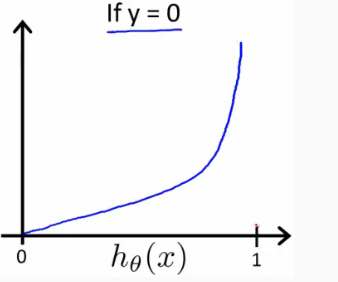
Similarly, when y = 0, we get the following plot for J(θ) vs hθ(x):
If our correct answer 'y' is 1, then the cost function will be 0 if our hypothesis function outputs 1. If our hypothesis approaches 0, then the cost function will approach infinity.
当 \(y=1\) 时,若 \(h_\theta(x)=1\) ,则 \(Cost=0\) ,若 \(h_\theta(x)=0\) ,则 \(Cost \to \infty\);
If our correct answer 'y' is 0, then the cost function will be 0 if our hypothesis function also outputs 0. If our hypothesis approaches 1, then the cost function will approach infinity.
当 \(y=0\) 时,若 \(h_\theta(x)=0\) ,则 \(Cost=0\) ,若 \(h_\theta(x)=1\) ,则 \(Cost \to \infty\)。
Note that writing the cost function in this way guarantees that J(θ) is convex for logistic regression.
这种代价函数的表示方法可以确保逻辑回归的 \(J(\theta)\) 是凸函数,所以可以使用梯度下降求解 \(\theta\)
将 \(Cost \Big(h_\theta(x),y \Big)\) 简化可得(We can compress our cost function's two conditional cases into one case):
\(Cost \Big(h_\theta(x),y \Big)=-y \cdot log \Big(h_\theta(x) \Big) - (1-y) \cdot log \Big(1-h_\theta(x) \Big)\)
最终的代价函数为(We can fully write out our entire cost function as follows):
\(J(\theta)=-\frac{1}{m} \sum\limits_{i=1}^m \Bigg[ y^{(i)} \cdot log \bigg(h_\theta(x^{(i)}) \bigg) + (1-y^{(i)}) \cdot log \bigg(1-h_\theta(x^{(i)}) \bigg) \Bigg]\)
向量化表示为(A vectorized implementation is):
\(\overrightarrow{h}=g(X \overrightarrow{\theta})\)
\(J(\theta)=\frac{1}{m} \cdot \Big( -\overrightarrow{y}^T \cdot log(\overrightarrow{h}) - (1- \overrightarrow{y})^T \cdot log(1- \overrightarrow{h}) \Big)\)
梯度下降(Gradient Descent)
重复,直到收敛(Repeat until convergence):
\(\theta_j := \theta_j - \alpha\frac{\partial}{\partial\theta_j}J(\theta_0,\theta_1,···\theta_n)\), 其中 \(\frac{\partial}{\partial\theta_j}J(\theta_0,\theta_1,···\theta_n)\) 计算方法为对 \(\theta_j\) 求偏导数(partial derivative)
即(We can work out the derivative part using calculus to get):
\(\theta_j := \theta_j - \alpha\frac{1}{m}\sum\limits_{i = 1}^{m}\biggl(h_\theta(x^{(i)}) - y^{(i)}\biggl)\cdot x_j^{(i)}\)
同时更新(simultaneously update)\(\theta_j\), for j = 0, 1 ..., n
另外, \(x_0^{(i)} \equiv 1\)
向量化表示为(A vectorized implementation is):
\(\theta := \theta - \frac{\alpha}{m} X^T \Big( g(X\theta) - \overrightarrow{y} \Big)\)
Advanced Optimization for Gradient Descent
除了梯度下降法外,还有其他方法计算 \(\overrightarrow{\theta}\) :
- 共轭梯度法(Conjugate gradient)
- 变长度法(BFGS)
- 限制尺度法(L-BFGS)
优点是,无需手动选择学习速率 \(\alpha\) , 以及收敛速度更快。缺点是更加的复杂。
Octave 中已经有提供该方法(fminunc),要调用 fminunc 方法来计算 \(\overrightarrow{\theta}\),需先计算 \(J(\theta)\) 和 \(\frac{\alpha}{\alpha \theta_j}J(\theta)\)
可以写一个简单的函数返回这两个值
function [jVal, gradient] = costFunction(theta)

  jVal = [...code to compute J(theta)...];

  gradient = [...code to compute derivative of J(theta)...];

end
然后使用Octave的“fminunc()”优化算法以及“optimset()”函数来创建一个包含要发送到“fminunc()”的“options“对象。
options = optimset('GradObj', 'on', 'MaxIter', 100);

initialTheta = zeros(2,1); % our initial vector of theta values

[optTheta, functionVal, exitFlag] = fminunc(@costFunction, initialTheta, options);
多元分类(Multiclass Classification: One-vs-all)
对于多元分类的情况,即 y = {0,1...n},我们可以把问题分解为 n+1 个二元分类的问题。 +1 是因为索引是从0开始的。
$y \in $ {0,1...n}
\(h_\theta^{(0)}(x)=P(y=0|x;\theta)\)
\(h_\theta^{(1)}(x)=P(y=1|x;\theta)\)
\(...\)
\(h_\theta^{(n)}(x)=P(y=n|x;\theta)\)
\(prediction=\max\limits_i(h_\theta^{(i)}(x))\)
我们基本上是选择一个类,然后把所有其他类都放到第二类中。重复这样做,对每种情况应用二元逻辑回归,然后使用返回最大值的假设作为我们的预测。
The following image shows how one could classify 3 classes:

To summarize:
Train a logistic regression classifier \(h_\theta(x)\) for each class to predict the probability that  y = i .
To make a prediction on a new x, pick the class that maximizes \(h_\theta (x)\)
程序代码
直接查看Logistic Regression.ipynb可点击
获取源码以其他文件,可点击右上角 Fork me on GitHub 自行 Clone。
[C2] 逻辑回归(Logistic Regression)的更多相关文章
- 机器学习总结之逻辑回归Logistic Regression
机器学习总结之逻辑回归Logistic Regression 逻辑回归logistic regression,虽然名字是回归,但是实际上它是处理分类问题的算法.简单的说回归问题和分类问题如下: 回归问 ...
- 机器学习(四)--------逻辑回归(Logistic Regression)
逻辑回归(Logistic Regression) 线性回归用来预测,逻辑回归用来分类. 线性回归是拟合函数,逻辑回归是预测函数 逻辑回归就是分类. 分类问题用线性方程是不行的 线性方程拟合的是连 ...
- 机器学习入门11 - 逻辑回归 (Logistic Regression)
原文链接:https://developers.google.com/machine-learning/crash-course/logistic-regression/ 逻辑回归会生成一个介于 0 ...
- Coursera公开课笔记: 斯坦福大学机器学习第六课“逻辑回归(Logistic Regression)” 清晰讲解logistic-good!!!!!!
原文:http://52opencourse.com/125/coursera%E5%85%AC%E5%BC%80%E8%AF%BE%E7%AC%94%E8%AE%B0-%E6%96%AF%E5%9D ...
- 机器学习方法(五):逻辑回归Logistic Regression,Softmax Regression
欢迎转载,转载请注明:本文出自Bin的专栏blog.csdn.net/xbinworld. 技术交流QQ群:433250724,欢迎对算法.技术.应用感兴趣的同学加入. 前面介绍过线性回归的基本知识, ...
- 机器学习 (三) 逻辑回归 Logistic Regression
文章内容均来自斯坦福大学的Andrew Ng教授讲解的Machine Learning课程,本文是针对该课程的个人学习笔记,如有疏漏,请以原课程所讲述内容为准.感谢博主Rachel Zhang 的个人 ...
- ML 逻辑回归 Logistic Regression
逻辑回归 Logistic Regression 1 分类 Classification 首先我们来看看使用线性回归来解决分类会出现的问题.下图中,我们加入了一个训练集,产生的新的假设函数使得我们进行 ...
- 逻辑回归(Logistic Regression)详解,公式推导及代码实现
逻辑回归(Logistic Regression) 什么是逻辑回归: 逻辑回归(Logistic Regression)是一种基于概率的模式识别算法,虽然名字中带"回归",但实际上 ...
- 逻辑回归 Logistic Regression
逻辑回归(Logistic Regression)是广义线性回归的一种.逻辑回归是用来做分类任务的常用算法.分类任务的目标是找一个函数,把观测值匹配到相关的类和标签上.比如一个人有没有病,又因为噪声的 ...
随机推荐
- linux的路由功能实现
参考URL: https://blog.csdn.net/chengqiuming/article/details/80140768 一,启用Linux的路由转发功能. 二,新建veth pair 三 ...
- windows下redis作为系统服务如何重启
第一种方法: 键入win+R打开运行对话框,键入Services.msc打开windows服务窗口,找到redis服务,先停止该服务,然后再启动 第二种方法: 键入win+R打开运行对话框,键入cmd ...
- WPF 动态列(DataGridTemplateColumn) 绑定数据 (自定义控件)
原文:WPF 动态列(DataGridTemplateColumn) 绑定数据 (自定义控件) 因为项目需要 要实现这个~ 怎么实现画红框内容部分 田字格和上面Textbox 属于一个自定义控件 大 ...
- Java类加载机制以及双亲委派模型
一.Java类加载机制 1.概述 Class文件由类装载器装载后,在JVM中将形成一份描述Class结构的元信息对象,通过该元信息对象可以获知Class的结构信息:如构造函数,属性和方法等,Java允 ...
- 发布Jar包到中央仓库
参考流程 https://blog.csdn.net/qq_36838191/article/details/81027586 备份还原 gpg-keys https://blog.rathena.c ...
- 【C#】C#获取本地的内网(局域网)和外网(公网)IP地址的方法
1.获取本机的IP地址集合: /// <summary> /// 获取本机所有ip地址 /// </summary> /// <param name="netT ...
- C# windows服务,解决应用程序开机自启问题
最近在东营做一个超市购物的项目,业务体量很小,是仅供内部员工使用的内网应用程序,其中涉及一个商品数据同步的winform应用程序,有一个问题就是服务器重启后,必须登录服务器操作系统,手动启动才行,于是 ...
- java高并发系列 - 第4天:JMM相关的一些概念
JMM(java内存模型),由于并发程序要比串行程序复杂很多,其中一个重要原因是并发程序中数据访问一致性和安全性将会受到严重挑战.如何保证一个线程可以看到正确的数据呢?这个问题看起来很白痴.对于串行程 ...
- 死磕 java同步系列之ReentrantReadWriteLock源码解析
问题 (1)读写锁是什么? (2)读写锁具有哪些特性? (3)ReentrantReadWriteLock是怎么实现读写锁的? (4)如何使用ReentrantReadWriteLock实现高效安全的 ...
- MySQL(8)---游标
Mysql(8)-游标 上一遍博客写了有关存储过程的语法知识 Mysql(7)---存储过程 游标或许你在工作中很少用到,但用不到不代表不去了解它,但你真正需要它来解决问题的时候,再花时间去学习很可能 ...