
Django之DRF源码分析(二)---数据校验部分
Django之DRF源码分析(二)---数据校验部分
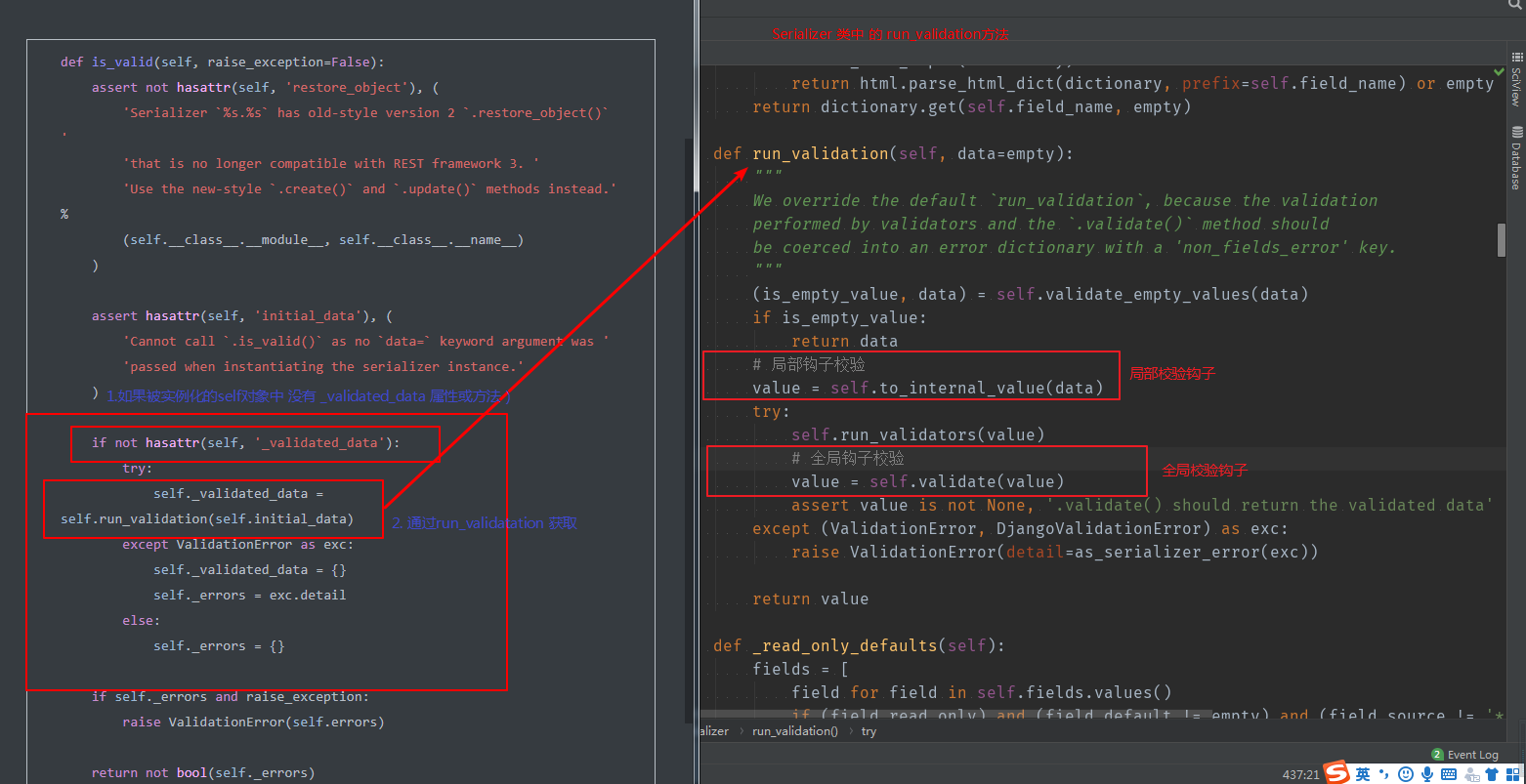
is_valid() 源码
def is_valid(self, raise_exception=False):

    assert not hasattr(self, 'restore_object'), (

        'Serializer `%s.%s` has old-style version 2 `.restore_object()` '

        'that is no longer compatible with REST framework 3. '

        'Use the new-style `.create()` and `.update()` methods instead.' %

        (self.__class__.__module__, self.__class__.__name__)

    )

    assert hasattr(self, 'initial_data'), (

        'Cannot call `.is_valid()` as no `data=` keyword argument was '

        'passed when instantiating the serializer instance.'

    )

    if not hasattr(self, '_validated_data'):

        try:

            self._validated_data = self.run_validation(self.initial_data)

        except ValidationError as exc:

            self._validated_data = {}

            self._errors = exc.detail

        else:

            self._errors = {}

    if self._errors and raise_exception:

        raise ValidationError(self.errors)

    return not bool(self._errors)
serializers.py
    def run_validation(self, data=empty):

        """

        We override the default `run_validation`, because the validation

        performed by validators and the `.validate()` method should

        be coerced into an error dictionary with a 'non_fields_error' key.

        我们覆盖默认的“run_validation”,因为验证器和“.validate()”方法执行的验证应该强制到一个带有“non_fields_error”键的错误字典中。

        """

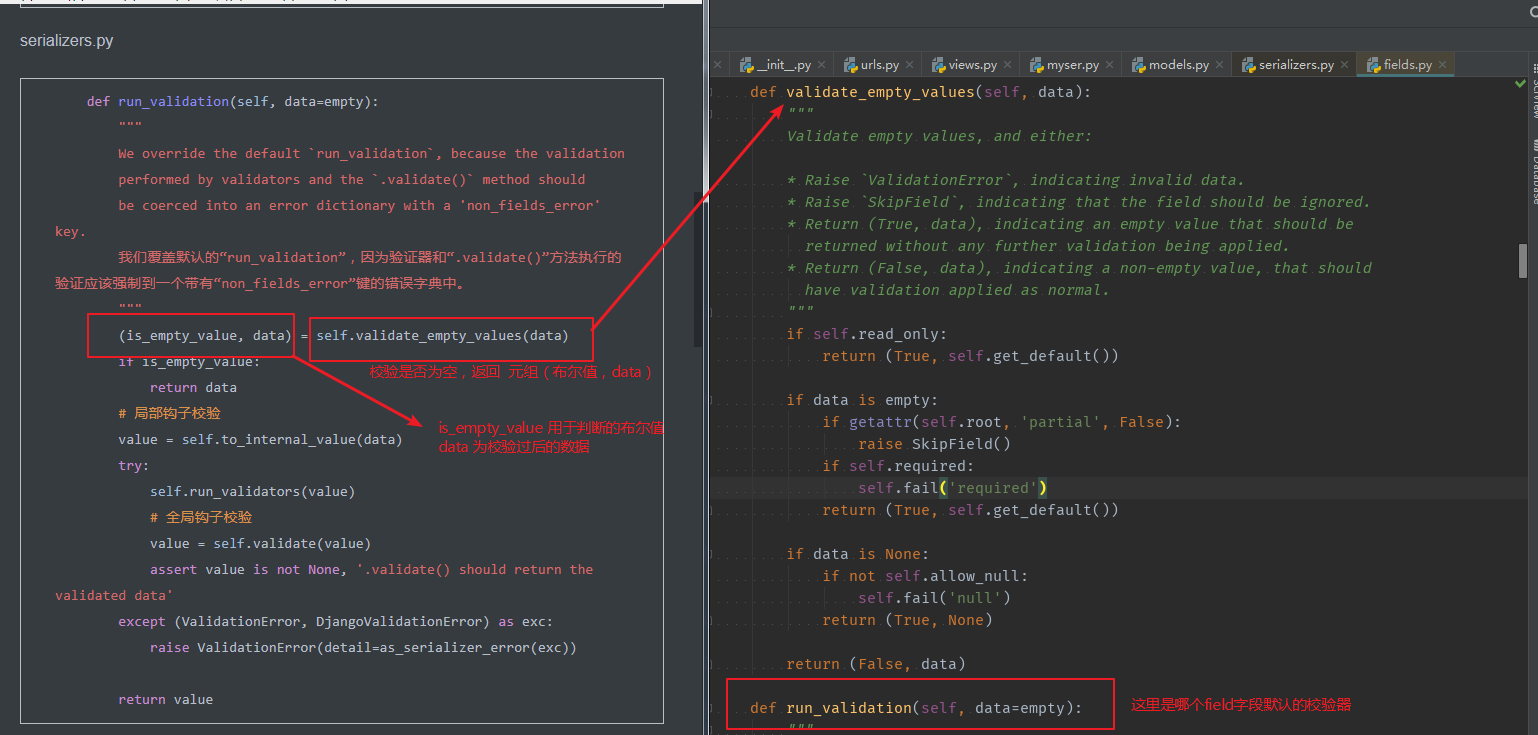
        (is_empty_value, data) = self.validate_empty_values(data)

        if is_empty_value:

            return data

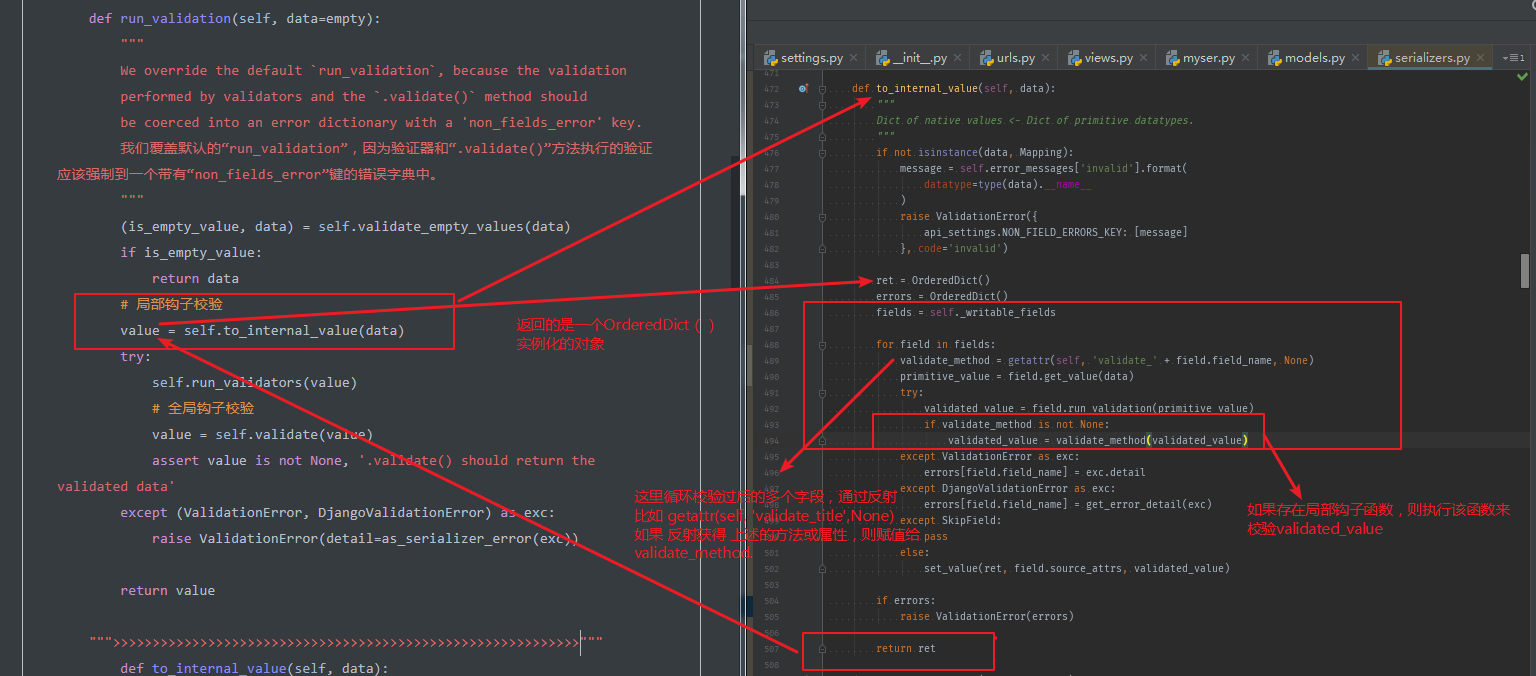
        # 局部钩子校验

        value = self.to_internal_value(data)

        try:

            self.run_validators(value)

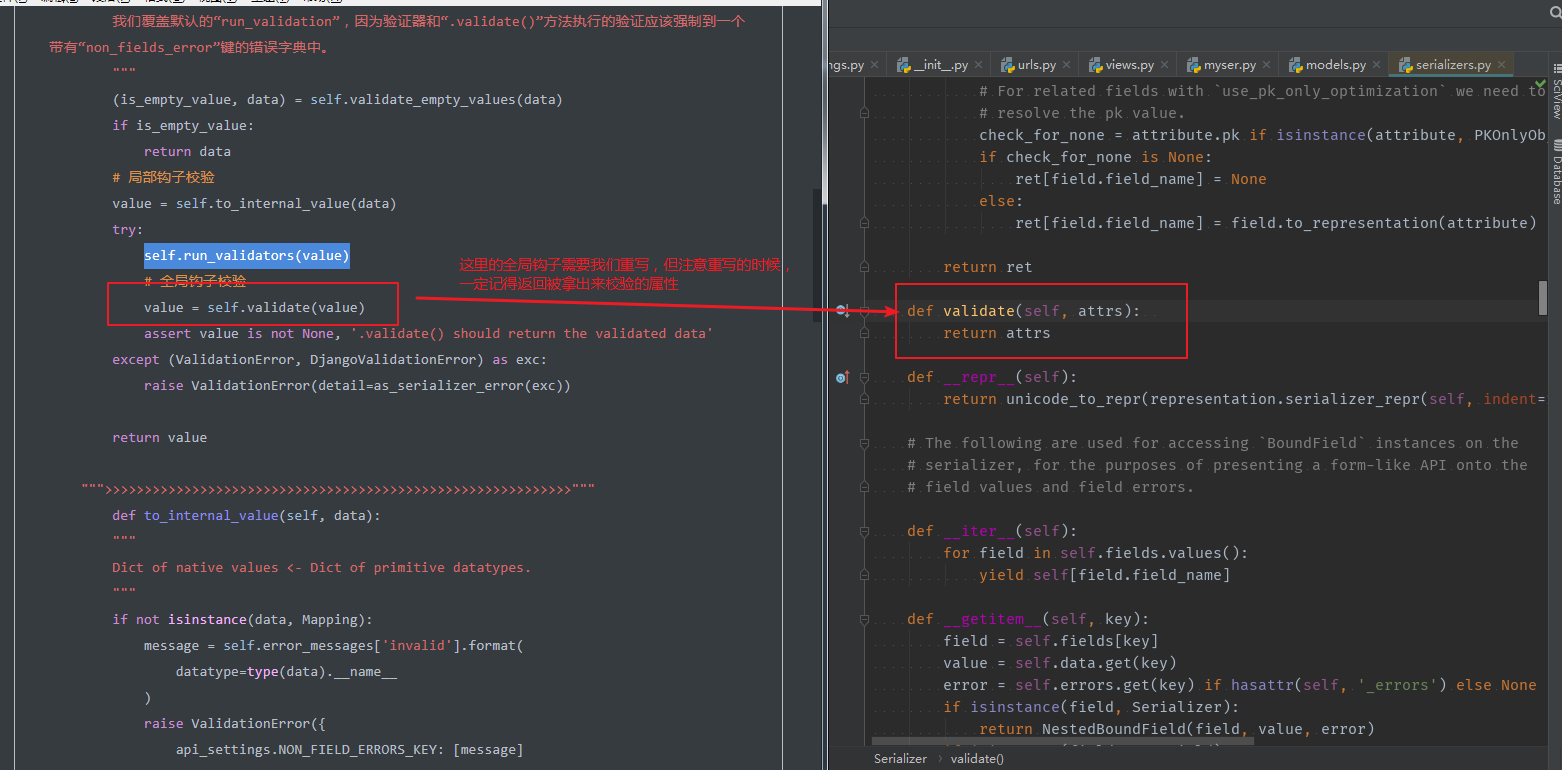
            # 全局钩子校验

            value = self.validate(value)

            assert value is not None, '.validate() should return the validated data'

        except (ValidationError, DjangoValidationError) as exc:

            raise ValidationError(detail=as_serializer_error(exc))

        return value

    """>>>>>>>>>>>>>>>>>>>>>>>>>>>>>>>>>>>>>>>>>>>>>>>>>>>>>>>>>>>"""

        def to_internal_value(self, data):

        """

        Dict of native values <- Dict of primitive datatypes.

        """

        if not isinstance(data, Mapping):

            message = self.error_messages['invalid'].format(

                datatype=type(data).__name__

            )

            raise ValidationError({

                api_settings.NON_FIELD_ERRORS_KEY: [message]

            }, code='invalid')

        ret = OrderedDict()

        errors = OrderedDict()

        fields = self._writable_fields

        for field in fields:

            validate_method = getattr(self, 'validate_' + field.field_name, None)

            primitive_value = field.get_value(data)

            try:

                validated_value = field.run_validation(primitive_value)

                if validate_method is not None:

                    validated_value = validate_method(validated_value)

            except ValidationError as exc:

                errors[field.field_name] = exc.detail

            except DjangoValidationError as exc:

                errors[field.field_name] = get_error_detail(exc)

            except SkipField:

                pass

            else:

                set_value(ret, field.source_attrs, validated_value)

        if errors:

            raise ValidationError(errors)

        return ret

    """>>>>>>>>>>>>>>>>>>>>>>>>>>>>>>>>>>>>>>>>>>>>>>>>>>>>>>>>>>>>>>>>>>>>>>>>>>>>>>"""

        def validate(self, attrs):

        return attrs
fileds.py
    def validate_empty_values(self, data):

        """

        Validate empty values, and either:

        * Raise `ValidationError`, indicating invalid data.

        * Raise `SkipField`, indicating that the field should be ignored.

        * Return (True, data), indicating an empty value that should be

          returned without any further validation being applied.

        * Return (False, data), indicating a non-empty value, that should

          have validation applied as normal.

        """

        if self.read_only:

            return (True, self.get_default())

        if data is empty:

            if getattr(self.root, 'partial', False):

                raise SkipField()

            if self.required:

                self.fail('required')

            return (True, self.get_default())

        if data is None:

            if not self.allow_null:

                self.fail('null')

            return (True, None)

        return (False, data)

    def run_validation(self, data=empty):

        """

        Validate a simple representation and return the internal value.

        The provided data may be `empty` if no representation was included

        in the input.

        May raise `SkipField` if the field should not be included in the

        validated data.

        """

        (is_empty_value, data) = self.validate_empty_values(data)

        if is_empty_value:

            return data

        value = self.to_internal_value(data)

        self.run_validators(value)

        return value

    def run_validators(self, value):

        """

        Test the given value against all the validators on the field,

        and either raise a `ValidationError` or simply return.

        """

        errors = []

        for validator in self.validators:

            if hasattr(validator, 'set_context'):

                validator.set_context(self)

            try:

                validator(value)

            except ValidationError as exc:

                # If the validation error contains a mapping of fields to

                # errors then simply raise it immediately rather than

                # attempting to accumulate a list of errors.

                if isinstance(exc.detail, dict):

                    raise

                errors.extend(exc.detail)

            except DjangoValidationError as exc:

                errors.extend(get_error_detail(exc))

        if errors:

            raise ValidationError(errors)

    def to_internal_value(self, data):

        """

        Transform the *incoming* primitive data into a native value.

        """

        raise NotImplementedError(

            '{cls}.to_internal_value() must be implemented.'.format(

                cls=self.__class__.__name__

            )

        )

    def to_representation(self, value):

        """

        Transform the *outgoing* native value into primitive data.

        """

        raise NotImplementedError(

            '{cls}.to_representation() must be implemented for field '

            '{field_name}. If you do not need to support write operations '

            'you probably want to subclass `ReadOnlyField` instead.'.format(

                cls=self.__class__.__name__,

                field_name=self.field_name,

            )

        )
Django之DRF源码分析(二)---数据校验部分的更多相关文章
- Django搭建及源码分析(二)
上节针对linux最小系统,如何安装Django,以及配置简单的Django环境进行了说明. 本节从由Django生成的manage.py开始,分析Django源码.python版本2.6,Djang ...
- Django之DRF源码分析(四)---频率认证组件
核心源码 def check_throttles(self, request): """ Check if request should be throttled. Ra ...
- Django与drf 源码视图解析
0902自我总结 Django 与drf 源码视图解析 一.原生Django CBV 源码分析:View """ 1)as_view()是入口,得到view函数地址 2) ...
- Django搭建及源码分析(三)---+uWSGI+nginx
每个框架或者应用都是为了解决某些问题才出现旦生的,没有一个事物是可以解决所有问题的.如果觉得某个框架或者应用使用很不方便,那么很有可能就是你没有将其使用到正确的地方,没有按开发者的设计初衷来使用它,当 ...
- Fresco 源码分析(二) Fresco客户端与服务端交互(1) 解决遗留的Q1问题
4.2 Fresco客户端与服务端的交互(一) 解决Q1问题 从这篇博客开始,我们开始讨论客户端与服务端是如何交互的,这个交互的入口,我们从Q1问题入手(博客按照这样的问题入手,是因为当时我也是从这里 ...
- HDFS源码分析之数据块及副本状态BlockUCState、ReplicaState
关于数据块.副本的介绍,请参考文章<HDFS源码分析之数据块Block.副本Replica>. 一.数据块状态BlockUCState 数据块状态用枚举类BlockUCState来表示,代 ...
- 十、Spring之BeanFactory源码分析(二)
Spring之BeanFactory源码分析(二) 前言 在前面我们简单的分析了BeanFactory的结构,ListableBeanFactory,HierarchicalBeanFactory,A ...
- Vue源码分析(二) : Vue实例挂载
Vue源码分析(二) : Vue实例挂载 author: @TiffanysBear 实例挂载主要是 $mount 方法的实现,在 src/platforms/web/entry-runtime-wi ...
- 框架-springmvc源码分析(二)
框架-springmvc源码分析(二) 参考: http://www.cnblogs.com/leftthen/p/5207787.html http://www.cnblogs.com/leftth ...
随机推荐
- 洛谷p1458顺序的分数题解
抱歉,您们的蒟蒻yxj不知道怎么插入链接qwq就只好粘个文本的了qwq:https://www.luogu.org/problemnew/show/P1458 没错,是个黄题,因为你们的小蒟蒻只会这样 ...
- ECMAScript6-2
1.模板字串.箭头函数 1.1.模板字串 传统js,输出模板 var str='<b>姓名:</b>'+ '<span>lxr</span>'; con ...
- JAVA程序执行顺序(静态代码块》非静态代码块》静态方法》构造函数)
总结:静态代码块总是最先执行. 非静态代码块跟非静态方法一样,跟对象有关.只不过非静态代码块在构造函数之前执行. 父类非静态代码块.构造函数执行完毕后(相当于父类对象初始化完成), 才开始执行子类的非 ...
- JS 常见问题
JavaScript 是一种有趣的语言,我们都喜欢它,因为它的性质.浏览器是JavaScript的主要运行的地方,两者在我们的服务中协同工作.JS有一些概念,人们往往会对它掉以轻心,有时可能会忽略不计 ...
- stop容器,把信号量传给java进程,优雅退出
Java中可以添加ShutdownHook监听关闭事件,包括kill -15, control+c,terminal等信号.kill -9则接收不到. Runtime.getRuntime().add ...
- Kafka Offset Monitor页面显示空白
下载包:https://github.com/Morningstar/kafka-offset-monitor.git 解决:jar包内\KafkaOffsetMonitor-assembly-0.2 ...
- LOJ3124 CTS2019 氪金手游 概率、容斥、树形DP
传送门 D2T3签到题可真是IQ Decrease,概率独立没想到然后就20pts滚粗了 注意题目是先对于所有点rand一个权值\(w\)然后再抽卡. 先考虑给出的关系是一棵外向树的情况.那么我们要求 ...
- 测试效率加倍提升!shell 高阶命令快来 get 下!
背景 目前大部分的项目都是部署在Linux系统上,作为测试,掌握常用Linux命令是必须的技能.很多的工作了好几年的测试人员可能还只会简单的ls.cd.cat等等这些命令,这些命令是可以应付工作的大部 ...
- WeakhashMap源码1
弱引用(WeakReference)的特性是:当gc线程发现某个对象只有弱引用指向它,那么就会将其销毁并回收内存.WeakReference也会被加入到引用队列queue中. 它的特殊之处在于 Wea ...
- sql优化(原理,方法,特点,实例)
整理的有点多,做好心理准备...... 1.资源优化理解: 不同设备,io不同.每种设备都有两个指标:延时(响应时间):表示硬件的突发处理能力:带宽(吞吐量):代表硬件持续处理能力. 每种硬件主要的工 ...