
使用scikit-learn解决文本多分类问题(附python演练)
来源 | TowardsDataScience
译者 | Revolver
在我们的商业世界中,存在着许多需要对文本进行分类的情况。例如,新闻报道通常按主题进行组织; 内容或产品通常需要按类别打上标签; 根据用户在线上谈论产品或品牌时的文字内容将用户分到不同的群组......
但是,互联网上的绝大多数文本分类文章和教程都是二文本分类,如垃圾邮件过滤(垃圾邮件与正常邮件),情感分析(正面与负面)。在大多数情况下,我们的现实世界问题要复杂得多。因此,这就是我们今天要做的事情:将消费者在金融方面的投诉分为12个事先定义好的类别。数据可以从data.gov
(https://catalog.data.gov/dataset/consumer-complaint-database)下载。
我们使用Python和Jupyter Notebook来开发我们的系统,并用到了Scikit-Learn中的机器学习组件。如果您想看到在PySpark
(https://medium.com/@actsusanli/multi-class-text-classification-with-pyspark-7d78d022ed35)上的实现,请阅读下一篇文章。
一、问题描述
我们的问题是是文本分类的有监督问题,我们的目标是调查哪种监督机器学习方法最适合解决它。
如果来了一条新的投诉,我们希望将其分配到12个类别中的一个。分类器假设每条新投诉都分配给一个且仅一个类别。这是文本多分类问题。是不是很迫不及待想看到我们可以做到什么程度呢!
二、数据探索
在深入研究机器学习模型之前,我们首先应该观察一下部分数据,看看每个类别下的投诉都是什么样儿?
import pandas as pd

df = pd.read_csv('Consumer_Complaints.csv')

df.head()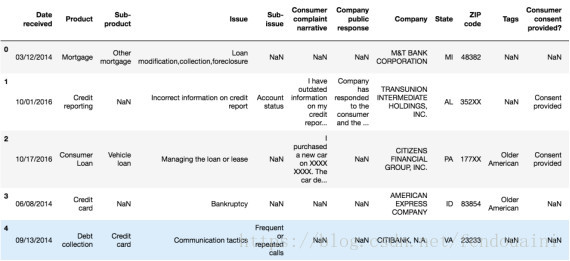
对于这个项目,我们其实只需要关注两列数据 - “Product”和“ Consumer complaint narrative ”(消费者投诉叙述)。
输入:Consumer_complaint_narrative
示例:“ I have outdated information on my credit report that I have previously disputed that has yet to be removed this information is more then seven years old and does not meet credit reporting requirements”
(“我的信用报告中存在过时信息,我之前已经提到过但还是没被删除, 此信息存在达七年之久,这并不符合信用报告要求”)
输出:Product
示例:Credit reporting (信用报告)
我们将移除“Consumer_complaint_narrative”这列中含缺失值的记录,并添加一列将Product编码为整数的列,因为分类标签通常更适合用整数表示而非字符串。
我们还创建了几个字典对象保存类标签和Product的映射关系,供将来使用。
清洗完毕后,以下是我们将要处理的前五行数据:
from io import StringIO

col = ['Product', 'Consumer complaint narrative']

df = df[col]

df = df[pd.notnull(df['Consumer complaint narrative'])]

df.columns = ['Product', 'Consumer_complaint_narrative']

df['category_id'] = df['Product'].factorize()[0]

category_id_df = df[['Product', 'category_id']].drop_duplicates().sort_values('category_id')

category_to_id = dict(category_id_df.values)

id_to_category = dict(category_id_df[['category_id', 'Product']].values)

df.head()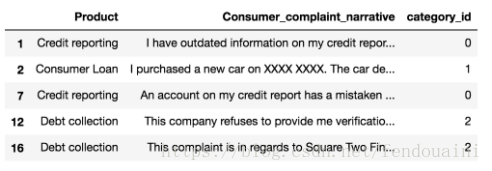
三、不平衡的类
我们发现每种产品收到的投诉记录的数量是不平衡的。消费者的投诉更倾向于Debt collection(债款收回),Credit reporting (信用报告),
Mortgage(抵押贷款。)
Import matplotlib.pyplot as plt

fig = plt.figure(figsize=(8,6))

df.groupby('Product').Consumer_complaint_narrative.count().plot.bar(ylim=0)

plt.show()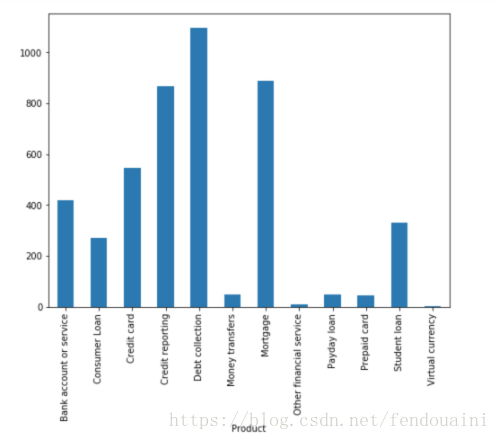
当我们遇到这样的问题时,如果用一般算法去解决问题就会遇到很多困难。传统算法通常不考虑数据分布,而倾向数量较大的类别。在最坏的情况下,少数群体会视为异常值被忽略。对于某些场景,例如欺诈检测或癌症预测,我们需要仔细配置我们的模型或人为地对数据集做再平衡处理,例如通过对每个类进行欠采样或过采样。
但是在我们今天这个例子里,数量多的类别正好可能是我们最感兴趣的部分。我们希望训练出这样一种分类器,该分类器在数量多的类别上提供高预测精度,同时又保持样本较少的类的合理准确性。因此,我们打算让数据集的比例保持原样,不做改变。
四、文本表示
分类器和学习算法没办法对文本的原始形式做直接处理,因为它们期望的输入是长度固定且为数值型的特征向量,而不是具有可变长度的原始文本。因此,在预处理阶段,文本需要被转换为更易于操作的表示形式。
从文本中提取特征的一种常用方法是使用词袋模型:对于每条文本样本,也即本案例中的Consumer_complaint_narrative,词袋模型会考虑单词的出现频率,但忽略它们出现的顺序。
具体来说,对于我们数据集中的每个单词,我们将计算它的词频和逆文档频率,简称tf-idf。我们将使用sklearn.feature_extraction.text.TfidfVectorizer 来计算每个消费者投诉叙述的向量的tf-idf向量:
(1) sublinear_df设置为True使用频率的对数形式。
(2) min_df 是一个单词必须存在的最小文档数量。
(3) norm设置为l2,以确保我们所有的特征向量是欧几里德范数为1的向量。
(4) ngram_range设置为(1, 2)表示我们要将文档的unigrams和bigrams两种形式的词条纳入我们的考虑。
(5) stop_words被设置为"english"删除所有诸如普通代词("a","the",...)的停用词,以减少噪音特征的数量。
from sklearn.feature_extraction.text import TfidfVectorizer

tfidf = TfidfVectorizer(sublinear_tf=True, min_df=5, norm='l2', encoding='latin-1', ngram_range=(1, 2), stop_words='english')

features = tfidf.fit_transform(df.Consumer_complaint_narrative).toarray()

labels = df.category_id

features.shape

(4569,12633)
现在,4569个消费者投诉叙述记录中的每一条都有12633个特征,代表不同的unigrams和bigrams的tf-idf分数。
我们可以用sklearn.feature_selection.chi2查找与每种类别(Product)最为相关的词条:
from sklearn.feature_selection import chi2

import numpy as np

N = 2

for Product, category_id in sorted(category_to_id.items()):

 features_chi2 = chi2(features, labels == category_id)

 indices = np.argsort(features_chi2[0])

 feature_names = np.array(tfidf.get_feature_names())[indices]

 unigrams = [v for v in feature_names if len(v.split(' ')) == 1]

 bigrams = [v for v in feature_names if len(v.split(' ')) == 2]

 print("# '{}':".format(Product))

 print("  . Most correlated unigrams:\n. {}".format('\n. '.join(unigrams[-N:])))

 print("  . Most correlated bigrams:\n. {}".format('\n. '.join(bigrams[-N:])))

# ‘Bank account or service’:

. Most correlated unigrams:

. bank

. overdraft

. Most correlated bigrams:

. overdraft fees

. checking account

# ‘Consumer Loan’:

. Most correlated unigrams:

. car

. vehicle

. Most correlated bigrams:

. vehicle xxxx

. toyota financial

# ‘Credit card’:

. Most correlated unigrams:

. citi

. card

. Most correlated bigrams:

. annual fee

. credit card

# ‘Credit reporting’:

. Most correlated unigrams:

. experian

. equifax

. Most correlated bigrams:

. trans union

. credit report

# ‘Debt collection’:

. Most correlated unigrams:

. collection

. debt

. Most correlated bigrams:

. collect debt

. collection agency

# ‘Money transfers’:

. Most correlated unigrams:

. wu

. paypal

. Most correlated bigrams:

. western union

. money transfer

# ‘Mortgage’:

. Most correlated unigrams:

. modification

. mortgage

. Most correlated bigrams:

. mortgage company

. loan modification
上面列出来的词条跟类别的匹配,看上去是不是好像有点道理?
五、多类标分类器:特征与设计
1. 为了训练有监督的分类器,我们首先将“Consumer_complaint_narrative”转变为数值向量。我们探索了诸如TF-IDF加权向量这样的向量表示。
2. 在文本有了自己的向量表示之后,我们就可以来训练有监督分类器模型,并对那些新来的“Consumer_complaint_narrative”预测它们所属的“Product”。
完成上述所有数据转换后,现在我们已经拥有了所有的特征和标签,现在是时候训练分类器了。我们可以使用许多算法来解决这类问题。
3. 朴素贝叶斯分类器:最适合单词统计的自然是朴素贝叶斯多项式模型:
from sklearn.model_selection import train_test_split

from sklearn.feature_extraction.text import CountVectorizer

from sklearn.feature_extraction.text import TfidfTransformer

from sklearn.naive_bayes import MultinomialNB

X_train, X_test, y_train, y_test = train_test_split(df['Consumer_complaint_narrative'], df['Product'], random_state = 0)

count_vect = CountVectorizer()

X_train_counts = count_vect.fit_transform(X_train)

tfidf_transformer = TfidfTransformer()

X_train_tfidf = tfidf_transformer.fit_transform(X_train_counts)

clf = MultinomialNB().fit(X_train_tfidf, y_train)
在对训练集训练之后,让我们用它来做一些预测。
print(clf.predict(count_vect.transform(["This company refuses to provide me verification and validation of debt per my right under the FDCPA. I do not believe this debt is mine."])))

[‘Debt collection’]

df[df['Consumer_complaint_narrative'] == "This company refuses to provide me verification and validation of debt per my right under the FDCPA. I do not believe this debt is mine."]

print(clf.predict(count_vect.transform(["I am disputing the inaccurate information the Chex-Systems has on my credit report. I initially submitted a police report on XXXX/XXXX/16 and Chex Systems only deleted the items that I mentioned in the letter and not all the items that were actually listed on the police report. In other words they wanted me to say word for word to them what items were fraudulent. The total disregard of the police report and what accounts that it states that are fraudulent. If they just had paid a little closer attention to the police report I would not been in this position now and they would n't have to research once again. I would like the reported information to be removed : XXXX XXXX XXXX"])))

[‘Credit reporting’]

df[df['Consumer_complaint_narrative'] == "I am disputing the inaccurate information the Chex-Systems has on my credit report. I initially submitted a police report on XXXX/XXXX/16 and Chex Systems only deleted the items that I mentioned in the letter and not all the items that were actually listed on the police report. In other words they wanted me to say word for word to them what items were fraudulent. The total disregard of the police report and what accounts that it states that are fraudulent. If they just had paid a little closer attention to the police report I would not been in this position now and they would n't have to research once again. I would like the reported information to be removed : XXXX XXXX XXXX"]
效果还不错!
六、模型选择
我们现在已经准备好尝试更多不同的机器学习模型,评估它们的准确性并找出任何潜在问题的根源。
我们将检测以下四种模型:
逻辑回归
(多项式)朴素贝叶斯
线性支持向量机
随机森林
from sklearn.linear_model import LogisticRegression

from sklearn.ensemble import RandomForestClassifier

from sklearn.svm import LinearSVC

from sklearn.model_selection import cross_val_score

models = [

   RandomForestClassifier(n_estimators=200, max_depth=3, random_state=0),

   LinearSVC(),

   MultinomialNB(),

   LogisticRegression(random_state=0),

]

CV = 5

cv_df = pd.DataFrame(index=range(CV * len(models)))

entries = []

for model in models:

 model_name = model.__class__.__name__

 accuracies = cross_val_score(model, features, labels, scoring='accuracy', cv=CV)

 for fold_idx, accuracy in enumerate(accuracies):

   entries.append((model_name, fold_idx, accuracy))

cv_df = pd.DataFrame(entries, columns=['model_name', 'fold_idx', 'accuracy'])

import seaborn as sns

sns.boxplot(x='model_name', y='accuracy', data=cv_df)

sns.stripplot(x='model_name', y='accuracy', data=cv_df,

             size=8, jitter=True, edgecolor="gray", linewidth=2)

plt.show()

cv_df.groupby('model_name').accuracy.mean()

model_name

LinearSVC: 0.822890

LogisticRegression: 0.792927

MultinomialNB: 0.688519

RandomForestClassifier: 0.443826

Name: accuracy, dtype: float64
线性支持向量机和逻辑回归比其他两个分类器表现更好,线性支持向量机略占优势,中值精度约为82%。
七、模型评估
接着继续探索我们的最佳模型(LinearSVC),先查看它混淆矩阵,然后显示预测值和实际标签之间的差异。
model = LinearSVC()

X_train, X_test, y_train, y_test, indices_train, indices_test = train_test_split(features, labels, df.index, test_size=0.33, random_state=0)

model.fit(X_train, y_train)

y_pred = model.predict(X_test)

from sklearn.metrics import confusion_matrix

conf_mat = confusion_matrix(y_test, y_pred)

fig, ax = plt.subplots(figsize=(10,10))

sns.heatmap(conf_mat, annot=True, fmt='d',

           xticklabels=category_id_df.Product.values, yticklabels=category_id_df.Product.values)

plt.ylabel('Actual')

plt.xlabel('Predicted')

plt.show()预测结果的绝大多数都位于对角线上(预测标签=实际标签),也就是我们希望它们会落到的地方。但是还是存在不少错误的分类,找到错误的原因也是一件有意思的事情:
from IPython.display import display

for predicted in category_id_df.category_id:

 for actual in category_id_df.category_id:

   if predicted != actual and conf_mat[actual, predicted] >= 10:

     print("'{}' predicted as '{}' : {} examples.".format(id_to_category[actual], id_to_category[predicted], conf_mat[actual, predicted]))

     display(df.loc[indices_test[(y_test == actual) & (y_pred == predicted)]][['Product', 'Consumer_complaint_narrative']])

     print('')
正如您所看到的,一些错误分类的投诉往往涉及了多个主题(例如,同时涉及信用卡和信用报告两方面的投诉)。这种错误总会发生。
接着我们再一次使用卡方检验来查找与每个类别最相关的词条:
model.fit(features, labels)

N = 2

for Product, category_id in sorted(category_to_id.items()):

 indices = np.argsort(model.coef_[category_id])

 feature_names = np.array(tfidf.get_feature_names())[indices]

 unigrams = [v for v in reversed(feature_names) if len(v.split(' ')) == 1][:N]

 bigrams = [v for v in reversed(feature_names) if len(v.split(' ')) == 2][:N]

 print("# '{}':".format(Product))

 print("  . Top unigrams:\n       . {}".format('\n       . '.join(unigrams)))

 print("  . Top bigrams:\n       . {}".format('\n       . '.join(bigrams)))

# ‘Bank account or service’:

. Top unigrams:

. bank

. account

. Top bigrams:

. debit card

. overdraft fees

# ‘Consumer Loan’:

. Top unigrams:

. vehicle

. car

. Top bigrams:

. personal loan

. history xxxx

# ‘Credit card’:

. Top unigrams:

. card

. discover

. Top bigrams:

. credit card

. discover card

# ‘Credit reporting’:

. Top unigrams:

. equifax

. transunion

. Top bigrams:

. xxxx account

. trans union

# ‘Debt collection’:

. Top unigrams:

. debt

. collection

. Top bigrams:

. account credit

. time provided
结果与我们的期望一致。
最后,我们打印出每个类别的分类报告:
from sklearn import metrics

print(metrics.classification_report(y_test, y_pred, target_names=df['Product'].unique()))以上源代码(https://github.com/susanli2016/Machine-Learning-with-Python/blob/master/Consumer_complaints.ipynb)
都可以在Github上找到。
使用scikit-learn解决文本多分类问题(附python演练)的更多相关文章
- 医学图像 | 使用深度学习实现乳腺癌分类(附python演练)
乳腺癌是全球第二常见的女性癌症.2012年,它占所有新癌症病例的12%,占所有女性癌症病例的25%. 当乳腺细胞生长失控时,乳腺癌就开始了.这些细胞通常形成一个肿瘤,通常可以在x光片上直接看到或感觉到 ...
- 如何使用scikit—learn处理文本数据
答案在这里:http://www.tuicool.com/articles/U3uiiu http://scikit-learn.org/stable/modules/feature_extracti ...
- scikit learn 模块 调参 pipeline+girdsearch 数据举例:文档分类 (python代码)
scikit learn 模块 调参 pipeline+girdsearch 数据举例:文档分类数据集 fetch_20newsgroups #-*- coding: UTF-8 -*- import ...
- Scikit Learn: 在python中机器学习
转自:http://my.oschina.net/u/175377/blog/84420#OSC_h2_23 Scikit Learn: 在python中机器学习 Warning 警告:有些没能理解的 ...
- NLP文本情感分类传统模型+深度学习(demo)
文本情感分类: 文本情感分类(一):传统模型 摘自:http://spaces.ac.cn/index.php/archives/3360/ 测试句子:工信处女干事每月经过下属科室都要亲口交代24口交 ...
- (原创)(四)机器学习笔记之Scikit Learn的Logistic回归初探
目录 5.3 使用LogisticRegressionCV进行正则化的 Logistic Regression 参数调优 一.Scikit Learn中有关logistics回归函数的介绍 1. 交叉 ...
- 文本情感分类:分词 OR 不分词(3)
为什么要用深度学习模型?除了它更高精度等原因之外,还有一个重要原因,那就是它是目前唯一的能够实现“端到端”的模型.所谓“端到端”,就是能够直接将原始数据和标签输入,然后让模型自己完成一切过程——包括特 ...
- 基于Bert的文本情感分类
详细代码已上传到github: click me Abstract: Sentiment classification is the process of analyzing and reaso ...
- NLP大赛冠军总结:300万知乎多标签文本分类任务(附深度学习源码)
NLP大赛冠军总结:300万知乎多标签文本分类任务(附深度学习源码) 七月,酷暑难耐,认识的几位同学参加知乎看山杯,均取得不错的排名.当时天池AI医疗大赛初赛结束,官方正在为复赛进行平台调 ...
随机推荐
- C++走向远洋——47(第十二周、运算符重载基础程序、阅读)
*/ * Copyright (c) 2016,烟台大学计算机与控制工程学院 * All rights reserved. * 文件名:text.cpp * 作者:常轩 * 微信公众号:Worldhe ...
- shell 函数(特定的函数和脚本内传参)
和其他脚本语言一样,bash同样支持函数.我们可创建特定的函数,也可以创建能够接受参数的函数.需要的时候直接调用就可以了. 1.定义函数 function fname() { statements; ...
- GO - if判断,for循环,switch语句,数组的使用
1.if - else if - else的使用 package main import "fmt" func main() { // 1.简单使用 var a=10 if a== ...
- 提高 Web开发性能的 10 个方法
随着网络的高速发展,网络性能的持续提高成为能否在芸芸App中脱颖而出的关键.高度联结的世界意味着用户对网络体验提出了更严苛的要求.假如你的网站不能做到快速响应,又或你的App存在延迟,用户很快就会移情 ...
- Java多态实现的机制
Java提供了编译时多态和运行时多态两种多态机制.前者是通过方法重载实现的,后者是通过方法的覆盖实现的. 在方法覆盖中,子类可以覆盖父类的方法,因此同类的方法会在父类与子类中有着不同的表现形式. 在J ...
- Could not find a valid gem 'redis' (= 0)
Could not find a valid gem 'redis' (= 0) 报错详情如下: ERROR: Could not find a valid gem 'redis' (>= 0) ...
- [转帖]RSYNC 的核心算法
RSYNC 的核心算法 https://coolshell.cn/articles/7425.html rsync是unix/linux下同步文件的一个高效算法,它能同步更新两处计算机的文件与目录,并 ...
- React的路由react-router
意思是:当你写一个web应用时候,应噶install的是react-router-dom,同样的,当你想写一个Native应用时候,需要install的是react-router-native,这两个 ...
- cocos2d-x android 入门
前一段时间使用传统方式做了一个CS软件,发现 UI 显示的比较慢,突发奇起,开始研究起来 GPU 加速,最后开始学习 cocos2dx. 开发环境以最新的 Cocos2d-x 3.17.1 Andro ...
- python3.7安装pygame
经过各种找,下面这个安装地址中的版本是最全的 下载地址:https://www.lfd.uci.edu/~gohlke/pythonlibs/#pygame 本机python版本