
POJ-1324-Holedox Moving(BFS)
Description
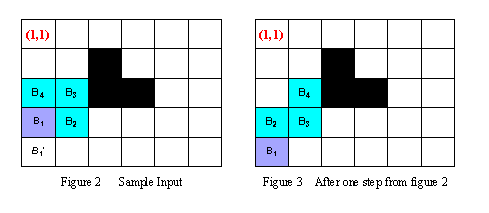
Holedox is a special snake, but its body is not very long. Its lair is like a maze and can be imagined as a rectangle with n*m squares. Each square is either a stone or a vacant place, and only vacant places allow Holedox to move in. Using ordered pair of row
and column number of the lair, the square of exit located at (1,1).
Holedox's body, whose length is L, can be represented block by block. And let B1(r1,c1) B2(r2,c2) .. BL(rL,cL) denote its L length body, where Bi is adjacent to Bi+1 in the lair for 1 <= i <=L-1, and B1 is its head, BL is its tail.
To move in the lair, Holedox chooses an adjacent vacant square of its head, which is neither a stone nor occupied by its body. Then it moves the head into the vacant square, and at the same time, each other block of its body is moved into the square occupied
by the corresponding previous block.
For example, in the Figure 2, at the beginning the body of Holedox can be represented as B1(4,1) B2(4,2) B3(3,2)B4(3,1). During the next step, observing that B1'(5,1) is the only square that the head can be moved into, Holedox moves its head into B1'(5,1),
then moves B2 into B1, B3 into B2, and B4 into B3. Thus after one step, the body of Holedox locates in B1(5,1)B2(4,1)B3(4,2) B4(3,2) (see the Figure 3).
Given the map of the lair and the original location of each block of Holedox's body, your task is to write a program to tell the minimal number of steps that Holedox has to take to move its head to reach the square of exit (1,1).
Input
next L lines contain a pair of row and column number each, indicating the original position of each block of Holedox's body, from B1(r1,c1) to BL(rL,cL) orderly, where 1<=ri<=n, and 1<=ci<=m,1<=i<=L. The next line contains an integer K, representing the number
of squares of stones in the lair. The following K lines contain a pair of row and column number each, indicating the location of each square of stone. Then a blank line follows to separate the cases.
The input is terminated by a line with three zeros.
Note: Bi is always adjacent to Bi+1 (1<=i<=L-1) and exit square (1,1) will never be a stone.
Output
Sample Input
5 6 4

4 1

4 2

3 2

3 1

3

2 3

3 3

3 4

4 4 4

2 3

1 3

1 4

2 4

4

2 1

2 2

3 4

4 2

0 0 0
Sample Output
Case 1: 9

Case 2: -1
Hint
Source
思路:从头部開始想尾部走,不同方向代表不同的值,就得到蛇的状态,然后就是普通的BFS,还要注意不能咬到自己,首尾相连也不行。
#include <stdio.h>

struct S{

int step,x[9],y[9],head;

}que[1000000];

bool vis[20][20][16384];

int mp[20][20],nxt[4][2]={{1,0},{0,-1},{0,1},{-1,0}},mi[8]={1,4,16,64,156,1024,4096,16384};

int main()

{

    int n,m,l,i,j,k,x,y,head,temp,lx,ly,tl,valx,valy,casenum=1,top,bottom;

    while(~scanf("%d%d%d",&n,&m,&l) && n)

    {

        for(i=0;i<l;i++)

        {

            scanf("%d%d",&x,&y);

            que[0].x[i]=x-1;

            que[0].y[i]=y-1;

        }

        for(i=0;i<n;i++) for(j=0;j<m;j++) mp[i][j]=1;

        for(i=0;i<n;i++) for(j=0;j<m;j++) for(k=0;k<mi[l-1];k++) vis[i][j][k]=0;

        scanf("%d",&k);

        while(k--)

        {

            scanf("%d%d",&x,&y);

            mp[x-1][y-1]=0;

        }

        que[0].step=0;

        que[0].head=0;

        top=0;

        bottom=1;

        while(top<bottom)

        {

            if(!que[top].x[que[top].head] && !que[top].y[que[top].head])

            {

                printf("Case %d: %d\n",casenum++,que[top].step);

                break;

            }

            head=que[top].head-1;

            if(head==-1) head=l;

            que[top].step++;

            for(i=0;i<4;i++)

            {

                x=que[top].x[head]=que[top].x[que[top].head]+nxt[i][0];

                y=que[top].y[head]=que[top].y[que[top].head]+nxt[i][1];

                if(x>=0 && x<n && y>=0 && y<m && mp[x][y])

                {

                    temp=0;

                    lx=x;

                    ly=y;

                    tl=0;

                    for(j=que[top].head;tl<l;j++)

                    {

                        if(j==l+1) j=0;

                        if(que[top].x[j]==x && que[top].y[j]==y) break;//假设会咬到自己

                        if(tl<l-1)//计算状态

                        {

                            valx=lx-que[top].x[j];

                            valy=ly-que[top].y[j];

                            if(valx==0 && valy==1) temp=temp<<2;

                            else if(valx==1 && valy==0) temp=temp<<2|1;

                            else if(valx==-1 && valy==0) temp=temp<<2|2;

                            else if(valx==0 && valy==-1) temp=temp<<2|3;

                            lx=que[top].x[j];

                            ly=que[top].y[j];

                        }

                        tl++;

                    }

                    if(tl==l && !vis[x][y][temp])//假设不会咬到自己而且该状态没有訪问过

                    {

                        vis[x][y][temp]=1;

                        que[top].head--;

                        if(que[top].head==-1) que[top].head=l;

                        que[top].x[head]=x;

                        que[top].y[head]=y;

                        que[bottom++]=que[top];

                        que[top].head++;

                        if(que[top].head==l+1) que[top].head=0;

                    }

                }

            }

            top++;

        }

        if(top==bottom) printf("Case %d: -1\n",casenum++);

    }

}
POJ-1324-Holedox Moving(BFS)的更多相关文章
- POJ 1324 Holedox Moving (状压BFS)
POJ 1324 Holedox Moving (状压BFS) Time Limit: 5000MS Memory Limit: 65536K Total Submissions: 18091 Acc ...
- poj 1324 Holedox Moving
poj 1324 Holedox Moving 题目地址: http://poj.org/problem?id=1324 题意: 给出一个矩阵中,一条贪吃蛇,占据L长度的格子, 另外有些格子是石头, ...
- POJ - 1324 Holedox Moving (状态压缩+BFS/A*)
题目链接 有一个n*m(1<=n,m<=20)的网格图,图中有k堵墙和有一条长度为L(L<=8)的蛇,蛇在移动的过程中不能碰到自己的身体.求蛇移动到点(1,1)所需的最小步数. 显然 ...
- POJ 1324 Holedox Moving 搜索
题目地址: http://poj.org/problem?id=1324 优先队列---A*的估价函数不能为蛇头到(1,1)的距离,这样会出错. 看了discuss,有大神说这题A*的估价函数为BFS ...
- poj 1324 状态压缩+bfs
http://poj.org/problem?id=1324 Holedox Moving Time Limit: 5000MS Memory Limit: 65536K Total Submis ...
- poj1324 Holedox Moving
Holedox Moving Time Limit: 5000MS Memory Limit: 65536K Total Submissions: 16980 Accepted: 4039 D ...
- poj 3414 Pots 【BFS+记录路径 】
//yy:昨天看着这题突然有点懵,不知道怎么记录路径,然后交给房教了,,,然后默默去写另一个bfs,想清楚思路后花了半小时写了120+行的代码然后出现奇葩的CE,看完FAQ改了之后又WA了.然后第一次 ...
- UVALive 2520 Holedox Moving(BFS+状态压缩)
这个题目在比赛的时候我们是没有做出来的,但是听到他们说进制哈希的时候,感觉真的是挺高端的,于是赛后开始补题,本着我的习惯在看题解之前自己再试着写一遍,我当时存储状态的方法是string + map,我 ...
- POJ 1324(BFS + 状态压缩)
题意:给你一条蛇,要求一以最少的步数走到1,1 思路: 最开始一直没想到应该怎样保存状态,后来发现别人用二进制保存蛇的状态,即每两个节点之间的方向和头节点,二进制最多14位(感觉状态保存都能扯到二进制 ...
- poj 3026 Borg Maze (BFS + Prim)
http://poj.org/problem?id=3026 Borg Maze Time Limit:1000MS Memory Limit:65536KB 64bit IO For ...
随机推荐
- sql: sql developer使用
在sql developer中登陆某数据库,在procedure里面加入一个proc,种类选ARBOR: CREATE OR REPLACE PROCEDURE PROCEDURE23 IS NAM ...
- PHP学习之-1.2 认识PHP脚本标识
想在代码中实现PHP代码非常简单,如下面代码 <?php echo "和我一起学习php吧"; ?> 就像你在编写javascript脚本中需要写<script& ...
- [Warning] Aborted connection 11203 to db: 'ide' user: 'nuc' host: 'prd01.mb.com' (Got an error writi
PS:一台物理机扯分了3个虚拟机,一个主db,一个主备,一个从备. 切换到0301的时候 Sep 6 09:16:16 prddb0301 mysqld: 130906 9:16:16 [Warn ...
- 零基础数据分析与挖掘R语言实战课程(R语言)
随着大数据在各行业的落地生根和蓬勃发展,能从数据中挖金子的数据分析人员越来越宝贝,于是很多的程序员都想转行到数据分析, 挖掘技术哪家强?当然是R语言了,R语言的火热程度,从TIOBE上编程语言排名情况 ...
- Javascript做模糊查询
<html> <head> <title>Javascript模糊查找</title> </head> <body> <l ...
- TCP/IP笔记 一.综述
1. TCP/IP分层 TCP/IP 是四层的体系结构:应用层.运输层.网际层和网络接口层,如下图: OSI协议是国际标准的网络协议,但是由于OSI的实用性等问题造成OSI没有流行起来.目前国际上广泛 ...
- 优化Java堆大小5温馨提示
总结:Java没有足够的堆大小可能会导致性能非常大的影响,这无疑将给予必要的程序,并不能带来麻烦.本文总结了影响Java居前五位的能力不足,并整齐地叠优化? 笔者Pierre有一个10高级系统架构师有 ...
- Android 事件处理
目的:通过全面的分析Android的鼠标和键盘事件.了解Android中如何接收和处理键盘和鼠标事件,以及如何用代码来产生事件. 主要学习内容: 1. 接收并处理鼠标事件:按下.弹起.移动.双击.长按 ...
- 棋盘问题 简单搜索DFS
Description 在一个给定形状的棋盘(形状可能是不规则的)上面摆放棋子,棋子没有区别.要求摆放时任意的两个棋子不能放在棋盘中的同一行或者同一列,请编程求解对于给定形状和大小的棋盘,摆放k个棋子 ...
- Mac Python路径总结
Mac 下Python 可以多版本的并存,并且Python的目录也有好几个,不过总体来说,Mac 自带的有python 还是比较方便的 Mac 系统自带的又Python ,可能Python版本需要更新 ...