
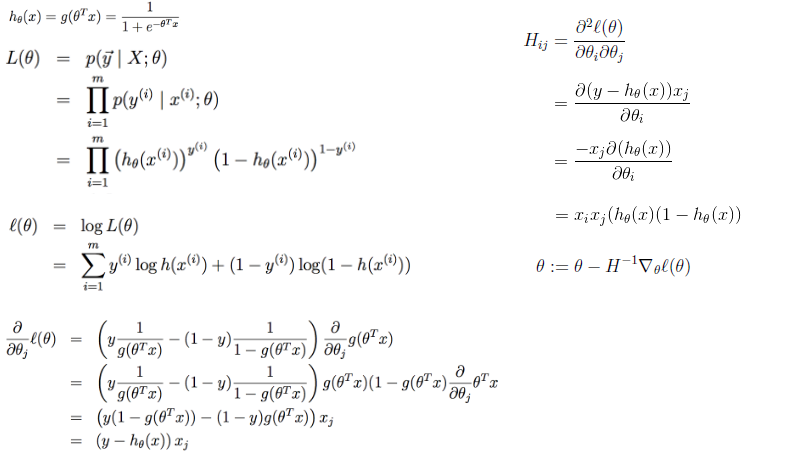
Logistic回归的牛顿法及DFP、BFGS拟牛顿法求解
牛顿法
  # coding:utf-8

 import matplotlib.pyplot as plt

 import numpy as np

 def dataN(length):#生成数据

     x = np.ones(shape = (length,3))

     y = np.zeros(length)

     for i in np.arange(0,length/100,0.02):

         x[100*i][0]=1

         x[100*i][1]=i

         x[100*i][2]=i + 1 + np.random.uniform(0,1.2)

         y[100*i]=1

         x[100*i+1][0]=1

         x[100*i+1][1]=i+0.01

         x[100*i+1][2]=i+0.01 + np.random.uniform(0,1.2)

         y[100*i+1]=0

     return x,y

 def sigmoid(x): #simoid 函数

     return 1.0/(1+np.exp(-x))

 def DFP(x,y, iter):#DFP拟牛顿法

     n = len(x[0])

     theta=np.ones((n,1))

     y=np.mat(y).T

     Gk=np.eye(n,n)

     grad_last = np.dot(x.T,sigmoid(np.dot(x,theta))-y)

     cost=[]

     for it in range(iter):

         pk = -1 * Gk.dot(grad_last)

         rate=alphA(x,y,theta,pk)

         theta = theta + rate * pk

         grad= np.dot(x.T,sigmoid(np.dot(x,theta))-y)

         delta_k = rate * pk

         y_k = (grad - grad_last)

         Pk = delta_k.dot(delta_k.T) / (delta_k.T.dot(y_k))

         Qk= Gk.dot(y_k).dot(y_k.T).dot(Gk) / (y_k.T.dot(Gk).dot(y_k)) * (-1)

         Gk += Pk + Qk

         grad_last = grad

         cost.append(np.sum(grad_last))

     return theta,cost

 def BFGS(x,y, iter):#BFGS拟牛顿法

     n = len(x[0])

     theta=np.ones((n,1))

     y=np.mat(y).T

     Bk=np.eye(n,n)

     grad_last = np.dot(x.T,sigmoid(np.dot(x,theta))-y)

     cost=[]

     for it in range(iter):

         pk = -1 * np.linalg.solve(Bk, grad_last)

         rate=alphA(x,y,theta,pk)

         theta = theta + rate * pk

         grad= np.dot(x.T,sigmoid(np.dot(x,theta))-y)

         delta_k = rate * pk

         y_k = (grad - grad_last)

         Pk = y_k.dot(y_k.T) / (y_k.T.dot(delta_k))

         Qk= Bk.dot(delta_k).dot(delta_k.T).dot(Bk) / (delta_k.T.dot(Bk).dot(delta_k)) * (-1)

         Bk += Pk + Qk

         grad_last = grad

         cost.append(np.sum(grad_last))

     return theta,cost

 def alphA(x,y,theta,pk): #选取前20次迭代cost最小的alpha

     c=float("inf")

     t=theta

     for k in range(1,200):

             a=1.0/k**2

             theta = t + a * pk

             f= np.sum(np.dot(x.T,sigmoid(np.dot(x,theta))-y))

             if abs(f)>c:

                 break

             c=abs(f)

             alpha=a

     return alpha

 def newtonMethod(x,y, iter):#牛顿法

     m = len(x)

     n = len(x[0])

     theta = np.zeros(n)

     cost=[]

     for it in range(iter):

         gradientSum = np.zeros(n)

         hessianMatSum = np.zeros(shape = (n,n))

         for i in range(m):

             hypothesis = sigmoid(np.dot(x[i], theta))

             loss =hypothesis-y[i]

             gradient = loss*x[i]

             gradientSum = gradientSum+gradient

             hessian=[b*x[i]*(1-hypothesis)*hypothesis for b in x[i]]

             hessianMatSum = np.add(hessianMatSum,hessian)

         hessianMatInv = np.mat(hessianMatSum).I

         for k in range(n):

             theta[k] -= np.dot(hessianMatInv[k], gradientSum)

         cost.append(np.sum(gradientSum))

     return theta,cost

 def tesT(theta, x, y):#准确率

     length=len(x)

     count=0

     for i in xrange(length):

         predict = sigmoid(x[i, :] * np.reshape(theta,(3,1)))[0] > 0.5

         if predict == bool(y[i]):

             count+= 1

     accuracy = float(count)/length

     return accuracy

 def showP(x,y,theta,cost,iter):#作图

     plt.figure(1)

     plt.plot(range(iter),cost)

     plt.figure(2)

     color=['or','ob']

     for i in xrange(length):

         plt.plot(x[i, 1], x[i, 2],color[int(y[i])])

     plt.plot([0,length/100],[-theta[0],-theta[0]-theta[1]*length/100]/theta[2])

     plt.show()

 length=200

 iter=5

 x,y=dataN(length)

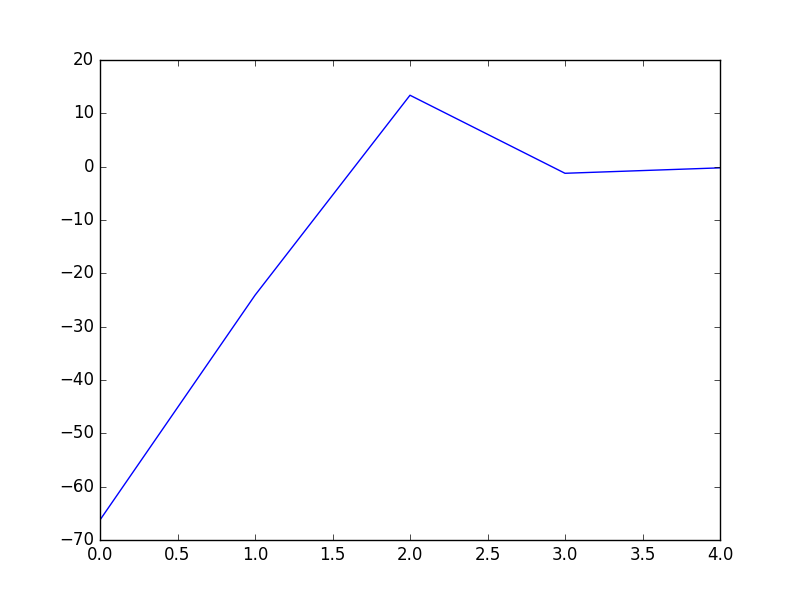
 theta,cost=BFGS(x,y,iter)

 print theta   #[[-18.93768161][-16.52178427][ 16.95779981]]

 print tesT(theta, np.mat(x), y)  #0.935

 showP(x,y,theta.getA(),cost,iter)

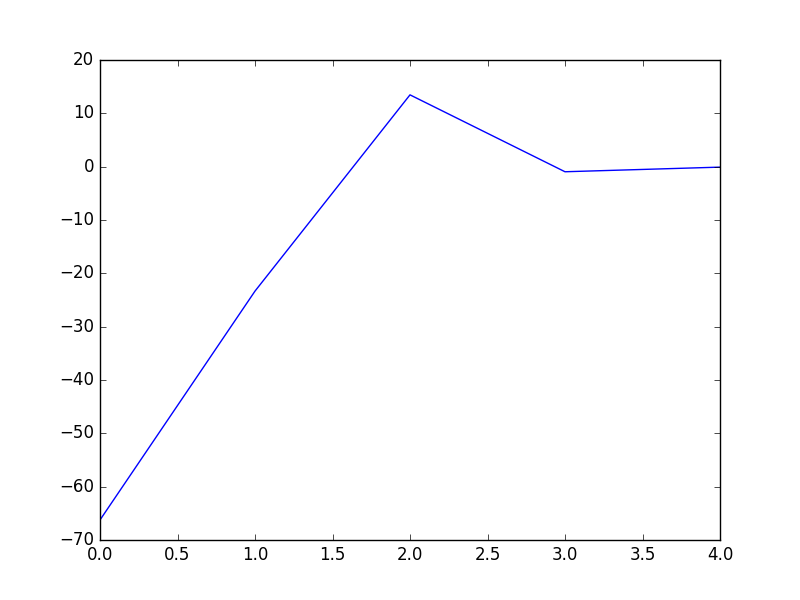
 theta,cost=DFP(x,y,iter)

 print theta   #[[-18.51841028][-16.17880599][ 16.59649161]]

 print tesT(theta, np.mat(x), y)  #0.935

 showP(x,y,theta.getA(),cost,iter)

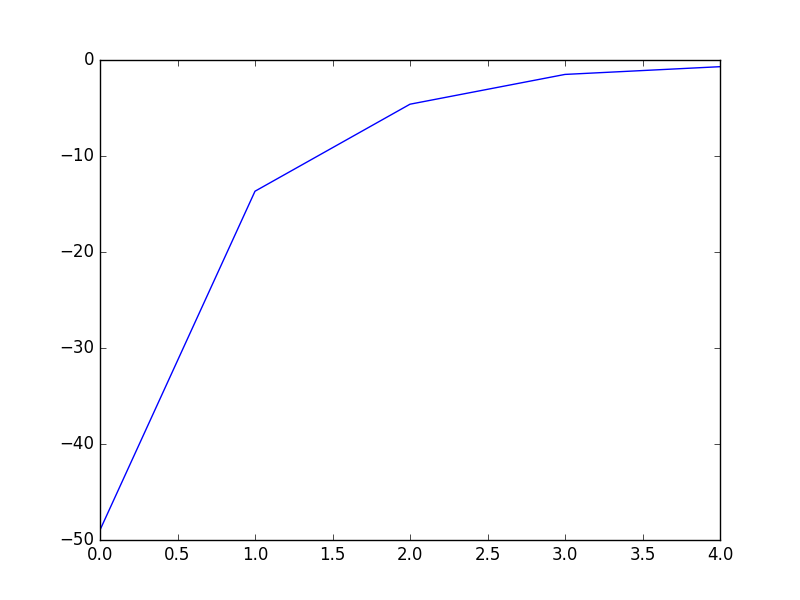
 theta,cost=newtonMethod(x,y,iter)

 print theta   #[-14.49650536 -12.78692552  13.05843361]

 print tesT(theta, np.mat(x), y)  #0.935

 showP(x,y,theta,cost,iter)

Logistic回归的牛顿法及DFP、BFGS拟牛顿法求解的更多相关文章
- 机器学习公开课笔记(3):Logistic回归
Logistic 回归 通常是二元分类器(也可以用于多元分类),例如以下的分类问题 Email: spam / not spam Tumor: Malignant / benign 假设 (Hypot ...
- 机器学习 —— 基础整理(五)线性回归;二项Logistic回归;Softmax回归及其梯度推导;广义线性模型
本文简单整理了以下内容: (一)线性回归 (二)二分类:二项Logistic回归 (三)多分类:Softmax回归 (四)广义线性模型 闲话:二项Logistic回归是我去年入门机器学习时学的第一个模 ...
- 机器学习——logistic回归,鸢尾花数据集预测,数据可视化
0.鸢尾花数据集 鸢尾花数据集作为入门经典数据集.Iris数据集是常用的分类实验数据集,由Fisher, 1936收集整理.Iris也称鸢尾花卉数据集,是一类多重变量分析的数据集.数据集包含150个数 ...
- 【机器学习速成宝典】模型篇03逻辑斯谛回归【Logistic回归】(Python版)
目录 一元线性回归.多元线性回归.Logistic回归.广义线性回归.非线性回归的关系 什么是极大似然估计 逻辑斯谛回归(Logistic回归) 多类分类Logistic回归 Python代码(skl ...
- 【导包】使用Sklearn构建Logistic回归分类器
官方英文文档地址:http://scikit-learn.org/dev/modules/generated/sklearn.linear_model.LogisticRegression.html# ...
- 对线性回归,logistic回归和一般回归的认识
原文:http://www.cnblogs.com/jerrylead/archive/2011/03/05/1971867.html#3281650 对线性回归,logistic回归和一般回归的认识 ...
- 线性回归,logistic回归和一般回归
1 摘要 本报告是在学习斯坦福大学机器学习课程前四节加上配套的讲义后的总结与认识.前四节主要讲述了回归问题,回归属于有监督学习中的一种方法.该方法的核心思想是从连续型统计数据中得到数学模型,然后将该数 ...
- 转载 Deep learning:六(regularized logistic回归练习)
前言: 在上一讲Deep learning:五(regularized线性回归练习)中已经介绍了regularization项在线性回归问题中的应用,这节主要是练习regularization项在lo ...
- 机器学习之线性回归---logistic回归---softmax回归
在本节中,我们介绍Softmax回归模型,该模型是logistic回归模型在多分类问题上的推广,在多分类问题中,类标签 可以取两个以上的值. Softmax回归模型对于诸如MNIST手写数字分类等问题 ...
随机推荐
- java.lang包的分类
提供利用 Java 编程语言进行程序设计的基础类. 1> 最重要的类是 Object(它是类层次结构的根)和 Class(它的实例表示正在运行的应用程序中的类). 2> 把基本类型 ...
- Listview之优化BaseAdapter中的getView中的contentView
BaseAdapter中getView中改动的地方: @Override public View getView(int position, View contentView, ViewGroup a ...
- poj3356 dp
//Accepted 4100 KB 0 ms //类似poj1080 //dp[i][j]表示s1用前i个,s2用前j个的最少匹配步数 //dp[i][j]=min(dp[i][j-1]+1,dp[ ...
- PAT 06-2 字符串字母大小写转换
没什么好说的,记得使用ctype.h就好了,谭浩强那本书就介绍了,再不使用就太对不起他老人家了:有一点小小的地方需要注意一下,&&的优先级比=号高,所以getchar()两边没有括号的 ...
- stm32的软件架构问题
1. 架构组成:程序代码分为四种结构a) 顺序执行代码定义:按照顺序逐行执行的代码优点:是思路简单,代码可靠不易被干扰.缺点:占用资源用途:只用来各种变量.函数的定义,硬件的初始化程序位置:main. ...
- OBJECT ARX 获取标注样式信息
CString str = _T("标注样式"); CString strTmp(_T("")); ////获得当前图形的标注样式表 AcDbDimStyleT ...
- CPU MPU MCU SOC SOPC关系及区别
在嵌入式开过程,会经常接触到一些缩写术语概念,这些概念在嵌入式行业中使用率非常高,下面我们就解释一下这些概念之间的关系和区别: 1.CPU(Central Processing Unit),是一台计算 ...
- openstack 本地化
研究了一下 openstack中的本地化:主要使用gettext模块: 其中本地化包括对一般字符串的本地化和log的本地化: (1) _localedir = os.environ.get('es ...
- Ubuntu封装制作ISO镜像
首先下载Remastersys的Deb软件包 链接:http://pan.baidu.com/s/1i3tYPKT 密码: 使用命令强制安装 dpkg --force-all -i remasters ...
- Python mix-in 组合 ~ 将类组合起来 .
在一个池塘中有10个乌龟 1 条鱼 . class Turtle: def __init__(self,x): # 在生命对象的时候 说明对象的 数量 . (还是一个对象 . 数量只是该对象的一个属性 ...