
转载 Deep learning:六(regularized logistic回归练习)
前言:
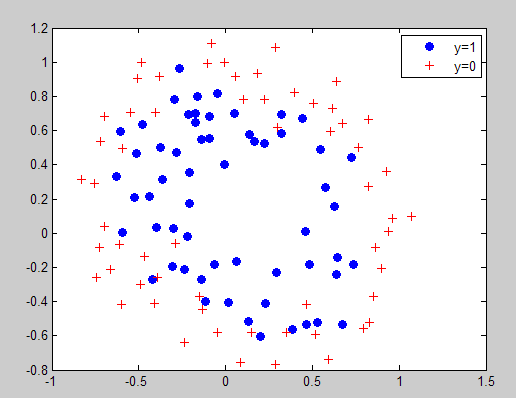
在上一讲Deep learning:五(regularized线性回归练习)中已经介绍了regularization项在线性回归问题中的应用,这节主要是练习regularization项在logistic回归中的应用,并使用牛顿法来求解模型的参数。参考的网页资料为:http://openclassroom.stanford.edu/MainFolder/DocumentPage.php?course=DeepLearning&doc=exercises/ex5/ex5.html。要解决的问题是,给出了具有2个特征的一堆训练数据集,从该数据的分布可以看出它们并不是非常线性可分的,因此很有必要用更高阶的特征来模拟。例如本程序中个就用到了特征值的6次方来求解。
实验基础:
contour:
该函数是绘制轮廓线的,比如程序中的contour(u, v, z, [0, 0], 'LineWidth', 2),指的是在二维平面U-V中绘制曲面z的轮廓,z的值为0,轮廓线宽为2。注意此时的z对应的范围应该与U和V所表达的范围相同。因为contour函数是用来等高线,而本实验中只需画一条等高线,所以第4个参数里面的值都是一样的,这里为[0,0],0指的是函数值z在0和0之间的等高线(很明显,只能是一条)。
在logistic回归中,其表达式为:
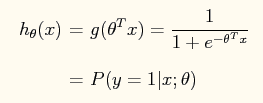
在此问题中,将特征x映射到一个28维的空间中,其x向量映射后为:
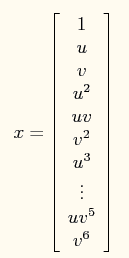
此时加入了规则项后的系统的损失函数为:

对应的牛顿法参数更新方程为:
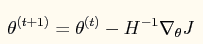
其中:
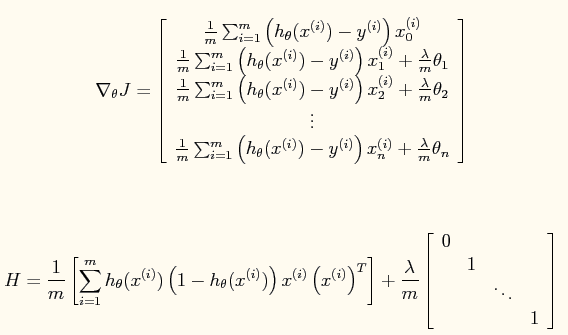
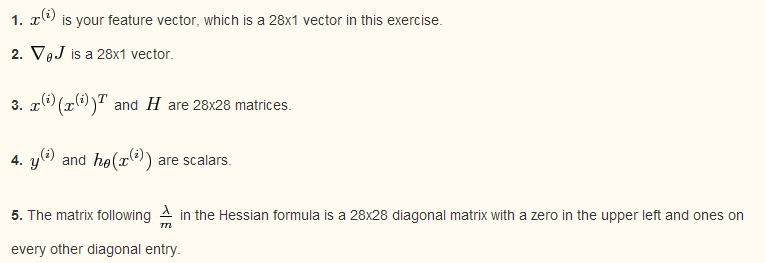
公式中的一些宏观说明(直接截的原网页):
实验结果:
原训练数据点的分布情况:
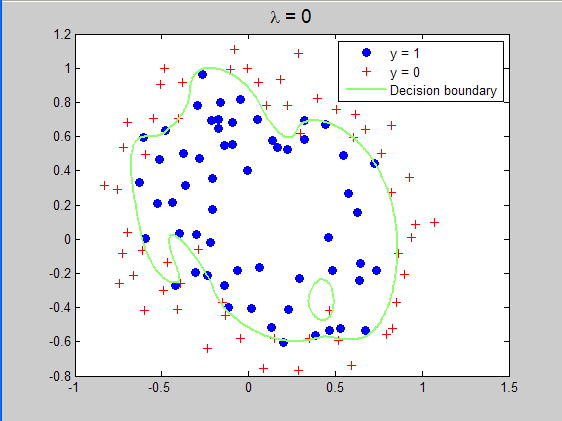
当lambda=0时所求得的分界曲面:
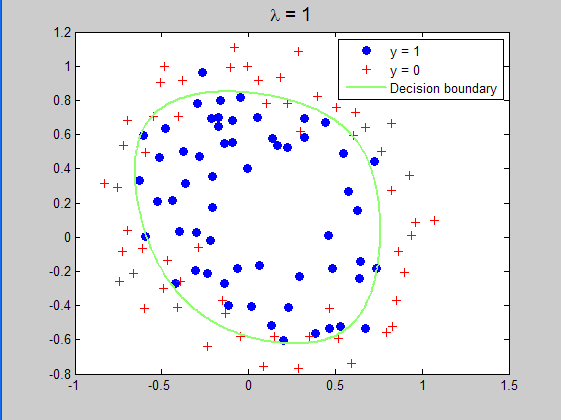
当lambda=1时所求得的分界曲面:
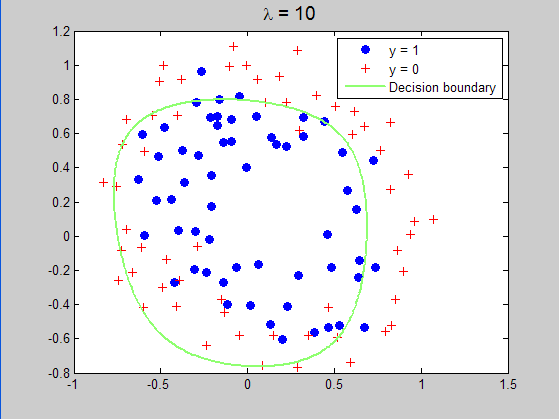
当lambda=10时所求得的分界曲面:
实验程序代码:
%载入数据

clc,clear,close all;

x = load('ex5Logx.dat');

y = load('ex5Logy.dat');

%画出数据的分布图

plot(x(find(y),1),x(find(y),2),'o','MarkerFaceColor','b')

hold on;

plot(x(find(y==0),1),x(find(y==0),2),'r+')

legend('y=1','y=0')

% Add polynomial features to x by

% calling the feature mapping function

% provided in separate m-file

x = map_feature(x(:,1), x(:,2));

[m, n] = size(x);

% Initialize fitting parameters

theta = zeros(n, 1);

% Define the sigmoid function

g = inline('1.0 ./ (1.0 + exp(-z))');

% setup for Newton's method

MAX_ITR = 15;

J = zeros(MAX_ITR, 1);

% Lambda is the regularization parameter

lambda = 1;%lambda=0,1,10,修改这个地方,运行3次可以得到3种结果。

% Newton's Method

for i = 1:MAX_ITR

    % Calculate the hypothesis function

    z = x * theta;

    h = g(z);

    % Calculate J (for testing convergence)

    J(i) =(1/m)*sum(-y.*log(h) - (1-y).*log(1-h))+ ...

    (lambda/(2*m))*norm(theta([2:end]))^2;

    % Calculate gradient and hessian.

    G = (lambda/m).*theta; G(1) = 0; % extra term for gradient

    L = (lambda/m).*eye(n); L(1) = 0;% extra term for Hessian

    grad = ((1/m).*x' * (h-y)) + G;

    H = ((1/m).*x' * diag(h) * diag(1-h) * x) + L;

    % Here is the actual update

    theta = theta - H\grad;

end

% Show J to determine if algorithm has converged

J

% display the norm of our parameters

norm_theta = norm(theta)

% Plot the results

% We will evaluate theta*x over a

% grid of features and plot the contour

% where theta*x equals zero

% Here is the grid range

u = linspace(-1, 1.5, 200);

v = linspace(-1, 1.5, 200);

z = zeros(length(u), length(v));

% Evaluate z = theta*x over the grid

for i = 1:length(u)

    for j = 1:length(v)

        z(i,j) = map_feature(u(i), v(j))*theta;%这里绘制的并不是损失函数与迭代次数之间的曲线,而是线性变换后的值

    end

end

z = z'; % important to transpose z before calling contour

% Plot z = 0

% Notice you need to specify the range [0, 0]

contour(u, v, z, [0, 0], 'LineWidth', 2)%在z上画出为0值时的界面,因为为0时刚好概率为0.5,符合要求

legend('y = 1', 'y = 0', 'Decision boundary')

title(sprintf('\\lambda = %g', lambda), 'FontSize', 14)

hold off

% Uncomment to plot J

% figure

% plot(0:MAX_ITR-1, J, 'o--', 'MarkerFaceColor', 'r', 'MarkerSize', 8)

% xlabel('Iteration'); ylabel('J')
参考文献:
Deep learning:五(regularized线性回归练习)
作者:tornadomeet 出处:http://www.cnblogs.com/tornadomeet 欢迎转载或分享,但请务必声明文章出处。
转载 Deep learning:六(regularized logistic回归练习)的更多相关文章
- 转载 Deep learning:四(logistic regression练习)
前言: 本节来练习下logistic regression相关内容,参考的资料为网页:http://openclassroom.stanford.edu/MainFolder/DocumentPage ...
- 转载 Deep learning:一(基础知识_1)
前言: 最近打算稍微系统的学习下deep learing的一些理论知识,打算采用Andrew Ng的网页教程UFLDL Tutorial,据说这个教程写得浅显易懂,也不太长.不过在这这之前还是复习下m ...
- [转载]Deep Learning(深度学习)学习笔记整理
转载自:http://blog.csdn.net/zouxy09/article/details/8775360 感谢原作者:zouxy09@qq.com 八.Deep learning训练过程 8. ...
- 转载 deep learning:八(SparseCoding稀疏编码)
转载 http://blog.sina.com.cn/s/blog_4a1853330102v0mr.html Sparse coding: 本节将简单介绍下sparse coding(稀疏编码),因 ...
- 转载 Deep learning:三(Multivariance Linear Regression练习)
前言: 本文主要是来练习多变量线性回归问题(其实本文也就3个变量),参考资料见网页:http://openclassroom.stanford.edu/MainFolder/DocumentPage. ...
- 转载 Deep learning:七(基础知识_2)
前面的文章已经介绍过了2种经典的机器学习算法:线性回归和logistic回归,并且在后面的练习中也能够感觉到这2种方法在一些问题的求解中能够取得很好的效果.现在开始来看看另一种机器学习算法--神经网络 ...
- 机器学习(六)— logistic回归
最近一直在看机器学习相关的算法,今天学习logistic回归,在对算法进行了简单分析编程实现之后,通过实例进行验证. 一 logistic概述 个人理解的回归就是发现变量之间的关系,也就是求回归系数, ...
- 转载 Deep learning:五(regularized线性回归练习)
前言: 本节主要是练习regularization项的使用原则.因为在机器学习的一些模型中,如果模型的参数太多,而训练样本又太少的话,这样训练出来的模型很容易产生过拟合现象.因此在模型的损失函数中,需 ...
- 转载 Deep learning:二(linear regression练习)
前言 本文是多元线性回归的练习,这里练习的是最简单的二元线性回归,参考斯坦福大学的教学网http://openclassroom.stanford.edu/MainFolder/DocumentPag ...
随机推荐
- poj 1687 Buggy Sat 简单计算几何
暑期集训出的第一道一血 感觉自己萌萌哒…… 这道题本身并没有坑点 仅仅是翻译巨坑…… 解大腿在做B 安学长在做E 我闲着也没事 就一个词一个词翻译F…… 最后感觉…… 题干大多数都看不懂…… 也都没啥 ...
- 一个文字无缝滚动的jQuery插件
直接上代码吧 <!DOCTYPE HTML PUBLIC "-//W3C//DTD HTML 4.01 Transitional//EN" "http://www. ...
- 2015 ACM/ICPC Asia Regional Changchun Online
1001 Alisha’s Party 比赛的时候学长stl吃T.手写堆过. 赛后我贴了那两份代码都过.相差.2s. 于是用stl写水果. # include <iostream> # i ...
- xtrabackup 2.0.8备份mysql5.1.65报错
sh : xtrabackup not found innobackupex: fatal error: no 'mysqld' group in MySQL options fix: add inn ...
- SPI模式下MCU对SD卡的控制及操作命令(转)
源:SPI模式下MCU对SD卡的控制及操作命令 一.前言 SD 卡有两个可选的通讯协议:SD 模式和 SPI模式 SD 模式是SD 卡标准的读写方式,但是在选用SD 模式时,往往需要选择带有SD 卡控 ...
- ASP.NET中application对象的用法(面试题)
ASP.NET中application对象的用法 本文导读:Application对象是HttpApplicationState类的一个实例,Application状态是整个应用程序全局的.Appli ...
- ios 测试工程是否内存泄漏
转自http://www.cocoachina.com/ios/20141203/10519.html 虽然iOS 5.0版本之后加入了ARC机制,由于相互引用关系比较复杂时,内存泄露还是可能存在.所 ...
- html让背景透明
style="z-index:100000;display:block;position:absolute;filter:progid:DXImageTransform.Microsoft. ...
- DOM操作-主动触发按钮的单击事件
代码: ———————————————————————————————— <script> function fireBtnClick(){ var myBtn ...
- react中文API解读一(快速开始)
记下自己的react学习之路 ,官方文档写的很详尽,学起来应该比较简单 官方文档地址:react.http://reactjs.cn/react/docs/getting-started.html 1 ...