
Convert Adjacency matrix into edgelist
Table of Contents
- [Edge List <-- Adjacency Matrix](# Edge List <-- Adjacency Matrix)
- [Edge List --> Adjacency Matrix](# Edge List --> Adjacency Matrix)
- [About Adjacency List](#About Adjacency List)
Edge List <-- Adjacency Matrix
'''

ref: https://www.cnblogs.com/sonictl/p/10688533.html

convert adjMatrix into edgelist: 'data/unweighted_edgelist.number' or 'data/weighted_edgelist.number''

input: adjacency matrix with delimiter=', '

  it can process:

  - Unweighted directed graph

  - Weighted directed graph

output: edgelist (unweighted and weighted)

'''

import numpy as np

import networkx as nx

# -------DIRECTED Graph, Unweighted-----------

# Unweighted directed graph:

a = np.loadtxt('data/test_adjMatrix.txt', delimiter=', ', dtype=int)

D = nx.DiGraph(a)

nx.write_edgelist(D, 'data/unweighted_edgelist.number', data=False)  # output

edges = [(u, v) for (u, v) in D.edges()]

print(edges)

# -------DIRECTED Graph, Weighted------------

# Weighted directed graph (weighted adj_matrix):

a = np.loadtxt('data/adjmatrix_weight_sample.txt', delimiter=', ', dtype=float)

D = nx.DiGraph(a)

nx.write_weighted_edgelist(D, 'data/weighted_edgelist.number')  # write the weighted edgelist into file

# print(D.edges)

elarge = [(u, v, d['weight']) for (u, v, d) in D.edges(data=True) if d['weight'] > 0.]

print(elarge)    # class: list

# -------UNDIRECTED Graph -------------------

# for undirected graph, simply use:

udrtG = D.to_undirected()

'''

test_adjMatrix.txt:  (Symmetric matrices if unweighted graph)

---

0, 1, 1, 1, 0, 1, 1, 0

0, 0, 1, 0, 0, 0, 1, 1

0, 0, 0, 1, 1, 0, 0, 0

0, 1, 0, 0, 1, 1, 0, 0

0, 0, 0, 0, 0, 0, 0, 0

0, 0, 0, 0, 0, 0, 0, 0

0, 0, 0, 0, 0, 0, 0, 0

0, 0, 1, 0, 0, 0, 0, 0

===

adjmatrix_weight_sample.txt:

---

0, 0.5, 0.5, 0.5, 0, 0.5, 0.5, 0

0, 0, 0.5, 0, 0, 0, 0.5, 0.5

0, 0, 0, 0.5, 0.5, 0, 0, 0

0, 0.5, 0, 0, 0.5, 0.5, 0, 0

0, 0, 0, 0, 0, 0, 0, 0

0, 0, 0, 0, 0, 0, 0, 0

0, 0, 0, 0, 0, 0, 0, 0

0, 0, 0.5, 0, 0, 0, 0, 0

===

output:

---

[(0, 1), (0, 2), (0, 3), (0, 5), (0, 6), (1, 2), (1, 6), (1, 7), (2, 3), (2, 4), (3, 1), (3, 4), (3, 5), (7, 2)]

[(0, 1, 0.5), (0, 2, 0.5), (0, 3, 0.5), (0, 5, 0.5), (0, 6, 0.5), (1, 2, 0.5), (1, 6, 0.5), (1, 7, 0.5), (2, 3, 0.5), (2, 4, 0.5), (3, 1, 0.5), (3, 4, 0.5), (3, 5, 0.5), (7, 2, 0.5)]

===

'''
Edge List --> Adjacency Matrix
'''

  https://networkx.github.io/documentation/networkx-2.2/reference/generated/networkx.linalg.graphmatrix.adjacency_matrix.html

'''

import numpy

import networkx as nx

# edgelist to adjacency matrix

# way1: G=nx.read_edgelist

D = nx.read_edgelist('input/edgelist_sample.txt', create_using=nx.DiGraph(), nodetype=int)  # create_using=nx.Graph()

print(D.edges)

print(D.nodes)

# way2:

'''

a = numpy.loadtxt('input/edgelist_sample.txt', dtype=int)

edges = [tuple(e) for e in a]

D = nx.DiGraph()

D.add_edges_from(edges)   # D.add_edges_from(nodes); D.edges; D.nodes

D.name = 'digraph_sample'

print(nx.info(D))

udrtG = D.to_undirected()

udrtG.name = 'udrt'

print(nx.info(udrtG))

'''

# dump to file as adjacency Matrix

A = nx.adjacency_matrix(D, nodelist=list(range(len(D.nodes))))  # nx.adjacency_matrix(D, nodelist=None, weight='weight')   # Return type: SciPy sparse matrix

# print(A)   # type < SciPy sparse matrix >

A_dense = A.todense()   # type-> numpy.matrixlib.defmatrix.matrix

print(A_dense, type(A_dense))

print('--- See two row of matrix equal or not: ---')

print((numpy.equal(A_dense[5], A_dense[6])).all())

# print('to_numpy_array:\n', nx.to_numpy_array(D, nodelist=list(range(len(D.nodes)))))

# print('to_dict_of_dicts:\n', nx.to_dict_of_dicts(D, nodelist=list(range(len(D.nodes)))))
About Adjacency LIST
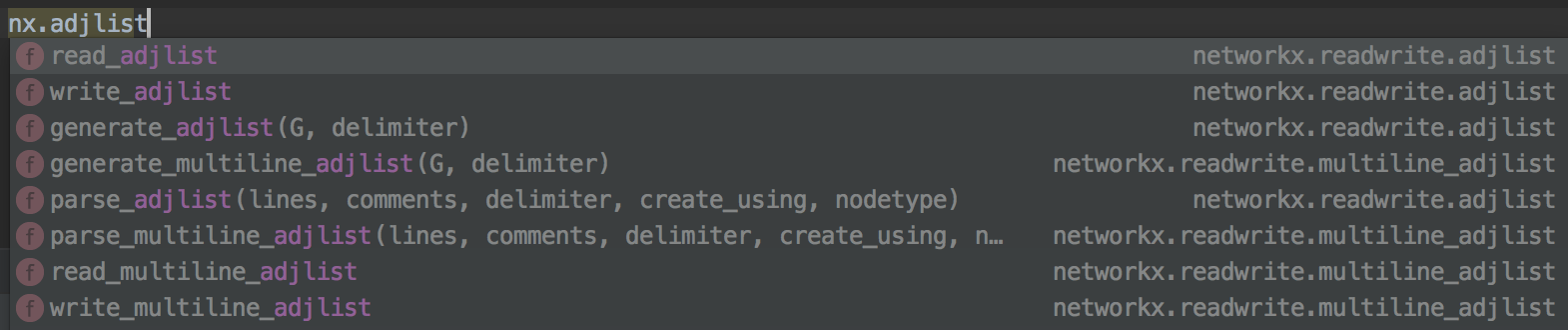
nx.read_adjlist()
Convert Adjacency matrix into edgelist
import numpy as np

#read matrix without head.

a = np.loadtxt('admatrix.txt', delimiter=', ', dtype=int)  #set the delimiter as you need

print "a:"

print a

print 'shape:',a.shape[0] ,"*", a.shape[1]

num_nodes = a.shape[0] + a.shape[1]

num_edge = 0

edgeSet = set()

for row in range(a.shape[0]):

    for column in range(a.shape[1]):

        if a.item(row,column) == 1 and (column,row) not in edgeSet: #get rid of repeat edge

            num_edge += 1

            edgeSet.add((row,column))

print '\nnum_edge:', num_edge

print 'edge Set:', edgeSet

print ''

for edge in edgeSet:

    print edge[0] , edge[1]
Sample Adjacency Matrix Input file:
0, 1, 1, 1, 0, 1, 1, 0

0, 0, 1, 0, 0, 0, 1, 1

0, 0, 0, 1, 1, 0, 0, 0

0, 1, 0, 0, 1, 1, 0, 0

0, 0, 0, 0, 0, 0, 0, 0

0, 0, 0, 0, 0, 0, 0, 0

0, 0, 0, 0, 0, 0, 0, 0

0, 0, 1, 0, 0, 0, 0, 0
Convert Adjacency matrix into edgelist的更多相关文章
- 路径规划 Adjacency matrix 传球问题
建模 问题是什么 知道了问题是什么答案就ok了 重复考虑 与 重复计算 程序可以重复考虑 但往目标篮子中放入时,放不放把握好就ok了. 集合 交集 并集 w 路径规划 字符串处理 42423 424 ...
- 【leetcode】1284. Minimum Number of Flips to Convert Binary Matrix to Zero Matrix
题目如下: Given a m x n binary matrix mat. In one step, you can choose one cell and flip it and all the ...
- LeetCode 1284. Minimum Number of Flips to Convert Binary Matrix to Zero Matrix (最少翻转次数将二进制矩阵全部置为0)
给一个矩阵mat,每个格子都是0或1,翻转一个格子会将该格子以及相邻的格子(有共同边)全部翻转(0变为1,1变为0) 求问最少需要翻转几次将所有格子全部置为0. 这题的重点是数据范围,比赛结束看了眼数 ...
- Adjacency matrix based Graph
Interface AddVertex(T data) AddEdge(int from, int to) DFS BFS MST TopSort PrintGraph using System; u ...
- R matrix 转换为 dataframe
When I try converting a matrix to a data frame, it works for me: > x <- matrix(1:6,ncol=2,dimn ...
- 拉普拉斯矩阵(Laplacian Matrix) 及半正定性证明
摘自 https://blog.csdn.net/beiyangdashu/article/details/49300479 和 https://en.wikipedia.org/wiki/Lapla ...
- Distance matrix
w https://en.wikipedia.org/wiki/Distance_matrix For example, suppose these data are to be analyzed, ...
- 用matalb、python画聚类结果图
用matlab %读入聚类后的数据, 已经分好级别了,例如前4行是亚洲一流, %-13是亚洲二流,-24是亚洲三流 a=xlsread('C:\Users\Liugengxin\Desktop\1.x ...
- OO课程第三次总结QWQ
调研,然后总结介绍规格化设计的大致发展历史和为什么得到了人们的重视 emmm为这个问题翻遍百度谷歌知乎也没有得到答案,那我就把自己认为最重要的两点简要说明一下吧,欢迎大家补充~ 1.便于完成代码的重用 ...
随机推荐
- 阿里云一 第一篇:云服务器ECS
阿里云(www.aliyun.com)创立于2009年,是全球领先的云计算及人工智能科技公司,为200多个国家和地区的企业.开发者和政府机构提供服务.截至2017年3月,阿里云付费云计算用户达87.4 ...
- sku
以淘宝为例,sku是具体到某一个商家具体规格商品,比如某商家红色64g的iPhone6,sku对应有对应的价格和库存.而SPU就是我们在输入框里输入的iPhone6,它是多个商家的集合.淘宝的“宝贝” ...
- 【转存】阿里云服务器下 LAMP 环境配置 —— 基于 CentOS 6.3
阿里云服务器下 LAMP 环境配置 —— 基于 CentOS 6.3 Posted on 2016年2月10日 by 学院君 1.Apache 配置 —————————————————– vi / ...
- elipse使用,Java和Javaee模式区别
Java带有用户界面的基本ide,缺少数据库和web开发工具 IDE(Integrated Development Environment,集成开发环境).集成开发环境(简称IDE)软件是用于程序开发 ...
- 学习笔记DL008:概率论,随机变量,概率分布,边缘概率,条件概率,期望、方差、协方差
概率和信息论. 概率论,表示不确定性声明数学框架.提供量化不确定性方法,提供导出新不确定性声明(statement)公理.人工智能领域,概率法则,AI系统推理,设计算法计算概率论导出表达式.概率和统计 ...
- js比较洋气的写法
案例一:使用js的构造方法生成js对象.给该对象赋属性值或function 案例二:使用json的代码风格,完成同样的功能. <!DOCTYPE html> <html> &l ...
- Web 安全之 XSS 攻击与防御
前言 黑客,相信大家对这一名词并不陌生,黑客们往往会利用 Web 应用程序的漏洞来攻击咱们的系统.开放式 Web 应用程序安全项目(OWASP, Open Web Application Securi ...
- Int和String互转的方法
Java 中int.String的类型转换 int -> String int i=12345;String s="";第一种方法:s=i+"";第二 ...
- linux 软件应用
grub2 安装grub2到某分区 mount /mnt/dev /dev/sdb2 //这里选择你刚才分区的第二个分区 sudo grub-install --root-directory=/mnt ...
- Android环境下hanlp汉字转拼音功能的使用介绍
由于项目需要在Android手机设备上实现汉字转拼音功能(支持多音字),于是首先想到了Pinyin4j+多音字映射对照表的实现方案,并在项目中试用了一段时间,发现数据量大时,其耗时非常严重.后来寻找其 ...