
Spring基于AspectJ的AOP的开发——注解
源码:https://gitee.com/kszsa/dchart
一, AspectJ的概述:
AspectJ是一个面向切面的框架,它扩展了Java语言。AspectJ定义了AOP语法所以它有一个专门的编译器用来生成遵守Java字节编码规范的Class文件。
Spring为了简化自身的AOP的开发,将AspectJ拿过来作为Spring自身一个AOP的开发.
二, Spring AspectJ开发实例
2.1 开发所需jar包
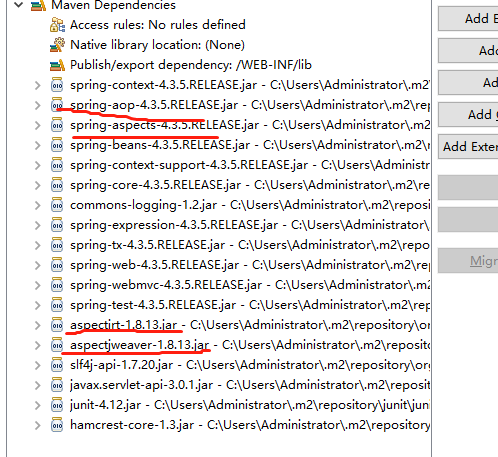
maven中相关包引入
<dependency>

            <groupId>org.springframework</groupId>

            <artifactId>spring-aop</artifactId>

            <version>${spring.version}</version>

        </dependency>

        <dependency>

            <groupId>org.springframework</groupId>

            <artifactId>spring-aspects</artifactId>

            <version>${spring.version}</version>

        </dependency>

<!-- aspectJ依赖包 -->

        <dependency>

            <groupId>org.aspectj</groupId>

            <artifactId>aspectjrt</artifactId>

            <version>${aspectj.version}</version>

        </dependency>

        <dependency>

            <groupId>org.aspectj</groupId>

            <artifactId>aspectjweaver</artifactId>

            <version>${aspectj.version}</version>

        </dependency>
2.2 AspectJ 注解开发规范
2.2.1 AspectJ的切入点:
    //统一管理切入点的表达式.

    @Pointcut(value="execution(* com.dchart.aop.service.CustomerService+.find(..))")

    private void myPointcut1(){}//这个类没有实际用途, 只是为了@Pointcut 注解
2.2.2 @AspectJ提供不同的通知类型
@Before 前置通知,相当于BeforeAdvice
在执行目标方法之前完成一个操作,获得到切入点信息.
@Before(value="execution(* com.dchart.aop.service.CustomerService+.save(..))")

    public void before(JoinPoint joinPoint){

        System.out.println("前置通知============"+joinPoint);

    }
@AfterReturning 后置通知,相当于AfterReturningAdvice
在目标方法执行之后完成一个操作,获得方法的返回值.
@AfterReturning(value="execution(* com.dchart.aop.service.CustomerService+.update(..))",returning="result")

    public void afterReturn(Object result){

        System.out.println("后置通知============"+result);

    }
@Around 环绕通知,相当于MethodInterceptor
在目标方法执行的前和执行后完成一个操作,阻止目标方法执行.
@Around(value="execution(* com.dchart.aop.service.CustomerService+.delete(..))")

    public Object around(ProceedingJoinPoint joinPoint) throws Throwable{

        System.out.println("环绕前通知==========");

        Object obj = joinPoint.proceed();

        System.out.println("环绕后通知==========");

        return obj;

    }
@AfterThrowing抛出通知,相当于ThrowAdvice
在目标方法出现异常的时候,完成一个操作.获得异常信息.
@AfterThrowing(value="CustomerServiceAspect.myPointcut1()",throwing="e")

    public void afterThrowing(Throwable e){

        System.out.println("异常抛出通知========="+e.getMessage());

    }
@After 最终final通知,不管是否异常,该通知都会执行
在目标方法任何情况下都会执行的操作.相当于finally中的代码.
@After(value="CustomerServiceAspect.myPointcut1()")

    public void after(){

        System.out.println("最终通知===========");

    }
2.2.3 通过配置启用@AspectJ切面
1、开启AspectJ的自动代理
<?xml version="1.0" encoding="UTF-8"?>

<beans xmlns="http://www.springframework.org/schema/beans"

    xmlns:xsi="http://www.w3.org/2001/XMLSchema-instance" xmlns:aop="http://www.springframework.org/schema/aop"

    xmlns:context="http://www.springframework.org/schema/context"

    xsi:schemaLocation="http://www.springframework.org/schema/beans http://www.springframework.org/schema/beans/spring-beans.xsd

      http://www.springframework.org/schema/aop http://www.springframework.org/schema/aop/spring-aop-4.0.xsd

      http://www.springframework.org/schema/context http://www.springframework.org/schema/context/spring-context-4.0.xsd">

    <!-- 开启AspectJ自动代理 -->

    <aop:aspectj-autoproxy></aop:aspectj-autoproxy>

</beans>
2、对应的切面类添加注解
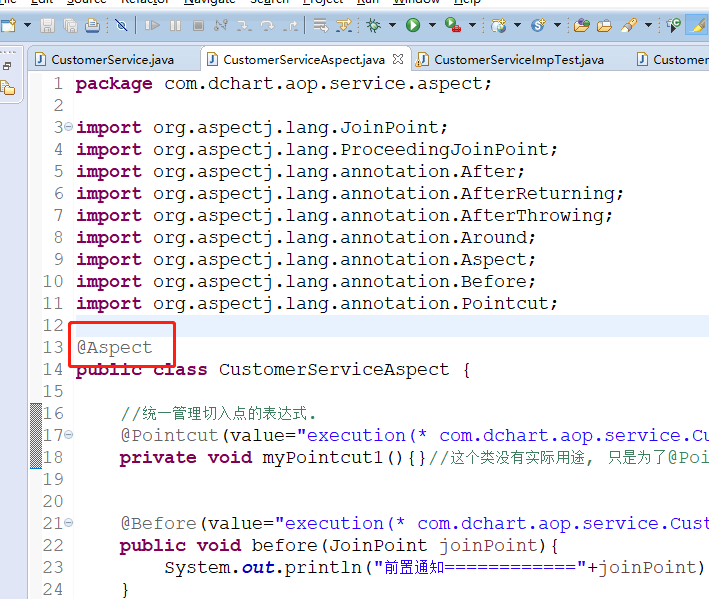
2.2.4 Aspect和Advisor的区别:
Advisor :传统的切面.传统切面一般都是由一个切入点和一个通知的组合.
Aspect :真正意义上的切面.由多个切入点和多个通知的组合.
2.2.5 在通知中通过value属性定义切点
通过execution函数,可以定义切点的方法切入
语法:
execution(<访问修饰符>?<返回类型><方法名>(<参数>)<异常>)
例如
匹配所有类public方法 execution(public * *(..))
匹配指定包下所有类方法 execution(* cn.itcast.dao.*(..)) 不包含子包
execution(* cn.itcast.dao..*(..)) ..*表示包、子孙包下所有类
匹配指定类所有方法 execution(* cn.itcast.service.UserService.*(..))
匹配实现特定接口所有类方法 execution(* cn.itcast.dao.GenericDAO+.*(..))
匹配所有save开头的方法 execution(* save*(..))
2.3 Spring AspctJ 基于注解模式的开发例子
定义接口CustomerService.java
package com.dchart.aop.service;

public interface CustomerService {

    public void save();

    public Integer update();

    public void delete();

    public void find();

}
接口实现
CustomerServiceImp.java
package com.dchart.aop.service.imp;

import com.dchart.aop.service.CustomerService;

public class CustomerServiceImp implements CustomerService {

     @Override

        public void save() {

            System.out.println("保存客户...");

        }

        @Override

        public Integer update() {

            System.out.println("修改客户...");

            return 100;

        }

        @Override

        public void delete() {

            System.out.println("删除客户...");

        }

        @Override

        public void find() {

            System.out.println("查询客户...");

           // int d = 1 / 0;

        }

}
编写切面类
CustomerServiceAspect.java
package com.dchart.aop.service.aspect;

import org.aspectj.lang.JoinPoint;

import org.aspectj.lang.ProceedingJoinPoint;

import org.aspectj.lang.annotation.After;

import org.aspectj.lang.annotation.AfterReturning;

import org.aspectj.lang.annotation.AfterThrowing;

import org.aspectj.lang.annotation.Around;

import org.aspectj.lang.annotation.Aspect;

import org.aspectj.lang.annotation.Before;

import org.aspectj.lang.annotation.Pointcut;

@Aspect

public class CustomerServiceAspect {

    //统一管理切入点的表达式.

    @Pointcut(value="execution(* com.dchart.aop.service.CustomerService+.find(..))")

    private void myPointcut1(){}//这个类没有实际用途, 只是为了@Pointcut 注解

    @Before(value="execution(* com.dchart.aop.service.CustomerService+.save(..))")

    public void before(JoinPoint joinPoint){

        System.out.println("前置通知============"+joinPoint);

    }

    @AfterReturning(value="execution(* com.dchart.aop.service.CustomerService+.update(..))",returning="result")

    public void afterReturn(Object result){

        System.out.println("后置通知============"+result);

    }

    @Around(value="execution(* com.dchart.aop.service.CustomerService+.delete(..))")

    public Object around(ProceedingJoinPoint joinPoint) throws Throwable{

        System.out.println("环绕前通知==========");

        Object obj = joinPoint.proceed();

        System.out.println("环绕后通知==========");

        return obj;

    }

    @AfterThrowing(value="CustomerServiceAspect.myPointcut1()",throwing="e")

    public void afterThrowing(Throwable e){

        System.out.println("异常抛出通知========="+e.getMessage());

    }

    @After(value="CustomerServiceAspect.myPointcut1()")

    public void after(){

        System.out.println("最终通知===========");

    }

}
单元测试类CustomerServiceImpTest.java
package com.dchart.aop.service.imp;

import static org.junit.Assert.*;

import javax.annotation.Resource;

import org.junit.Test;

import org.junit.runner.RunWith;

import org.springframework.test.context.ContextConfiguration;

import org.springframework.test.context.junit4.SpringJUnit4ClassRunner;

import com.dchart.aop.service.CustomerService;

@RunWith(SpringJUnit4ClassRunner.class)

@ContextConfiguration("classpath:spring_aop.xml")

public class CustomerServiceImpTest {

    @Resource(name="customerService")

    private CustomerService customerService;

    @Test

    public void test() {

        customerService.save();

        customerService.update();

        customerService.delete();

        customerService.find();

    }

}
Spring 配置文件:spring_aop.xml
<?xml version="1.0" encoding="UTF-8"?>

<beans xmlns="http://www.springframework.org/schema/beans"

    xmlns:xsi="http://www.w3.org/2001/XMLSchema-instance" xmlns:aop="http://www.springframework.org/schema/aop"

    xmlns:context="http://www.springframework.org/schema/context"

    xsi:schemaLocation="http://www.springframework.org/schema/beans http://www.springframework.org/schema/beans/spring-beans.xsd

      http://www.springframework.org/schema/aop http://www.springframework.org/schema/aop/spring-aop-4.0.xsd

      http://www.springframework.org/schema/context http://www.springframework.org/schema/context/spring-context-4.0.xsd">

    <!-- 开启AspectJ自动代理 -->

    <aop:aspectj-autoproxy></aop:aspectj-autoproxy>

    <!-- 目标对象 -->

    <bean id="customerService" class="com.dchart.aop.service.imp.CustomerServiceImp" />

    <!-- 配置切面 -->

    <bean id="myAspectAnno" class="com.dchart.aop.service.aspect.CustomerServiceAspect" />

</beans>
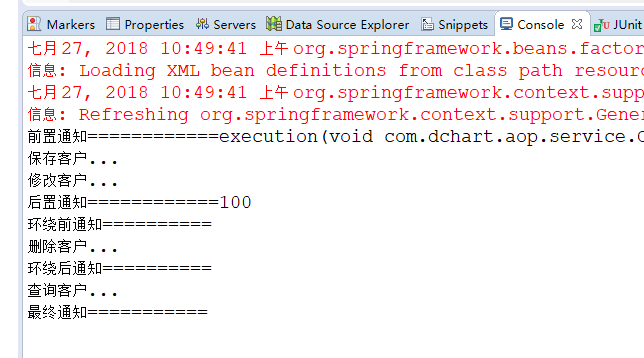
运行结果:
源码:https://gitee.com/kszsa/dchart
参考地址:http://www.cnblogs.com/wang-meng/p/5641687.html
Spring基于AspectJ的AOP的开发——注解的更多相关文章
- [Spring框架]Spring AOP基础入门总结二:Spring基于AspectJ的AOP的开发.
前言: 在上一篇中: [Spring框架]Spring AOP基础入门总结一. 中 我们已经知道了一个Spring AOP程序是如何开发的, 在这里呢我们将基于AspectJ来进行AOP 的总结和学习 ...
- Spring 基于 AspectJ 的 AOP 开发
Spring 基于 AspectJ 的 AOP 开发 在 Spring 的 aop 代理方式中, AspectJ 才是主流. 1. AspectJ 简介 AspectJ 是一个基于 java 语言的 ...
- (转)Spring使用AspectJ进行AOP的开发:注解方式
http://blog.csdn.net/yerenyuan_pku/article/details/69790950 Spring使用AspectJ进行AOP的开发:注解方式 之前我已讲过Sprin ...
- Spring基于AspectJ的AOP的开发之AOP的相关术语
1. Joinpoint(连接点) -- 所谓连接点是指那些被拦截到的点.在spring中,这些点指的是方法,因为spring只支持方法类型的连接点(任何一个方法都可以称为连接点) 2. Pointc ...
- Spring整合AspectJ的AOP
学而时习之,不亦说乎! --<论语> 看这一篇之前最好先看前面关于AOP的两篇. http://www.cnblogs.com/z ...
- 利用基于@AspectJ的AOP实现权限控制
一. AOP与@AspectJ AOP 是 Aspect Oriented Programming 的缩写,意思是面向方面的编程.我们在系统开发中可以提取出很多共性的东西作为一个 Aspect,可以理 ...
- Spring学习之旅(八)Spring 基于AspectJ注解配置的AOP编程工作原理初探
由小编的上篇博文可以一窥基于AspectJ注解配置的AOP编程实现. 本文一下未贴出的相关代码示例请关注小编的上篇博文<Spring学习之旅(七)基于XML配置与基于AspectJ注解配置的AO ...
- Spring框架学习09——基于AspectJ的AOP开发
1.基于注解开发AspectJ (1)AspectJ注解 基于注解开发AspectJ要比基于XML配置开发AspectJ便捷许多,所以在实际开发中推荐使用注解方式.关于注解的相关内容如下: @Aspe ...
- 基于aspectj的aop注解操作
随机推荐
- [20190219]那个更快(11g).txt
[20190219]那个更快(11g).txt --//前几天测试11g Query Result Cache RC Latches时,链接http://blog.itpub.net/267265/v ...
- LeetCode算法题-Single Number(Java实现)
这是悦乐书的第175次更新,第177篇原创 01 看题和准备 今天介绍的是LeetCode算法题中Easy级别的第34题(顺位题号是136).给定一个非空的整数数组,除了一个元素外,每个元素都会出现两 ...
- MATLAB与C语言对比实例:随机数生成
MATLAB与C语言对比实例:随机数生成 作者:凯鲁嘎吉 - 博客园 http://www.cnblogs.com/kailugaji/ 一.整型随机数生成函数 1.C语言程序 int intrand ...
- python3编写网络爬虫18-代理池的维护
一.代理池的维护 上面我们利用代理可以解决目标网站封IP的问题 在网上有大量公开的免费代理 或者我们也可以购买付费的代理IP但是无论是免费的还是付费的,都不能保证都是可用的 因为可能此IP被其他人使用 ...
- 前端数据库——WebSQL和IndexedDB
一.WebSQL WebSQL是前端的一个独立模块,是web存储方式的一种,我们调试的时候会经常看到,只是一般很少使用.并且,当前只有谷歌支持,ie和火狐均不支持. 我们对数据库的一般概念是后端才会跟 ...
- Loj #6073.「2017 山东一轮集训 Day5」距离
Loj #6073.「2017 山东一轮集训 Day5」距离 Description 给定一棵 \(n\) 个点的边带权的树,以及一个排列$ p\(,有\)q $个询问,给定点 \(u, v, k\) ...
- 微软刚发布的区块链去中心化身份识别系统DID
https://mp.weixin.qq.com/s?__biz=MzAwMDU1MTE1OQ==&mid=2653549389&idx=1&sn=158f9feb10d76a ...
- php 依赖注入的实现
当A类需要依赖于B类,也就是说需要在A类中实例化B类的对象来使用时候,如果B类中的功能发生改变,也会导致A类中使用B类的地方也要跟着修改,导致A类与B类高耦合.这个时候解决方式是,A类应该去依赖B类的 ...
- Python:Day40 html
URL包括三个部分:协议.域名.路径 htyper text markup language (html) 即超文本标记语言 前端一共包括三个内容:html.css.js html做为基础,让CSS ...
- java 定时任务多线程处理
@Configuration@EnableSchedulingpublic class ScheduleConfig implements SchedulingConfigurer, AsyncCon ...