
oracle下的OVER(PARTITION BY)函数介绍
转自:http://www.cnblogs.com/lanzi/archive/2010/10/26/1861338.html
OVER(PARTITION BY)函数介绍
Oracle从8.1.6开始提供分析函数,分析函数用于计算基于组的某种聚合值,它和聚合函数的不同之处是:对于每个组返回多行,而聚合函数对于每个组只返回一行。
开窗函数指定了分析函数工作的数据窗口大小,这个数据窗口大小可能会随着行的变化而变化,举例如下:
1:over后的写法:
over(order by salary) 按照salary排序进行累计,order by是个默认的开窗函数
over(partition by deptno)按照部门分区
2:开窗的窗口范围:
over(order by salary range between 5 preceding and 5 following):窗口范围为当前行数据幅度减5加5后的范围内的。
举例:
--sum(s)over(order by s range between 2 preceding and 2 following) 表示加2或2的范围内的求和
select name,class,s, sum(s)over(order by s range between 2 preceding and 2 following) mm from t2
adf 3 45 45 --45加2减2即43到47,但是s在这个范围内只有45
asdf 3 55 55
cfe 2 74 74
3dd 3 78 158 --78在76到80范围内有78,80,求和得158
fda 1 80 158
gds 2 92 92
ffd 1 95 190
dss 1 95 190
ddd 3 99 198
gf 3 99 198
举例:
select name,class,s, sum(s)over(order by s rows between 2 preceding and 2 following) mm from t2
adf 3 45 174 (45+55+74=174)
asdf 3 55 252 (45+55+74+78=252)
cfe 2 74 332 (74+55+45+78+80=332)
3dd 3 78 379 (78+74+55+80+92=379)
fda 1 80 419
gds 2 92 440
ffd 1 95 461
dss 1 95 480
ddd 3 99 388
gf 3 99 293
3、与over函数结合的几个函数介绍
下面以班级成绩表t2来说明其应用
t2表信息如下:
cfe 2 74
dss 1 95
ffd 1 95
fda 1 80
gds 2 92
gf 3 99
ddd 3 99
adf 3 45
asdf 3 55
3dd 3 78
select * from
(
select name,class,s,rank()over(partition by class order by s desc) mm from t2
)
where mm=1;
得到的结果是:
dss 1 95 1
ffd 1 95 1
gds 2 92 1
gf 3 99 1
ddd 3 99 1
注意:
1.在求第一名成绩的时候,不能用row_number(),因为如果同班有两个并列第一,row_number()只返回一个结果;
select * from
(
select name,class,s,row_number()over(partition by class order by s desc) mm from t2
)
where mm=1;
1 95 1 --95有两名但是只显示一个
2 92 1
3 99 1 --99有两名但也只显示一个
2.rank()和dense_rank()可以将所有的都查找出来:
如上可以看到采用rank可以将并列第一名的都查找出来;
rank()和dense_rank()区别:
--rank()是跳跃排序,有两个第二名时接下来就是第四名;
select name,class,s,rank()over(partition by class order by s desc) mm from t2
dss 1 95 1
ffd 1 95 1
fda 1 80 3 --直接就跳到了第三
gds 2 92 1
cfe 2 74 2
gf 3 99 1
ddd 3 99 1
3dd 3 78 3
asdf 3 55 4
adf 3 45 5
--dense_rank()l是连续排序,有两个第二名时仍然跟着第三名
select name,class,s,dense_rank()over(partition by class order by s desc) mm from t2
dss 1 95 1
ffd 1 95 1
fda 1 80 2 --连续排序(仍为2)
gds 2 92 1
cfe 2 74 2
gf 3 99 1
ddd 3 99 1
3dd 3 78 2
asdf 3 55 3
adf 3 45 4
--sum()over()的使用
select name,class,s, sum(s)over(partition by class order by s desc) mm from t2 --根据班级进行分数求和
dss 1 95 190 --由于两个95都是第一名,所以累加时是两个第一名的相加
ffd 1 95 190
fda 1 80 270 --第一名加上第二名的
gds 2 92 92
cfe 2 74 166
gf 3 99 198
ddd 3 99 198
3dd 3 78 276
asdf 3 55 331
adf 3 45 376
first_value() over()和last_value() over()的使用
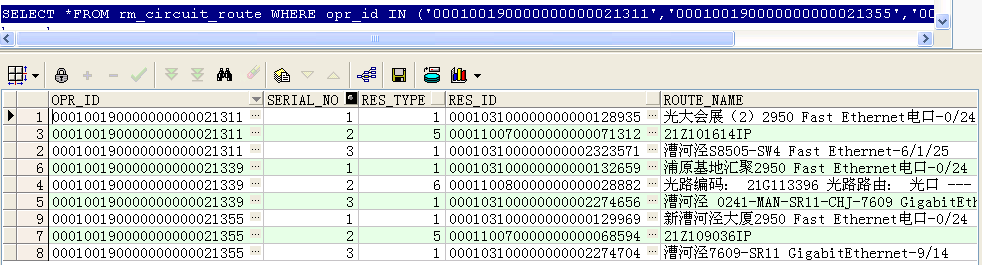
--找出这三条电路每条电路的第一条记录类型和最后一条记录类型
first_value(res_type) over(PARTITION BY opr_id ORDER BY res_type) low,
last_value(res_type) over(PARTITION BY opr_id ORDER BY res_type rows BETWEEN unbounded preceding AND unbounded following) high
FROM rm_circuit_route
WHERE opr_id IN ('000100190000000000021311','000100190000000000021355','000100190000000000021339')
ORDER BY opr_id;
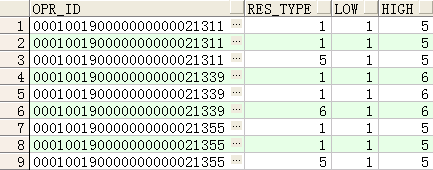
注:rows BETWEEN unbounded preceding AND unbounded following 的使用
--取last_value时不使用rows BETWEEN unbounded preceding AND unbounded following的结果
first_value(res_type) over(PARTITION BY opr_id ORDER BY res_type) low,
last_value(res_type) over(PARTITION BY opr_id ORDER BY res_type) high
FROM rm_circuit_route
WHERE opr_id IN ('000100190000000000021311','000100190000000000021355','000100190000000000021339')
ORDER BY opr_id;
如下图可以看到,如果不使用

数据如下:

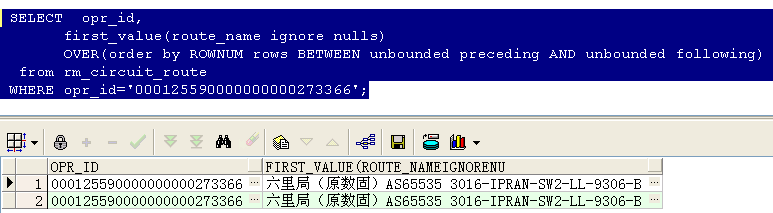
取出该电路的第一条记录,加上ignore nulls后,如果第一条是判断的那个字段是空的,则默认取下一条,结果如下所示:

lag(expresstion,<offset>,<default>)
with a as
(select 1 id,'a' name from dual
union
select 2 id,'b' name from dual
union
select 3 id,'c' name from dual
union
select 4 id,'d' name from dual
union
select 5 id,'e' name from dual
)
select id,name,lag(id,1,'')over(order by name) from a;
--lead() over()函数用法(取出后N行数据)
lead(expresstion,<offset>,<default>)
with a as
(select 1 id,'a' name from dual
union
select 2 id,'b' name from dual
union
select 3 id,'c' name from dual
union
select 4 id,'d' name from dual
union
select 5 id,'e' name from dual
)
select id,name,lead(id,1,'')over(order by name) from a;
--ratio_to_report(a)函数用法 Ratio_to_report() 括号中就是分子,over() 括号中就是分母
with a as (select 1 a from dual
union all
select 1 a from dual
union all
select 1 a from dual
union all
select 2 a from dual
union all
select 3 a from dual
union all
select 4 a from dual
union all
select 4 a from dual
union all
select 5 a from dual
)
select a, ratio_to_report(a)over(partition by a) b from a
order by a;
with a as (select 1 a from dual
union all
select 1 a from dual
union all
select 1 a from dual
union all
select 2 a from dual
union all
select 3 a from dual
union all
select 4 a from dual
union all
select 4 a from dual
union all
select 5 a from dual
)
select a, ratio_to_report(a)over() b from a --分母缺省就是整个占比
order by a;
with a as (select 1 a from dual
union all
select 1 a from dual
union all
select 1 a from dual
union all
select 2 a from dual
union all
select 3 a from dual
union all
select 4 a from dual
union all
select 4 a from dual
union all
select 5 a from dual
)
select a, ratio_to_report(a)over() b from a
group by a order by a;--分组后的占比
SELECT a.deptno,
a.ename,
a.sal,
a.r,
b.n,
(a.r-1)/(n-1) pr1,
percent_rank() over(PARTITION BY a.deptno ORDER BY a.sal) pr2
FROM (SELECT deptno,
ename,
sal,
rank() over(PARTITION BY deptno ORDER BY sal) r --计算出在组中的排名序号
FROM emp
ORDER BY deptno, sal) a,
(SELECT deptno, COUNT(1) n FROM emp GROUP BY deptno) b --按部门计算每个部门的所有成员数
WHERE a.deptno = b.deptno;

如下所示自己计算的pr1与通过percent_rank函数得到的值是一样的:
SELECT a.deptno,
a.ename,
a.sal,
a.r,
b.n,
c.rn,
(a.r + c.rn - 1) / n pr1,
cume_dist() over(PARTITION BY a.deptno ORDER BY a.sal) pr2
FROM (SELECT deptno,
ename,
sal,
rank() over(PARTITION BY deptno ORDER BY sal) r
FROM emp
ORDER BY deptno, sal) a,
(SELECT deptno, COUNT(1) n FROM emp GROUP BY deptno) b,
(SELECT deptno, r, COUNT(1) rn,sal
FROM (SELECT deptno,sal,
rank() over(PARTITION BY deptno ORDER BY sal) r
FROM emp)
GROUP BY deptno, r,sal
ORDER BY deptno) c --c表就是为了得到每个部门员工工资的一样的个数
WHERE a.deptno = b.deptno
AND a.deptno = c.deptno(+)
AND a.sal = c.sal;

如下,输入百分比为0.7,因为0.7介于0.6和0.8之间,因此返回的结果就是0.6对应的sal的1500加上0.8对应的sal的1600平均
SELECT ename,
sal,
deptno,
percentile_cont(0.7) within GROUP(ORDER BY sal) over(PARTITION BY deptno) "Percentile_Cont",
percent_rank() over(PARTITION BY deptno ORDER BY sal) "Percent_Rank"
FROM emp
WHERE deptno IN (30, 60);

SELECT ename,
sal,
deptno,
percentile_cont(0.6) within GROUP(ORDER BY sal) over(PARTITION BY deptno) "Percentile_Cont",
percent_rank() over(PARTITION BY deptno ORDER BY sal) "Percent_Rank"
FROM emp
WHERE deptno IN (30, 60);

注意:本函数与PERCENTILE_CONT的区别在找不到对应的分布值时返回的替代值的计算方法不同
SAMPLE:下例中0.7的分布值在部门30中没有对应的Cume_Dist值,所以就取下一个分布值0.83333333所对应的SALARY来替代
SELECT ename,
sal,
deptno,
percentile_disc(0.7) within GROUP(ORDER BY sal) over(PARTITION BY deptno) "Percentile_Disc",
cume_dist() over(PARTITION BY deptno ORDER BY sal) "Cume_Dist"
FROM emp
WHERE deptno IN (30, 60);

oracle下的OVER(PARTITION BY)函数介绍的更多相关文章
- row_number() OVER(PARTITION BY)函数介绍
OVER(PARTITION BY)函数介绍 开窗函数 Oracle从8.1.6开始提供分析函数,分析函数用于计算基于组的某种聚合值,它和聚合函数的不同之处是:对于每个 ...
- OVER(PARTITION BY)函数介绍
问题场景 最近在项目中遇到了对每一个类型进行求和并且求该类型所占的比例,当时考虑求出每种类型的和,并在java中分别对每一种类型的和与总和相除求出所占比例.后来,想到这样有点麻烦,并且项目中持久层使用 ...
- 【Oracle】row_number() over(partition by )函数用法
row_number() OVER (PARTITION BY COL1 ORDER BY COL2) 表示根据COL1分组,在分组内部根据 COL2排序,而此函数计算的值就表示每组内部排序后的顺序编 ...
- HIVE-利用ow_number() OVER(PARTITION BY)函数介绍求TOP-K
http://blog.csdn.net/631799/article/details/7419797 第一句话: select row_number() over (partition by mon ...
- oracle OVER(PARTITION BY) 函数
OVER(PARTITION BY)函数介绍 开窗函数 Oracle从8.1.6开始提供分析函数,分析函数用于计算基于组的某种聚合值,它和聚合函数的不同之处是:对于每个组返 ...
- Oracle自我补充之OVER()函数介绍
OVER(PARTITION BY)函数介绍 开窗函数 Oracle从8.1.6开始提供分析函数,分析函数用于计算基于组的某种聚合值,它和聚合函数的不同之处是:对于每个组返 ...
- 【Oracle】OVER(PARTITION BY)函数用法
http://blog.itpub.net/10159839/viewspace-254449/ ................................ OVER(PARTITION BY) ...
- OVER(PARTITION BY)函数用法
OVER(PARTITION BY)函数介绍 开窗函数 Oracle从8.1.6开始提供分析函数,分析函数用于计算基于组的某种聚合值,它和聚合函数的不同之处是:对于每个组返 ...
- 获得供应商最近一次报价:OVER(PARTITION BY)函数用法的实际用法
利用rownumber ,关键字partition进行小范围分页 方法一: --所有供应商对该产品最近的一次报价with oa as(select a.SupplierId ,UnitPrice,Pr ...
随机推荐
- svn的merge使用例子
先说说什么是branch.按照Subversion的说法,一个branch是某个development line(通常是主线也即trunk)的一个拷贝,见下图: branch存在的意义在于,在不干扰t ...
- mysql 闪回表工具
use HTTP::Date qw(time2iso str2time time2iso time2isoz); use POSIX; my $SDATE = strftime("%Y-%m ...
- wsse:InvalidSecurity Error When Testing FND_PROFILE Web Service in Oracle Applications R 12.1.2 from SOAP UI (Doc ID 1314946.1)
wsse:InvalidSecurity Error When Testing FND_PROFILE Web Service in Oracle Applications R 12.1.2 from ...
- p2p穿透技术
ios 怎么和wifi外设摄像头实时传输视频 ios 控制wifi摄像头外设的拍照.录像.删除照片等等都可以通过tcp/ip 发送定义好的json指令实现. 但是不知道怎么和wifi外设摄像头实时传输 ...
- tap,touch,touchstart,事件与click事件的区别
根据源码所见, 移动端为了将将单击事件更加灵敏,所以现在的JQM,ST...框架都将JS单击事件封装成tap,或者touch或者touchstart事件, 其实现本质是将click触发多次,以打成移动 ...
- 5个难以置信的VS 2015预览版新特性
Visual Studio 2015 Preview包含了很多强大的新特性,无论你是从事WEB应用程序开发,还是桌面应用程序开发,甚至是移动应用开发,VS 2015都将大大提高你的开发效率.有几个特性 ...
- Web打印控件smsx.cab使用说明
在项目开发中,经常会用到页面打印的功能,在ASP.NET环境下推荐一款web打印控件smsx.cab. 使用方法:一般会先定义一个用于打印的母版页(Print.Master),在母版页上做好布局 ...
- LeetCode Lowest Common Ancestor of a Binary Search Tree (LCA最近公共祖先)
题意: 给一棵二叉排序树,找p和q的LCA. 思路: 给的是BST(无相同节点),那么每个节点肯定大于左子树中的最大,小于右子树种的最小.根据这个特性,找LCA就简单多了. 分三种情况: (1)p和q ...
- [VC6]ONMESSAGE()宏编译时出现"sytax error ;"错误时
自定义消息时编译出错,经排查,在定义消息的头文件里 #define WM_XXX (WM_USER+1000); 最后多加了一个分号引起. 吐血.
- eayui 验证扩展
$.extend($.fn.validatebox.defaults.rules, { idcard : {// 验证身份证 validator : function(value) { return ...