
C# 委托浅析
C# 中的委托(Delegate)类似于 C 或 C++ 中函数的指针。委托(Delegate) 是存有对某个方法的引用的一种引用类型变量。引用可在运行时被改变。
委托(Delegate)特别用于实现事件和回调方法。所有的委托(Delegate)都派生自 System.Delegate 类。
委托的声明(没有方法体的函数加上delegate关键字):
        /// <summary>

        /// 无参委托

        /// </summary>

        public delegate void DelegaetNoReturnPara();

        /// <summary>

        /// 有参委托

        /// </summary>

        /// <param name="num"></param>

        public delegate void DelegatePara(int num);

        /// <summary>

        /// 有参带返回值的委托

        /// </summary>

        /// <param name="num"></param>

        public delegate int DelegateParaNumber(int num);

        /// <summary>

        /// 泛型委托

        /// </summary>

        /// <typeparam name="T"></typeparam>

        /// <param name="t"></param>

        /// <returns></returns>

        public delegate T DelegateGeneric<T>(T t);
我们用反编译工具查看一下
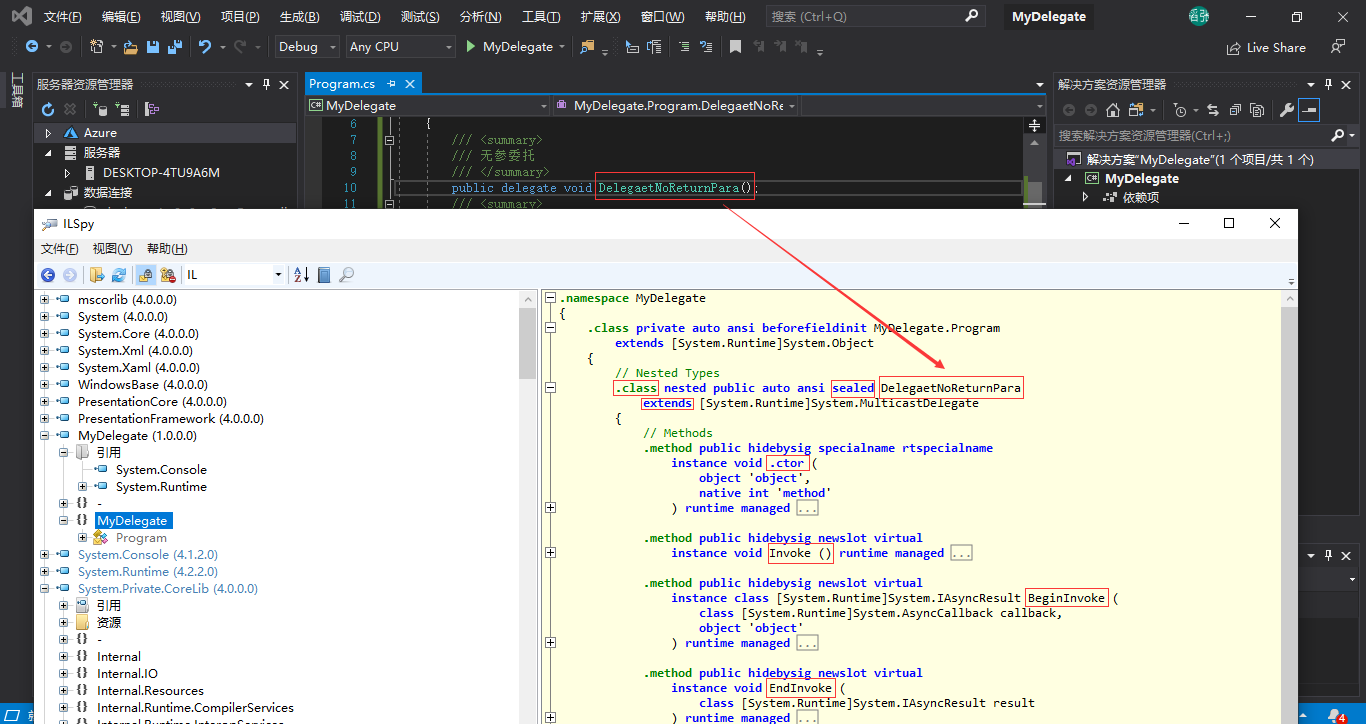
用反编译工具可以看到委托是一个密闭的方法并且继承于[System.Runtime]System.MulticastDelegate,委托有一个构造函数,带有Invoke、BeginInvoke、EndInvoke三个方法。
委托既然是类,那我们也可对其进行实例化
        public static void GetData(int num)

        {

            Console.WriteLine($"调用了{nameof(GetData)}方法");

        }

        public delegate void DelegatePara(int num);

        static void Main(string[] args)

        {

            Customer.GetData();
            //委托的实例化必须传递一个方法,这个方法的返回值和参数必须和实例化的这个委托一致
            //把方法包装成变量,Invoke的时候自动执行方法

            DelegatePara noReturnPara = new DelegatePara(Customer.GetData);
            noReturnPara.Invoke(1);//调用委托
            noReturnPara(1);

        }
在这里可能有同学会想,为什么不直接调用方法呢?ok,接着往下看.
有一个student类和一个获取集合对象的一个方法.
public class Student

{

    public string name { get; set; }

    public int age { get; set; }

    public string sex { get; set; }

}

public async Task<List<Student>> GetAllStudents()

{

    var result = new List<Student>();

    for (int i = ; i < ; i++)

    {

        result.Add(new Student

        {

            age =  + i,

            name = $"橘猫{i}",

            sex = i /  ==  ? "男" : "女"

        });

    }

    return result;

}
假如现在有三个判断条件筛选集合中的内容
/// <summary>

/// 查询name的长度大于2的同学

/// </summary>

/// <returns></returns>

public async Task<List<Student>> GetStudents()

{

    var result = new List<Student>();

    var data = await this.GetAllStudents();

    foreach (var item in data)

    {

        if (item.name.Length > )

            result.Add(item);

    }

    return result;

}
/// <summary>

/// 查询年龄大于18岁的同学

/// </summary>

/// <returns></returns>

public async Task<List<Student>> GetStudents()

{

    var result = new List<Student>();

    var data = await this.GetAllStudents();

    foreach (var item in data)

    {

        if (item.age > )

            result.Add(item);

    }

    return result;

}
/// <summary>

/// 查询年龄大于18岁并且是女生的同学

/// </summary>

/// <returns></returns>

public async Task<List<Student>> GetStudents()

{

    var result = new List<Student>();

    var data = await this.GetAllStudents();

    foreach (var item in data)

    {

        if (item.age >  && item.sex.Equals("女"))

            result.Add(item);

    }

    return result;

}
三个判断条件要写三个方法是不是太冗余了,我们直接写在一个方法里,根据条件类型来筛选数据
/// <summary>

/// 根据type来查询

/// </summary>

/// <returns></returns>

public async Task<List<Student>> GetStudents(int type)

{

    var result = new List<Student>();

    var data = await this.GetAllStudents();

    switch (type)

    {

        case :

            foreach (var item in data)

            {

                if (item.name.Length > )

                    result.Add(item);

            }

            break;

        case :

            foreach (var item in data)

            {

                if (item.age > )

                    result.Add(item);

            }

            break;

        case :

            foreach (var item in data)

            {

                if (item.age >  && item.sex.Equals("女"))

                    result.Add(item);

            }

            break;

        default:

            Console.WriteLine("查询的类型有误,请重新输入");

            break;

    }

    return result;

}
这样的话行是行,但是如果在多加一个条件呢?那么我们可不可以将判断逻辑传到方法里,只需返回true或false就行了.
//定义委托
public delegate bool judge(Student student);


//用来判断姓名

public bool judgeName(Student student)

{

    return student.name.Length > ;

}
//用来判断年龄

public bool judgeAge(Student student)

{

    return student.age > ;

}
//用来判断年龄和性别

public bool judgeAgeAndSex(Student student)

{

    return student.age >  && student.sex.Equals("女");

}
/// <summary>

/// 将判断逻辑传递过来

/// 委托解耦,减少重复代码,将公共逻辑当成变量传递过来

/// </summary>

/// <returns></returns>

public async Task<List<Student>> GetStudents(judge judge)

{

    var result = new List<Student>();

    var data = await this.GetAllStudents();

    foreach (var item in data)

    {

        if (judge.Invoke(item))

            result.Add(item);

    }

    return result;

}
有同学会说,你这代码也不精简,为什么不用lamda.这里的话主要是想告诉大家委托的作用,侧重点不同,望理解。
多播委托:
public delegate void DelegatePara(int num);

//这个委托实例只包含一个方法

DelegatePara noReturnPara = new DelegatePara(Customer.GetData);
//+= 为委托实例按顺序增加方法,形成方法链,依次执行

DelegatePara noReturnPara = new DelegatePara(Customer.GetData);

noReturnPara += new DelegatePara(Customer.GetData);

noReturnPara += new DelegatePara(new DelegateInstance().GetData);

noReturnPara.Invoke();//调用委托
//-= 为委托实例移除方法,从方法链的底部开始匹配,遇到第一个完全吻合的,移除且只移除一个

noReturnPara += new DelegatePara(Customer.GetData);

noReturnPara += new DelegatePara(new DelegateInstance().GetData);//这个去不掉,因为不是同一个实例中的方法
//循环获得委托中的实例

foreach (var item in noReturnPara.GetInvocationList())

{

    item.DynamicInvoke();//调用委托

}
多播委托如果带返回值,结果以最后的为准。
事件:是带event关键字的委托实例,event可以限制变量被外部调用/直接赋值
public delegate void HandleEvent(int num);

public event HandleEvent handleEvent;

public void DelegateEvent()

{

    handleEvent = new HandleEvent(Customer.GetData);

    handleEvent.Invoke();

}
如果不是在本身所在的类中调用(事件)会如何呢?

很明显报错了
只能像下面这样写
DelegateInstance delegateInstance = new DelegateInstance();

delegateInstance.handleEvent += new DelegateInstance.HandleEvent(Customer.GetData);

Console.ReadKey();
这里需要说一下:Event+委托的一个实例,加上一个event关键字限制了外部调用权限,保证其安全(不能再其它类中调用和赋值,只能用来添加和移除注册方法),在本身类中可以调用和赋值,但是在子类中也不可以调用和赋值.
委托与事件的区别和联系:委托是一个类型(委托的本质是一个类);事件是委托类型的一个实例.
ok,今天先到这儿。如有不足的地方,望见谅。
C# 委托浅析的更多相关文章
- C#委托及事件处理机制浅析
事件可以理解为某个对象所发出的消息,以通知特定动作(行为)的发生或状态的改变.行为的发生可能是来自用户交互,如鼠标点击:也可能源自其它的程序逻辑.在这里,触发事件的对象被称为事件(消息)发出者(sen ...
- 浅析C#之委托、Action、Func
一.委托 1.1 委托的定义 delegate(委托)是一种可用于封装命名方法或匿名方法的引用类型, 委托类似于 C++ 中的函数指针: .Net通过委托来提供回调函数机制. 声明一个委托类型 int ...
- c#委托之浅析
前言: 这章我们将弄懂,委托是什么?有什么作用?在什么样的场景下可以启到什么作用? 委托适用的场景:当确定处理一个任务时,不确定其处理任务的方法时可使用,这样可以提高扩展性,调用符合条件的处理方法,避 ...
- 读书笔记 C#委托的BeginInvoke、EndInvoke之浅析
c#中有一种类型叫委托,它是一种引用类型.可以引用静态与非静态的方法,且这些方法的参数列表和返回值类型必须与所声明的委托一致. 委托引用的方法可以通过BeginInvoke和EndInvoke来异步进 ...
- c#进阶之浅析委托和事件
何为委托 加了delegate关键字,没有方法体{}的方法模版(方法列表);委托是一种类型 public void Write() { //TODO } //加上关键字delegate,去掉方法体{} ...
- C#回调浅析(委托、接口回调)
https://wenku.baidu.com/view/ed724173bd64783e08122b2f.html
- 【深入浅出jQuery】源码浅析2--奇技淫巧
最近一直在研读 jQuery 源码,初看源码一头雾水毫无头绪,真正静下心来细看写的真是精妙,让你感叹代码之美. 其结构明晰,高内聚.低耦合,兼具优秀的性能与便利的扩展性,在浏览器的兼容性(功能缺陷.渐 ...
- Reactive Extensions(Rx)并发浅析
Reactive Extensions(Rx)并发浅析 iSun Design & Code .Net并行编程 - Reactive Extensions(Rx)并发浅析 关于Reactive ...
- C# Winform窗口之间传值的多种方法浅析(转)
摘要http://www.jb51.net/article/63837.htm 这篇文章主要介绍了C# Winform窗口之间传值的多种方法浅析,本文起讲解了通过构造器传值.通过属性传递.通过事件携带 ...
随机推荐
- HTTP请求头中的X-Forwarded-For介绍
概述 我们在做nginx方向代理的时候,为了记录整个代理过程,我们往往会在配置文件中加上如下配置: location ^~ /app/download/ { ... proxy_set_header ...
- 吃零食 csust oj 贪心
吃零食 桌上有n袋零食,不同的零食会有不同的美味程度wi和腐坏程度di,每种零食在一单位时间内美味程度都会下降di,但是不会降到0以下. qwb每一单位时间可以吃掉一袋零食.现在qwb想要在吃完所有零 ...
- SpringData Redis的简单使用
SpringDate Redis是在Jedis框架的基础之上对Redis进行了高度封装,通过简单的属性配置就可以通过调用方法完成对Redis数据库的操作,而且SpringData Redis使用了连接 ...
- Collections集合工具类常用的方法
java.utils.Collections //是集合工具类,用来对集合进行操作.部分方法如下: public static <T> boolean addAll(Collection& ...
- 动态代理学习(一)自己动手模拟JDK动态代理
最近一直在学习Spring的源码,Spring底层大量使用了动态代理.所以花一些时间对动态代理的知识做一下总结. 我们自己动手模拟一个动态代理 对JDK动态代理的源码进行分析 文章目录 场景: 思路: ...
- lambda表达式入门详解
转自 2018-03-02 Sevenvidia 码农翻身 1.什么是Lambda? 我们知道,对于一个Java变量,我们可以赋给其一个"值". 如果你想把"一块代码 ...
- EChart将timeline图标设置为加号
一 要实现的效果 二 官方文档 看一下官方文档上,替换symbol的描述: timeline.symbol string [ default: 'emptyCircle' ] timeline标记的图 ...
- Flutter为什么使用Dart?
老孟导读:关于Flutter为什么使用Dart?这个话题,就像PHP是世界上最好的语言一样,争论从来没有停止过,有很多说法,比如: Google是为了推广Dart,Dart是亲儿子. Flutter团 ...
- (1)从通信中的MCS含义开始讲起
通信中的MCS:Modulation and Coding Scheme,意思为调制编码方案/调制编码策略,其内涵可分为两个部分:Modulation 和 Coding. 在基带的信号处理流程中, ...
- python3语法学习第四天--字符串
字符串:是python中的常用数据类型 Python 不支持单字符类型,单字符在 Python 中也是作为一个字符串使用 访问字符串的值: 下标和分片截取 字符串的连接:‘+’ 字符串内置函数挺多,选 ...