
Use a TL431 shunt regulator to limit high ac input voltage
Most isolated, offline SMPSs (switched-mode power supplies), including flyback, forward, and resonant, must operate at input voltages of 90 to 260V rms. Some cases even use line-to-line voltages of 400V rms±10%, leading to increased component-voltage ratings and, thus, increased cost of the overall design. In such cases, it is preferable to use input-limiting circuits, allowing you to increase the input voltage to 440V rms without damaging the power-supply components.
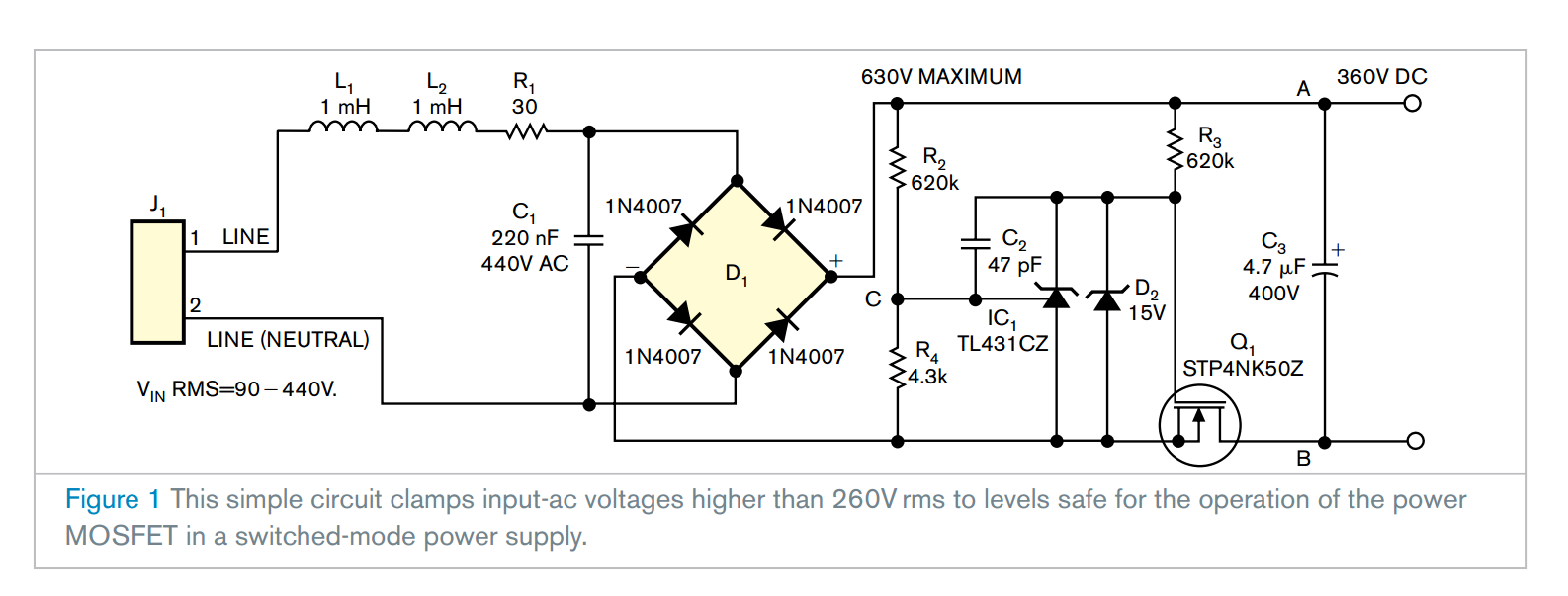
The circuit in Figure 1 limits, or clamps, input-ac voltages higher than 260V rms to levels safe for the operation of the power MOSFET in an SMPS. The circuit employs MOSFET Q1 working as a 100-Hz switch and shunt-regulator IC1, a TL431CZ, setting the clamped high-voltage level by divider R2 and R4. The circuit uses the component values shown. The clamped output voltage is 360V dc, the input voltage is 260V rms, and the maximum input voltage is 440V rms. The circuit was tested at power levels of 5 to 10W.
At an input voltage of less than 260V rms, Point C is less than 2.5V, and IC1 is off, sinking the minimum off-state cathode current. Zener diode D2 breaks down to 15V, ensuring a stable on-state for Q1. This operation is the normal condition of Q1 at input voltages lower than 260V rms. Accordingly, at these voltage levels, the circuit works as a standard full-bridge rectifier under capacitive load C3.
At an input voltage of 260V rms or greater, Point C becomes higher than 2.5V, and IC1turns on, diverting and sinking the current from D2. The gate-to-source voltage of Q1drops to approximately 2V, and Q1 switches off. Now, no current flows to charge bulk capacitor C3 even if the D1 bridge-rectifier diodes are forward-biased. The rectified input-ac voltage is higher than the voltage across C3, but Q1 is off, the loop is interrupted, and no current flows. Accordingly, the output-dc voltage across C3 gets limited because no charging current is available.
When the rectified ac-input voltage starts decreasing, it eventually hits the 2.5V threshold level of Point C, and Q1 again switches on. But current does not flow because the rectifier bridge’s diodes are now reverse-biased; the rectified input-ac voltage is less than the voltage across C3. The voltage across C3 decreases at a rate that the output-power level determines. Eventually, the voltage across C3 and the rectified input-ac voltage intersect at a level when the rectifier bridge’s diodes get forward-biased. Q1 is still on; therefore, charging current starts flowing. A short interval follows, during which both Q1 and D1 conduct. The short charging pulses replenish the energy loss, increasing the voltage to the limited level. When the input voltage gets higher than 260V rms, Q1 again switches off, and the whole process repeats.
Q1 has small power dissipation. During every switching period, the MOSFET is on for only 450 µsec, resulting in high efficiency for this high-voltage-limiting circuit. You can use it as a MOSFET switch with the STMicroelectronics SuperMesh MOSFET STP4NK50Z, which comes in a TO-220 package, but you can also use a Dpak to save space because the MOSFET is not a dissipative-voltage limiter. The current through Q1gets interrupted when the 50/60-Hz rectifying diodes are forward-biased. This current interruption causes ringing on the drain-to-source voltage. The clamping circuit passed the conducted EMI (electromagnetic-interference) tests, according to EN 55022 Class B, using peak and average detection. The 1-mH, 0.2A chokes, L1 and L2, suppress EMI. The 220-nF, 440V-ac capacitor, C1, is a simple snubber element across the rectifying diodes of the D1 bridge.
Use a TL431 shunt regulator to limit high ac input voltage的更多相关文章
- MOSFET shunt regulator substitutes for series regulator
You would normally use a series linear regulator or a dc/dc converter to obtain 3V dc from a higher ...
- Regulator IC forms convenient overvoltage detector
Figure 1 shows a simple, stand-alone overvoltage detector. The intent of the circuit is to monitor a ...
- Linear regulator=low-cost dc/dc converter
The circuit in Figure 1 is a good choice if you need a power supply with high efficiency and you don ...
- Simple dc/dc converter increases available power in dual-voltage system
The schematic in Figure 1 shows a way to increase the power available from a current-limited 5V supp ...
- Tiny microcontroller hosts dual dc/dc-boost converters
Batteries are the typical power sources for portable-system applications, and it is not unusual thes ...
- BQ24296充电管理芯片使用过程中的注意事项
BQ24296遇到的一点问题 概述:BQ24296是TI出品的具有窄范围VDC控制.基于I2C通讯的最大支持3A充电电流的开关式电源路径管理芯片.可以轻松实现2A以上的大电流充电,能量转换效率达到90 ...
- Cascode MOSFET increases boost regulator's input- and output-voltage ranges
Targeting use in portable-system applications that require raising a battery's voltage to a higher l ...
- Changing the Output Voltage of a Switching Regulator on the Fly
http://www.powerguru.org/changing-the-output-voltage-of-a-switching-regulator-on-the-fly/ There are ...
- Linux Regulator Framework(2)_regulator driver
转自蜗窝科技:http://www.wowotech.net/pm_subsystem/regulator_driver.html 说实话,这篇好难懂啊... 1. 前言 本文从regulator d ...
随机推荐
- spring-mybatis.xml配置
1.自动扫描 <context:component-scan base-package="com.javen" /> 2.引入配置文件 <bean id=&quo ...
- ~Delphi const 杂谈~
来自:http://www.cnblogs.com/tibetwolf/articles/1785744.html ------------------------------------------ ...
- 使用coding云作为git远程库
1.在命令行中创建GIT仓库 mkdir DriveAssistant cd DriveAssistant git init echo "# DriveAssistant" > ...
- C语言 五子棋
#include <stdlib.h> #include <stdio.h> #include <conio.h> #include <string.h> ...
- HEVC代码记录(删除)
得到编码残差 TEncSearch.cpp 4543:rpcYuvResi->subtract( pcYuvOrg, pcYuvPred, 0, uiWidth );
- EF – 4.CRUD与事务
5.6.1 <Entity Framework数据更新概述> 首先介绍Entity Framework实现CRUD的基本方法,接着介绍了如何使用分部类增强和调整数据实体类的功能与行为特性 ...
- awk书上练习
文件car: plym fury chevy malibu ford mustang volvo s80 ford thundbd chevy malibu bmw 325i honda accord ...
- 字符串处理strcpy strcat函数的用法
C语言函数字符串处理strcpy strcat函数的用法: 1)strcat是用来连接两个字符串的,原型是char *strcat(char *dest,char *src),作用是把src所指字符串 ...
- 快速搭建sonar代码质量管理平台
安装 下载,直接解压http://www.sonarqube.org/downloads/ 添加mysql驱动至\extensions\jdbc-driver\mysql\ 创建mysql数据库和用户 ...
- Java常用工具类之Excel导出
package com.wazn.learn.util; import java.util.List; import java.util.Map; import org.apache.poi.hssf ...