
Ionic + AngularJS
Ionic Framework
Ionic framework is the youngest in our top 5 stack, as the alpha was released in late November 2013. Built on top of the popular AngularJS framework from Google, Ionic utilizes AngularJS to provide the application structure, while Ionic itself focuses on the user interface. In other words, we see a match between the power of Angular and the beauty of Ionic UI.
Ionic provides a set of Angular directives (custom HTML elements) for it’s own components, making it as easy to use the widgets as writing a line of HTML code. In addition to directives, Ionic uses Angular’s touch recognizers, view animation logic, HTML sanitation, and asynchronous communication.
While you can use Ionic straight after cloning or unpacking the library zip, you can also install their Node.js-based CLI through NPM and start quickly with their seed project.
Even though Angular is currently the Ionic’s workhorse, the developers are keeping their (and ours) options open with plans to support other frameworks such as Knockout or EmberJS. This particular review is strongly influenced by AngularJS and it doesn’t vouch for the accuracy with other frameworks when Ionic support emerges.
MV* Pattern
Angular JS used to be an MVC framework, but over time it became closer to MVVM where the $scope object acts as a ViewModel, manipulated through a Controller function. With such a flexible approach developers can use MVC or MVVM per their liking, as long as the goal is achieved: separating presentation from business logic while boosting maintainability and productivity.
Class System
Neither Angular JS or Ionic are object oriented JavaScript frameworks so they don’t make use of a class system. This can (but shouldn’t) be observed as a weakness or a strength, depending on the level of simplicity requested on the JavaScript front end.
DOM control
Angular embeds jqLite, a fraction of jQuery that allows DOM manipulation in a cross-browser compatible manner, leaving a very small footprint. For extended functionality, jQuery can be loaded with the document.
UI and Theming
When it comes to UI, Ionic shows its potential. Ionic’s true beauty is its simplicity. In almost Google-like (but not Android-like) style it uses the existing HTML5 and CSS3 capabilities to deliver fast experiences. The speed is exactly in its simplicity – no unnecessary shadows, rounded corners, gradients but just flat, clean simple, powerful, unadulterated HTML5. Ionic doesn’t promise you native-looking UI, but it does deliver very fast and consistent interface, even on the devices you considered to be slow with rendering HTML5 apps.
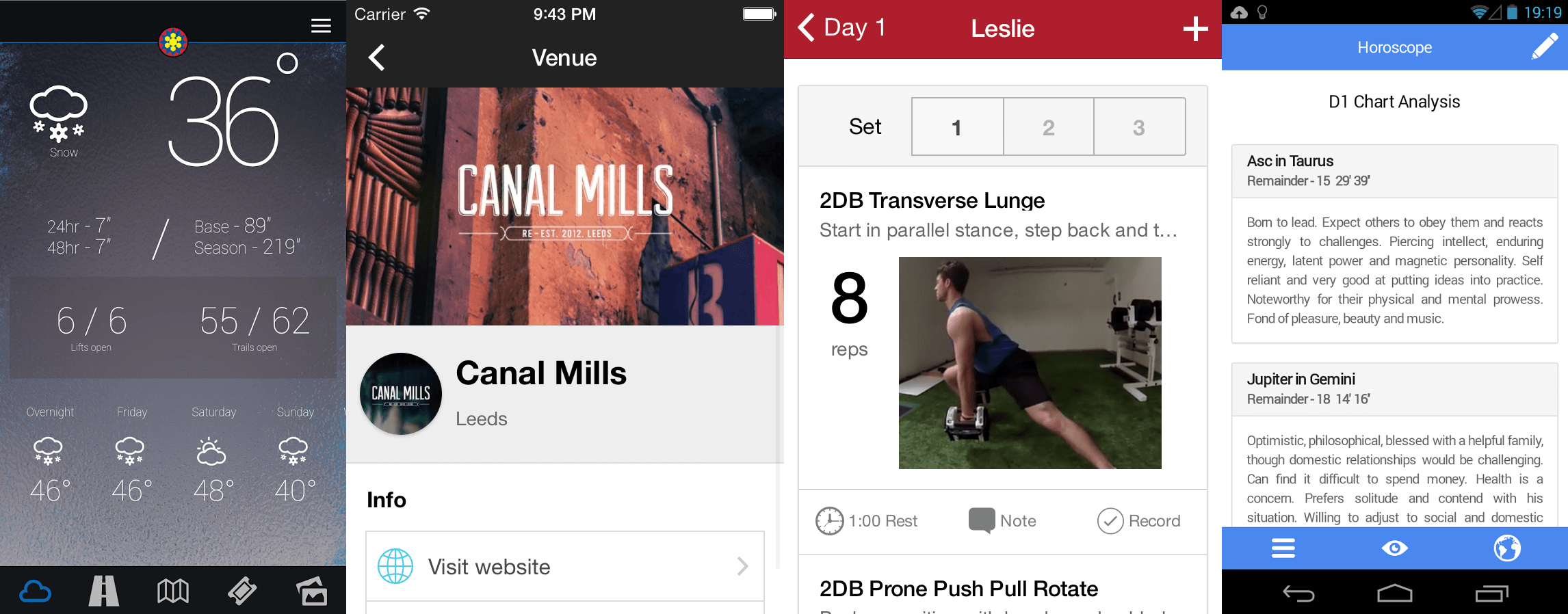
Customizable through SASS, Ionic comes with handy variables and mixins to extend for customized appearance. Additionally, it’s packaged with its own open sourced icon library featuring over 440 icons to chose from.
Widgets
Ionic’s components are powerfully simple. They are custom HTML elements, as per Angular directive principles, but Ionic also provides Controllers to complement configuration and interaction. While some frameworks may provide more complex widgets, Ionic offers somewhat simpler building blocks that can be combined to deliver rich user interfaces. As of alpha version, the framework provides with a plethora of form elements, header and footer bars, buttons, a simple list with customizable items, grid elements, and more.
Responsive Design (RWD)
Internally, Ionic leverages Responsive Web Design principles to yield optimized experience such as based on screen size or pixel density. Any app-specific RWD scenarios are welcome and will play very nicely with Ionic.
Desktop support
Meant for hybrid mobile applications (installable on a mobile device through an app store), Ionic is not meant to be be used for desktop web apps/sites. While the content will be displayed nicely, it will be optimized for its intended purpose. Those wishing to create apps that fit both environments can stay with Angular JS, but use Zurb Foundation, Twitter Bootstrap or similar UI library.
Third party plugins
No third party plugins or extensions are available at the moment.
Extensibility
Much of extensibility in Ionic will come either from (S)CSS or creating Angular directives and controllers. That makes extensibility an integral part of application development – unavoidable, but not demanding at all. Even the developers new at Ionic and Angular won’t struggle.
Building tools
Grunt is used for building Ionic making that #1 JavaScript building tool that much more attractive for your project’s purposes.
Packaging (native)
Ionic apps will require external tools for packaging purposes. It is tested to work with PhoneGap, Cordova, and Trigger.io.
Device API
Ionic does not support device APIs.
Documentation
Ionic’s documentation is decently complete considering the alpha stage of the framework. Example rich, the docs show a preview of what most of components will do on a mobile device. And the preview is very attractive, too.
Angular’s documentation will satisfy beginner developers, but may soon become insufficient. As the appetites for information grow to expert levels, developers may be forced to resort to the source code or elsewhere.
License
Both Ionic and AngularJS are available under the MIT license.
Community
Since it’s in a very early stage of life, Ionic still doesn’t have a mature community. However, given the same circumstance, its popularity is raising faster than for many other (and older) frameworks.
What would they say?
JavaScript developer:
A refreshing and straight forward way of building rich apps no matter the size. The MVC and MVVM patterns are done cum grano salis,
as the old latin would say had they had the opportunity to work with
Angular JS. Additionally, as views are defined using HTML and data
models as simple as plain JavaScript objects, the developers will easily
end up writing less code and use less of the expensive time to produce
high quality apps.
Designer:
Passionate designers will love Ionic as it allows them to customize the
layout to their liking, without having to modify someone else’s
complicated widgets and potentially break the app’s functionality.
Customizing the UI may remind of working with Zurb Foundation or Twitter
Bootstrap.
Product manager:
The initial barrier to get started with AngularJS is very low, without
needing to know the entire framework in order to build an easy app.
However, beginners faced with more advanced tasks in a complex
application will face an increasingly steep learning curve. Also,
Angular is built with testing in mind. Make use of it early in the game.
Keep in mind that Ionic is meant to be used for hybrid apps and not mobile websites.
Ionic + AngularJS的更多相关文章
- Cordova Ionic AngularJS
实践分享:开始用Cordova+Ionic+AngularJS开发App http://www.cocoachina.com/webapp/20150707/12395.html
- Ionic/Angularjs 知识点解析
Ionic/Angularjs 知识点解析 angular-ui-router(状态跳转) state的定义:(在app.js的config下配置) $stateProvider .state('ap ...
- 【Ionic+AngularJS 开发】之『个人日常管理』App(一)
写在前面的话 过去一年自己接触了不少手机前端开发,得益于现在手机性能的提升和4G普及,感觉使用混合技术开发手机App已经可以满足越来越多的应用场景了.新年伊始,对自己2016年所学知识做一个阶段性 ...
- WebApp开发框架Ionic+AngularJS+Cordova
目前的手机APP有三类:原生APP.WebAPP.HybridApp:HybridApp结合了前两类APP各自的优点,越来越流行. Ionic Ionic是一个新的.可以使用HTML5构建混合移动应用 ...
- 【Ionic+AngularJS 开发】之『个人日常管理』App(二)
准备工作 资源 预装工具 安装bower npm install -g bower 安装ngCordova bower install ngCordova (*由于网络获取资源的原因,后面几次建项目后 ...
- HybridAPP开发框架Ionic+AngularJS+Cordova搭建
Ionic Ionic是一个新的.可以使用HTML5构建混合移动应用的用户界面框架,它自称为是"本地与HTML5的结合".该框架提供了很多基本的移动用户界面范例,例如像列表(lis ...
- Ionic+AngularJS 开发的页面在微信公众号下显示不出来原因查究
ionic 页面 微信浏览器遇到的坑 公司的微信公众号一部分页面是用AngularJS+Ioinc开发,发现在本地浏览器测试的时候都没问题,传到服务器在微信公众号下跑就出问题来,经查是: index- ...
- 实践分享:开始用Cordova+Ionic+AngularJS开发App
http://www.cocoachina.com/webapp/20150707/12395.html 本文是一篇关于我本人在使用Cordova+Ionic以及AngularJS开发移动App的过程 ...
- ionic+angularjs开发hybrid App(环境配置+创建测试项目)
本文使用的系统是win10 因为后期需要使用nodejs 所以先把node装好 https://nodejs.org/download/ 下载JDK并配置Java运行环境 http://www.ora ...
随机推荐
- uoj228 基础数据结构练习题
趁别人题解没有放出来赶快写一篇 整数序列,操作 区间加 区间变成sqrt(下取整) 区间和 考虑一下对于每个区间里所有sqrt不同的段操作,那么可以在O(段数logn)一次的时间内完成sqrt操作.考 ...
- svn 更新命令(冲突时使用theirs)
svn cleanup svn revert -R -q ./ svn up --force --accept tc
- 出现个Expression(str != NULL)
CPrimerPlus的11章复习题10:编写个函数,其参数为一个字符串指针,返回一个指针,返回的指针指向字符串中第一个空格的位置(如果没有空格就返回空指针) #include <stdio.h ...
- python中如何避免中文是乱码
这个问题是一个具有很强操作性的问题.我这里有一个经验总结,分享一下,供参考:首先,提倡使用utf-8编码方案,因为它跨平台不错.经验一:在开头声明: # -*- coding: utf-8 -*- 有 ...
- __cdecl 、__fastcall、__stdcall
调用约定: __cdecl __fastcall与 __stdcall,三者都是调用约定(Calling convention),它决定以下内容:1)函数参数的压栈顺序,2)由调用者还是被调用者把参数 ...
- python selenium中使用ddt进行数据驱动测试
- SignalR 2.1 简单入门项目
概述 SignalR是通讯框架,前台Web页面与后台服务实现数据的交互.ASP.NET SignalR 是一个为 ASP.NET 开发人员的库,简化了将实时 web 功能添加到应用程序的过程.实时We ...
- Power BI for Office 365(二)Power Query
在上一篇中我们看到了Power BI在移动端的支持,从这一篇起降依次介绍Power BI中的各个功能组件,此篇讲通过一个故事来介绍如何在Power Query中获取并且组织数据. 在这个系列中,我们将 ...
- 基于requests实现极客学院课程爬虫
背景 本文主要是为了完成极客学院课程<Python 单线程爬虫>中讲师布置的实战作业. 开发环境 操作系统:windows 10 Python :Python 2.7 IDE:PyChar ...
- 目标跟踪_MeanShift
找到一些关于目标跟踪的资料 http://blog.csdn.net/jinshengtao/article/details/30258833 http://blog.sina.com.cn/s/bl ...