
Spring Aop源码分析
最近看了SpringAop的源码实现 大概记录一下aop的源码流程
创建一个最简单的一个测试类
package com.zcg.learn.Test;
import org.aopalliance.aop.Advice;
import org.junit.Test;
import org.springframework.aop.aspectj.AspectJExpressionPointcutAdvisor;
import org.springframework.aop.aspectj.annotation.AspectJProxyFactory;
import org.springframework.aop.framework.Advised;
import org.springframework.aop.framework.ProxyFactory;
import org.springframework.tests.aop.advice.CountingAfterReturningAdvice;
import org.springframework.tests.aop.advice.CountingBeforeAdvice;
import com.zcg.learn.UserService;
import com.zcg.learn.UserServiceImpl;
/**
* SpringAop源码分析测试类
* @author zcg
* 2018/3/1
*
*/
public class SpringAopTest {
/**
* 创建代理
*/
@Test
public void createProxyTest() {
Object target = new UserServiceImpl();
ProxyFactory pf = new ProxyFactory(target);
//CountingBeforeAdvice 前置通知计数器
CountingBeforeAdvice countingBeforeAdvice = new CountingBeforeAdvice();
pf.addAdvice(countingBeforeAdvice);
UserService service = (UserService) pf.getProxy();
service.addUser();
}
/**
* 动态添加 移除通知
*/
@Test
public void createProxyTest2() {
Object target = new UserServiceImpl();
ProxyFactory pf = new ProxyFactory(target);
UserService service = (UserService) pf.getProxy();
Advised advised = (Advised) service;
CountingBeforeAdvice countingBeforeAdvice = new CountingBeforeAdvice();
CountingAfterReturningAdvice countingAfterReturningAdvice = new CountingAfterReturningAdvice();
advised.addAdvice(countingAfterReturningAdvice);
advised.addAdvice(countingBeforeAdvice);
service.addUser();
advised.removeAdvice(countingAfterReturningAdvice);
service.addUser();
}
@Test
public void createProxyAspectJByTest() {
Object target = new UserServiceImpl();
AspectJProxyFactory pf = new AspectJProxyFactory(target);
AspectJExpressionPointcutAdvisor advisor = new AspectJExpressionPointcutAdvisor();
advisor.setExpression("execution(* *.addUser(..))");
CountingBeforeAdvice counting = new CountingBeforeAdvice();
advisor.setAdvice(counting);
pf.addAdvisor(advisor);
UserService userService = pf.getProxy();
userService.addUser();
/**
* advice 通知拦截器
* advisor 通知加切入点适配器
*/
}
}
其中测试方式
@Test
public void createProxyTest() {
Object target = new UserServiceImpl();
ProxyFactory pf = new ProxyFactory(target);
//CountingBeforeAdvice 前置通知计数器
CountingBeforeAdvice countingBeforeAdvice = new CountingBeforeAdvice();
pf.addAdvice(countingBeforeAdvice);
UserService service = (UserService) pf.getProxy();
service.addUser();
}
1.target 以构造参数的形式放入在ProxyFactory中,实际上将该tartget放入在AdvisedSupport类中
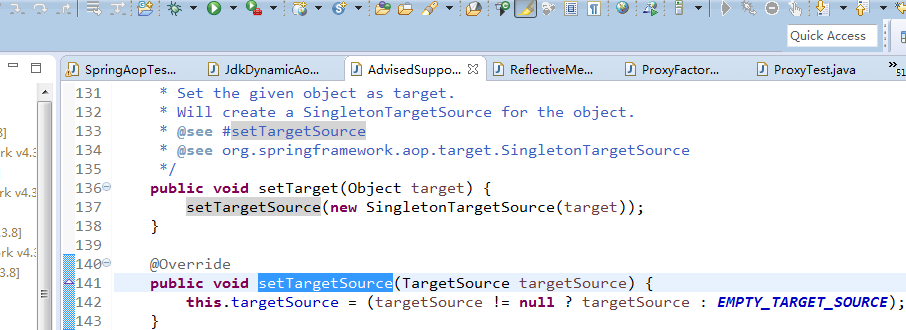
2.countingBeforeAdvice 为Spring Aop自带的前置通知计数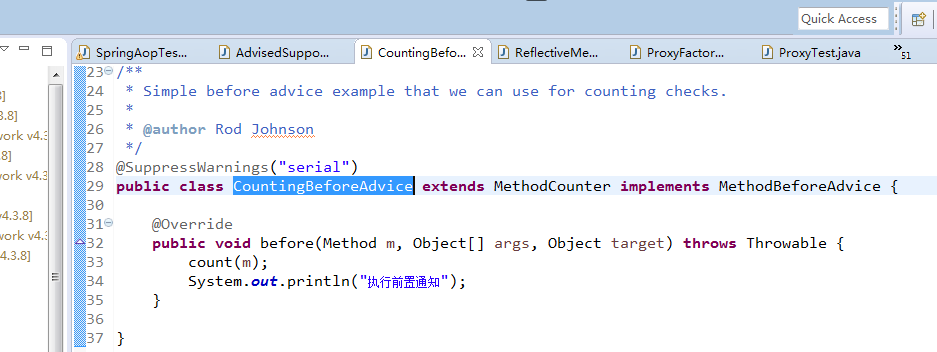
3.1 UserService service = (UserService) pf.getProxy();从中获取代理类
ProxyFactory类中 extends ProxyCreatorSupport
/*
* 代理生成工厂
*/
@SuppressWarnings("serial")
public class ProxyFactory extends ProxyCreatorSupport {
/**
* Create a new proxy according to the settings in this factory.
* <p>Can be called repeatedly. Effect will vary if we've added
* or removed interfaces. Can add and remove interceptors.
* <p>Uses a default class loader: Usually, the thread context class loader
* (if necessary for proxy creation).
* @return the proxy object
*/
public Object getProxy() {
return createAopProxy().getProxy();
}
}
3.2 createAopProxy()方法是父类ProxyCreatorSupport里面的方法
protected final synchronized AopProxy createAopProxy() {
if (!this.active) {
activate();
}
//得到Aop代理工厂和在当前代理工厂创建该代理类
return getAopProxyFactory().createAopProxy(this);
}
其中getAopProxyFactory().createAopProxy(this)在DefaultAopProxyFa1ctory类中执行 具体代码如下
@SuppressWarnings("serial")
public class DefaultAopProxyFactory implements AopProxyFactory, Serializable {
@Override
public AopProxy createAopProxy(AdvisedSupport config) throws AopConfigException {
if (config.isOptimize() || config.isProxyTargetClass() || hasNoUserSuppliedProxyInterfaces(config)) {
Class<?> targetClass = config.getTargetClass();
if (targetClass == null) {
throw new AopConfigException("TargetSource cannot determine target class: " +
"Either an interface or a target is required for proxy creation.");
}
//r如果目标类有接口或者是代理类,则走jdk的动态代理 否则走cglib的动态代理
if (targetClass.isInterface() || Proxy.isProxyClass(targetClass)) {
return new JdkDynamicAopProxy(config);
}
return new ObjenesisCglibAopProxy(config);
}
else {
return new JdkDynamicAopProxy(config);
}
}
/**
* Determine whether the supplied {@link AdvisedSupport} has only the
* {@link org.springframework.aop.SpringProxy} interface specified
* (or no proxy interfaces specified at all).
*/
private boolean hasNoUserSuppliedProxyInterfaces(AdvisedSupport config) {
Class<?>[] ifcs = config.getProxiedInterfaces();
return (ifcs.length == 0 || (ifcs.length == 1 && SpringProxy.class.isAssignableFrom(ifcs[0])));
}
}
3.3 JdkDynamicAopProxy类实现了InvocationHandler 对invoke进行的重写 核心代码如下
final class JdkDynamicAopProxy implements AopProxy, InvocationHandler, Serializable {
@Override
public Object invoke(Object proxy, Method method, Object[] args) throws Throwable {
MethodInvocation invocation;
Object oldProxy = null;
boolean setProxyContext = false;
TargetSource targetSource = this.advised.targetSource;
Class<?> targetClass = null;
Object target = null;
try {
if (!this.equalsDefined && AopUtils.isEqualsMethod(method)) {
// The target does not implement the equals(Object) method itself.
return equals(args[0]);
}
else if (!this.hashCodeDefined && AopUtils.isHashCodeMethod(method)) {
// The target does not implement the hashCode() method itself.
return hashCode();
}
else if (method.getDeclaringClass() == DecoratingProxy.class) {
// There is only getDecoratedClass() declared -> dispatch to proxy config.
return AopProxyUtils.ultimateTargetClass(this.advised);
}
else if (!this.advised.opaque && method.getDeclaringClass().isInterface() &&
method.getDeclaringClass().isAssignableFrom(Advised.class)) {
// Service invocations on ProxyConfig with the proxy config...
return AopUtils.invokeJoinpointUsingReflection(this.advised, method, args);
}
Object retVal;
if (this.advised.exposeProxy) {
// Make invocation available if necessary.
oldProxy = AopContext.setCurrentProxy(proxy);
setProxyContext = true;
}
// May be null. Get as late as possible to minimize the time we "own" the target,
// in case it comes from a pool.
target = targetSource.getTarget();
if (target != null) {
targetClass = target.getClass();
}
// Get the interception chain for this method. 生成通知链条 当前对象和方式是否在拦截范围内
List<Object> chain = this.advised.getInterceptorsAndDynamicInterceptionAdvice(method, targetClass);
// Check whether we have any advice. If we don't, we can fallback on direct
// reflective invocation of the target, and avoid creating a MethodInvocation.
//如果没有调用掉直接执行方式
if (chain.isEmpty()) {
// We can skip creating a MethodInvocation: just invoke the target directly
// Note that the final invoker must be an InvokerInterceptor so we know it does
// nothing but a reflective operation on the target, and no hot swapping or fancy proxying.
Object[] argsToUse = AopProxyUtils.adaptArgumentsIfNecessary(method, args);
retVal = AopUtils.invokeJoinpointUsingReflection(target, method, argsToUse);
}
else {
// We need to create a method invocation...
//初始化MethodInvocation类
invocation = new ReflectiveMethodInvocation(proxy, target, method, args, targetClass, chain);
// Proceed to the joinpoint through the interceptor chain.
执行调用链的所有方法和本身方法
retVal = invocation.proceed();
}
// Massage return value if necessary.
Class<?> returnType = method.getReturnType();
if (retVal != null && retVal == target &&
returnType != Object.class && returnType.isInstance(proxy) &&
!RawTargetAccess.class.isAssignableFrom(method.getDeclaringClass())) {
// Special case: it returned "this" and the return type of the method
// is type-compatible. Note that we can't help if the target sets
// a reference to itself in another returned object.
retVal = proxy;
}
else if (retVal == null && returnType != Void.TYPE && returnType.isPrimitive()) {
throw new AopInvocationException(
"Null return value from advice does not match primitive return type for: " + method);
}
return retVal;
}
finally {
if (target != null && !targetSource.isStatic()) {
// Must have come from TargetSource.
targetSource.releaseTarget(target);
}
if (setProxyContext) {
// Restore old proxy.
AopContext.setCurrentProxy(oldProxy);
}
}
}
}
其中的 AdvisedSupport类的this.advised.getInterceptorsAndDynamicInterceptionAdvice(method, targetClass)方法主要得到代理的所有拦截器方法
核心代码如下
public List<Object> getInterceptorsAndDynamicInterceptionAdvice(Method method, Class<?> targetClass) {
MethodCacheKey cacheKey = new MethodCacheKey(method);
List<Object> cached = this.methodCache.get(cacheKey);
if (cached == null) {
cached = this.advisorChainFactory.getInterceptorsAndDynamicInterceptionAdvice(
this, method, targetClass);
this.methodCache.put(cacheKey, cached);
}
return cached;
}
getInterceptorsAndDynamicInterceptionAdvice方法核心代码如下:
public class DefaultAdvisorChainFactory implements AdvisorChainFactory, Serializable {
@Override
public List<Object> getInterceptorsAndDynamicInterceptionAdvice(
Advised config, Method method, Class<?> targetClass) {
// This is somewhat tricky... We have to process introductions first,
// but we need to preserve order in the ultimate list.
List<Object> interceptorList = new ArrayList<Object>(config.getAdvisors().length);
Class<?> actualClass = (targetClass != null ? targetClass : method.getDeclaringClass());
boolean hasIntroductions = hasMatchingIntroductions(config, actualClass);
AdvisorAdapterRegistry registry = GlobalAdvisorAdapterRegistry.getInstance();
for (Advisor advisor : config.getAdvisors()) {
if (advisor instanceof PointcutAdvisor) {
// Add it conditionally.
PointcutAdvisor pointcutAdvisor = (PointcutAdvisor) advisor;
if (config.isPreFiltered() || pointcutAdvisor.getPointcut().getClassFilter().matches(actualClass)) {
MethodInterceptor[] interceptors = registry.getInterceptors(advisor);
MethodMatcher mm = pointcutAdvisor.getPointcut().getMethodMatcher();
if (MethodMatchers.matches(mm, method, actualClass, hasIntroductions)) {
if (mm.isRuntime()) {
// Creating a new object instance in the getInterceptors() method
// isn't a problem as we normally cache created chains.
for (MethodInterceptor interceptor : interceptors) {
interceptorList.add(new InterceptorAndDynamicMethodMatcher(interceptor, mm));
}
}
else {
interceptorList.addAll(Arrays.asList(interceptors));
}
}
}
}
else if (advisor instanceof IntroductionAdvisor) {
IntroductionAdvisor ia = (IntroductionAdvisor) advisor;
if (config.isPreFiltered() || ia.getClassFilter().matches(actualClass)) {
Interceptor[] interceptors = registry.getInterceptors(advisor);
interceptorList.addAll(Arrays.asList(interceptors));
}
}
else {
Interceptor[] interceptors = registry.getInterceptors(advisor);
interceptorList.addAll(Arrays.asList(interceptors));
}
}
return interceptorList;
}
}
3.4 invocation.proceed()核心代码如下
public class ReflectiveMethodInvocation implements ProxyMethodInvocation, Cloneable{
@Override
public Object proceed() throws Throwable {
// We start with an index of -1 and increment early.
if (this.currentInterceptorIndex == this.interceptorsAndDynamicMethodMatchers.size() - 1) {
return invokeJoinpoint();
}
Object interceptorOrInterceptionAdvice =
this.interceptorsAndDynamicMethodMatchers.get(++this.currentInterceptorIndex);
if (interceptorOrInterceptionAdvice instanceof InterceptorAndDynamicMethodMatcher) {
// Evaluate dynamic method matcher here: static part will already have
// been evaluated and found to match.
//执行所有调用链的所有方法
InterceptorAndDynamicMethodMatcher dm =
(InterceptorAndDynamicMethodMatcher) interceptorOrInterceptionAdvice;
if (dm.methodMatcher.matches(this.method, this.targetClass, this.arguments)) {
return dm.interceptor.invoke(this);
}
else {
// Dynamic matching failed.
// Skip this interceptor and invoke the next in the chain.
return proceed();
}
}
else {
// It's an interceptor, so we just invoke it: The pointcut will have
// been evaluated statically before this object was constructed.
return ((MethodInterceptor) interceptorOrInterceptionAdvice).invoke(this);
}
}
}
其中前置拦截器方法如下
@SuppressWarnings("serial")
public class MethodBeforeAdviceInterceptor implements MethodInterceptor, Serializable {
private MethodBeforeAdvice advice;
/**
* Create a new MethodBeforeAdviceInterceptor for the given advice.
* @param advice the MethodBeforeAdvice to wrap
*/
public MethodBeforeAdviceInterceptor(MethodBeforeAdvice advice) {
Assert.notNull(advice, "Advice must not be null");
this.advice = advice;
}
//重写invoke方法
@Override
public Object invoke(MethodInvocation mi) throws Throwable {
this.advice.before(mi.getMethod(), mi.getArguments(), mi.getThis() );
return mi.proceed();
}
}
后置通知拦截器方法
@SuppressWarnings("serial")
public class AfterReturningAdviceInterceptor implements MethodInterceptor, AfterAdvice, Serializable {
private final AfterReturningAdvice advice;
/**
* Create a new AfterReturningAdviceInterceptor for the given advice.
* @param advice the AfterReturningAdvice to wrap
*/
public AfterReturningAdviceInterceptor(AfterReturningAdvice advice) {
Assert.notNull(advice, "Advice must not be null");
this.advice = advice;
}
@Override
public Object invoke(MethodInvocation mi) throws Throwable {
Object retVal = mi.proceed();
this.advice.afterReturning(retVal, mi.getMethod(), mi.getArguments(), mi.getThis());
return retVal;
}
}
流程大概如此 可能有点模糊,如果想继续学习加我QQ:1051980588 一起探讨和看其他相关的源码解析视频
Spring Aop源码分析的更多相关文章
- spring AOP源码分析(三)
在上一篇文章 spring AOP源码分析(二)中,我们已经知道如何生成一个代理对象了,那么当代理对象调用代理方法时,增强行为也就是拦截器是如何发挥作用的呢?接下来我们将介绍JDK动态代理和cglib ...
- Spring AOP 源码分析 - 拦截器链的执行过程
1.简介 本篇文章是 AOP 源码分析系列文章的最后一篇文章,在前面的两篇文章中,我分别介绍了 Spring AOP 是如何为目标 bean 筛选合适的通知器,以及如何创建代理对象的过程.现在我们的得 ...
- Spring AOP 源码分析 - 创建代理对象
1.简介 在上一篇文章中,我分析了 Spring 是如何为目标 bean 筛选合适的通知器的.现在通知器选好了,接下来就要通过代理的方式将通知器(Advisor)所持有的通知(Advice)织入到 b ...
- Spring AOP 源码分析 - 筛选合适的通知器
1.简介 从本篇文章开始,我将会对 Spring AOP 部分的源码进行分析.本文是 Spring AOP 源码分析系列文章的第二篇,本文主要分析 Spring AOP 是如何为目标 bean 筛选出 ...
- Spring AOP 源码分析系列文章导读
1. 简介 前一段时间,我学习了 Spring IOC 容器方面的源码,并写了数篇文章对此进行讲解.在写完 Spring IOC 容器源码分析系列文章中的最后一篇后,没敢懈怠,趁热打铁,花了3天时间阅 ...
- Spring AOP源码分析(三):基于JDK动态代理和CGLIB创建代理对象的实现原理
AOP代理对象的创建 AOP相关的代理对象的创建主要在applyBeanPostProcessorsBeforeInstantiation方法实现: protected Object applyBea ...
- 5.2 Spring5源码--Spring AOP源码分析二
目标: 1. 什么是AOP, 什么是AspectJ 2. 什么是Spring AOP 3. Spring AOP注解版实现原理 4. Spring AOP切面原理解析 一. 认识AOP及其使用 详见博 ...
- 5.2 spring5源码--spring AOP源码分析二--切面的配置方式
目标: 1. 什么是AOP, 什么是AspectJ 2. 什么是Spring AOP 3. Spring AOP注解版实现原理 4. Spring AOP切面原理解析 一. 认识AOP及其使用 详见博 ...
- spring aop 源码分析(三) @Scope注解创建代理对象
一.源码环境的搭建: @Component @Scope(scopeName = ConfigurableBeanFactory.SCOPE_SINGLETON,proxyMode = ScopedP ...
- 最简 Spring AOP 源码分析!
前言 最近在研究 Spring 源码,Spring 最核心的功能就是 IOC 容器和 AOP.本文定位是以最简的方式,分析 Spring AOP 源码. 基本概念 上面的思维导图能够概括了 Sprin ...
随机推荐
- CSS伪类详情
参考:http://blog.csdn.net/Panda_m/article/details/50084699
- 解决CentOS 7中php-fpm进程数过多导致服务器内存资源消耗较大的问题
本文由荒原之梦原创,原文链接:http://zhaokaifeng.com/?p=653 什么是php-fpm: php-fpm即FastCGI进程管理器,用于控制php的内存和进程等. 操作环境: ...
- Spring Security OAuth2 Demo -- good
1. 添加依赖授权服务是基于Spring Security的,因此需要在项目中引入两个依赖: <dependency> <groupId>org.springframework ...
- Docker for Windows 使用 VMware WorkStation
一.前言 Docker for Windows 不同于 Docker Toolbox.Docker for Windows 对系统的要求至少为Windows 10专业版,因为它需要Hyper-V的支持 ...
- SQL Server 2000安装教程图解
SQL Server 2000安装教程图解... ============= 下面网盘链接中的SQL2000数据库在Win7和Win10系统上安装都是可以正常使用的,只不过是Win10上安装的话,需要 ...
- Java 面试知识点解析(七)——Web篇
前言: 在遨游了一番 Java Web 的世界之后,发现了自己的一些缺失,所以就着一篇深度好文:知名互联网公司校招 Java 开发岗面试知识点解析 ,来好好的对 Java 知识点进行复习和学习一番,大 ...
- 映射内网ftp服务器到公网报错问题解决
这两天公司测试环境有个需求要让合作方通过ftp推送数据,一般内网环境是不会对公网开放ftp服务的,但是因为是临时需求就帮着搭了ftp服务,并且做了公网映射.ftp服务搭好之后在内网访问正常,但是在公网 ...
- fatal: HttpRequestException encountered 解决方法
fatal: HttpRequestException encountered解决方法 之前在windows下一段时间git push都没什么问题,最近一旦提交就会弹出 无论是push前先将远程 ...
- SpringCloud实战8-Bus消息总线
好了现在我们接着上一篇的随笔,继续来讲.上一篇我们讲到,我们如果要去更新所有微服务的配置,在不重启的情况下去更新配置,只能依靠spring cloud config了,但是,是我们要一个服务一个服务的 ...
- c# Web.config中 windows连接数据库
<add name="DataModel" connectionString="data source=iZ25i7k61adZ;initial catalog=P ...