
LinkedList 学习笔记
先摆上JDK1.8中hashMap的类注释;我翻译了一下
/**

 * Doubly-linked list implementation of the {@code List} and {@code Deque}

 * interfaces.  Implements all optional list operations, and permits all

 * elements (including {@code null}).

 * 双向链表实现了List和Deque接口。实现了List所有的操作,双向链表允许所有元素,包括null

 *

 * <p>All of the operations perform as could be expected for a doubly-linked

 * list.  Operations that index into the list will traverse the list from

 * the beginning or the end, whichever is closer to the specified index.

 * 对于LinkedList所有的操作都是可以被预期的。操作LinkedList将会遍历LinkedList的指针.

 * 解读:通过set(i,e),get(i)访问LinkedList的元素时,要遍历指针,如果i>LinkedList容量的一半,

 * 就从尾部开始遍历.

 *

 * <p><strong>Note that this implementation is not synchronized.</strong>

 * If multiple threads access a linked list concurrently, and at least

 * one of the threads modifies the list structurally, it <i>must</i> be

 * synchronized externally.  (A structural modification is any operation

 * that adds or deletes one or more elements; merely setting the value of

 * an element is not a structural modification.)  This is typically

 * accomplished by synchronizing on some object that naturally

 * encapsulates the list.

 * 注意,LinkedList是线程不同步的.如果多线程同时访问LinkedList,此时如果有一个线程修改LinkedList结构,

 * 那么就必须在外层进行同步操作处理(这里的修改结构包括添加元素,删除元素)。

 * 解读:ArrayList同样有此特性.

 *

 * If no such object exists, the list should be "wrapped" using the

 * {@link Collections#synchronizedList Collections.synchronizedList}

 * method.  This is best done at creation time, to prevent accidental

 * unsynchronized access to the list:<pre>

 *  List list = Collections.synchronizedList(new LinkedList(...));</pre>

 * 考虑线程同步问题,可以用Collections.synchronizedList替代LindedList

 *

 * <p>The iterators returned by this class's {@code iterator} and

 * {@code listIterator} methods are <i>fail-fast</i>: if the list is

 * structurally modified at any time after the iterator is created, in

 * any way except through the Iterator's own {@code remove} or

 * {@code add} methods, the iterator will throw a {@link

 * ConcurrentModificationException}.  Thus, in the face of concurrent

 * modification, the iterator fails quickly and cleanly, rather than

 * risking arbitrary, non-deterministic behavior at an undetermined

 * time in the future.

 * 在迭代一个LinkedList时,任何修改LinkedList的操作,迭代器都会终止,并抛出

 * ConcurrentModificationException异常.

 *

 * <p>Note that the fail-fast behavior of an iterator cannot be guaranteed

 * as it is, generally speaking, impossible to make any hard guarantees in the

 * presence of unsynchronized concurrent modification.  Fail-fast iterators

 * throw {@code ConcurrentModificationException} on a best-effort basis.

 * Therefore, it would be wrong to write a program that depended on this

 * exception for its correctness:   <i>the fail-fast behavior of iterators

 * should be used only to detect bugs.</i>

 * 快速失败机制,是一种错误检测机制。它只能被用来检测错误,因为JDK并不保证fail-fast机制一定会发生.

 * 参考我的博客 ”Iterator fail-fast“

 *

 * @author  Josh Bloch

 * @see     List

 * @see     ArrayList

 * @since 1.2

 * @param <E> the type of elements held in this collection

 */

public class LinkedList<E>

    extends AbstractSequentialList<E>

    implements List<E>, Deque<E>, Cloneable, java.io.Serializable
总结
1. LinkedList是基于链表结构实现,所以在类中包含了first和last两个指针(Node)。Node中包含了上一个节点和下一个节点的引用,这样就构成了双向的链表。每个Node只能
知道自己的前一个节点和后一个节点,但对于链表来说,这已经足够了
在此看一下LinkedList的数据结构,立体感受一下这个特性
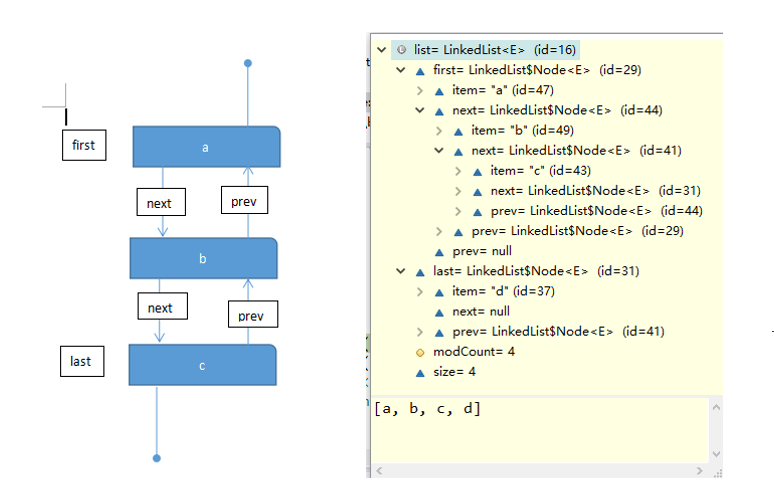
所以LinkedList插入和删除元素效率很高,比ArrayList高。通过set(i,e),get(i)访问效率低,因为要遍历指针,如果i>size/2,那么就从尾部开始遍历。
翻阅get(i),set(i,E)的源码
 /**

      * Replaces the element at the specified position in this list with the

      * specified element.

      *

      * @param index index of the element to replace

      * @param element element to be stored at the specified position

      * @return the element previously at the specified position

      * @throws IndexOutOfBoundsException {@inheritDoc}

      */

     public E set(int index, E element) {

         checkElementIndex(index);

         Node<E> x = node(index);

         E oldVal = x.item;

         x.item = element;

         return oldVal;

     }

  /**

      * Returns the element at the specified position in this list.

      *

      * @param index index of the element to return

      * @return the element at the specified position in this list

      * @throws IndexOutOfBoundsException {@inheritDoc}

      */

     public E get(int index) {

         checkElementIndex(index);

         return node(index).item;

     }

  /**

      * Returns the (non-null) Node at the specified element index.

      */

     Node<E> node(int index) {

         // assert isElementIndex(index);

         if (index < (size >> 1)) {

             Node<E> x = first;

             for (int i = 0; i < index; i++)

                 x = x.next;

             return x;

         } else {

             Node<E> x = last;

             for (int i = size - 1; i > index; i--)

                 x = x.prev;

             return x;

         }

     }
很明显,在进行set和get操作时,并不是每次都从头部开始遍历指针的,而是调用了node(int index)这个方法,就是用来判断当前index的大致位置,如果i<(size>>1)也就是i<size/2,那么从first开始遍历,否则从last开始遍历。此时set,get操作的时间复杂度也就由O(n)变成了O(n/2)
2. 链表没有容量限制,但是双向链表本身使用了更多的空间.每插入一个元素都要构造一个Node对象
3. LinkedList线程不同步,采用fail-fast机制
LinkedList 学习笔记的更多相关文章
- [Java] LinkedList / Queue - 源代码学习笔记
简单地画了下 LinkedList 的继承关系,如下图.只是画了关注的部分,并不是完整的关系图.本博文涉及的是 Queue, Deque, LinkedList 的源代码阅读笔记.关于 List 接口 ...
- 《Java学习笔记(第8版)》学习指导
<Java学习笔记(第8版)>学习指导 目录 图书简况 学习指导 第一章 Java平台概论 第二章 从JDK到IDE 第三章 基础语法 第四章 认识对象 第五章 对象封装 第六章 继承与多 ...
- Redis学习笔记一:数据结构与对象
1. String(SDS) Redis使用自定义的一种字符串结构SDS来作为字符串的表示. 127.0.0.1:6379> set name liushijie OK 在如上操作中,name( ...
- 20145330第五周《Java学习笔记》
20145330第五周<Java学习笔记> 这一周又是紧张的一周. 语法与继承架构 Java中所有错误都会打包为对象可以尝试try.catch代表错误的对象后做一些处理. 使用try.ca ...
- Android(java)学习笔记267:Android线程池形态
1. 线程池简介 多线程技术主要解决处理器单元内多个线程执行的问题,它可以显著减少处理器单元的闲置时间,增加处理器单元的吞吐能力. 假设一个服务器完成一项任务所需时间为:T1 创建线程时间, ...
- 黑马程序员-C#学习笔记(二)
---------------------- ASP.Net+Android+IOS开发..Net培训.期待与您交流! ---------------------- - C# 学习笔记 一.变量与表达 ...
- Web Service学习笔记(webservice、soap、wsdl、jws详细分析)
Web Service概述 Web Service的定义 W3C组织对其的定义如下,它是一个软件系统,为了支持跨网络的机器间相互操作交互而设计.Web Service服务通常被定义为一组模块化的API ...
- Web Service学习笔记
Web Service概述 Web Service的定义 W3C组织对其的定义如下,它是一个软件系统,为了支持跨网络的机器间相互操作交互而设计.Web Service服务通常被定义为一组模块化的API ...
- [Java] List / ArrayList - 源代码学习笔记
在阅读 List / ArrayList 源代码过程中,做了下面的笔记. LinkedList 的笔记较多,放到了另一篇博文 LinkedList / Queue- 源代码学习笔记 List List ...
随机推荐
- 百度地图API新手入门
最近,共享单车着实火了一把,市场竞争也是异常的激烈,百花争艳,百家争鸣,群雄逐鹿,最后鹿死谁手,现在还不得而知,不过可以肯定的是细节决定成败,更重要的还在于用户的体验. 用过的同学们都会知道,打开共享 ...
- StringBuffer与StringBuilder的区别,及实现原理
区别 1.StringBuffer 与 StringBuilder 中的方法和功能完全是等价的, 2.只是StringBuffer 中的方法大都采用了 synchronized 关键字进行修饰,因此是 ...
- wemall app商城源码中基于JAVA通过Http请求获取json字符串的代码
wemall-mobile是基于WeMall的Android app商城,只需要在原商城目录下上传接口文件即可完成服务端的配置,客户端可定制修改.分享其中关于通过Http请求获取json字符串的代码供 ...
- hdoj1016 [dfs]
http://acm.hdu.edu.cn/showproblem.php?pid=1016 题意: 已知一个数n,在1-n(包含 n ,0 < n < 20)里组合形成一个环形,使得每两 ...
- Linux之cut命令
cut 参数: -d 指定分隔符,与-f 一起使用,默认是空格.例如:-d“|” -f 指定取第几段的数据与-d一起使用 -c 以字符为单位取出固定字符区间 示例: 取不连续区间的内容的时候使用 ...
- Ant.SOA微服务框架开源
开源地址:https://github.com/yuzd/AntServiceStack 框架特色0.Service Management(服务治理) 1.CodeGen Contract Fir ...
- sass或scss入门
1.sass环境搭载: 安装ruby 安装sass 安装compass 配置webstorm 如果只是使用sass的话,就配置sass命名监听就好了 如图: sass目录如下: 如果配置了compas ...
- vue监听滚动事件,实现滚动监听
在vue中实现滚动监听和原生js无太大差异,下面是一个简单的demo,可在控制台查看结果 <!DOCTYPE html> <html lang="en"> ...
- PRINCE2的国际形势?光环国际项目管理培训
PRINCE2的使用和应用非常广泛.在过去的12个月里,超过60,000人参加了PRINCE2基础资格(Foundation)或从业资格(Practitioner)考试.现在每周参加考试的人数超过了2 ...
- 以正确的姿势实现一棵JavaScript菜单树
菜单树是常见的前端特效, 一般长下面这样 还有各种形态的变种, 有长这样的 也有长这样的 尽管这些菜单的相貌都不尽相同, 在功能实现的本质上却都是相同的.实现程序的大致流程如下 读取服务器端的菜单数据 ...