
The Runtime Interaction Model for Views-UI布局事件处理流程
The Runtime Interaction Model for Views
Any time a user interacts with your user interface, or any time your own code programmatically changes something, a complex sequence of events takes place inside of UIKit to handle that interaction. At specific points during that sequence, UIKit calls out to your view classes and gives them a chance to respond on behalf of your application. Understanding these callout points is important to understanding where your views fit into the system. Figure 1-7shows the basic sequence of events that starts with the user touching the screen and ends with the graphics system updating the screen content in response. The same sequence of events would also occur for any programmatically initiated actions.
Figure 1-7 UIKit interactions with your view objects 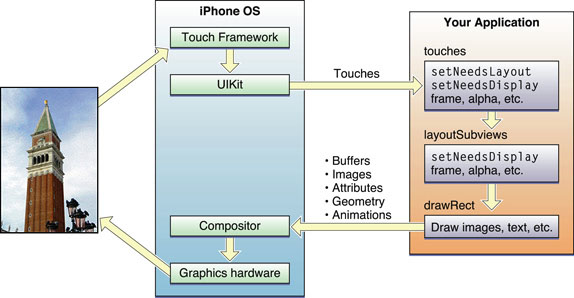
The following steps break the event sequence in Figure 1-7 down even further and explain what happens at each stage and how you might want your application to react in response.
The user touches the screen.
The hardware reports the touch event to the UIKit framework.
The UIKit framework packages the touch into a
UIEventobject and dispatches it to the appropriate view. (For a detailed explanation of how UIKit delivers events to your views, see Event Handling Guide for iOS.)The event-handling code of your view responds to the event. For example, your code might:
Change the properties (frame, bounds, alpha, and so on) of the view or its subviews.
Call the
setNeedsLayoutmethod to mark the view (or its subviews) as needing a layout update.Call the
setNeedsDisplayorsetNeedsDisplayInRect:method to mark the view (or its subviews) as needing to be redrawn.Notify a controller about changes to some piece of data.
Of course, it is up to you to decide which of these things the view should do and which methods it should call.
If the geometry of a view changed for any reason, UIKit updates its subviews according to the following rules:
If you have configured autoresizing rules for your views, UIKit adjusts each view according to those rules. For more information about how autoresizing rules work, see Handling Layout Changes Automatically Using Autoresizing Rules.
If the view implements the
layoutSubviewsmethod, UIKit calls it.You can override this method in your custom views and use it to adjust the position and size of any subviews. For example, a view that provides a large scrollable area would need to use several subviews as “tiles” rather than create one large view, which is not likely to fit in memory anyway. In its implementation of this method, the view would hide any subviews that are now offscreen or reposition them and use them to draw newly exposed content. As part of this process, the view’s layout code can also invalidate any views that need to be redrawn.
If any part of any view was marked as needing to be redrawn, UIKit asks the view to redraw itself.
For custom views that explicitly define a
drawRect:method, UIKit calls that method. Your implementation of this method should redraw the specified area of the view as quickly as possible and nothing else. Do not make additional layout changes at this point and do not make other changes to your application’s data model. The purpose of this method is to update the visual content of your view.Standard system views typically do not implement a
drawRect:method but instead manage their drawing at this time.Any updated views are composited with the rest of the application’s visible content and sent to the graphics hardware for display.
The graphics hardware transfers the rendered content to the screen.
https://developer.apple.com/library/content/documentation/WindowsViews/Conceptual/ViewPG_iPhoneOS/WindowsandViews/WindowsandViews.html#//apple_ref/doc/uid/TP40009503-CH2-SW5
The Runtime Interaction Model for Views-UI布局事件处理流程的更多相关文章
- iOS-屏幕适配-UI布局
iOS 屏幕适配:autoResizing autoLayout和sizeClass 一.图片解说 -------------------------------------------------- ...
- iOS开发~UI布局(三)深入理解autolayout
一.概要 通过对iOS8界面布局的学习和总结,发现autolayout才是主角,autolayout是iOS6引入的新特性,当时还粗浅的学习了下,可是没有真正应用到项目中.随着iOS设备尺寸逐渐碎片化 ...
- 移动UI布局设计原则(一)
学习笔记1 Learning notes one 移动UI布局设计的布局原则 Layout Principles of Mobile UI Layout Design 移动UI视觉交互设计法则 Des ...
- Duilib源码分析(五)UI布局—Layout与各子控件
接下来,继续分析duilib之UI布局Layout,目前提供的布局有:VerticalLayout.HorizontalLayout.TileLayout.TabLayout.ChildLayout分 ...
- iOS开发之遍历Model类的属性并完善使用Runtime给Model类赋值
在上篇博客<iOS开发之使用Runtime给Model类赋值>中介绍了如何使用运行时在实体类的基类中添加给实体类的属性赋值的方法,这个方法的前提是字典的Key必须和实体类的Property ...
- AppleWatch___学习笔记(二)UI布局和UI控件
1.UI布局 直接开发,你会发现Apple Watch并不支持AutoLayout,WatchKit里有个类叫做WKInterfaceGroup,乍一看像是UIView,但是这货其实是用来布局的.从 ...
- iOS开发~UI布局(二)storyboard中autolayout和size class的使用详解
一.概要:前一篇初步的描述了size class的概念,那么实际中如何使用呢,下面两个问题是我们一定会遇到的: 1.Xcode6中增加了size class,在storyboard中如何使用? 2.a ...
- iOS开发~UI布局(一)初探Size Class
随着iOS8系统的发布,一个全新的页面UI布局概念出现,这个新特性将颠覆包括iOS7及之前版本的UI布局方式,这个新特性就是Size Class.Size Class配合Auto Layout可以解决 ...
- WPF UI布局之概述
在线演示:http://v.youku.com/v_show/id_XNzA5NDk2Mjcy.html 清晰版视频+代码下载:http://115.com/lb/5lbeer0m9lad 一.简单介 ...
随机推荐
- YII数据流程浅析
MVC就不解释,直接上代码分析数据流程: 数据库图: 模型部分介绍: <?php /* * 前两个方法必须写 * 继承自CActiveRecord类 这个类位于 \framework\db\ar ...
- HDU 4950 Monster(公式)
HDU 4950 Monster 题目链接 题意:给定怪兽血量h,你攻击力a.怪物回血力b,你攻击k次要歇息一次,问是否能杀死怪兽 思路:签到题,注意最后一下假设打死了怪,那么怪就不会回血了 思路: ...
- IT咨询顾问:一次吐血的项目救火 java或判断优化小技巧 asp.net core Session的测试使用心得 【.NET架构】BIM软件架构02:Web管控平台后台架构 NetCore入门篇:(十一)NetCore项目读取配置文件appsettings.json 使用LINQ生成Where的SQL语句 js_jquery_创建cookie有效期问题_时区问题
IT咨询顾问:一次吐血的项目救火 年后的一个合作公司上线了一个子业务系统,对接公司内部的单点系统.我收到该公司的技术咨询:项目启动后没有规律的突然无法登录了,重新启动后,登录一断时间后又无法重新登 ...
- 背包系统学习笔(tu)记(cao)
这几天在学习背包系统,网上有看到一个挺牛逼的背包系统,不过人家那个功能很全面,一个背包系统就囊括了装备,锻造,购买等等功能(这里给出网址:https://blog.csdn.net/say__yes/ ...
- 【v2.x OGE教程 16】 Modifier使用相关
OGE引擎的改动器功能非常强大,为我们提供了丰富的改动器的实现类,能够改动实体的属性.提供了移动.旋转.缩放.透明.自己定义序列.同步.循环等功能,并且改变的效果能够当场生效.也能够在某一个时间段内生 ...
- 解决ubuntu中firefox浏览器总是提示找不到server的问题
这个情况在我机器上常常出现,并且时不时的给你出点问题.可是有些时候等一下就好了.或者把引擎换到百度的话它就又行得通了.. 被这个问题搞得非常烦.上网查了下说是防火墙啊之类的出问题.可是自己弄了后这个问 ...
- [计算机故障]excel无法存盘,总是自动重启恢复
同事的excel文档,无法保存.总是提示什么要发送错误报告.错误报告中的错误信息包含event type:BXE.这个文件大小约1M多.工作簿中包含表大约有30张,表名称为中文.我去看了看,其他电子表 ...
- (七)Java 变量类型
Java 变量类型 在Java语言中,所有的变量在使用前必须声明.声明变量的基本格式如下: type identifier [ = value][, identifier [= value] ...] ...
- uboot中添加自己的命令【转】
本文转载自:http://blog.csdn.net/huanghai381/article/details/51206646 每个命令都是通过U_BOOT_CMD宏来定义的.这个宏定义了一个相关的结 ...
- 怎么查询数据库中第30到40条记录呢? 通过ID,查询当前第30-40条记录 注意,ID不是顺序的
http://blog.csdn.net/lee576/article/details/5812347 http://bbs.csdn.net/topics/190070614 http://www. ...