
openstack policy 鉴权过程分析
转:http://blog.chinaunix.net/uid-20940095-id-4144300.html
1. openstack 鉴权简单介绍
众所周知,openstack通过keystone用来完成authenticate(认证),真正的鉴权(authorize)是在各个模块分别做的,具体实现为每个模块都有一个policy文件,叫policy.json,里面定义了鉴权用的rules。
以nova为例,policy文件的位置在:/etc/nova/policy.json,下面先来看几条rules,了解其基本含义:
本含义:
"compute:create": "",

"compute:create:attach_network": "",

"compute:create:attach_volume": "",

"compute:create:forced_host": "is_admin:True",

"compute:get_all": "",

"compute:get_all_tenants": "",

"compute:start": "rule:admin_or_owner",

"compute:stop": "rule:admin_or_owner",

"compute:unlock_override": "rule:admin_api",
语法规则为:rule:[result]
rule:指这条规则是干啥的,通常对应一个action,以类似scope:action的形式给出,scope表示作用范围,action表示执行哪种操作
result: 表示这条rule的判定结果或者如何进行判定,比如"compute:create:forced_host":"is_admin:True",如果执行此操作的用户具有admin角色(role),则这条结果的判定结果就是True。
另外,rule是可以嵌套的,比如"compute:stop": "rule:admin_or_owner",表示compute:stop这条规则的结果为admin_or_owner这条规则的结果,而admin_or_owner规则如下:
"admin_or_owner": "is_admin:True or project_id:%(project_id)s",
如果调用这个操作的用户的角色是admin,就返回True,或者返回用户所属的project的id.
2. policy鉴权代码分析
针对每一个操作,都会经过一个叫@wrap_check_policy的decorator,以nova的resize操作为例,在执行真正的resize代码之前,先要经过一个叫@wrap_check_policy的装饰器来完成policy的check过程,具体参见后面的代码check_policy函数:
    @wrap_check_policy

    @check_instance_lock

    @check_instance_cell

    @check_instance_state(vm_state=[vm_states.ACTIVE, vm_states.STOPPED],

                          task_state=[None])

    def resize(self, context, instance, flavor_id=None,

               **extra_instance_updates):
check_policy(context, action, target, scope='compute')函数有四个参数:
(1) context: 执行resize操作的上下文,其内容包括project_id, user_id, role,auth_token等信息,具体如下:
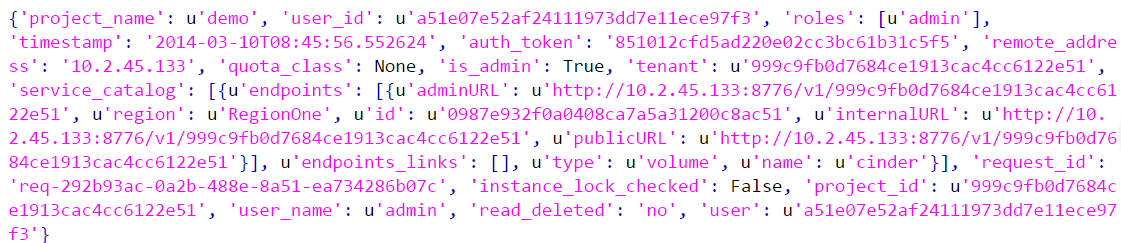
(2) action:表示当前执行的操作是啥,这里就是resize
(3) target:操作针对的object是啥,这里就是instance id
(4) scope:当前操作的作用域是啥,主要为了与policy文件中定义的作用域匹配,这里为compute,即nova执行的操作
def check_policy(context, action, target, scope='compute'):

        _action = '%s:%s' % (scope, action)  ##这里拼接成policy.json的rule,即_action=compute:resize

        nova.policy.enforce(context, _action, target)

------------------------------------------------------------------------------------------------------------------------

    def enforce(context, action, target, do_raise=True):

        """Verifies that the action is valid on the target in this context.

           :param context: nova context

           :param action: string representing the action to be checked

               this should be colon separated for clarity.

               i.e. ``compute:create_instance``,

               ``compute:attach_volume``,

               ``volume:attach_volume``

           :param target: dictionary representing the object of the action

               for object creation this should be a dictionary representing the

               location of the object e.g. ``{'project_id': context.project_id}``

           :param do_raise: if True (the default), raises PolicyNotAuthorized;

               if False, returns False

           :raises nova.exception.PolicyNotAuthorized: if verification fails

               and do_raise is True.

           :return: returns a non-False value (not necessarily "True") if

               authorized, and the exact value False if not authorized and

               do_raise is False.

        """

        init()   ##policy.json被cache到cache_info数据结构中,init()函数就是去检查policy.json是否已经被加载或修改过,如果cache_info结构为空,说明policy.json还没有加载过,则执行加载;如果policy.json被修改过,也会重新进行加载

        credentials = context.to_dict()  ##将context转化成dictonary,就是上面context给出的内容,以便后面代码使用

        # Add the exception arguments if asked to do a raise

        extra = {}

        if do_raise:

            extra.update(exc=exception.PolicyNotAuthorized, action=action)  ##增加no auth hook函数,即如果rule的结果为False,则执行no auth hook函数做一些处理

        return policy.check(action, target, credentials, **extra)  ##进行policy的check

--------------------------------------------------------------------------------------------------------------------

def init():

    global _POLICY_PATH

    global _POLICY_CACHE

    if not _POLICY_PATH:

        _POLICY_PATH = CONF.policy_file

        if not os.path.exists(_POLICY_PATH):

            _POLICY_PATH = CONF.find_file(_POLICY_PATH)

        if not _POLICY_PATH:

            raise exception.ConfigNotFound(path=CONF.policy_file)

    utils.read_cached_file(_POLICY_PATH, _POLICY_CACHE,

                           reload_func=_set_rules) ##加载policy.json文件

----------------------------------------------------------------------------------------------------------------------

def read_cached_file(filename, cache_info, reload_func=None):

    """Read from a file if it has been modified.

    :param cache_info: dictionary to hold opaque cache.

    :param reload_func: optional function to be called with data when

                        file is reloaded due to a modification.

    :returns: data from file

    """

    mtime = os.path.getmtime(filename)  ###获取policy.json文件的modify time,如果与cache_info中的mtime不同,则说明文件被修改过,则执行重新加载

    if not cache_info or mtime != cache_info.get('mtime'):

        LOG.debug(_("Reloading cached file %s") % filename)

        with open(filename) as fap:

            cache_info['data'] = fap.read()

        cache_info['mtime'] = mtime

        if reload_func:

            reload_func(cache_info['data'])

    return cache_info['data']            ###返回加载后的policy.json文件的内容

---------------------------------------------------------------------------------------------------------------------------

def check(rule, target, creds, exc=None, *args, **kwargs):

    """

    Checks authorization of a rule against the target and credentials.

    :param rule: The rule to evaluate.

    :param target: As much information about the object being operated

                   on as possible, as a dictionary.

    :param creds: As much information about the user performing the

                  action as possible, as a dictionary.

    :param exc: Class of the exception to raise if the check fails.

                Any remaining arguments passed to check() (both

                positional and keyword arguments) will be passed to

                the exception class. If exc is not provided, returns

                False.

    :return: Returns False if the policy does not allow the action and

             exc is not provided; otherwise, returns a value that

             evaluates to True. Note: for rules using the "case"

             expression, this True value will be the specified string

             from the expression.

    """

    # Allow the rule to be a Check tree

    if isinstance(rule, BaseCheck):

        result = rule(target, creds)

    elif not _rules:

        # No rules to reference means we're going to fail closed

        result = False

    else:

        try:

            # Evaluate the rule

            result = _rules[rule](target, creds)  ##没一条rule执行一个函数,这个对应关系记录在全局变量_rules

        except KeyError:

            # If the rule doesn't exist, fail closed

            result = False

    # If it is False, raise the exception if requested

    if exc and result is False:

        raise exc(*args, **kwargs)

    return result
3. 总结
之前一直以为修改了policy.json文件,需要重启service才能重新加载policy.json生效,通过分析代码,证明policy.json是动态更新的。另外,通过分析代码,也搞清楚了如何添加自定义的rule,以便实现更细粒度的rule,稍后会给出一个自己实现的例子。
openstack policy 鉴权过程分析的更多相关文章
- 使用ranger对kafka进行鉴权
使用ranger对kafka进行鉴权测试环境:ranger-kafka-plugin为0.6.3版本,kafka版本为kafka_2.10-0.10.1.1,且kafka broker为一个节点.一. ...
- 七牛云 PHP SDK服务器鉴权失败!参数解释
昨天搞了一下午,用7牛官方的SDK demo 1.上传凭证 $policy = array( 'callbackUrl' => 'http://api.example.com/qiniu/upl ...
- 鉴权应用服务器 app客户端 web服务端 安全令牌(SecurityToken)、临时访问密钥(AccessKeyId, AccessKeySecret)
设置EndPoint和凭证 移动终端是一个不受信任的环境,把AccessKeyId和AccessKeySecret直接保存在终端用来加签请求,存在极高的风险.建议只在测试时使用明文设置模式,业务应用推 ...
- .NET Core中的鉴权授权正确方式(.NET5)
一.简介 前后端分离的站点一般都会用jwt或IdentityServer4之类的生成token的方式进行登录鉴权.这里要说的是小项目没有做前后端分离的时站点登录授权的正确方式. 一.传统的授权方式 这 ...
- ApiAuthValue鉴权机制总结
一.背景介绍 1.自动化的配置工具autoconfig介绍 项目开发过程中,有些配置会随着运行环境的变化而各不相同.如jdbc驱动的配置,在开发环境可能链接到开发本地的数据库,测试环境则有一套测试专用 ...
- 搭建一个分布式MongoDB鉴权集群
今天休假在家,测试并搭建了一个replica set shard MongoDB鉴权集群.replica set shard 鉴权集群中文资料比较少,本文是个人笔记,同时也希望对后来者有所帮助.本文仅 ...
- 开放平台鉴权以及OAuth2.0介绍
OAuth 2.0 协议 OAuth是一个开发标准,允许用户授权第三方网站或应用访问他们存储在另外的服务提供者上的信息,而不需要将用户名和密码提供给第三方网站或分享他们数据的内容. OAuth 2.0 ...
- 取消mod_sofia的呼叫鉴权
FreeSWITCH中默认的SIP呼叫是要鉴权的,流程如下. 终端 FreeSWITCH A -----Invite------> FS A <----Trying------ FS A ...
- android 高德地图出现【定位失败key鉴权失败】
如题:android 高德地图出现[定位失败key鉴权失败] 原因:使用的是debug模式下的SHA1,发布的版本正确获取SHA1的方式见: 方法二使用 keytool(jdk自带工具),按照如下步骤 ...
随机推荐
- Anaconda+django写出第一个web app(三)
前面我们已经建立了模型Tutorial,也已经可以用Navicat Premium打开数据看查看数据,接下来我们通过建立admin账户来上传数据. 在命令行执行如下命令来创建用户: python ma ...
- Error: Cannot retrieve metalink for repository: epel. Please verify its path and try again错误解决
rpm -ivh http://dl.fedoraproject.org/pub/epel/6/i386/epel-release-6-8.noarch.rpm 安装了epel源 但 yum -y ...
- log4net记录系统错误日志到文本文件用法详解
log4net是一个完全免费开源的插件,可以去官网下载源码. 一般系统操作日志不会用log4net,自己写代码存入数据库更方便合理,但是系统部署后运行在客户环境,难免会发生系统bug.崩溃.断网等无法 ...
- CSS 特殊性、继承与层叠
一.特殊性规则 选择器的特殊性由选择器本身的组件确定:特殊性由四个部分组成,其初始值为0,0,0,0. 1. 对于选择器中的每一个id,记0,1,0,0: 2. 对于选择器中的每一个类.伪 ...
- jQuery核心函数——(一)
- curator框架的使用以及实现分布式锁等应用与zkclient操作zookeeper,简化复杂原生API
打开zookeeper集群 先体会一下原生API有多麻烦(可略过): //地址 static final String ADDR = "192.168.171.128:2181,192.16 ...
- 如何禁止Linux内核的-O2编译选项【转】
转自:http://blog.csdn.net/larryliuqing/article/details/8674274 http://lenky.info/2013/03/10/%E5%A6%82% ...
- 2017北京网络赛 Bounce GCD加找规律
题目链接:http://hihocoder.com/problemset/problem/1584 题意:就是求一个小球从矩阵的左上角,跑到矩形的右下角不能重复经过的格子,小球碰到墙壁就反射. 解法: ...
- Robotium测试套管理测试用例
前提:已写好测试用例 新建个测试套MyTestSuite管理你需要跑的测试用例,或者将相同功能的测试用例归纳到一个测试套中 package com.robotium.test.testsuite; i ...
- 【自用】bat ftp下载前一天备份
@echo off rem 指定FTP用户名 set ftpUser=app rem 指定FTP密码 set ftpPass=app rem 指定FTP服务器地址 set ftpIP=192.168. ...