
<转>SQL Server CROSS APPLY and OUTER APPLY
Problem
SQL Server 2005 introduced the APPLY operator, which is like a join clause and it allows joining between two table expressions i.e. joining a left/outer table expression with a right/inner table expression. The difference between the join and APPLY operator becomes evident when you have a table-valued expression on the right side and you want this table-valued expression to be evaluated for each row from the left table expression. In this tip I am going to demonstrate the APPLY operator, how it differs fromregular JOINs and some uses.
Solution
The APPLY operator allows you to join two table expressions; the right table expression is processed every time for each row from the left table expression. As you might have guessed, the left table expression is evaluated first and then the right table expression is evaluated against each row of the left table expression for the final result set. The final result set contains all the selected columns from the left table expression followed by all the columns of the right table expression.
SQL Server APPLY operator has two variants; CROSS APPLY and OUTER APPLY
- The CROSS APPLY operator returns only those rows from the left table expression (in its final output) if it matches with the right table expression. In other words, the right table expression returns rows for the left table expression match only.
- The OUTER APPLY operator returns all the rows from the left table expression irrespective of its match with the right table expression. For those rows for which there are no corresponding matches in the right table expression, it contains NULL values in columns of the right table expression.
- So you might conclude, the CROSS APPLY is equivalent to an INNER JOIN (or to be more precise its like a CROSS JOIN with a correlated sub-query) with an implicit join condition of 1=1 whereas the OUTER APPLY is equivalent to a LEFT OUTER JOIN.
You might be wondering if the same can be achieved with a regular JOIN clause, so why and when do you use the APPLY operator? Although the same can be achieved with a normal JOIN, the need of APPLY arises if you have a table-valued expression on the right part and in some cases the use of the APPLY operator boosts performance of your query. Let me explain with some examples.
Create Sample Data for CROSS APPLY and OUTER APPLY examples
Script #1 creates a Department table to hold information about departments. Then it creates an Employee table which holds information about the employees. Please note, each employee belongs to a department, hence the Employee table has referential integrity with the Department table.
--Script #1 - Creating some temporary objects to work on...

USE [tempdb]

GO

IF EXISTS (SELECT * FROM sys.objects WHERE OBJECT_ID = OBJECT_ID(N'[Employee]') AND type IN (N'U'))

BEGIN

   DROP TABLE [Employee]

END

GO

IF EXISTS (SELECT * FROM sys.objects WHERE OBJECT_ID = OBJECT_ID(N'[Department]') AND type IN (N'U'))

BEGIN

   DROP TABLE [Department]

END

CREATE TABLE [Department](

   [DepartmentID] [int] NOT NULL PRIMARY KEY,

   [Name] VARCHAR(250) NOT NULL,

) ON [PRIMARY]

INSERT [Department] ([DepartmentID], [Name])

VALUES (1, N'Engineering')

INSERT [Department] ([DepartmentID], [Name])

VALUES (2, N'Administration')

INSERT [Department] ([DepartmentID], [Name])

VALUES (3, N'Sales')

INSERT [Department] ([DepartmentID], [Name])

VALUES (4, N'Marketing')

INSERT [Department] ([DepartmentID], [Name])

VALUES (5, N'Finance')

GO

CREATE TABLE [Employee](

   [EmployeeID] [int] NOT NULL PRIMARY KEY,

   [FirstName] VARCHAR(250) NOT NULL,

   [LastName] VARCHAR(250) NOT NULL,

   [DepartmentID] [int] NOT NULL REFERENCES [Department](DepartmentID),

) ON [PRIMARY]

GO

INSERT [Employee] ([EmployeeID], [FirstName], [LastName], [DepartmentID])

VALUES (1, N'Orlando', N'Gee', 1 )

INSERT [Employee] ([EmployeeID], [FirstName], [LastName], [DepartmentID])

VALUES (2, N'Keith', N'Harris', 2 )

INSERT [Employee] ([EmployeeID], [FirstName], [LastName], [DepartmentID])

VALUES (3, N'Donna', N'Carreras', 3 )

INSERT [Employee] ([EmployeeID], [FirstName], [LastName], [DepartmentID])

VALUES (4, N'Janet', N'Gates', 3 )
SQL Server CROSS APPLY vs INNER JOIN example
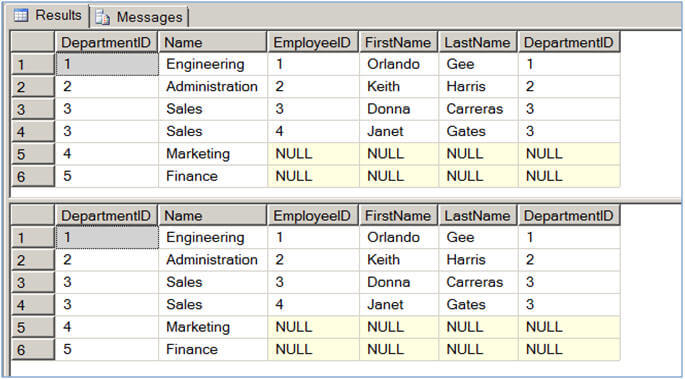
The first query in Script #2 selects data from the Department table and uses a CROSS APPLY to evaluate the Employee table for each record of the Department table. The second query simply joins the Department table with the Employee table and all matching records are produced.
--Script #2 - CROSS APPLY and INNER JOIN

SELECT * FROM Department D

CROSS APPLY

   (

   SELECT * FROM Employee E

   WHERE E.DepartmentID = D.DepartmentID

   ) A

GO

SELECT * FROM Department D

INNER JOIN Employee E ON D.DepartmentID = E.DepartmentID

GO
f you look at the results, you can see see they are the same.

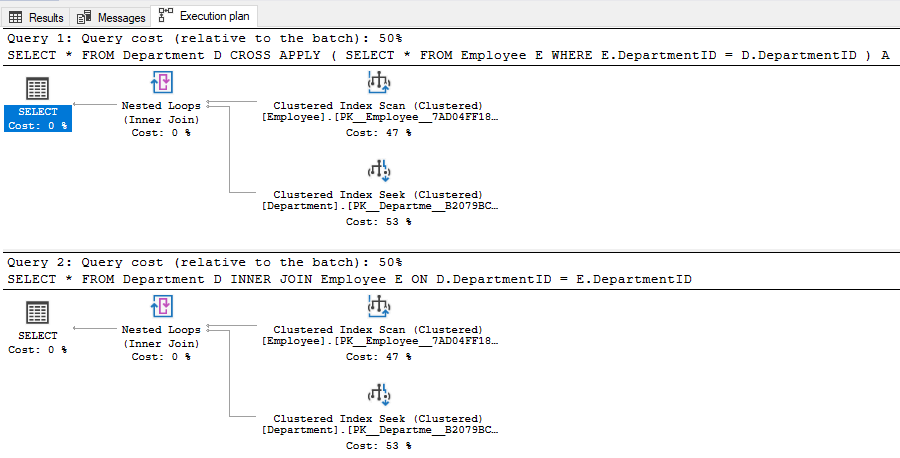
Also, the execution plans for these queries are similar and they have an equal query cost, as you can see in the image below.
So what is the use of APPLY operator? How does it differ from a JOIN and how does it help in writing more efficient queries? I will discuss this later.
SQL Sever OUTER APPLY vs LEFT OUTER JOIN example
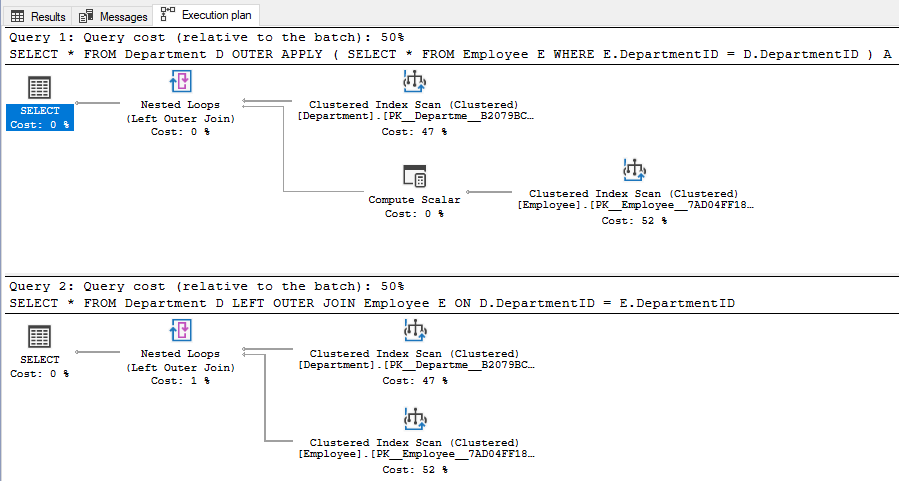
The first query in Script #3 selects data from Department table and uses an OUTER APPLY to evaluate the Employee table for each record of the Department table. For those rows for which there is not a match in the Employee table, those rows contain NULL values as you can see in case of row 5 and 6 below. The second query simply uses a LEFT OUTER JOIN between the Department table and the Employee table. As expected the query returns all rows from Department table, even for those rows for which there is no match in the Employee table.
--Script #3 - OUTER APPLY and LEFT OUTER JOIN

SELECT * FROM Department D

OUTER APPLY

   (

   SELECT * FROM Employee E

   WHERE E.DepartmentID = D.DepartmentID

   ) A

GO

SELECT * FROM Department D

LEFT OUTER JOIN Employee E ON D.DepartmentID = E.DepartmentID

GO
Even though the above two queries return the same information, the execution plan is a bit different. Although cost wise there is not much difference, the query with the OUTER APPLY uses a Compute Scalar operator (with estimated operator cost of 0.0000103 or around 0%) before the Nested Loops operator to evaluate and produce the columns of the Employee table.
Joining table valued functions and tables using APPLY operators
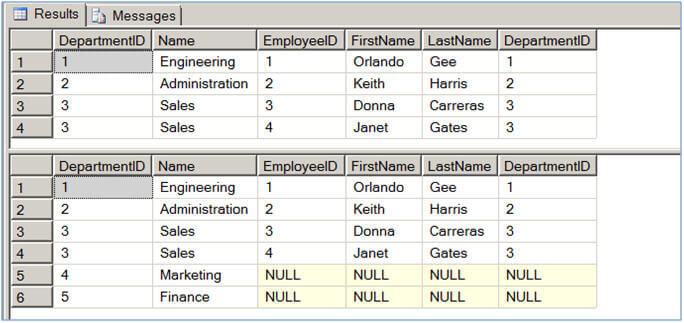
In Script #4, I am creating a table-valued function which accepts DepartmentID as its parameter and returns all the employees who belong to this department. The next query selects data from the Department table and uses a CROSS APPLY to join with the function we created. It passes the DepartmentID for each row from the outer table expression (in our case Department table) and evaluates the function for each row similar to a correlated subquery. The next query uses the OUTER APPLY in place of the CROSS APPLY and hence unlike the CROSS APPLY which returned only correlated data, the OUTER APPLY returns non-correlated data as well, placing NULLs into the missing columns.
--Script #4 - APPLY with table-valued function

IF EXISTS (SELECT * FROM sys.objects WHERE OBJECT_ID = OBJECT_ID(N'[fn_GetAllEmployeeOfADepartment]') AND type IN (N'IF'))

BEGIN

   DROP FUNCTION dbo.fn_GetAllEmployeeOfADepartment

END

GO

CREATE FUNCTION dbo.fn_GetAllEmployeeOfADepartment(@DeptID AS INT)

RETURNS TABLE

AS

RETURN

   (

   SELECT * FROM Employee E

   WHERE E.DepartmentID = @DeptID

   )

GO

SELECT * FROM Department D

CROSS APPLY dbo.fn_GetAllEmployeeOfADepartment(D.DepartmentID)

GO

SELECT * FROM Department D

OUTER APPLY dbo.fn_GetAllEmployeeOfADepartment(D.DepartmentID)

GO
 ]]
]]
You might be wondering if we can use a simple join in place of the above queries, the answer is NO. If you replace the CROSS/OUTER APPLY in the above queries with an INNER JOIN/LEFT OUTER JOIN, specifying the ON clause with 1=1 and run the query, you will get the error "The multi-part identifier "D.DepartmentID" could not be bound.". This is because with JOINs the execution context of the outer query is different from the execution context of the function (or a derived table), and you cannot bind a value/variable from the outer query to the function as a parameter. Hence the APPLY operator is required for such queries.
So in summary the APPLY operator is required when you have to use a table-valued function in the query, but it can also be used with inline SELECT statements.
Joining table valued system functions and tables using APPLY operators
Let me show you another query with a Dynamic Management Function (DMF). Script #5 returns all the currently executing user queries except for the queries being executed by the current session. As you can see in the script below, the sys.dm_exec_requestsdynamic management view is being CROSS APPLY'ed with the sys.dm_exec_sql_text dynamic management function which accepts a "plan handle" for the query and the "plan handle" is being passed from the left/outer expression to the function to return the data.
--Script #5 - APPLY with Dynamic Management Function (DMF)

USE master

GO

SELECT DB_NAME(r.database_id) AS [Database], st.[text] AS [Query]

FROM sys.dm_exec_requests r

CROSS APPLY sys.dm_exec_sql_text(r.plan_handle) st

WHERE r.session_Id > 50           -- Consider spids for users only, no system spids.

AND r.session_Id NOT IN (@@SPID)  -- Don't include request from current spid.
Note, for the above query, the [text] column in the query returns all queries submitted in a batch. If you want to see only the active (currently executing) query you can use the statement_start_offset and statement_end_offset columns to trim the active part of the query. Refer to this tip How to isolate the current running commands in SQL Server for a good example.
Other Notes
As I told you before there are certain scenarios where a query with an APPLY operator performs better than a query with regular joins. I am not going to delve into much details rather here are some articles that discuss this topic in greater detail.
Please note, the APPLY operator is not an ANSI operator but rather an extension of SQL Server T-SQL (available in SQL Server 2005 and later), so if you plan to port your database to some other DBMS take this into consideration.
<转>SQL Server CROSS APPLY and OUTER APPLY的更多相关文章
- sql server cross/outer apply 用法
这是 sql server 帮助文档关于apply的描述: 使用 APPLY 运算符(2005或以上版本)可以为实现查询操作的外部表表达式返回的每个行调用表值函数.表值函数作为右输入,外部表表达式作为 ...
- SQL Server连接查询之Cross Apply和Outer Apply的区别及用法(转载)
先简单了解下cross apply的语法以及会产生什么样的结果集吧!示例表: SELECT * FROM tableA CROSS APPLY tableB 两张表直接连接,不需要任何的关联条件,产生 ...
- SQL Server中CROSS APPLY和OUTER APPLY应用
1.什么是Cross Apply和Outer Apply ? 我们知道SQL Server 2000中有Cross Join用于交叉联接的.实际上增加Cross Apply和Outer Apply是用 ...
- SQL Server 关于CROSS APPLY 和 OUTER APPLY应用
先看看语法: <left_table_expression> {cross|outer} apply<right_table_expression> 再让我们了解一下appl ...
- SQL SERVER使用 CROSS APPLY 与 OUTER APPLY 连接查询
概述 CROSS APPLY 与 OUTER APPLY 可以做到: 左表一条关联右表多条记录时,我需要控制右表的某一条或多条记录跟左表匹配的情况. 有两张表:Student(学生表)和 S ...
- SQL 关于apply的两种形式cross apply 和 outer apply
SQL 关于apply的两种形式cross apply 和 outer apply 例子: CREATE TABLE [dbo].[Customers]( ) COLLATE Chinese_PRC_ ...
- SQL 关于apply的两种形式cross apply 和 outer apply(转)
转载链接:http://www.cnblogs.com/shuangnet/archive/2013/04/02/2995798.html apply有两种形式: cross apply 和 oute ...
- SQL关于apply的两种形式cross apply和outer apply(转载)
SQL 关于apply的两种形式cross apply 和 outer apply apply有两种形式: cross apply 和 outer apply 先看看语法: <lef ...
- 转:SQL 关于apply的两种形式cross apply 和 outer apply
原文地址:http://www.cnblogs.com/Leo_wl/archive/2013/04/02/2997012.html SQL 关于apply的两种形式cross apply 和 out ...
随机推荐
- 找bug hhh
http://oj.acm.zstu.edu.cn/JudgeOnline/problem.php?id=4434 没有用队列,疯狂找不到bug,后来发现很简单的判断时==n和m了,本来心花怒放,测试 ...
- poj 1966(求点连通度,边连通度的一类方法)
题目链接:http://poj.org/problem?id=1966 思路:从网上找了一下大牛对于这类问题的总结:图的连通度问题是指:在图中删去部分元素(点或边),使得图中指定的两个点s和t不连通 ...
- python数据结构之选择排序
选择排序(select_sort)是一个基础排序,它主要通过查找已给序列中的元素的最大或者最小元素,然后将其放在序列的起始位置或者结束位置,并通过多次这样的循环完成对已知序列的排序,在我们对n个元素进 ...
- 给有C或C++基础的Python入门 :Python Crash Course 4 操作列表 4.1--4.3
操作列表,也就是遍历列表.本章我们要学的就是如何遍历列表. 4.1--4.2 遍历列表 遍历列表,用for循环. 不同于C++或者C语言的for循环,Python的for循环更容易让人理解. 看一个例 ...
- 如何解决Failed to retrieve MSVC Environment from XXXXXXXX
升级了新版的Qt5.9.3后,本人的电脑也出了这个问题. 最后通过删除了path中的一些错误.多余的环境变量解决了.(删除了一些mysql的环境变量)
- Java并发编程(十)-- Java中的锁
在学习或者使用Java的过程中进程会遇到各种各样的锁的概念:公平锁.非公平锁.自旋锁.可重入锁.偏向锁.轻量级锁.重量级锁.读写锁.互斥锁.死锁.活锁等,本文将简概的介绍一下各种锁. 公平锁和非公平锁 ...
- Scrapy基础(九)————将不定长度的URL进行固定长度写入Item中
前面讲到将每篇文章的URL写入Item,但是每个url的长度是不同的,可以在Item中设置一个字段怎样使得每个URL的长度相同,这就需要对每个URL进行md5运算,使得长度统一,再加入到设定的Item ...
- Linux搭建 SVN 服务器
安装 Subversion Subversion 是一个版本控制系统,相对于的 RCS . CVS ,采用了分支管理系统,它的设计目标就是取代 CVS . yum install -y subvers ...
- Python——lambda函数
Lambda 函数又称匿名函数,匿名函数就是没有名字的函数,函数没有名字也行?当然可以啦.有些函数如果只是临时一用,而且它的业务逻辑也很简单时,就没必要非给它取个名字不可. 好比电影里面的群众演员,往 ...
- [CF961E] Tufurama
Description: 有一天Polycarp决定重看他最喜爱的电视剧<Tufurama>.当他搜索"在线全高清免费观看Tufurama第3季第7集"却只得到第7季第 ...