
PCL学习(二)三维模型转点云 obj转pcd----PCL实现
#include <pcl/io/io.h>

#include <pcl/io/pcd_io.h>

#include <pcl/io/obj_io.h>

#include <pcl/PolygonMesh.h>

//#include <pcl/ros/conversions.h>//formROSMsg所属头文件;

#include <pcl/point_cloud.h>

#include <pcl/io/vtk_lib_io.h>//loadPolygonFileOBJ所属头文件;

//#include <pcl/visualization/pcl_visualizer.h>

using namespace std;

using namespace pcl;

int main()

{

	pcl::PolygonMesh mesh;

	pcl::io::loadPolygonFile("sofa.obj", mesh);

	pcl::PointCloud<pcl::PointXYZ>::Ptr cloud(new pcl::PointCloud<pcl::PointXYZ>);

	pcl::fromPCLPointCloud2(mesh.cloud, *cloud);

	pcl::io::savePCDFileASCII("result.pcd", *cloud);

	cout << cloud->size() << endl;

	cout << "OK!";

	cin.get();

	return 0;

}
- 转换前的obj模型
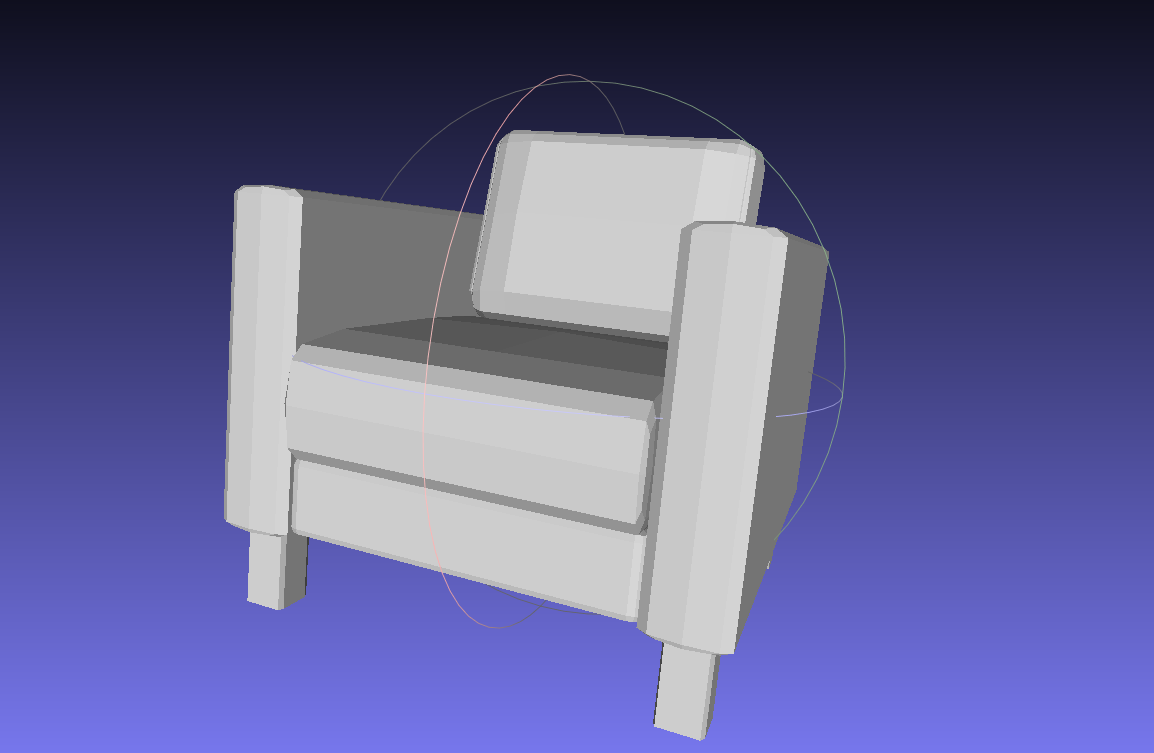
- 转换成pcd点云后

提取3D模型的meshes的顶点(Vertex)坐标,对于点云来说点数不够,而且在3D模型存在平面或者是简单立方体的情况下几乎没有点。
所以又需要PCL库了,pcl_mesh_sampling可以轻松解决这个问题。
它是通过调用VTK(Visualization ToolKit)读取模型,在3D模型平面均匀地采样点然后生成点云,并且你可以选择需要的点数, 以及voxel grid的采样距离。
#include <pcl/visualization/pcl_visualizer.h>

#include <pcl/io/pcd_io.h>

#include <pcl/io/vtk_lib_io.h>

#include <pcl/common/transforms.h>

#include <vtkVersion.h>

#include <vtkPLYReader.h>

#include <vtkOBJReader.h>

#include <vtkTriangle.h>

#include <vtkTriangleFilter.h>

#include <vtkPolyDataMapper.h>

#include <pcl/filters/voxel_grid.h>

#include <pcl/console/print.h>

#include <pcl/console/parse.h>

inline double

uniform_deviate (int seed)

{

  double ran = seed * (1.0 / (RAND_MAX + 1.0));

  return ran;

}

inline void

randomPointTriangle (float a1, float a2, float a3, float b1, float b2, float b3, float c1, float c2, float c3,

                     Eigen::Vector4f& p)

{

  float r1 = static_cast<float> (uniform_deviate (rand ()));

  float r2 = static_cast<float> (uniform_deviate (rand ()));

  float r1sqr = std::sqrt (r1);

  float OneMinR1Sqr = (1 - r1sqr);

  float OneMinR2 = (1 - r2);

  a1 *= OneMinR1Sqr;

  a2 *= OneMinR1Sqr;

  a3 *= OneMinR1Sqr;

  b1 *= OneMinR2;

  b2 *= OneMinR2;

  b3 *= OneMinR2;

  c1 = r1sqr * (r2 * c1 + b1) + a1;

  c2 = r1sqr * (r2 * c2 + b2) + a2;

  c3 = r1sqr * (r2 * c3 + b3) + a3;

  p[0] = c1;

  p[1] = c2;

  p[2] = c3;

  p[3] = 0;

}

inline void

randPSurface (vtkPolyData * polydata, std::vector<double> * cumulativeAreas, double totalArea, Eigen::Vector4f& p, bool calcNormal, Eigen::Vector3f& n)

{

  float r = static_cast<float> (uniform_deviate (rand ()) * totalArea);

  std::vector<double>::iterator low = std::lower_bound (cumulativeAreas->begin (), cumulativeAreas->end (), r);

  vtkIdType el = vtkIdType (low - cumulativeAreas->begin ());

  double A[3], B[3], C[3];

  vtkIdType npts = 0;

  vtkIdType *ptIds = NULL;

  polydata->GetCellPoints (el, npts, ptIds);

  polydata->GetPoint (ptIds[0], A);

  polydata->GetPoint (ptIds[1], B);

  polydata->GetPoint (ptIds[2], C);

  if (calcNormal)

  {

    // OBJ: Vertices are stored in a counter-clockwise order by default

    Eigen::Vector3f v1 = Eigen::Vector3f (A[0], A[1], A[2]) - Eigen::Vector3f (C[0], C[1], C[2]);

    Eigen::Vector3f v2 = Eigen::Vector3f (B[0], B[1], B[2]) - Eigen::Vector3f (C[0], C[1], C[2]);

    n = v1.cross (v2);

    n.normalize ();

  }

  randomPointTriangle (float (A[0]), float (A[1]), float (A[2]),

                       float (B[0]), float (B[1]), float (B[2]),

                       float (C[0]), float (C[1]), float (C[2]), p);

}

void

uniform_sampling (vtkSmartPointer<vtkPolyData> polydata, size_t n_samples, bool calc_normal, pcl::PointCloud<pcl::PointNormal> & cloud_out)

{

  polydata->BuildCells ();

  vtkSmartPointer<vtkCellArray> cells = polydata->GetPolys ();

  double p1[3], p2[3], p3[3], totalArea = 0;

  std::vector<double> cumulativeAreas (cells->GetNumberOfCells (), 0);

  size_t i = 0;

  vtkIdType npts = 0, *ptIds = NULL;

  for (cells->InitTraversal (); cells->GetNextCell (npts, ptIds); i++)

  {

    polydata->GetPoint (ptIds[0], p1);

    polydata->GetPoint (ptIds[1], p2);

    polydata->GetPoint (ptIds[2], p3);

    totalArea += vtkTriangle::TriangleArea (p1, p2, p3);

    cumulativeAreas[i] = totalArea;

  }

  cloud_out.points.resize (n_samples);

  cloud_out.width = static_cast<pcl::uint32_t> (n_samples);

  cloud_out.height = 1;

  for (i = 0; i < n_samples; i++)

  {

    Eigen::Vector4f p;

    Eigen::Vector3f n;

    randPSurface (polydata, &cumulativeAreas, totalArea, p, calc_normal, n);

    cloud_out.points[i].x = p[0];

    cloud_out.points[i].y = p[1];

    cloud_out.points[i].z = p[2];

    if (calc_normal)

    {

      cloud_out.points[i].normal_x = n[0];

      cloud_out.points[i].normal_y = n[1];

      cloud_out.points[i].normal_z = n[2];

    }

  }

}

using namespace pcl;

using namespace pcl::io;

using namespace pcl::console;

const int default_number_samples = 100000;

const float default_leaf_size = 0.01f;

void

printHelp (int, char **argv)

{

  print_error ("Syntax is: %s input.{ply,obj} output.pcd <options>\n", argv[0]);

  print_info ("  where options are:\n");

  print_info ("                     -n_samples X      = number of samples (default: ");

  print_value ("%d", default_number_samples);

  print_info (")\n");

  print_info (

              "                     -leaf_size X  = the XYZ leaf size for the VoxelGrid -- for data reduction (default: ");

  print_value ("%f", default_leaf_size);

  print_info (" m)\n");

  print_info ("                     -write_normals = flag to write normals to the output pcd\n");

  print_info (

              "                     -no_vis_result = flag to stop visualizing the generated pcd\n");

}

/* ---[ */

int

main (int argc, char **argv)

{

  print_info ("Convert a CAD model to a point cloud using uniform sampling. For more information, use: %s -h\n",

              argv[0]);

  if (argc < 3)

  {

    printHelp (argc, argv);

    return (-1);

  }

  // Parse command line arguments

  int SAMPLE_POINTS_ = default_number_samples;

  parse_argument (argc, argv, "-n_samples", SAMPLE_POINTS_);

  float leaf_size = default_leaf_size;

  parse_argument (argc, argv, "-leaf_size", leaf_size);

  bool vis_result = ! find_switch (argc, argv, "-no_vis_result");

  const bool write_normals = find_switch (argc, argv, "-write_normals");

  // Parse the command line arguments for .ply and PCD files

  std::vector<int> pcd_file_indices = parse_file_extension_argument (argc, argv, ".pcd");

  if (pcd_file_indices.size () != 1)

  {

    print_error ("Need a single output PCD file to continue.\n");

    return (-1);

  }

  std::vector<int> ply_file_indices = parse_file_extension_argument (argc, argv, ".ply");

  std::vector<int> obj_file_indices = parse_file_extension_argument (argc, argv, ".obj");

  if (ply_file_indices.size () != 1 && obj_file_indices.size () != 1)

  {

    print_error ("Need a single input PLY/OBJ file to continue.\n");

    return (-1);

  }

  vtkSmartPointer<vtkPolyData> polydata1 = vtkSmartPointer<vtkPolyData>::New ();

  if (ply_file_indices.size () == 1)

  {

    pcl::PolygonMesh mesh;

    pcl::io::loadPolygonFilePLY (argv[ply_file_indices[0]], mesh);

    pcl::io::mesh2vtk (mesh, polydata1);

  }

  else if (obj_file_indices.size () == 1)

  {

    vtkSmartPointer<vtkOBJReader> readerQuery = vtkSmartPointer<vtkOBJReader>::New ();

    readerQuery->SetFileName (argv[obj_file_indices[0]]);

    readerQuery->Update ();

    polydata1 = readerQuery->GetOutput ();

  }

  //make sure that the polygons are triangles!

  vtkSmartPointer<vtkTriangleFilter> triangleFilter = vtkSmartPointer<vtkTriangleFilter>::New ();

#if VTK_MAJOR_VERSION < 6

  triangleFilter->SetInput (polydata1);

#else

  triangleFilter->SetInputData (polydata1);

#endif

  triangleFilter->Update ();

  vtkSmartPointer<vtkPolyDataMapper> triangleMapper = vtkSmartPointer<vtkPolyDataMapper>::New ();

  triangleMapper->SetInputConnection (triangleFilter->GetOutputPort ());

  triangleMapper->Update ();

  polydata1 = triangleMapper->GetInput ();

  bool INTER_VIS = false;

  if (INTER_VIS)

  {

    visualization::PCLVisualizer vis;

    vis.addModelFromPolyData (polydata1, "mesh1", 0);

    vis.setRepresentationToSurfaceForAllActors ();

    vis.spin ();

  }

  pcl::PointCloud<pcl::PointNormal>::Ptr cloud_1 (new pcl::PointCloud<pcl::PointNormal>);

  uniform_sampling (polydata1, SAMPLE_POINTS_, write_normals, *cloud_1);

  if (INTER_VIS)

  {

    visualization::PCLVisualizer vis_sampled;

    vis_sampled.addPointCloud<pcl::PointNormal> (cloud_1);

    if (write_normals)

      vis_sampled.addPointCloudNormals<pcl::PointNormal> (cloud_1, 1, 0.02f, "cloud_normals");

    vis_sampled.spin ();

  }

  // Voxelgrid

  VoxelGrid<PointNormal> grid_;

  grid_.setInputCloud (cloud_1);

  grid_.setLeafSize (leaf_size, leaf_size, leaf_size);

  pcl::PointCloud<pcl::PointNormal>::Ptr voxel_cloud (new pcl::PointCloud<pcl::PointNormal>);

  grid_.filter (*voxel_cloud);

  if (vis_result)

  {

    visualization::PCLVisualizer vis3 ("VOXELIZED SAMPLES CLOUD");

    vis3.addPointCloud<pcl::PointNormal> (voxel_cloud);

    if (write_normals)

      vis3.addPointCloudNormals<pcl::PointNormal> (voxel_cloud, 1, 0.02f, "cloud_normals");

    vis3.spin ();

  }

  if (!write_normals)

  {

    pcl::PointCloud<pcl::PointXYZ>::Ptr cloud_xyz (new pcl::PointCloud<pcl::PointXYZ>);

    // Strip uninitialized normals from cloud:

    pcl::copyPointCloud (*voxel_cloud, *cloud_xyz);

    savePCDFileASCII (argv[pcd_file_indices[0]], *cloud_xyz);

  }

  else

  {

    savePCDFileASCII (argv[pcd_file_indices[0]], *voxel_cloud);

  }

}
PCL学习(二)三维模型转点云 obj转pcd----PCL实现的更多相关文章
- PCL学习(四)点云转换为网格
Remove needless points compute normals surface reconstruction get texture(param 4096 basic) save pro ...
- 点云库PCL学习
1. 点云的提取 点云的获取:RGBD获取 点云的获取:图像匹配获取(通过摄影测量提取点云数据) 点云的获取:三维激光扫描仪 2. PCL简介 PCL是Point Cloud Library的简称,是 ...
- PCL学习(一)从PLY文件读入点云数据
#include <iostream> #include <pcl/io/pcd_io.h> #include <pcl/point_types.h> #inclu ...
- 从零开始一起学习SLAM | 你好,点云
本文提纲 先热热身点云是啥你知道点云优缺点吗?点云库PCL:开发者的福音PCL安装指北炒鸡简单的PCL实践留个作业再走先热热身 小白:hi,师兄,好久不见师兄:师妹好,上周单应矩阵作业做了吗?小白:嗯 ...
- PCL学习八叉树
建立空间索引在点云数据处理中有着广泛的应用,常见的空间索引一般 是自顶而下逐级划分空间的各种空间索引结构,比较有代表性的包括BSP树,KD树,KDB树,R树,四叉树,八叉树等索引结构,而这些结构中,K ...
- SpringCloud学习(二):微服务入门实战项目搭建
一.开始使用Spring Cloud实战微服务 1.SpringCloud是什么? 云计算的解决方案?不是 SpringCloud是一个在SpringBoot的基础上构建的一个快速构建分布式系统的工具 ...
- DjangoRestFramework学习二之序列化组件、视图组件 serializer modelserializer
DjangoRestFramework学习二之序列化组件.视图组件 本节目录 一 序列化组件 二 视图组件 三 xxx 四 xxx 五 xxx 六 xxx 七 xxx 八 xxx 一 序列化组 ...
- PCL学习笔记1
先贴一段代码,从别处抄来的 #include <iostream> #include <pcl/io/pcd_io.h> #include <pcl/point_type ...
- Android JNI学习(二)——实战JNI之“hello world”
本系列文章如下: Android JNI(一)——NDK与JNI基础 Android JNI学习(二)——实战JNI之“hello world” Android JNI学习(三)——Java与Nati ...
随机推荐
- luogu 4211
题意 存在一棵树,每次询问 \(l, r, z\) 求 \[\sum_{i = l} ^ {r} deep(lca(i, z))\] 考虑 lca 的实质:两点到根的路径的交集中深度最大的点 其中一点 ...
- Git项目代码统计-Python3版gitstats
gitstats是一个Git项目统计工具,可以统计git项目代码提交量,提交者的贡献量及活动热力图等信息,如下图. gitstats基于Python2.7,使用git log命令生成统计信息,基于gn ...
- Codeforces Round #501 (Div. 3)
A - Points in Segments 题意:implement #include<bits/stdc++.h> using namespace std; typedef long ...
- 【实战】Vue全家桶(vue + axios + vue-router + vuex)搭建移动端H5项目
使用Vue全家桶开发移动端页面. 本博文默认已安装node.js. github链接 一.准备工作 安装vue npm install vue 安装脚手架vue-cli npm install -g ...
- 微信小程序--更换用户头像/上传用户头像/更新用户头像
changeAvatar:function (){ var that=this; wx.chooseImage({ count: 1, // 默认9 sizeType: ['original', 'c ...
- GC的判定的2种方式
对象是否死亡的2中判定方法:引用计数和可达性分析(又称引用链) 1.引用计数 对象再被创建时,对象头里会存储引用计数器,对象被引用,计数器+1:引用失效,计数器 -1:GC时会回收计数器为0的对象.但 ...
- Go 语言入门(三)并发
写在前面 在学习 Go 语言之前,我自己是有一定的 Java 和 C++ 基础的,这篇文章主要是基于A tour of Go编写的,主要是希望记录一下自己的学习历程,加深自己的理解 Go 语言入门(三 ...
- 4.弹性网络( Elastic Net)
版权声明:本文为博主原创文章,未经博主允许不得转载. https://blog.csdn.net/qq_21904665/article/details/52315642 ElasticNet 是一种 ...
- python 可执行
py2exe使用方法 py2exe作者:zzj 日期:2006-07-05字体大小: 小 中 大 一.简介 py2exe是一个将python脚本转换成windows上的可独立执行的可执行程序(*.ex ...
- golang 循环创建闭包 问题排查
][]string{ { { "邀请码是什么", "我没有邀请码", "这个邀请码我可以随便填吗", "邀请码可以填他的手机号吗& ...