
《Think in Java》17~18
chapter 17 容器深入研究
填充容器
package cn.test;

import java.util.ArrayList;

import java.util.Collections;

import java.util.List;

class StringAddress{

    private String s;

    public StringAddress(String s) {this.s=s;};

    public String toString() {

        return super.toString()+" "+s;

    }

}

public class FillingLists {

    public static void main(String[] args) {

        List<StringAddress> list=new ArrayList<StringAddress>(Collections.nCopies(4, new StringAddress("Hello")));

        System.out.println(list);

        Collections.fill(list, new StringAddress("World!"));

        System.out.println(list);

    }

}
一种Generator解决方案
public interface Generator<T> {

    T next();

}
package cn.test;

import java.util.ArrayList;

public class CollectionData<T> extends ArrayList<T> {

    public CollectionData(Generator<T> gen,int quantity) {

        for(int i=0;i<quantity;i++) {

            add(gen.next());

        }

    }

    public static <T> CollectionData<T>

    list(Generator<T> gen,int quantity){

        return new CollectionData<T>(gen,quantity);

    }

}
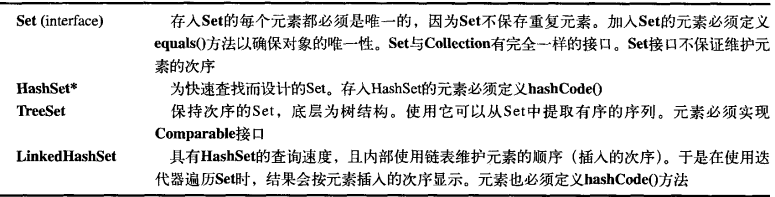
Set和存储顺序
队列
package cn.test;

import java.util.LinkedList;

import java.util.PriorityQueue;

import java.util.Queue;

import java.util.concurrent.ArrayBlockingQueue;

import java.util.concurrent.ConcurrentLinkedQueue;

import java.util.concurrent.LinkedBlockingQueue;

import java.util.concurrent.PriorityBlockingQueue;

public class QueueBehavior {

    private static int count=10;

    static <T> void test(Queue<T> queue,Generator<T> gen) {

        for(int i=0;i<count;i++) {

            queue.offer(gen.next());

            while(queue.peek()!=null) {

                System.out.print(queue.remove()+" ");

            }

        }

        System.out.println();

    }

    static class Gen implements Generator<String>{

        String[] s=("one two three four five six seven "

                + "eight nine ten").split(" ");

        int i;

        public String next() {

            return s[i++];

        }

    }

    public static void main(String[] args) {

        test(new LinkedList<String>(),new Gen());

        test(new PriorityQueue<String>(),new Gen());

        test(new ArrayBlockingQueue<String>(count),new Gen());

        test(new ConcurrentLinkedQueue<String>(),new Gen());

        test(new LinkedBlockingQueue<String>(),new Gen());

        test(new PriorityBlockingQueue<String>(),new Gen());

    }

}
优先级队列
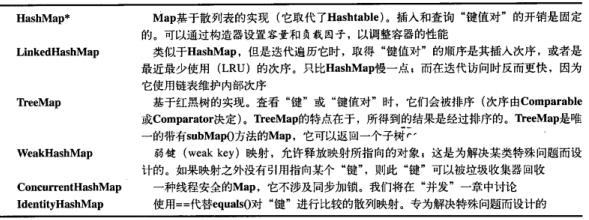
理解Map
性能

SortedMap
散列与散列码
package cn.test;

import java.lang.reflect.Constructor;

import java.util.HashMap;

import java.util.Map;

import java.util.Random;

class Groundhog{

    protected int number;

    public Groundhog(int n) {number = n;}

    public String toString() {

        return "Groundhog # "+number;

    }

}

class Prediction{

    private static Random rand=new Random(47);

    private boolean shadow=rand.nextDouble() > 0.5;

    public String toString() {

        if(shadow)

            return "Six more weeks of Winter!";

        else

            return "Early Spring!";

    }

}

public class SpringDetector {

    public static <T extends Groundhog>

    void detectSpring(Class<T> type)throws Exception{

        Constructor<T> ghog = type.getConstructor(int.class);

        Map<Groundhog,Prediction> map=new HashMap<Groundhog,Prediction>();

        for(int i=0;i<10;i++)

            map.put(ghog.newInstance(i), new Prediction());

        System.out.println("map = "+map);

        Groundhog gh = ghog.newInstance(3);

        System.out.println("Looking up prediction for "+gh);

        if(map.containsKey(gh))

            System.out.println(map.get(gh));

        else

            System.out.println("Key not found: "+gh);

    }

    public static void main(String[] args) throws Exception {

        detectSpring(Groundhog.class);

    }

}
为速度而散列
覆盖hashCode()
Collection或Map的同步控制
public class Synchronization {

    public static void main(String[] args) {

        Collection<String> c = Collections.synchronizedCollection(new ArrayList<String>());

        List<String> list = Collections.synchronizedList(new ArrayList<String>());

        Set<String> s = Collections.synchronizedSet(new HashSet<String>());

        SortedSet<String> ss = Collections.synchronizedSortedSet(new TreeSet<String>());

        Map<String,String> m=Collections.synchronizedMap(new HashMap<String,String>());

        Map<String,String> sm=Collections.synchronizedSortedMap(new TreeMap<String,String>());

    }

}
快速报错
public class FailFast {

    public static void main(String[] args) {

        Collection<String> c=new ArrayList<String>();

        Iterator<String> it=c.iterator();

        c.add("An object");

        try {

            String s=it.next();

        } catch (ConcurrentModificationException e) {

            System.out.println(e);

        }

    }

}
//  java.util.ConcurrentModificationException
在获取迭代器后,容器发生了变化。
持有引用
Hashtable
Hashtable 过时的类,线程安全,键值不为null;
HashMap 线程不安全 ,但可以通过Collections类转为线程安全。Map m = Collections.synchronizeMap(hashMap),键值可以为null;
Stack
package cn.test;

import java.util.LinkedList;

import java.util.Stack;

enum Month{

    january,february,march,april,may,june,july,august,september,october,november

}

public class Stacks {

    public static void main(String[] args) {

        Stack<String> stack=new Stack<String>();

        for(Month m:Month.values())

            stack.push(m.toString());

        System.out.println("stack = "+ stack);

        stack.addElement("The last line");

        System.out.println("element 5 = "+stack.elementAt(5));

        System.out.println("popping elements : ");

        while(!stack.empty())

            System.out.println(stack.pop()+" ");

        LinkedList<String> lstack=new LinkedList<String>();

        for(Month m: Month.values())

            lstack.addFirst(m.toString());

        System.out.println("lstack = "+lstack);

        while(!lstack.isEmpty())

            System.out.println(lstack.removeFirst()+" ");

    }

}
chapter 18 Java I/O系统
输入和输出
XML
I/O流的典型使用方式
对象序列化
对于某些实现了Serialiazable 又不想被序列化的字段,可以在字段前添加 transient 关键字。
《Think in Java》17~18的更多相关文章
- 读书笔记 之《Thinking in Java》(对象、集合)
一.前言: 本来想看完书再整理下自己的笔记的,可是书才看了一半发现笔记有点多,有点乱,就先整理一份吧,顺便复习下前面的知识,之后的再补上. 真的感觉,看书是个好习惯啊,难怪人家说"书籍是人类 ...
- 《Head First Java》读书笔记(1) - Java语言基础
<Head First Java>(点击查看详情) 1.写在前面的话 这本书的知识点说实话感觉有点散乱,但是贵在其将文字转换成了生动和更容易接受的图片,大量的比喻让人感受到了知识点的有趣之 ...
- 读书笔记 之《Thinking in Java》(对象、集合、异常)
一.前言 本来想看完书再整理下自己的笔记的,可是书才看了一半发现笔记有点多,有点乱,就先整理一份吧,顺便复习下前面的知识,之后的再补上. 真的感觉,看书是个好习惯啊,难怪人家说“书籍是人类进步的阶梯” ...
- 《Play for Java》学习笔记(一)项目框架
从今天开始认真复习<Play for JAVA>,该书以一个案例为主线,以前为应付项目马马虎虎看了一遍,好多地方都不明白!现在跟着这本书再走一遍,认真模拟,当做一个项目啦!! 一.Play ...
- 《图书管理系统——java》
/* (程序头部凝视開始) * 程序的版权和版本号声明部分 * Copyright (c) 2011, 烟台大学计算机学院学生 * All rights reserved. * 文件名: < ...
- 【书海】《Head First Java》 ——读后总结
<Head First Java> 中文版 (第二版) IT`huhui前言录 <Head First Java>这本书我不算特别细的看了一遍.认为十分适合初学者,甚至是没接触 ...
- 我本人一直以来犯的错误,在看了《Think In Java》后才抓了出来(转)
也许你是只老鸟,也许你的程序编的很精,但是,在你的程序生活,你也许没有注意到一些“常识性”的问题,因为有些时候我们不需要去注意,我们的程序 照样能够运行得飞快,但是如果那天有一个无聊的人问你一个像这样 ...
- 《Thinking in Java》 And 《Effective Java》啃起来
前言 今天从京东入手了两本书,<Thinking in Java>(第四版) 和 <Effective Java>(第二版).都可以称得上是硬书,需要慢慢啃的,预定计划是在今年 ...
- D1——初读《Head First Java》
今天随便看了点<Head First Java>,发觉这本书的风格真是有趣.打算先把这本书踏踏实实的看了.学习切忌好高骛远.心浮气躁,尤其入门基础阶段更应该踏踏实实地学习知识.下面随便谈谈 ...
随机推荐
- avalon1.3的新特性预览
avalon1.2的性能优化风暴很快就告一段落,入职也快一个月了,许多乱七八糟的事也少了下来,估计未来一个月会有许多好东呈现给大家. 首先是一个性能检测工具.由于MVVM是将原本由人脑干的事,转到各种 ...
- json和jsonp的区别(转)
原文链接:http://www.cnblogs.com/dowinning/archive/2012/04/19/json-jsonp-jquery.html 前言: 说到AJAX就会不可避免的面临 ...
- linux: 空指令(:)
:指令 描述: 空命令,除了参数替换和重定向外不执行任何操作,总是保证退出码为0. eg1:创建文件(不需要调用其它程序,速度更快) :>/path/to/file 测试: 创建10000个不存 ...
- 【uva1658 算法竞赛入门经典】海军上将【费用流】
题意 给出一个v(3<=v<=1000)个点e(3<=e<=10000)条边的有向加权图,求1-v的两条不相交(除了起点和终点外没有公共点)的路径,使得权和最小. 分析 费用流 ...
- js使用浏览器的另存为下载文件
页面上的页面如下: 我需要根据返回的url下载文件: js: //判断浏览器类型 function myBrowser(){ var userAgent = navigator.userAgent; ...
- 前Forward / 延时Deferred
本章节描述了延时光照的渲染路径的细节,如果想了解延迟光照技术,请查阅Deferred Lighting Approaches article. Deferred Lighting is renderi ...
- HTTP协议简析(二)
HTTP响应也包含四部分内容: 响应行: 协议版本:HTTP/1.1 状态码:200 状态描述:对状态码的说明 响应头:用来规范数据,常用的有: server:服务器信息 date:响应的时间 las ...
- Cloudstack4.2之改变数据卷容量的大小(Resize Data Volumes)
下图标注了这个功能在cloudstack4.2 UI中的位置 在cloudstack中是通过磁盘服务来设定卷的大小的.管理员可以设置相应的磁盘服务以供用户来使用.为了增强系统的灵活性,方便最终用户的使 ...
- 心理学轨迹及AI基础理论读后感
今天简单的看了下心理学轨迹及AI基础理论发现世界确实是那3%的人改变的,我等屁民还努力在红尘中争渡,下面简单记录下我刚看完的思路,算做个笔记给自己看.. 模型建立的最终结果可以解读所有的心理学现象,可 ...
- eclipse导入web项目报错 Cannot find the class file for javax.servlet.ServletContext.
当eclipse中新导入的Java Project的时候,往往会碰到各种各样的问题,下面是个典型的问题: Cannot find the class file for javax.servlet.Se ...