
Cartographer源码阅读(9):图优化的前端——闭环检测
约束计算
闭环检测的策略:搜索闭环,通过匹配检测是否是闭环,采用了分支定界法。
前已经述及PoseGraph的内容,此处继续。位姿图类定义了pose_graph::ConstraintBuilder constraint_builder_对象。
1.ConstraintBuilder类图
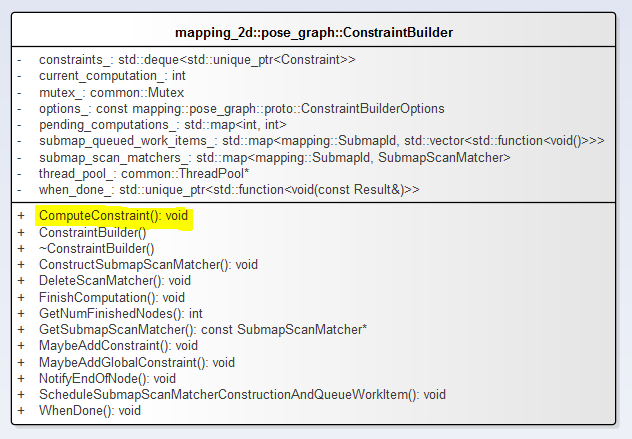
定义了SubmapScanMatcher的键值对。
 // Map of already constructed scan matchers by 'submap_id'.

 std::map<mapping::SubmapId, SubmapScanMatcher> submap_scan_matchers_ GUARDED_BY(mutex_);
SubmapScanMatcher结构体定义如下:
   struct SubmapScanMatcher

  {

     const ProbabilityGrid* probability_grid;

     std::unique_ptr<scan_matching::FastCorrelativeScanMatcher>

         fast_correlative_scan_matcher;

   };
注意ConstraintBuilder::ComputeConstraint方法,MaybeAddConstraint和MaybeAddGlobalConstraint都调用了该方法。
 void ConstraintBuilder::ComputeConstraint(

     const mapping::SubmapId& submap_id, const Submap* const submap,

     const mapping::NodeId& node_id, bool match_full_submap,

     const mapping::TrajectoryNode::Data* const constant_data,

     const transform::Rigid2d& initial_relative_pose,

     std::unique_ptr<ConstraintBuilder::Constraint>* constraint) {

   const transform::Rigid2d initial_pose =

       ComputeSubmapPose(*submap) * initial_relative_pose;

   const SubmapScanMatcher* const submap_scan_matcher =

       GetSubmapScanMatcher(submap_id);

   // The 'constraint_transform' (submap i <- node j) is computed from:

   // - a 'filtered_gravity_aligned_point_cloud' in node j,

   // - the initial guess 'initial_pose' for (map <- node j),

   // - the result 'pose_estimate' of Match() (map <- node j).

   // - the ComputeSubmapPose() (map <- submap i)

   float score = .;

   transform::Rigid2d pose_estimate = transform::Rigid2d::Identity();

   // Compute 'pose_estimate' in three stages:

   // 1. Fast estimate using the fast correlative scan matcher.

   // 2. Prune if the score is too low.

   // 3. Refine.

   if (match_full_submap) {

     if (submap_scan_matcher->fast_correlative_scan_matcher->MatchFullSubmap(

             constant_data->filtered_gravity_aligned_point_cloud,

             options_.global_localization_min_score(), &score, &pose_estimate)) {

       CHECK_GT(score, options_.global_localization_min_score());

       CHECK_GE(node_id.trajectory_id, );

       CHECK_GE(submap_id.trajectory_id, );

     } else {

       return;

     }

   } else {

     if (submap_scan_matcher->fast_correlative_scan_matcher->Match(

             initial_pose, constant_data->filtered_gravity_aligned_point_cloud,

             options_.min_score(), &score, &pose_estimate)) {

       // We've reported a successful local match.

       CHECK_GT(score, options_.min_score());

     } else {

       return;

     }

   }

   {

     common::MutexLocker locker(&mutex_);

     score_histogram_.Add(score);

   }

   // Use the CSM estimate as both the initial and previous pose. This has the

   // effect that, in the absence of better information, we prefer the original

   // CSM estimate.

   ceres::Solver::Summary unused_summary;

   ceres_scan_matcher_.Match(pose_estimate.translation(), pose_estimate,

                             constant_data->filtered_gravity_aligned_point_cloud,

                             *submap_scan_matcher->probability_grid,

                             &pose_estimate, &unused_summary);

   const transform::Rigid2d constraint_transform =

       ComputeSubmapPose(*submap).inverse() * pose_estimate;

   constraint->reset(new Constraint{submap_id,

                                    node_id,

                                    {transform::Embed3D(constraint_transform),

                                     options_.loop_closure_translation_weight(),

                                     options_.loop_closure_rotation_weight()},

                                    Constraint::INTER_SUBMAP});

   if (options_.log_matches()) {

     std::ostringstream info;

     info << "Node " << node_id << " with "

          << constant_data->filtered_gravity_aligned_point_cloud.size()

          << " points on submap " << submap_id << std::fixed;

     if (match_full_submap) {

       info << " matches";

     } else {

       const transform::Rigid2d difference =

           initial_pose.inverse() * pose_estimate;

       info << " differs by translation " << std::setprecision()

            << difference.translation().norm() << " rotation "

            << std::setprecision() << std::abs(difference.normalized_angle());

     }

     info << " with score " << std::setprecision() << . * score << "%.";

     LOG(INFO) << info.str();

   }

 }
这里出现了scan_matching::FastCorrelativeScanMatcher,另一种扫描匹配的方法。论文中介绍的分支定界法就在这个类中实现。
以上FastCorrelativeScanMatcher::Match和FastCorrelativeScanMatcher::MatchFullSubmap方法都调用了FastCorrelativeScanMatcher::MatchWithSearchParameters方法。
FastCorrelativeScanMatcher::MatchWithSearchParameters调用了FastCorrelativeScanMatcher::BranchAndBound方法。
|
Tips:总结一下出现的几种扫描匹配的方法? RealTimeCorrelativeScanMatcher FastCorrelativeScanMatcher |
 bool FastCorrelativeScanMatcher::MatchWithSearchParameters(

     SearchParameters search_parameters,

     const transform::Rigid2d& initial_pose_estimate,

     const sensor::PointCloud& point_cloud, float min_score, float* score,

     transform::Rigid2d* pose_estimate) const

 {

   CHECK_NOTNULL(score);

   CHECK_NOTNULL(pose_estimate);

   const Eigen::Rotation2Dd initial_rotation = initial_pose_estimate.rotation();

   const sensor::PointCloud rotated_point_cloud = sensor::TransformPointCloud(

       point_cloud,

       transform::Rigid3f::Rotation(Eigen::AngleAxisf(

           initial_rotation.cast<float>().angle(), Eigen::Vector3f::UnitZ())));

   const std::vector<sensor::PointCloud> rotated_scans =

       GenerateRotatedScans(rotated_point_cloud, search_parameters);

   const std::vector<DiscreteScan> discrete_scans = DiscretizeScans(

       limits_, rotated_scans,

       Eigen::Translation2f(initial_pose_estimate.translation().x(),

                            initial_pose_estimate.translation().y()));

   search_parameters.ShrinkToFit(discrete_scans, limits_.cell_limits());

   const std::vector<Candidate> lowest_resolution_candidates =

       ComputeLowestResolutionCandidates(discrete_scans, search_parameters);

   const Candidate best_candidate = BranchAndBound(

       discrete_scans, search_parameters, lowest_resolution_candidates,

       precomputation_grid_stack_->max_depth(), min_score);//分支定界法

   if (best_candidate.score > min_score) {

     *score = best_candidate.score;

     *pose_estimate = transform::Rigid2d(

         {initial_pose_estimate.translation().x() + best_candidate.x,

          initial_pose_estimate.translation().y() + best_candidate.y},

         initial_rotation * Eigen::Rotation2Dd(best_candidate.orientation));

     return true;

   }

   return false;

 }
2.分支定界法
FastCorrelativeScanMatcher::BranchAndBound,......
 Candidate FastCorrelativeScanMatcher::BranchAndBound(

     const std::vector<DiscreteScan>& discrete_scans,

     const SearchParameters& search_parameters,

     const std::vector<Candidate>& candidates, const int candidate_depth,

     float min_score) const

 {

   if (candidate_depth == )

   {

     // Return the best candidate.

     return *candidates.begin();

   }

   Candidate best_high_resolution_candidate(, , , search_parameters);

   best_high_resolution_candidate.score = min_score;

   for (const Candidate& candidate : candidates)

   {

     if (candidate.score <= min_score) {  break;  }

     std::vector<Candidate> higher_resolution_candidates;

     const int half_width =  << (candidate_depth - );

     for (int x_offset : {, half_width})

     {

       if (candidate.x_index_offset + x_offset >

           search_parameters.linear_bounds[candidate.scan_index].max_x) {

         break;

       }

       for (int y_offset : {, half_width}) {

         if (candidate.y_index_offset + y_offset >

             search_parameters.linear_bounds[candidate.scan_index].max_y) {

           break;

         }

         higher_resolution_candidates.emplace_back(

             candidate.scan_index, candidate.x_index_offset + x_offset,

             candidate.y_index_offset + y_offset, search_parameters);

       }

     }

     ScoreCandidates(precomputation_grid_stack_->Get(candidate_depth - ),

                     discrete_scans, search_parameters,

                     &higher_resolution_candidates);

     best_high_resolution_candidate = std::max(

         best_high_resolution_candidate,

         BranchAndBound(discrete_scans, search_parameters,

                        higher_resolution_candidates, candidate_depth - ,

                        best_high_resolution_candidate.score));

   }

   return best_high_resolution_candidate;

 }
Cartographer源码阅读(9):图优化的前端——闭环检测的更多相关文章
- Cartographer源码阅读(1):程序入口
带着几个思考问题: (1)IMU数据的使用,如何融合,Kalman滤波? (2)图优化的具体实现,闭环检测的策略? (3)3D激光的接入和闭环策略? 1. 安装Kdevelop工具: http://b ...
- Cartographer源码阅读(3):程序逻辑结构
Cartographer早期的代码在进行3d制图的时候使用了UKF方法,查看现有的tag版本,可以转到0.1.0和0.2.0查看,包含kalman_filter文件夹. 文件夹中的pose_track ...
- Cartographer源码阅读(5):PoseGraph位姿图
PoseGraph位姿图 mapping2D::PoseGraph类的注释: // Implements the loop closure method called Sparse Pose Adju ...
- Cartographer源码阅读(6):LocalTrajectoryBuilder和PoseExtrapolator
LocalTrajectoryBuilder意思是局部轨迹的构建,下面的类图中方法的参数没有画进去. 注意其中的三个类:PoseExtrapolator类,RealTimeCorrelativeSca ...
- Cartographer源码阅读(4):Node和MapBuilder对象2
MapBuilder的成员变量sensor::Collator sensor_collator_; 再次阅读MapBuilder::AddTrajectoryBuilder方法.首先构造了mappin ...
- Cartographer源码阅读(8):imu_tracker
IMU的输入为imu_linear_acceleration 和 imu_angular_velocity 线加速和角速度.最终作为属性输出的是方位四元数. Eigen::Quaterniond ...
- Cartographer源码阅读(2):Node和MapBuilder对象
上文提到特别注意map_builder_bridge_.AddTrajectory(x,x),查看其中的代码.两点: 首先是map_builder_.AddTrajectoryBuilder(...) ...
- Cartographer源码阅读(7):轨迹推算和位姿推算的原理
其实也就是包括两个方面的内容:类似于运动模型的位姿估计和扫描匹配,因为需要计算速度,所以时间就有必要了! 1. PoseExtrapolator解决了IMU数据.里程计和位姿信息进行融合的问题. 该类 ...
- 【原】SDWebImage源码阅读(四)
[原]SDWebImage源码阅读(四) 本文转载请注明出处 —— polobymulberry-博客园 1. 前言 SDWebImage中主要实现了NSURLConnectionDataDelega ...
随机推荐
- MySQL数据库的安装教程及相关问题
MySQL数据库的安装教程及相关问题 2018-07-13 MySQL数据库的下载及安装教程 问题1:Authentication plugin 'caching_sha2_password' can ...
- centos查看端口被哪个应用端口占用命令
在linux一般使用netstat 来查看系统端口使用情况步. netstat命令是一个监控TCP/IP网络的非常有用的工具,它可以显示路由表.实际的网络连接以及每一个网络接口设备的 net ...
- [Unity]Unity常见API
本文主要为了方便查阅 1. MonoBehaviour 生命周期 Awake 对象创建的时候调用,类似构造函数 Start 在Awake之后执行,区别在于,如果组件不可用(在Inspector没有勾选 ...
- JDK 自带的观察者模式源码分析以及和自定义实现的取舍
前言 总的结论就是:不推荐使用JDK自带的观察者API,而是自定义实现,但是可以借鉴其好的思想. java.util.Observer 接口源码分析 该接口十分简单,是各个观察者需要实现的接口 pac ...
- 消息中间件系列二:RabbitMQ入门(基本概念、RabbitMQ的安装和运行)
一.基本概念 1. AMQP AMQP,即Advanced Message Queuing Protocol,一个提供统一消息服务的应用层标准高级消息队列协议.支持不同语言和不同的产品 2. 生产者 ...
- 使用winsw部署spring boot jar 项目
参考:用winsw让任何Windows程序都能运行为服务 简介在linux下部署springboot项目是一件很简单的事,直接后台运行就行了,最多写个shell脚本开机自启就行了.我们最近做的项目需要 ...
- 移动网页广告引入mraid.js使用指南
在网上找mraid相关资料,相对比较少,大多都是API介绍,概念介绍等,没有一份详细的移动端网页广告使用教程,经过自己两天的摸索,完成了开发的移动端网页版的广告加入mraid功能. 背景: 我开发了移 ...
- java 位移运算符
import org.junit.Test; /** * 1)<< : 左移运算符 * 2)>> : 右移运算符 (测试正数) * 3)>> : 右移运算符 (测试 ...
- Qt编写自定义控件2-进度条标尺
前言 进度条标尺控件的应用场景一般是需要手动拉动进度,上面有标尺可以看到当前进度,类似于qslider控件,其实就是qslider+qprogressbar的杂交版本,不过我才用的是纯qpainter ...
- 扁平数组构建DOM树
interface IOrganizationNode { id: string; code: string; name: string; localName: string; localNameLo ...