
kubelet分析-csi driver注册源码分析
kubelet注册csi driver分析
kubelet注册csi driver的相关功能代码与kubelet的pluginManager有关,所以接下来对pluginManager进行分析。分析将分为pluginManager的初始化分析以及pluginManager的运行(处理逻辑)分析。
基于tag v1.17.4
https://github.com/kubernetes/kubernetes/releases/tag/v1.17.4
kubelet注册csi driver的原理
kubelet的pluginManager会监听某个特定目录,而负责向kubelet注册csi driver的组件Node Driver Registrar会创建暴露服务的socket在该目录下(每个plugin会对应一个Node Driver Registrar组件,也就是说,一个Node Driver Registrar只负责一个plugin的注册工作),pluginManager通过Node Driver Registrar组件暴露的socket获取plugin信息(包括plugin的socket地址、plugin名称等),从而最终做到根据该目录下socket文件的新增/删除来做相应的plugin注册/取消注册操作。
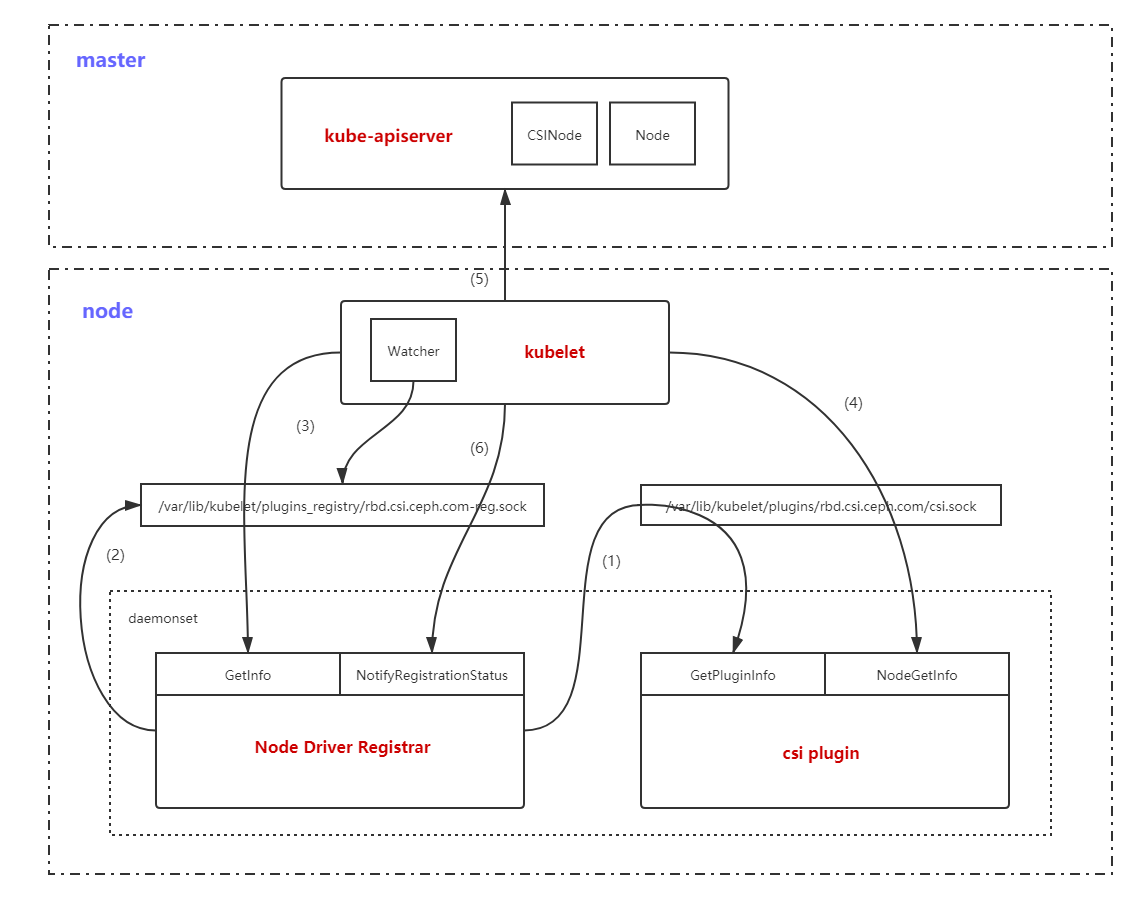
该图是Node Driver Registrar向kubelet注册csi driver的步骤流程图,这里大概看一下,具体请看这篇博客:Node Driver Registrar源码分析,结合本篇博客一起理解kubelet注册csi driver的整个过程。
plugin注册完成后,后续kubelet将通过plugin暴露的socket与plugin进行通信,做存储挂载/解除挂载等操作。
Node Driver Registrar
Node Driver Registrar在前面的文章中介绍过,它是一个sidecar容器,通过Kubelet的插件注册机制将CSI plugin(csi driver,两个名词意义一样)注册到Kubelet,让kubelet做volume的mount/umount操作时知道怎么调用相应的csi plugin。
kubelet pluginManager源码分析
1 pluginManager的初始化
调用NewMainKubelet()初始化kubelet的时候,会调用pluginmanager.NewPluginManager来初始化pluginManager,所以把NewMainKubelet()作为分析入口。
NewMainKubelet()
NewMainKubelet()中调用了pluginmanager.NewPluginManager来初始化pluginManager。
这里留意klet.getPluginsRegistrationDir(),调用该方法实际会返回plugins_registry,而该sockDir会传参进入pluginManager的desiredStateOfWorldPopulator结构体当中,相当于pluginManager会监听plugins_registry目录(负责向kubelet注册csi driver的组件Node Driver Registrar会创建暴露服务的socket在该目录下),pluginManager通过Node Driver Registrar组件暴露的socket获取plugin信息(包括plugin的socket地址、plugin名称等),从而最终做到根据该目录下socket文件的新增/删除来做相应的plugin注册/取消注册操作。
// pkg/kubelet/kubelet.go

// NewMainKubelet instantiates a new Kubelet object along with all the required internal modules.

// No initialization of Kubelet and its modules should happen here.

func NewMainKubelet(kubeCfg *kubeletconfiginternal.KubeletConfiguration,

	...

	nodeStatusMaxImages int32) (*Kubelet, error) {

	...

    klet.pluginManager = pluginmanager.NewPluginManager(

		klet.getPluginsRegistrationDir(), /* sockDir */

		kubeDeps.Recorder,

	)

	...

}
// pkg/kubelet/pluginmanager/plugin_manager.go

// NewPluginManager returns a new concrete instance implementing the

// PluginManager interface.

func NewPluginManager(

	sockDir string,

	recorder record.EventRecorder) PluginManager {

	asw := cache.NewActualStateOfWorld()

	dsw := cache.NewDesiredStateOfWorld()

	reconciler := reconciler.NewReconciler(

		operationexecutor.NewOperationExecutor(

			operationexecutor.NewOperationGenerator(

				recorder,

			),

		),

		loopSleepDuration,

		dsw,

		asw,

	)

	pm := &pluginManager{

		desiredStateOfWorldPopulator: pluginwatcher.NewWatcher(

			sockDir,

			dsw,

		),

		reconciler:          reconciler,

		desiredStateOfWorld: dsw,

		actualStateOfWorld:  asw,

	}

	return pm

}
klet.getPluginsRegistrationDir()
调用klet.getPluginsRegistrationDir()会返回plugins_registry。
// pkg/kubelet/kubelet_getters.go

// getPluginsRegistrationDir returns the full path to the directory under which

// plugins socket should be placed to be registered.

// More information is available about plugin registration in the pluginwatcher

// module

func (kl *Kubelet) getPluginsRegistrationDir() string {

	return filepath.Join(kl.getRootDir(), config.DefaultKubeletPluginsRegistrationDirName)

}
// pkg/kubelet/config/defaults.go

const (

    ...

    DefaultKubeletPluginsRegistrationDirName = "plugins_registry"

    ...

)
2 pluginManager struct
再来看到pluginManager结构体,pluginManager结构体与volumeManager结构体类似,都有actualStateOfWorld与desiredStateOfWorld两个属性。
kubelet pluginManager监听的socket注册目录每增加/删除一个socket文件,都会写入desiredStateOfWorld中/从desiredStateOfWorld中删除。
// pkg/kubelet/pluginmanager/plugin_manager.go

// pluginManager implements the PluginManager interface

type pluginManager struct {

	// desiredStateOfWorldPopulator (the plugin watcher) runs an asynchronous

	// periodic loop to populate the desiredStateOfWorld.

	desiredStateOfWorldPopulator *pluginwatcher.Watcher

	// reconciler runs an asynchronous periodic loop to reconcile the

	// desiredStateOfWorld with the actualStateOfWorld by triggering register

	// and unregister operations using the operationExecutor.

	reconciler reconciler.Reconciler

	// actualStateOfWorld is a data structure containing the actual state of

	// the world according to the manager: i.e. which plugins are registered.

	// The data structure is populated upon successful completion of register

	// and unregister actions triggered by the reconciler.

	actualStateOfWorld cache.ActualStateOfWorld

	// desiredStateOfWorld is a data structure containing the desired state of

	// the world according to the plugin manager: i.e. what plugins are registered.

	// The data structure is populated by the desired state of the world

	// populator (plugin watcher).

	desiredStateOfWorld cache.DesiredStateOfWorld

}
actualStateOfWorld
actualStateOfWorld结构体中存放的是已经完成了plugin注册操作的Node Driver Registrar组件暴露的socket相关信息。
// ActualStateOfWorld defines a set of thread-safe operations for the kubelet

// plugin manager's actual state of the world cache.

// This cache contains a map of socket file path to plugin information of

// all plugins attached to this node.

type ActualStateOfWorld interface {

	// GetRegisteredPlugins generates and returns a list of plugins

	// that are successfully registered plugins in the current actual state of world.

	GetRegisteredPlugins() []PluginInfo

	// AddPlugin add the given plugin in the cache.

	// An error will be returned if socketPath of the PluginInfo object is empty.

	// Note that this is different from desired world cache's AddOrUpdatePlugin

	// because for the actual state of world cache, there won't be a scenario where

	// we need to update an existing plugin if the timestamps don't match. This is

	// because the plugin should have been unregistered in the reconciller and therefore

	// removed from the actual state of world cache first before adding it back into

	// the actual state of world cache again with the new timestamp

	AddPlugin(pluginInfo PluginInfo) error

	// RemovePlugin deletes the plugin with the given socket path from the actual

	// state of world.

	// If a plugin does not exist with the given socket path, this is a no-op.

	RemovePlugin(socketPath string)

	// PluginExists checks if the given plugin exists in the current actual

	// state of world cache with the correct timestamp

	PluginExistsWithCorrectTimestamp(pluginInfo PluginInfo) bool

}

// NewActualStateOfWorld returns a new instance of ActualStateOfWorld

func NewActualStateOfWorld() ActualStateOfWorld {

	return &actualStateOfWorld{

		socketFileToInfo: make(map[string]PluginInfo),

	}

}

type actualStateOfWorld struct {

	// socketFileToInfo is a map containing the set of successfully registered plugins

	// The keys are plugin socket file paths. The values are PluginInfo objects

	socketFileToInfo map[string]PluginInfo

	sync.RWMutex

}
desiredStateOfWorld
desiredStateOfWorld结构体中存放的是在pluginManager监听目录下存在的,希望完成plugin注册操作的Node Driver Registrar组件暴露的socket相关信息。
// DesiredStateOfWorld defines a set of thread-safe operations for the kubelet

// plugin manager's desired state of the world cache.

// This cache contains a map of socket file path to plugin information of

// all plugins attached to this node.

type DesiredStateOfWorld interface {

	// AddOrUpdatePlugin add the given plugin in the cache if it doesn't already exist.

	// If it does exist in the cache, then the timestamp of the PluginInfo object in the cache will be updated.

	// An error will be returned if socketPath is empty.

	AddOrUpdatePlugin(socketPath string) error

	// RemovePlugin deletes the plugin with the given socket path from the desired

	// state of world.

	// If a plugin does not exist with the given socket path, this is a no-op.

	RemovePlugin(socketPath string)

	// GetPluginsToRegister generates and returns a list of plugins

	// in the current desired state of world.

	GetPluginsToRegister() []PluginInfo

	// PluginExists checks if the given socket path exists in the current desired

	// state of world cache

	PluginExists(socketPath string) bool

}

// NewDesiredStateOfWorld returns a new instance of DesiredStateOfWorld.

func NewDesiredStateOfWorld() DesiredStateOfWorld {

	return &desiredStateOfWorld{

		socketFileToInfo: make(map[string]PluginInfo),

	}

}

type desiredStateOfWorld struct {

	// socketFileToInfo is a map containing the set of successfully registered plugins

	// The keys are plugin socket file paths. The values are PluginInfo objects

	socketFileToInfo map[string]PluginInfo

	sync.RWMutex

}
3 pluginManager的运行
上面介绍了pluginManager的初始化,接下来介绍pluginManager的运行也即Run方法进行分析,分析一下pluginManager的处理逻辑。
因为调用逻辑比较复杂,这里直接跳过了调用过程的分析,直接进入kl.pluginManager.Run()的分析,下面只给出该方法的一个调用链:
kubelet的Run()方法(pkg/kubelet/kubelet.go) --> kl.updateRuntimeUp()(pkg/kubelet/kubelet.go) --> kl.initializeRuntimeDependentModules()(pkg/kubelet/kubelet.go) --> kl.pluginManager.Run()
kl.pluginManager.Run
下面直接看到kl.pluginManager.Run的代码。
该方法主要逻辑有两个:
(1)pm.desiredStateOfWorldPopulator.Start():持续监听plugin的socket注册目录的变化事件,将Node Driver Registrar的socket信息写入desiredStateOfWorld中/从desiredStateOfWorld中删除;
(2)pm.reconciler.Run()。
// pkg/kubelet/pluginmanager/plugin_manager.go

func (pm *pluginManager) Run(sourcesReady config.SourcesReady, stopCh <-chan struct{}) {

	defer runtime.HandleCrash()

	pm.desiredStateOfWorldPopulator.Start(stopCh)

	klog.V(2).Infof("The desired_state_of_world populator (plugin watcher) starts")

	klog.Infof("Starting Kubelet Plugin Manager")

	go pm.reconciler.Run(stopCh)

	metrics.Register(pm.actualStateOfWorld, pm.desiredStateOfWorld)

	<-stopCh

	klog.Infof("Shutting down Kubelet Plugin Manager")

}
3.1 pm.desiredStateOfWorldPopulator.Start()
跑一个goroutine,持续监听plugin的socket注册目录的变化事件:
(1)当变化事件为新增事件时,即socket目录下多了文件,则调用w.handleCreateEvent,将该socket加入到desiredStateOfWorld中;
(2)当变化事件为删除事件时,即socket目录下删除了文件,则调用w.handleDeleteEvent,将该socket从desiredStateOfWorld中删除。
// pkg/kubelet/pluginmanager/pluginwatcher/plugin_watcher.go

// Start watches for the creation and deletion of plugin sockets at the path

func (w *Watcher) Start(stopCh <-chan struct{}) error {

	klog.V(2).Infof("Plugin Watcher Start at %s", w.path)

	w.stopped = make(chan struct{})

	// Creating the directory to be watched if it doesn't exist yet,

	// and walks through the directory to discover the existing plugins.

	if err := w.init(); err != nil {

		return err

	}

	fsWatcher, err := fsnotify.NewWatcher()

	if err != nil {

		return fmt.Errorf("failed to start plugin fsWatcher, err: %v", err)

	}

	w.fsWatcher = fsWatcher

	// Traverse plugin dir and add filesystem watchers before starting the plugin processing goroutine.

	if err := w.traversePluginDir(w.path); err != nil {

		klog.Errorf("failed to traverse plugin socket path %q, err: %v", w.path, err)

	}

	go func(fsWatcher *fsnotify.Watcher) {

		defer close(w.stopped)

		for {

			select {

			case event := <-fsWatcher.Events:

				//TODO: Handle errors by taking corrective measures

				if event.Op&fsnotify.Create == fsnotify.Create {

					err := w.handleCreateEvent(event)

					if err != nil {

						klog.Errorf("error %v when handling create event: %s", err, event)

					}

				} else if event.Op&fsnotify.Remove == fsnotify.Remove {

					w.handleDeleteEvent(event)

				}

				continue

			case err := <-fsWatcher.Errors:

				if err != nil {

					klog.Errorf("fsWatcher received error: %v", err)

				}

				continue

			case <-stopCh:

				// In case of plugin watcher being stopped by plugin manager, stop

				// probing the creation/deletion of plugin sockets.

				// Also give all pending go routines a chance to complete

				select {

				case <-w.stopped:

				case <-time.After(11 * time.Second):

					klog.Errorf("timeout on stopping watcher")

				}

				w.fsWatcher.Close()

				return

			}

		}

	}(fsWatcher)

	return nil

}
w.handleCreateEvent()
w.handleCreateEvent()主要逻辑:
(1)判断新增事件是否为文件,且是否是socket文件;
(2)是socket文件,则调用w.handlePluginRegistration做处理,主要是将该socket加入到desiredStateOfWorld中。
// pkg/kubelet/pluginmanager/pluginwatcher/plugin_watcher.go

func (w *Watcher) handleCreateEvent(event fsnotify.Event) error {

	klog.V(6).Infof("Handling create event: %v", event)

	fi, err := os.Stat(event.Name)

	if err != nil {

		return fmt.Errorf("stat file %s failed: %v", event.Name, err)

	}

	if strings.HasPrefix(fi.Name(), ".") {

		klog.V(5).Infof("Ignoring file (starts with '.'): %s", fi.Name())

		return nil

	}

	if !fi.IsDir() {

		isSocket, err := util.IsUnixDomainSocket(util.NormalizePath(event.Name))

		if err != nil {

			return fmt.Errorf("failed to determine if file: %s is a unix domain socket: %v", event.Name, err)

		}

		if !isSocket {

			klog.V(5).Infof("Ignoring non socket file %s", fi.Name())

			return nil

		}

		return w.handlePluginRegistration(event.Name)

	}

	return w.traversePluginDir(event.Name)

}

func (w *Watcher) handlePluginRegistration(socketPath string) error {

	if runtime.GOOS == "windows" {

		socketPath = util.NormalizePath(socketPath)

	}

	//TODO: Implement rate limiting to mitigate any DOS kind of attacks.

	// Update desired state of world list of plugins

	// If the socket path does exist in the desired world cache, there's still

	// a possibility that it has been deleted and recreated again before it is

	// removed from the desired world cache, so we still need to call AddOrUpdatePlugin

	// in this case to update the timestamp

	klog.V(2).Infof("Adding socket path or updating timestamp %s to desired state cache", socketPath)

	err := w.desiredStateOfWorld.AddOrUpdatePlugin(socketPath)

	if err != nil {

		return fmt.Errorf("error adding socket path %s or updating timestamp to desired state cache: %v", socketPath, err)

	}

	return nil

}
w.handleDeleteEvent()
w.handleDeleteEvent()主要逻辑:
(1)将socket从desiredStateOfWorld中删除。
// pkg/kubelet/pluginmanager/pluginwatcher/plugin_watcher.go

func (w *Watcher) handleDeleteEvent(event fsnotify.Event) {

	klog.V(6).Infof("Handling delete event: %v", event)

	socketPath := event.Name

	klog.V(2).Infof("Removing socket path %s from desired state cache", socketPath)

	w.desiredStateOfWorld.RemovePlugin(socketPath)

}
3.2 pm.reconciler.Run()
pm.reconciler.Run()主要逻辑为对比desiredStateOfWorld与actualStateOfWorld做调谐,做plugin的注册操作/取消注册操作。具体逻辑如下:
(1)对比actualStateOfWorld,如果desiredStateOfWorld中没有该socket信息,或者desiredStateOfWorld中该socket的Timestamp值与actualStateOfWorld中的不相等(即plugin更新了),则说明该plugin需要取消注册(更新的plugin需先取消注册,然后再次注册),调用rc.operationExecutor.UnregisterPlugin做plugin取消注册操作;
(2)对比desiredStateOfWorld,如果actualStateOfWorld中没有该socket信息,则调用rc.operationExecutor.RegisterPlugin做plugin注册操作。
// pkg/kubelet/pluginmanager/reconciler/reconciler.go

func (rc *reconciler) Run(stopCh <-chan struct{}) {

	wait.Until(func() {

		rc.reconcile()

	},

		rc.loopSleepDuration,

		stopCh)

}

func (rc *reconciler) reconcile() {

	// Unregisterations are triggered before registrations

	// Ensure plugins that should be unregistered are unregistered.

	for _, registeredPlugin := range rc.actualStateOfWorld.GetRegisteredPlugins() {

		unregisterPlugin := false

		if !rc.desiredStateOfWorld.PluginExists(registeredPlugin.SocketPath) {

			unregisterPlugin = true

		} else {

			// We also need to unregister the plugins that exist in both actual state of world

			// and desired state of world cache, but the timestamps don't match.

			// Iterate through desired state of world plugins and see if there's any plugin

			// with the same socket path but different timestamp.

			for _, dswPlugin := range rc.desiredStateOfWorld.GetPluginsToRegister() {

				if dswPlugin.SocketPath == registeredPlugin.SocketPath && dswPlugin.Timestamp != registeredPlugin.Timestamp {

					klog.V(5).Infof(registeredPlugin.GenerateMsgDetailed("An updated version of plugin has been found, unregistering the plugin first before reregistering", ""))

					unregisterPlugin = true

					break

				}

			}

		}

		if unregisterPlugin {

			klog.V(5).Infof(registeredPlugin.GenerateMsgDetailed("Starting operationExecutor.UnregisterPlugin", ""))

			err := rc.operationExecutor.UnregisterPlugin(registeredPlugin.SocketPath, rc.getHandlers(), rc.actualStateOfWorld)

			if err != nil &&

				!goroutinemap.IsAlreadyExists(err) &&

				!exponentialbackoff.IsExponentialBackoff(err) {

				// Ignore goroutinemap.IsAlreadyExists and exponentialbackoff.IsExponentialBackoff errors, they are expected.

				// Log all other errors.

				klog.Errorf(registeredPlugin.GenerateErrorDetailed("operationExecutor.UnregisterPlugin failed", err).Error())

			}

			if err == nil {

				klog.V(1).Infof(registeredPlugin.GenerateMsgDetailed("operationExecutor.UnregisterPlugin started", ""))

			}

		}

	}

	// Ensure plugins that should be registered are registered

	for _, pluginToRegister := range rc.desiredStateOfWorld.GetPluginsToRegister() {

		if !rc.actualStateOfWorld.PluginExistsWithCorrectTimestamp(pluginToRegister) {

			klog.V(5).Infof(pluginToRegister.GenerateMsgDetailed("Starting operationExecutor.RegisterPlugin", ""))

			err := rc.operationExecutor.RegisterPlugin(pluginToRegister.SocketPath, pluginToRegister.Timestamp, rc.getHandlers(), rc.actualStateOfWorld)

			if err != nil &&

				!goroutinemap.IsAlreadyExists(err) &&

				!exponentialbackoff.IsExponentialBackoff(err) {

				// Ignore goroutinemap.IsAlreadyExists and exponentialbackoff.IsExponentialBackoff errors, they are expected.

				klog.Errorf(pluginToRegister.GenerateErrorDetailed("operationExecutor.RegisterPlugin failed", err).Error())

			}

			if err == nil {

				klog.V(1).Infof(pluginToRegister.GenerateMsgDetailed("operationExecutor.RegisterPlugin started", ""))

			}

		}

	}

}
3.2.1 rc.operationExecutor.UnregisterPlugin()
rc.operationExecutor.UnregisterPlugin()主要逻辑:做plugin取消注册操作。
那plugin取消注册操作具体做了什么呢?继续往下分析。
plugin取消注册操作方法调用链
kl.pluginManager.Run --> pm.desiredStateOfWorldPopulator.Start() --> pm.reconciler.Run() --> rc.reconcile() --> rc.operationExecutor.UnregisterPlugin() --> oe.operationGenerator.GenerateUnregisterPluginFunc() --> handler.DeRegisterPlugin() --> nim.UninstallCSIDriver() --> nim.updateNode()
下面来对plugin取消注册操作的部分关键方法进行分析。
GenerateUnregisterPluginFunc
下面来分析下GenerateUnregisterPluginFunc的逻辑,主要是定义并实现一个plugin取消注册的方法,然后返回。plugin取消注册方法主要逻辑如下:
(1)检测Node Driver Registrar组件socket的连通性;
(2)通过Node Driver Registrar组件socket获取plugin信息;
(3)从actualStateOfWorld中删除该Node Driver Registrar组件的socket信息;
(4)调用handler.DeRegisterPlugin做进一步的plugin取消注册操作。
所以接下来会对handler.DeRegisterPlugin方法进行分析。
// pkg/kubelet/pluginmanager/operationexecutor/operation_executor.go

func (oe *operationExecutor) UnregisterPlugin(

	socketPath string,

	pluginHandlers map[string]cache.PluginHandler,

	actualStateOfWorld ActualStateOfWorldUpdater) error {

	generatedOperation :=

		oe.operationGenerator.GenerateUnregisterPluginFunc(socketPath, pluginHandlers, actualStateOfWorld)

	return oe.pendingOperations.Run(

		socketPath, generatedOperation)

}
// pkg/kubelet/pluginmanager/operationexecutor/operation_generator.go
func (og *operationGenerator) GenerateUnregisterPluginFunc(
socketPath string,
pluginHandlers map[string]cache.PluginHandler,
actualStateOfWorldUpdater ActualStateOfWorldUpdater) func() error {
unregisterPluginFunc := func() error {
client, conn, err := dial(socketPath, dialTimeoutDuration)
if err != nil {
return fmt.Errorf("UnregisterPlugin error -- dial failed at socket %s, err: %v", socketPath, err)
}
defer conn.Close()
ctx, cancel := context.WithTimeout(context.Background(), time.Second)
defer cancel()
infoResp, err := client.GetInfo(ctx, ®isterapi.InfoRequest{})
if err != nil {
return fmt.Errorf("UnregisterPlugin error -- failed to get plugin info using RPC GetInfo at socket %s, err: %v", socketPath, err)
}
handler, ok := pluginHandlers[infoResp.Type]
if !ok {
return fmt.Errorf("UnregisterPlugin error -- no handler registered for plugin type: %s at socket %s", infoResp.Type, socketPath)
}
// We remove the plugin to the actual state of world cache before calling a plugin consumer's Unregister handle
// so that if we receive a register event during Register Plugin, we can process it as a Register call.
actualStateOfWorldUpdater.RemovePlugin(socketPath)
handler.DeRegisterPlugin(infoResp.Name)
return nil
}
return unregisterPluginFunc
}
handler.DeRegisterPlugin()
handler.DeRegisterPlugin()方法里逻辑比较简单,主要是调用了unregisterDriver()方法。
unregisterDriver()方法主要逻辑:
(1)从csiDrivers变量中删除该plugin信息(后续kubelet调用csi plugin进行存储的挂载/解除挂载操作,将通过plugin名称从csiDrivers变量中拿到socket地址并进行通信,所以取消注册plugin时,需要从csiDrivers变量中把该plugin信息去除);
(2)调用nim.UninstallCSIDriver()做进一步处理。
// pkg/volume/csi/csi_plugin.go

// DeRegisterPlugin is called when a plugin removed its socket, signaling

// it is no longer available

func (h *RegistrationHandler) DeRegisterPlugin(pluginName string) {

	klog.Info(log("registrationHandler.DeRegisterPlugin request for plugin %s", pluginName))

	if err := unregisterDriver(pluginName); err != nil {

		klog.Error(log("registrationHandler.DeRegisterPlugin failed: %v", err))

	}

}

func unregisterDriver(driverName string) error {

	csiDrivers.Delete(driverName)

	if err := nim.UninstallCSIDriver(driverName); err != nil {

		return errors.New(log("Error uninstalling CSI driver: %v", err))

	}

	return nil

}
nim.UninstallCSIDriver()
接下来看到nim.UninstallCSIDriver()方法的分析。
nim.UninstallCSIDriver()中主要看到nim.uninstallDriverFromCSINode()、removeMaxAttachLimit()与removeNodeIDFromNode()3个方法,主要逻辑都在其中:
(1)nim.uninstallDriverFromCSINode():更新CSINode对象,从中去除取消注册的plugin的相关信息。
(2)removeMaxAttachLimit():更新node对象,从node.Status.Capacity及node.Status.Allocatable中去除取消注册的plugin的相关信息。
(3)removeNodeIDFromNode():更新node对象,从node对象的annotation中key为csi.volume.kubernetes.io/nodeid的值中去除取消注册的plugin信息。
node对象的annotation示例:
csi.volume.kubernetes.io/nodeid: '{"cephfs.csi.ceph.com":"192.168.1.10","rbd.csi.ceph.com":"192.168.1.10"}'
CSIDriver对象示例:
apiVersion: storage.k8s.io/v1

kind: CSINode

metadata:

  name: 192.168.1.10

spec:

  drivers:

  - name: cephfs.csi.ceph.com

    nodeID: 192.168.1.10

    topologyKeys: null

  - name: rbd.csi.ceph.com

    nodeID: 192.168.1.10

    topologyKeys: null
nim.UninstallCSIDriver()源码:
// pkg/volume/csi/nodeinfomanager/nodeinfomanager.go

// UninstallCSIDriver removes the node ID annotation from the Node object and CSIDrivers field from the

// CSINode object. If the CSINOdeInfo object contains no CSIDrivers, it will be deleted.

// If multiple calls to UninstallCSIDriver() are made in parallel, some calls might receive Node or

// CSINode update conflicts, which causes the function to retry the corresponding update.

func (nim *nodeInfoManager) UninstallCSIDriver(driverName string) error {

	if utilfeature.DefaultFeatureGate.Enabled(features.CSINodeInfo) {

		err := nim.uninstallDriverFromCSINode(driverName)

		if err != nil {

			return fmt.Errorf("error uninstalling CSI driver from CSINode object %v", err)

		}

	}

	err := nim.updateNode(

		removeMaxAttachLimit(driverName),

		removeNodeIDFromNode(driverName),

	)

	if err != nil {

		return fmt.Errorf("error removing CSI driver node info from Node object %v", err)

	}

	return nil

}

func (nim *nodeInfoManager) updateNode(updateFuncs ...nodeUpdateFunc) error {

	var updateErrs []error

	err := wait.ExponentialBackoff(updateBackoff, func() (bool, error) {

		if err := nim.tryUpdateNode(updateFuncs...); err != nil {

			updateErrs = append(updateErrs, err)

			return false, nil

		}

		return true, nil

	})

	if err != nil {

		return fmt.Errorf("error updating node: %v; caused by: %v", err, utilerrors.NewAggregate(updateErrs))

	}

	return nil

}
(1)nim.uninstallDriverFromCSINode():更新CSINode对象,从中去除取消注册的plugin的相关信息。
// pkg/volume/csi/nodeinfomanager/nodeinfomanager.go

func (nim *nodeInfoManager) uninstallDriverFromCSINode(

	csiDriverName string) error {

	csiKubeClient := nim.volumeHost.GetKubeClient()

	if csiKubeClient == nil {

		return fmt.Errorf("error getting CSI client")

	}

	var updateErrs []error

	err := wait.ExponentialBackoff(updateBackoff, func() (bool, error) {

		if err := nim.tryUninstallDriverFromCSINode(csiKubeClient, csiDriverName); err != nil {

			updateErrs = append(updateErrs, err)

			return false, nil

		}

		return true, nil

	})

	if err != nil {

		return fmt.Errorf("error updating CSINode: %v; caused by: %v", err, utilerrors.NewAggregate(updateErrs))

	}

	return nil

}

func (nim *nodeInfoManager) tryUninstallDriverFromCSINode(

	csiKubeClient clientset.Interface,

	csiDriverName string) error {

	nodeInfoClient := csiKubeClient.StorageV1().CSINodes()

	nodeInfo, err := nodeInfoClient.Get(string(nim.nodeName), metav1.GetOptions{})

	if err != nil && errors.IsNotFound(err) {

		return nil

	} else if err != nil {

		return err

	}

	hasModified := false

	// Uninstall CSINodeDriver with name csiDriverName

	drivers := nodeInfo.Spec.Drivers[:0]

	for _, driver := range nodeInfo.Spec.Drivers {

		if driver.Name != csiDriverName {

			drivers = append(drivers, driver)

		} else {

			// Found a driver with name csiDriverName

			// Set hasModified to true because it will be removed

			hasModified = true

		}

	}

	if !hasModified {

		// No changes, don't update

		return nil

	}

	nodeInfo.Spec.Drivers = drivers

	_, err = nodeInfoClient.Update(nodeInfo)

	return err // do not wrap error

}
(2)removeMaxAttachLimit():更新node对象,从node.Status.Capacity及node.Status.Allocatable中去除取消注册的plugin的相关信息。
// pkg/volume/csi/nodeinfomanager/nodeinfomanager.go

func removeMaxAttachLimit(driverName string) nodeUpdateFunc {

	return func(node *v1.Node) (*v1.Node, bool, error) {

		limitKey := v1.ResourceName(util.GetCSIAttachLimitKey(driverName))

		capacityExists := false

		if node.Status.Capacity != nil {

			_, capacityExists = node.Status.Capacity[limitKey]

		}

		allocatableExists := false

		if node.Status.Allocatable != nil {

			_, allocatableExists = node.Status.Allocatable[limitKey]

		}

		if !capacityExists && !allocatableExists {

			return node, false, nil

		}

		delete(node.Status.Capacity, limitKey)

		if len(node.Status.Capacity) == 0 {

			node.Status.Capacity = nil

		}

		delete(node.Status.Allocatable, limitKey)

		if len(node.Status.Allocatable) == 0 {

			node.Status.Allocatable = nil

		}

		return node, true, nil

	}

}
(3)removeNodeIDFromNode():更新node对象,从node对象的annotation中key为csi.volume.kubernetes.io/nodeid的值中去除取消注册的plugin信息。
// pkg/volume/csi/nodeinfomanager/nodeinfomanager.go

// removeNodeIDFromNode returns a function that removes node ID information matching the given

// driver name from a Node object.

func removeNodeIDFromNode(csiDriverName string) nodeUpdateFunc {

	return func(node *v1.Node) (*v1.Node, bool, error) {

		var previousAnnotationValue string

		if node.ObjectMeta.Annotations != nil {

			previousAnnotationValue =

				node.ObjectMeta.Annotations[annotationKeyNodeID]

		}

		if previousAnnotationValue == "" {

			return node, false, nil

		}

		// Parse previousAnnotationValue as JSON

		existingDriverMap := map[string]string{}

		if err := json.Unmarshal([]byte(previousAnnotationValue), &existingDriverMap); err != nil {

			return nil, false, fmt.Errorf(

				"failed to parse node's %q annotation value (%q) err=%v",

				annotationKeyNodeID,

				previousAnnotationValue,

				err)

		}

		if _, ok := existingDriverMap[csiDriverName]; !ok {

			// Value is already missing in node annotation, nothing more to do

			return node, false, nil

		}

		// Delete annotation value

		delete(existingDriverMap, csiDriverName)

		if len(existingDriverMap) == 0 {

			delete(node.ObjectMeta.Annotations, annotationKeyNodeID)

		} else {

			jsonObj, err := json.Marshal(existingDriverMap)

			if err != nil {

				return nil, false, fmt.Errorf(

					"failed while trying to remove key %q from node %q annotation. Existing data: %v",

					csiDriverName,

					annotationKeyNodeID,

					previousAnnotationValue)

			}

			node.ObjectMeta.Annotations[annotationKeyNodeID] = string(jsonObj)

		}

		return node, true, nil

	}

}
3.2.2 rc.operationExecutor.RegisterPlugin()
rc.operationExecutor.RegisterPlugin()主要逻辑:做plugin注册操作。
那plugin注册操作具体做了什么呢?继续往下分析。
plugin注册操作方法调用链
kl.pluginManager.Run --> pm.desiredStateOfWorldPopulator.Start() --> pm.reconciler.Run() --> rc.reconcile() --> rc.operationExecutor.RegisterPlugin() --> oe.operationGenerator.GenerateRegisterPluginFunc() --> handler.RegisterPlugin() --> nim.InstallCSIDriver() --> nim.updateNode()
下面来对plugin注册操作的部分关键方法进行分析。
GenerateRegisterPluginFunc
下面来分析下GenerateRegisterPluginFunc的逻辑,主要是定义并实现一个plugin注册的方法,然后返回。plugin注册方法主要逻辑如下:
(1)检测Node Driver Registrar组件socket的连通性;
(2)通过Node Driver Registrar组件socket获取plugin信息(包括plugin的socket地址、plugin名称等);
(3)调用handler.ValidatePlugin(),检查已注册的plugin中是否有比该需要注册的plugin同名的的更高的版本,如有,则返回注册失败,并通知plugin注册失败;
(4)向actualStateOfWorld中增加该Node Driver Registrar组件的socket信息;
(5)调用handler.RegisterPlugin()做进一步的plugin注册操作;
(6)调用og.notifyPlugin,通知plugin,已经向kubelet注册成功/注册失败。
所以接下来会对handler.RegisterPlugin()方法进行分析。
// pkg/kubelet/pluginmanager/operationexecutor/operation_executor.go

func (oe *operationExecutor) RegisterPlugin(

	socketPath string,

	timestamp time.Time,

	pluginHandlers map[string]cache.PluginHandler,

	actualStateOfWorld ActualStateOfWorldUpdater) error {

	generatedOperation :=

		oe.operationGenerator.GenerateRegisterPluginFunc(socketPath, timestamp, pluginHandlers, actualStateOfWorld)

	return oe.pendingOperations.Run(

		socketPath, generatedOperation)

}
// pkg/kubelet/pluginmanager/operationexecutor/operation_generator.go
func (og *operationGenerator) GenerateRegisterPluginFunc(
socketPath string,
timestamp time.Time,
pluginHandlers map[string]cache.PluginHandler,
actualStateOfWorldUpdater ActualStateOfWorldUpdater) func() error {
registerPluginFunc := func() error {
client, conn, err := dial(socketPath, dialTimeoutDuration)
if err != nil {
return fmt.Errorf("RegisterPlugin error -- dial failed at socket %s, err: %v", socketPath, err)
}
defer conn.Close()
ctx, cancel := context.WithTimeout(context.Background(), time.Second)
defer cancel()
infoResp, err := client.GetInfo(ctx, ®isterapi.InfoRequest{})
if err != nil {
return fmt.Errorf("RegisterPlugin error -- failed to get plugin info using RPC GetInfo at socket %s, err: %v", socketPath, err)
}
handler, ok := pluginHandlers[infoResp.Type]
if !ok {
if err := og.notifyPlugin(client, false, fmt.Sprintf("RegisterPlugin error -- no handler registered for plugin type: %s at socket %s", infoResp.Type, socketPath)); err != nil {
return fmt.Errorf("RegisterPlugin error -- failed to send error at socket %s, err: %v", socketPath, err)
}
return fmt.Errorf("RegisterPlugin error -- no handler registered for plugin type: %s at socket %s", infoResp.Type, socketPath)
}
if infoResp.Endpoint == "" {
infoResp.Endpoint = socketPath
}
if err := handler.ValidatePlugin(infoResp.Name, infoResp.Endpoint, infoResp.SupportedVersions); err != nil {
if err = og.notifyPlugin(client, false, fmt.Sprintf("RegisterPlugin error -- plugin validation failed with err: %v", err)); err != nil {
return fmt.Errorf("RegisterPlugin error -- failed to send error at socket %s, err: %v", socketPath, err)
}
return fmt.Errorf("RegisterPlugin error -- pluginHandler.ValidatePluginFunc failed")
}
// We add the plugin to the actual state of world cache before calling a plugin consumer's Register handle
// so that if we receive a delete event during Register Plugin, we can process it as a DeRegister call.
err = actualStateOfWorldUpdater.AddPlugin(cache.PluginInfo{
SocketPath: socketPath,
Timestamp: timestamp,
})
if err != nil {
klog.Errorf("RegisterPlugin error -- failed to add plugin at socket %s, err: %v", socketPath, err)
}
if err := handler.RegisterPlugin(infoResp.Name, infoResp.Endpoint, infoResp.SupportedVersions); err != nil {
return og.notifyPlugin(client, false, fmt.Sprintf("RegisterPlugin error -- plugin registration failed with err: %v", err))
}
// Notify is called after register to guarantee that even if notify throws an error Register will always be called after validate
if err := og.notifyPlugin(client, true, ""); err != nil {
return fmt.Errorf("RegisterPlugin error -- failed to send registration status at socket %s, err: %v", socketPath, err)
}
return nil
}
return registerPluginFunc
}
handler.RegisterPlugin()
handler.DeRegisterPlugin()方法主要逻辑:
(1)存储该plugin信息(主要是plugin名称与plugin的socket地址)到csiDrivers变量中(后续kubelet调用csi plugin进行存储的挂载/解除挂载操作,将通过plugin名称从此变量中拿到socket地址并进行通信);
(2)检测Node Driver Registrar组件socket的连通性;
(3)通过plugin的socket获取plugin信息(包括plugin的NodeId、最大挂载数量限制、拓扑信息等);
(4)调用nim.InstallCSIDriver,做进一步的plugin注册操作。
// pkg/volume/csi/csi_plugin.go

// TODO (verult) consider using a struct instead of global variables

// csiDrivers map keep track of all registered CSI drivers on the node and their

// corresponding sockets

var csiDrivers = &DriversStore{}

// RegisterPlugin is called when a plugin can be registered

func (h *RegistrationHandler) RegisterPlugin(pluginName string, endpoint string, versions []string) error {

	klog.Infof(log("Register new plugin with name: %s at endpoint: %s", pluginName, endpoint))

	highestSupportedVersion, err := h.validateVersions("RegisterPlugin", pluginName, endpoint, versions)

	if err != nil {

		return err

	}

	// Storing endpoint of newly registered CSI driver into the map, where CSI driver name will be the key

	// all other CSI components will be able to get the actual socket of CSI drivers by its name.

	csiDrivers.Set(pluginName, Driver{

		endpoint:                endpoint,

		highestSupportedVersion: highestSupportedVersion,

	})

	// Get node info from the driver.

	csi, err := newCsiDriverClient(csiDriverName(pluginName))

	if err != nil {

		return err

	}

	ctx, cancel := context.WithTimeout(context.Background(), csiTimeout)

	defer cancel()

	driverNodeID, maxVolumePerNode, accessibleTopology, err := csi.NodeGetInfo(ctx)

	if err != nil {

		if unregErr := unregisterDriver(pluginName); unregErr != nil {

			klog.Error(log("registrationHandler.RegisterPlugin failed to unregister plugin due to previous error: %v", unregErr))

		}

		return err

	}

	err = nim.InstallCSIDriver(pluginName, driverNodeID, maxVolumePerNode, accessibleTopology)

	if err != nil {

		if unregErr := unregisterDriver(pluginName); unregErr != nil {

			klog.Error(log("registrationHandler.RegisterPlugin failed to unregister plugin due to previous error: %v", unregErr))

		}

		return err

	}

	return nil

}
nim.InstallCSIDriver()
nim.InstallCSIDriver()中主要看到updateNodeIDInNode()与nim.updateCSINode()两个方法,主要逻辑都在其中:
(1)updateNodeIDInNode():更新node对象,向node对象的annotation中key为csi.volume.kubernetes.io/nodeid的值中去增加注册的plugin信息。
(2)nim.updateCSINode():创建或更新CSINode对象。
// pkg/volume/csi/nodeinfomanager/nodeinfomanager.go

// InstallCSIDriver updates the node ID annotation in the Node object and CSIDrivers field in the

// CSINode object. If the CSINode object doesn't yet exist, it will be created.

// If multiple calls to InstallCSIDriver() are made in parallel, some calls might receive Node or

// CSINode update conflicts, which causes the function to retry the corresponding update.

func (nim *nodeInfoManager) InstallCSIDriver(driverName string, driverNodeID string, maxAttachLimit int64, topology map[string]string) error {

	if driverNodeID == "" {

		return fmt.Errorf("error adding CSI driver node info: driverNodeID must not be empty")

	}

	nodeUpdateFuncs := []nodeUpdateFunc{

		updateNodeIDInNode(driverName, driverNodeID),

	}

	if utilfeature.DefaultFeatureGate.Enabled(features.CSINodeInfo) {

		nodeUpdateFuncs = append(nodeUpdateFuncs, updateTopologyLabels(topology))

	}

	err := nim.updateNode(nodeUpdateFuncs...)

	if err != nil {

		return fmt.Errorf("error updating Node object with CSI driver node info: %v", err)

	}

	if utilfeature.DefaultFeatureGate.Enabled(features.CSINodeInfo) {

		err = nim.updateCSINode(driverName, driverNodeID, maxAttachLimit, topology)

		if err != nil {

			return fmt.Errorf("error updating CSINode object with CSI driver node info: %v", err)

		}

	}

	return nil

}
// pkg/volume/csi/nodeinfomanager/nodeinfomanager.go

// updateNodeIDInNode returns a function that updates a Node object with the given

// Node ID information.

func updateNodeIDInNode(

	csiDriverName string,

	csiDriverNodeID string) nodeUpdateFunc {

	return func(node *v1.Node) (*v1.Node, bool, error) {

		existingDriverMap, err := buildNodeIDMapFromAnnotation(node)

		if err != nil {

			return nil, false, err

		}

		if val, ok := existingDriverMap[csiDriverName]; ok {

			if val == csiDriverNodeID {

				// Value already exists in node annotation, nothing more to do

				return node, false, nil

			}

		}

		// Add/update annotation value

		existingDriverMap[csiDriverName] = csiDriverNodeID

		jsonObj, err := json.Marshal(existingDriverMap)

		if err != nil {

			return nil, false, fmt.Errorf(

				"error while marshalling node ID map updated with driverName=%q, nodeID=%q: %v",

				csiDriverName,

				csiDriverNodeID,

				err)

		}

		if node.ObjectMeta.Annotations == nil {

			node.ObjectMeta.Annotations = make(map[string]string)

		}

		node.ObjectMeta.Annotations[annotationKeyNodeID] = string(jsonObj)

		return node, true, nil

	}

}
// pkg/volume/csi/nodeinfomanager/nodeinfomanager.go

func (nim *nodeInfoManager) updateCSINode(

	driverName string,

	driverNodeID string,

	maxAttachLimit int64,

	topology map[string]string) error {

	csiKubeClient := nim.volumeHost.GetKubeClient()

	if csiKubeClient == nil {

		return fmt.Errorf("error getting CSI client")

	}

	var updateErrs []error

	err := wait.ExponentialBackoff(updateBackoff, func() (bool, error) {

		if err := nim.tryUpdateCSINode(csiKubeClient, driverName, driverNodeID, maxAttachLimit, topology); err != nil {

			updateErrs = append(updateErrs, err)

			return false, nil

		}

		return true, nil

	})

	if err != nil {

		return fmt.Errorf("error updating CSINode: %v; caused by: %v", err, utilerrors.NewAggregate(updateErrs))

	}

	return nil

}
总结
本节主要讲解了kubelet注册csi driver的原理,以及其代码的分析,也顺带提了一下Node Driver Registrar组件,下面来做个总结。
Node Driver Registrar
Node Driver Registrar在后面的文章中会介绍,Node Driver Registrar源码分析,它是一个sidecar容器,通过Kubelet的插件注册机制将CSI plugin(csi driver,两个名词意义一样)注册到Kubelet,让kubelet做volume的mount/umount操作时知道怎么调用相应的csi plugin。
kubelet注册csi driver的原理
kubelet的pluginManager会监听某个特定目录,而负责向kubelet注册csi driver的组件Node Driver Registrar会创建暴露服务的socket在该目录下(每个plugin会对应一个Node Driver Registrar组件,也就是说,一个Node Driver Registrar只负责一个plugin的注册工作),pluginManager通过Node Driver Registrar组件暴露的socket获取plugin信息(包括plugin的socket地址、plugin名称等),从而最终做到根据该目录下socket文件的新增/删除来做相应的plugin注册/取消注册操作。
plugin注册完成后,后续kubelet将通过plugin暴露的socket与plugin进行通信,做存储挂载/解除挂载等操作。
下面再来总结一下在kubelet的pluginManager中,plugin的注册/取消注册操作分别做了什么动作。
plugin注册操作
(1)存储该plugin信息(主要是plugin名称与plugin的socket地址)到csiDrivers变量中(后续kubelet调用csi plugin进行存储的挂载/解除挂载操作,将通过plugin名称从此变量中拿到socket地址并进行通信;csiDriver变量代码位置-pkg/volume/csi/csi_plugin.go);
(2)更新node对象,向node对象的annotation中key为csi.volume.kubernetes.io/nodeid的值中去增加注册的plugin信息。
(3)创建或更新CSINode对象。
plugin取消注册操作
(1)从csiDrivers变量中删除该plugin信息(后续kubelet调用csi plugin进行存储的挂载/解除挂载操作,将通过plugin名称从csiDrivers变量(csiDriver变量代码位置-pkg/volume/csi/csi_plugin.go)中拿到socket地址并进行通信,所以取消注册plugin时,需要从csiDrivers变量中把该plugin信息去除);
(2)更新CSINode对象,从中去除取消注册的plugin的相关信息。
(3)更新node对象,从node.Status.Capacity及node.Status.Allocatable中去除取消注册的plugin的相关信息。
(4)更新node对象,从node对象的annotation中key为csi.volume.kubernetes.io/nodeid的值中去除取消注册的plugin信息。
kubelet分析-csi driver注册源码分析的更多相关文章
- kubelet分析-csi driver注册分析-Node Driver Registrar源码分析
kubernetes ceph-csi分析目录导航 Node Driver Registrar分析 node-driver-registrar是一个sidecar容器,通过Kubelet的插件注册机制 ...
- Spring Cloud Eureka服务注册源码分析
Eureka是怎么work的 那eureka client如何将本地服务的注册信息发送到远端的注册服务器eureka server上.通过下面的源码分析,看出Eureka Client的定时任务调用E ...
- [转] jQuery源码分析-如何做jQuery源码分析
jQuery源码分析系列(持续更新) jQuery的源码有些晦涩难懂,本文分享一些我看源码的方法,每一个模块我基本按照这样的顺序去学习. 当我读到难度的书或者源码时,会和<如何阅读一本书> ...
- 序列化器中钩子函数源码分析、many关键字源码分析
局部钩子和全局钩子源码分析(2星) # 入口是 ser.is_valid(),是BaseSerializer的方法 # 最核心的代码 self._validated_data = self.run_v ...
- k8s client-go源码分析 informer源码分析(5)-Controller&Processor源码分析
client-go之Controller&Processor源码分析 1.controller与Processor概述 Controller Controller从DeltaFIFO中pop ...
- 使用canal分析binlog(二) canal源码分析
在能够跑通example后有几个疑问 1. canal的server端对于已经读取的binlog,client已经ack的position,是否持久化,保存在哪里 2. 即使不启动zookeeper, ...
- Java源码分析系列之HttpServletRequest源码分析
从源码当中 我们可以 得知,HttpServletRequest其实 实际上 并 不是一个类,它只是一个标准,一个 接口而已,它的 父类是ServletRequest. 认证方式 public int ...
- 【Java】NIO中Channel的注册源码分析
Channel的注册是在SelectableChannel中定义的: public abstract SelectionKey register(Selector sel, int ops, Obje ...
- Flink的Job启动Driver端(源码分析)
整个Flink的Job启动是通过在Driver端通过用户的Envirement的execute()方法将用户的算子转化成StreamGraph,然后得到JobGraph通过远程RPC将这个JobGra ...
随机推荐
- cmake和make
学计算机的,在写代码的时候,IDE安装好,环境按着教程配置好,就直接代码了,编辑器的具体原理只是一知半解,现在来系统学习一下,为了方便以后学习HElib! make和cmake 写程序大体步骤为: 1 ...
- 变体 variety 计算机学科中的改变类型;输入法的 类型
变体_百度百科 中文为改变原来的体式.或者计算机学科中的改变类型. 变体 variety 输入法的 类型
- Docker创建镜像以及私有仓库
Docker的安装及镜像.容器的基本操作详见博客https://blog.51cto.com/11134648/2160257下面介绍Docker创建镜像和创建私有仓库的方法,详细如下: 创建镜像 创 ...
- cento 7使用minicom串口调试工具
cento 7使用minicom串口调试工具 因为要使用串口配置设备,所以考虑要用串口管理软件,windows下比较容易了,直接用超级终端也好,用CRT也可以,CentOS系统稍微麻烦一点,前几天 ...
- Linux进阶之综合练习
综合练习: 1.准备2台centos7系统的服务器,远程互相免密登录,以下所有题目过程中开启防火墙 2.给1号机和2号机使用光盘搭建本地yum源(永久生效) 3.给服务器1添加2块硬盘,1块1GB,1 ...
- IDEA 怎么统计项目代码行数
引言 IDEA 统计项目代码行数,主要是使用 Statistic 插件来统计 第一步 点击 File->Settings,如下图所示: 第二步 点击 install 安装 Statistic 插 ...
- 【ArcGIS遇上Python】ArcGIS Python批处理入门到精通实用教程目录
目录 1. 专栏简介 2. 专栏地址 3. 专栏目录 1. 专栏简介 Python语言是目前很火热的语言,极大的促进了人工智能发展.你知道在ArcGIS中也会有python的身影吗?事实上,在ArcG ...
- java为什么是一次编译,多次解释
在编程语言中分为编译型语言.解释型语言,而我们的java语言既是编译型的也是解释型的,因为比如c语言是编译型的,因为我们将c语言的源代码编译过后就形成了.exe文件,这样windows系统就可以直接运 ...
- Navigation DialogFragment展示dialog
如果按照一般fragment的写法: 在nav_config中 <fragment android:id="@+id/fragment_crime_detail" andro ...
- Python小白的数学建模课-03.线性规划
线性规划是很多数模培训讲的第一个算法,算法很简单,思想很深刻. 要通过线性规划问题,理解如何学习数学建模.如何选择编程算法. 『Python小白的数学建模课 @ Youcans』带你从数模小白成为国赛 ...