
Dropping Balls UVA - 679
A number of K balls are dropped one by one from the root of a fully binary tree structure FBT. Each time the ball being dropped first visits a non-terminal node. It then keeps moving down, either follows the path of the left subtree, or follows the path of the right subtree, until it stops at one of the leaf nodes of FBT. To determine a ball’s moving direction a flag is set up in every non-terminal node with two values, either false or true. Initially, all of the flags are false. When visiting a non-terminal node if the flag’s current value at this node is false, then the ball will first switch this flag’s value, i.e., from the false to the true, and then follow the left subtree of this node to keep moving down. Otherwise, it will also switch this flag’s value, i.e., from the true to the false, but will follow the right subtree of this node to keep moving down. Furthermore, all nodes of FBT are sequentially numbered, starting at 1 with nodes on depth 1, and then those on depth 2, and so on. Nodes on any depth are numbered from left to right.
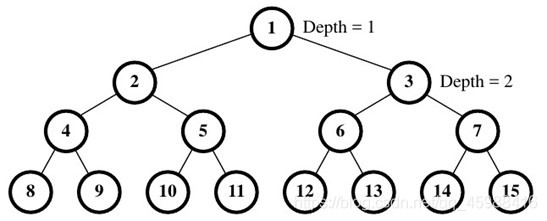
For example, Fig. 1 represents a fully binary tree of maximum depth 4 with the node numbers 1, 2, 3, ..., 15. Since all of the flags are initially set to be false, the first ball being dropped will switch flag’s values at node 1, node 2, and node 4 before it finally stops at position 8. The second ball being dropped will switch flag’s values at node 1, node 3, and node 6, and stop at position 12. Obviously, the third ball being dropped will switch flag’s values at node 1, node 2, and node 5 before it stops at
position 10.
Fig. 1: An example of FBT with the maximum depth 4 and sequential node numbers.
Now consider a number of test cases where two values will be given for each test. The first value is D, the maximum depth of FBT, and the second one is I, the I-th ball being dropped. You may assume the value of I will not exceed the total number of leaf nodes for the given FBT. Please write a program to determine the stop position P for each test case.
For each test cases the range of two parameters D and I is as below:
2≤ D ≤20, and 1≤ I ≤524288.
Input
Contains l +2 lines.
Line 1 l the number of test cases
Line 2 D1 I1 test case #1, two decimal numbers that are separated by one blank
...
Line k +1 Dk Ik test case #k Line l +1 Dl Il test case #l
Line l +2 -1 a constant ‘-1’ representing the end of the input file
Output
Contains l lines.
Line 1 the stop position P for the test case #1
...
Line k the stop position P for the test case #k
...
Line l the stop position P for the test case #l
Sample Input
5

4 2

3 4

10 1

2 2

8 128

-1
Sample Output
12

7

512

3

255
HINT
这个题目最重要的是他的结论:
- 给定一棵包含2 d 个结点(其中d 为树的高度)的完全二叉树,如果把结点从上到下从左到右编号为1,2,3……,则结点k 的左右子结点编号分别为2k 和2k +1。
- 如果使用题目中给出的编号I ,则当I 是奇数时,它是往左走的第(I +1)/2个小球;当I 是偶数时,它是往右走的第I /2个小球。
Accepted
#include <bits/stdc++.h>

using namespace std;

int main()

{

	int s, m, n;

	while (cin >> s&&s!=-1) {

		while (s--){

			cin >> m >> n;

			unsigned long long int k = 1;

			for (int i = 0;i < m - 1;i++)

				if (n % 2) { k = k * 2;n = (n + 1) / 2; }

				else { k = k * 2 + 1;n /= 2; }

			cout<<k<<endl;

		}

	}

}
Dropping Balls UVA - 679的更多相关文章
- 小球下落(Dropping Balls, Uva 679)
题目描述 有一棵二叉树,最大深度为D,且所有的叶子深度都相同.所有结点从上到下从左到右编号为1,2,3,-,2eD-1.在结点1处放一个小球,它会往下落.每个结点上都有一个开关,初始全部关闭,当每次有 ...
- Dropping Balls UVA - 679(二叉树的遍历)
题目链接:https://vjudge.net/problem/UVA-679 题目大意:t组样例,每组包括D M 层数是D 问第M个小球落在哪个叶子节点? 每个节点有开关 刚开始全都 ...
- uva-679 Dropping Balls UVA - 679
题目大意 总共有一个深度为D的满二叉树,I个小球,每个节点具有开关,小球经过节点后节点开关会有变化,初始都关闭,若关闭往左右否则往右走 只需要循环一下每层的情况即可 代码 #include <b ...
- UVA.679 Dropping Balls (二叉树 思维题)
UVA.679 Dropping Balls (二叉树 思维题) 题意分析 给出深度为D的完全二叉树,按照以下规则,求第I个小球下落在那个叶子节点. 1. 默认所有节点的开关均处于关闭状态. 2. 若 ...
- UVA 679 Dropping Balls 由小见大,分析思考 二叉树放小球,开关翻转,小球最终落下叶子编号。
A number of K balls are dropped one by one from the root of a fully binary tree structure FBT. Each ...
- Dropping Balls (二叉树+思维)
Dropping Balls A number of K balls are dropped one by one from the root of a fully binary tree st ...
- UVa 679 【思维题】
UVA 679 紫书P148例题. 题目大意:小球从一棵所有叶子深度相同的二叉树的顶点开始向下落,树开始所有节点都为0.若小球落到节点为0的则往左落,否则向右落.并且小球会改变它经过的节点,0变1,1 ...
- UVa 679 Dropping Balls (例题 6-6)
传送门:https://uva.onlinejudge.org/external/6/p679.pdf 题意:在一颗结点带开关的完全二叉树上扔球,初始时开关为关闭状态,树的深度为D(1 <= D ...
- Uva 679 Dropping Balls
这道题如果模拟着来写,思路很简单 #include <iostream> #include <cstring> using namespace std; int T,D,I,c ...
随机推荐
- Gc root 定义
常说的GC(Garbage Collector) roots,特指的是垃圾收集器(Garbage Collector)的对象,GC会收集那些不是GC roots且没有被GC roots引用的对象.一个 ...
- Python基础语法函数
函数是什么 Python中的函数与数学中的函数不同,它不再只是公式,而是实实在在有着自己特定功能的代码.其实在潜移默化中我们已经有所接触了. 比如print()函数,range()函数,type()函 ...
- Spring-05 使用注解开发
Spring-05 使用注解开发 使用注解开发 1.项目准备 在spring4之后,想要使用注解形式,必须得要引入aop的包5 <!-- https://mvnrepository.com/ar ...
- nginx错误分析 `104: Connection reset by peer`
故障描述 应用从虚拟机环境迁移到kubernetes环境中,有些应用不定时出现请求失败的情况,且应用没有记录任何日志,而在NGINX中记录502错误.我们查看了之前虚拟机中的访问情况,没有发现该问题. ...
- HDOJ-1176(数塔问题变形)
免费陷阱 HDOJ-1176 一开始正向推的时候,一直wa,后来采用逆向推得到正确结果. 初始化的时候dp数组都初始化为0. #include<bits/stdc++.h> using n ...
- ant-design-vue中table自定义列
1. 使用背景 在项目中使用ant-vue的a-table控件过程中,需要显示序号列或者在列中显示图片,超链,按钮等UI信息.经过查询文档customCell和customRender可以实现以上需求 ...
- MyBatis中模糊查询
接口 // 模糊查询 List<User> getUserLike(String value); Mapper.xml文件 <!-- 模糊查询 --> <select i ...
- java关于字符串是否存
1, if('true'.equalsIgnoreCase(response.result as String)); 2, if (scvrsp.toLowerCase().contains(&q ...
- C语言入门-mingw64安装+配置
OK,大家好,结合上期所说,本期让我们来配置编译器吧! 首先先下载mingw64离线包,官网下载慢,可以去群里下载,*.7z格式(有些同学可能没有解压软件,为了照顾这部分同学,笔者提供*.exe格式的 ...
- nginx使用-1(源码安装nginx)
Nginx概述 Nginx (engine x) 是一个高性能的HTTP和反向代理web服务器,同时也提供了IMAP/POP3/SMTP服务.Nginx是由伊戈尔·赛索耶夫为俄罗斯访问量第二的Ramb ...