
Neutron分析(6)—— neutron-openvswitch-agent
neutron-openvswitch-agent代码分析
neutron.plugins.openvswitch.agent.ovs_neutron_agent:main
# init ovs first by agent_config:
# setup plugin_rpc, state_rpc, msgq consumer, periodically state report
# setup br-int, br-tun, bridge_mapping
# start sg_agent

agent = OVSNeutronAgent(**agent_config)

# start to process rpc events
# process port up/down and related flow update/local vlan bounding
# process security group updates

agent.daemon_loop()
OVSNeutronAgent的初始化
class OVSNeutronAgent(n_rpc.RpcCallback,

                      sg_rpc.SecurityGroupAgentRpcCallbackMixin,

                      l2population_rpc.L2populationRpcCallBackMixin):

    '''Implements OVS-based tunneling, VLANs and flat networks.

    Two local bridges are created: an integration bridge (defaults to

    'br-int') and a tunneling bridge (defaults to 'br-tun'). An

    additional bridge is created for each physical network interface

    used for VLANs and/or flat networks.

    All VM VIFs are plugged into the integration bridge. VM VIFs on a

    given virtual network share a common "local" VLAN (i.e. not

    propagated externally). The VLAN id of this local VLAN is mapped

    to the physical networking details realizing that virtual network.

    For virtual networks realized as GRE tunnels, a Logical Switch

    (LS) identifier is used to differentiate tenant traffic on

    inter-HV tunnels. A mesh of tunnels is created to other

    Hypervisors in the cloud. These tunnels originate and terminate on

    the tunneling bridge of each hypervisor. Port patching is done to

    connect local VLANs on the integration bridge to inter-hypervisor

    tunnels on the tunnel bridge.

    For each virtual network realized as a VLAN or flat network, a

    veth or a pair of patch ports is used to connect the local VLAN on

    the integration bridge with the physical network bridge, with flow

    rules adding, modifying, or stripping VLAN tags as necessary.

    '''

    # history

    #   1.0 Initial version

    #   1.1 Support Security Group RPC

    RPC_API_VERSION = '1.1'

    def __init__(self, integ_br, tun_br, local_ip,

                 bridge_mappings, root_helper,

                 polling_interval, tunnel_types=None,

                 veth_mtu=None, l2_population=False,

                 minimize_polling=False,

                 ovsdb_monitor_respawn_interval=(

                     constants.DEFAULT_OVSDBMON_RESPAWN),

                 arp_responder=False,

                 use_veth_interconnection=False):

        '''Constructor.

        :param integ_br: name of the integration bridge.

        :param tun_br: name of the tunnel bridge.

        :param local_ip: local IP address of this hypervisor.

        :param bridge_mappings: mappings from physical network name to bridge.

        :param root_helper: utility to use when running shell cmds.

        :param polling_interval: interval (secs) to poll DB.

        :param tunnel_types: A list of tunnel types to enable support for in

               the agent. If set, will automatically set enable_tunneling to

               True.

        :param veth_mtu: MTU size for veth interfaces.

        :param l2_population: Optional, whether L2 population is turned on

        :param minimize_polling: Optional, whether to minimize polling by

               monitoring ovsdb for interface changes.

        :param ovsdb_monitor_respawn_interval: Optional, when using polling

               minimization, the number of seconds to wait before respawning

               the ovsdb monitor.

        :param arp_responder: Optional, enable local ARP responder if it is

               supported.

        :param use_veth_interconnection: use veths instead of patch ports to

               interconnect the integration bridge to physical bridges.

        '''

        super(OVSNeutronAgent, self).__init__()

        self.use_veth_interconnection = use_veth_interconnection

        self.veth_mtu = veth_mtu

        self.root_helper = root_helper

        self.available_local_vlans = set(moves.xrange(q_const.MIN_VLAN_TAG, # 1-1094

                                                      q_const.MAX_VLAN_TAG))

        self.tunnel_types = tunnel_types or []

        self.l2_pop = l2_population

        # TODO(ethuleau): Initially, local ARP responder is be dependent to the

        #                 ML2 l2 population mechanism driver.

        self.arp_responder_enabled = (arp_responder and

                                      self._check_arp_responder_support() and

                                      self.l2_pop)

        self.agent_state = {

            'binary': 'neutron-openvswitch-agent',

            'host': cfg.CONF.host,

            'topic': q_const.L2_AGENT_TOPIC,

            'configurations': {'bridge_mappings': bridge_mappings,

                               'tunnel_types': self.tunnel_types,

                               'tunneling_ip': local_ip,

                               'l2_population': self.l2_pop,

                               'arp_responder_enabled':

                               self.arp_responder_enabled},

            'agent_type': q_const.AGENT_TYPE_OVS,

            'start_flag': True}

        # Keep track of int_br's device count for use by _report_state()

        self.int_br_device_count = 0

        self.int_br = ovs_lib.OVSBridge(integ_br, self.root_helper)

        # Create integration bridge and patch ports,

        # remove all existing flows, and then witch all traffic using L2 learning

        # add a canary flow to int_br to track OVS restarts

        self.setup_integration_br()

        # Stores port update notifications for processing in main rpc loop

        self.updated_ports = set()

        # state_rpc: periodically report state by topic q-plugin

        # plugin_rpc:communicate with plugin by topic q-agent-notifier

        # consumer topic id includes:

        #       q-agent-notifier-port_update

        #       q-agent-notifier-network_delete

        #       q-agent-notifier-tunnel_update

        #       q-agent-notifier-security_group_update

        #       q-agent-notifier-l2population_update (需要启动l2populcation)

        self.setup_rpc()

        # bridge_mappings = default:br-eth1

        self.bridge_mappings = bridge_mappings

        # Creates physical network bridges and links them to integration bridge using veths.

        self.setup_physical_bridges(self.bridge_mappings)

        self.local_vlan_map = {}

        self.tun_br_ofports = {p_const.TYPE_GRE: {},

                               p_const.TYPE_VXLAN: {}}

        self.polling_interval = polling_interval

        self.minimize_polling = minimize_polling

        self.ovsdb_monitor_respawn_interval = ovsdb_monitor_respawn_interval

        if tunnel_types:

            self.enable_tunneling = True

        else:

            self.enable_tunneling = False

        self.local_ip = local_ip

        self.tunnel_count = 0

        self.vxlan_udp_port = cfg.CONF.AGENT.vxlan_udp_port

        self.dont_fragment = cfg.CONF.AGENT.dont_fragment

        self.tun_br = None

        # Creates tunnel bridge, and links it to the integration bridge

        # using a patch port.

        # create default flow tables

        if self.enable_tunneling:

            self.setup_tunnel_br(tun_br)

        # Collect additional bridges to monitor

        # Setup ancillary bridges - for example br-ex

        self.ancillary_brs = self.setup_ancillary_bridges(integ_br, tun_br)

        # Security group agent support

        # firewall_driver = neutron.agent.linux.iptables_firewall.OVSHybridIptablesFirewallDriver

        self.sg_agent = OVSSecurityGroupAgent(self.context,

                                              self.plugin_rpc,

                                              root_helper)

        # Initialize iteration counter

        self.iter_num = 0

        self.run_daemon_loop = True
OVSNeutronAgent初始化完成后启动agent.daemon_loop()
    def daemon_loop(self):

        with polling.get_polling_manager(

            self.minimize_polling,

            self.root_helper,

            self.ovsdb_monitor_respawn_interval) as pm:

            self.rpc_loop(polling_manager=pm)
rpc_loop
   def rpc_loop(self, polling_manager=None):

        # sync tunnel and check ovs restart

        if not polling_manager:

            polling_manager = polling.AlwaysPoll()

        sync = True

        ports = set()

        updated_ports_copy = set()

        ancillary_ports = set()

        tunnel_sync = True

        ovs_restarted = False

        while self.run_daemon_loop:

            start = time.time()

            port_stats = {'regular': {'added': 0,

                                      'updated': 0,

                                      'removed': 0},

                          'ancillary': {'added': 0,

                                        'removed': 0}}

            LOG.debug(_("Agent rpc_loop - iteration:%d started"),

                      self.iter_num)

            if sync:

                LOG.info(_("Agent out of sync with plugin!"))

                ports.clear()

                ancillary_ports.clear()

                sync = False

                polling_manager.force_polling()

            # check ovs restart by checking exist for the canary flow

            ovs_restarted = self.check_ovs_restart()

            if ovs_restarted:

                # reset br-int, br-tun, and other physical bridges

                self.setup_integration_br()

                self.setup_physical_bridges(self.bridge_mappings)

                if self.enable_tunneling:

                    self.setup_tunnel_br()

                    tunnel_sync = True

            # Notify the plugin of tunnel IP

            if self.enable_tunneling and tunnel_sync:

                LOG.info(_("Agent tunnel out of sync with plugin!"))

                try:

                    tunnel_sync = self.tunnel_sync()

                except Exception:

                    LOG.exception(_("Error while synchronizing tunnels"))

                    tunnel_sync = True

            # check if ports/security_groups updates and perform update

            if self._agent_has_updates(polling_manager) or ovs_restarted:

                try:

                    LOG.debug(_("Agent rpc_loop - iteration:%(iter_num)d - "

                                "starting polling. Elapsed:%(elapsed).3f"),

                              {'iter_num': self.iter_num,

                               'elapsed': time.time() - start})

                    # Save updated ports dict to perform rollback in

                    # case resync would be needed, and then clear

                    # self.updated_ports. As the greenthread should not yield

                    # between these two statements, this will be thread-safe

                    updated_ports_copy = self.updated_ports

                    self.updated_ports = set()

                    reg_ports = (set() if ovs_restarted else ports)

                    # {

                    #   'current': ['ovs-vsctl', --format=json', '--', '--columns=name,external_ids,ofport','list', 'Interface'] and then filted in get_vif_port_set()

                    #   'updated': check_changed_vlans() returns a set of port ids of the ports concerned by a vlan tag loss, and then updated_ports &= cur_ports

                    #   'added'  : cur_ports - registered_ports

                    #   'removed': registered_ports - cur_ports

                    #  }

                    port_info = self.scan_ports(reg_ports, updated_ports_copy)

                    LOG.debug(_("Agent rpc_loop - iteration:%(iter_num)d - "

                                "port information retrieved. "

                                "Elapsed:%(elapsed).3f"),

                              {'iter_num': self.iter_num,

                               'elapsed': time.time() - start})

                    # Secure and wire/unwire VIFs and update their status

                    # on Neutron server

                    if (self._port_info_has_changes(port_info) or

                        self.sg_agent.firewall_refresh_needed() or

                        ovs_restarted):

                        LOG.debug(_("Starting to process devices in:%s"),

                                  port_info)

                        # If treat devices fails - must resync with plugin

                        sync = self.process_network_ports(port_info,

                                                          ovs_restarted)

                        LOG.debug(_("Agent rpc_loop - iteration:%(iter_num)d -"

                                    "ports processed. Elapsed:%(elapsed).3f"),

                                  {'iter_num': self.iter_num,

                                   'elapsed': time.time() - start})

                        port_stats['regular']['added'] = (

                            len(port_info.get('added', [])))

                        port_stats['regular']['updated'] = (

                            len(port_info.get('updated', [])))

                        port_stats['regular']['removed'] = (

                            len(port_info.get('removed', [])))

                    ports = port_info['current']

                    # Treat ancillary devices if they exist

                    if self.ancillary_brs:

                        port_info = self.update_ancillary_ports(

                            ancillary_ports)

                        LOG.debug(_("Agent rpc_loop - iteration:%(iter_num)d -"

                                    "ancillary port info retrieved. "

                                    "Elapsed:%(elapsed).3f"),

                                  {'iter_num': self.iter_num,

                                   'elapsed': time.time() - start})

                        if port_info:

                            rc = self.process_ancillary_network_ports(

                                port_info)

                            LOG.debug(_("Agent rpc_loop - iteration:"

                                        "%(iter_num)d - ancillary ports "

                                        "processed. Elapsed:%(elapsed).3f"),

                                      {'iter_num': self.iter_num,

                                       'elapsed': time.time() - start})

                            ancillary_ports = port_info['current']

                            port_stats['ancillary']['added'] = (

                                len(port_info.get('added', [])))

                            port_stats['ancillary']['removed'] = (

                                len(port_info.get('removed', [])))

                            sync = sync | rc

                    polling_manager.polling_completed()

                except Exception:

                    LOG.exception(_("Error while processing VIF ports"))

                    # Put the ports back in self.updated_port

                    self.updated_ports |= updated_ports_copy

                    sync = True

            # sleep till end of polling interval

            elapsed = (time.time() - start)

            LOG.debug(_("Agent rpc_loop - iteration:%(iter_num)d "

                        "completed. Processed ports statistics: "

                        "%(port_stats)s. Elapsed:%(elapsed).3f"),

                      {'iter_num': self.iter_num,

                       'port_stats': port_stats,

                       'elapsed': elapsed})

            if (elapsed < self.polling_interval):

                time.sleep(self.polling_interval - elapsed)

            else:

                LOG.debug(_("Loop iteration exceeded interval "

                            "(%(polling_interval)s vs. %(elapsed)s)!"),

                          {'polling_interval': self.polling_interval,

                           'elapsed': elapsed})

            self.iter_num = self.iter_num + 1
rpc_loop()中最重要的两个函数为tunnel_sync(查询并建立隧道)和process_network_ports(处理port和安全组变更)
tunnel_sync 查询并建立隧道
    def tunnel_sync(self):

        resync = False

        try:

            for tunnel_type in self.tunnel_types:  # tunnel_types = vxlan, gre

                # query tunnel details from plugin_rpc by local_ip and tunnel_type

                details = self.plugin_rpc.tunnel_sync(self.context,

                                                      self.local_ip,

                                                      tunnel_type)

                # establish tunnel with all other tunnel_ip if l2_pop disabled

                # if l2_pop enabled, tunnel sync is processed by agent in q-agent-notifier-l2population_update consumer id

                if not self.l2_pop:

                    tunnels = details['tunnels']

                    for tunnel in tunnels:

                        if self.local_ip != tunnel['ip_address']:

                            tunnel_id = tunnel.get('id')

                            # Unlike the OVS plugin, ML2 doesn't return an id

                            # key. So use ip_address to form port name instead.

                            # Port name must be <=15 chars, so use shorter hex.

                            remote_ip = tunnel['ip_address']

                            remote_ip_hex = self.get_ip_in_hex(remote_ip)

                            if not tunnel_id and not remote_ip_hex:

                                continue

                            tun_name = '%s-%s' % (tunnel_type,

                                                  tunnel_id or remote_ip_hex)

                            # setup tunnel_port and related flows

                            self.setup_tunnel_port(tun_name,

                                                   tunnel['ip_address'],

                                                   tunnel_type)

        except Exception as e:

            LOG.debug(_("Unable to sync tunnel IP %(local_ip)s: %(e)s"),

                      {'local_ip': self.local_ip, 'e': e})

            resync = True

        return resync
process_network_ports 处理port和安全组变更
def process_network_ports(self, port_info, ovs_restarted):

        resync_a = False

        resync_b = False

        # TODO(salv-orlando): consider a solution for ensuring notifications

        # are processed exactly in the same order in which they were

        # received. This is tricky because there are two notification

        # sources: the neutron server, and the ovs db monitor process

        # If there is an exception while processing security groups ports

        # will not be wired anyway, and a resync will be triggered

        # TODO(salv-orlando): Optimize avoiding applying filters unnecessarily

        # (eg: when there are no IP address changes)

        # 通过plugin_rpc到plugin查询安全组,然后通过sg_agent应用安全组

        self.sg_agent.setup_port_filters(port_info.get('added', set()),

                                         port_info.get('updated', set()))

        # VIF wiring needs to be performed always for 'new' devices.

        # For updated ports, re-wiring is not needed in most cases, but needs

        # to be performed anyway when the admin state of a device is changed.

        # A device might be both in the 'added' and 'updated'

        # list at the same time; avoid processing it twice.

        devices_added_updated = (port_info.get('added', set()) |

                                 port_info.get('updated', set()))

        if devices_added_updated:

            start = time.time()

            try:

                # 添加或更新的ports: 查询port详细信息后通知plugin port up/down,接着再port_bound/port_dead

                skipped_devices = self.treat_devices_added_or_updated(

                    devices_added_updated, ovs_restarted)

                LOG.debug(_("process_network_ports - iteration:%(iter_num)d -"

                            "treat_devices_added_or_updated completed. "

                            "Skipped %(num_skipped)d devices of "

                            "%(num_current)d devices currently available. "

                            "Time elapsed: %(elapsed).3f"),

                          {'iter_num': self.iter_num,

                           'num_skipped': len(skipped_devices),

                           'num_current': len(port_info['current']),

                           'elapsed': time.time() - start})

                # Update the list of current ports storing only those which

                # have been actually processed.

                port_info['current'] = (port_info['current'] -

                                        set(skipped_devices))

            except DeviceListRetrievalError:

                # Need to resync as there was an error with server

                # communication.

                LOG.exception(_("process_network_ports - iteration:%d - "

                                "failure while retrieving port details "

                                "from server"), self.iter_num)

                resync_a = True

        if 'removed' in port_info:

            start = time.time()

            # 删除的port:删除安全组,通知plugin port down, 并unbound local_vlan,

            resync_b = self.treat_devices_removed(port_info['removed'])

            LOG.debug(_("process_network_ports - iteration:%(iter_num)d -"

                        "treat_devices_removed completed in %(elapsed).3f"),

                      {'iter_num': self.iter_num,

                       'elapsed': time.time() - start})

        # If one of the above operations fails => resync with plugin

        return (resync_a | resync_b)
neutron-ovs-cleanup
This service starts on boot and ensures that Networking has full control over the creation and management of tap devices.
def main():

    """Main method for cleaning up OVS bridges.

    The utility cleans up the integration bridges used by Neutron.

    """

    conf = setup_conf()

    conf()

    config.setup_logging(conf)

    configuration_bridges = set([conf.ovs_integration_bridge,

                                 conf.external_network_bridge])

    ovs_bridges = set(ovs_lib.get_bridges(conf.AGENT.root_helper))

    available_configuration_bridges = configuration_bridges & ovs_bridges

    if conf.ovs_all_ports:

        bridges = ovs_bridges

    else:

        bridges = available_configuration_bridges

    # Collect existing ports created by Neutron on configuration bridges.

    # After deleting ports from OVS bridges, we cannot determine which

    # ports were created by Neutron, so port information is collected now.

    ports = collect_neutron_ports(available_configuration_bridges,

                                  conf.AGENT.root_helper)

    for bridge in bridges:

        LOG.info(_("Cleaning %s"), bridge)

        ovs = ovs_lib.OVSBridge(bridge, conf.AGENT.root_helper)

        ovs.delete_ports(all_ports=conf.ovs_all_ports)

    # Remove remaining ports created by Neutron (usually veth pair)

    delete_neutron_ports(ports, conf.AGENT.root_helper)

    LOG.info(_("OVS cleanup completed successfully"))
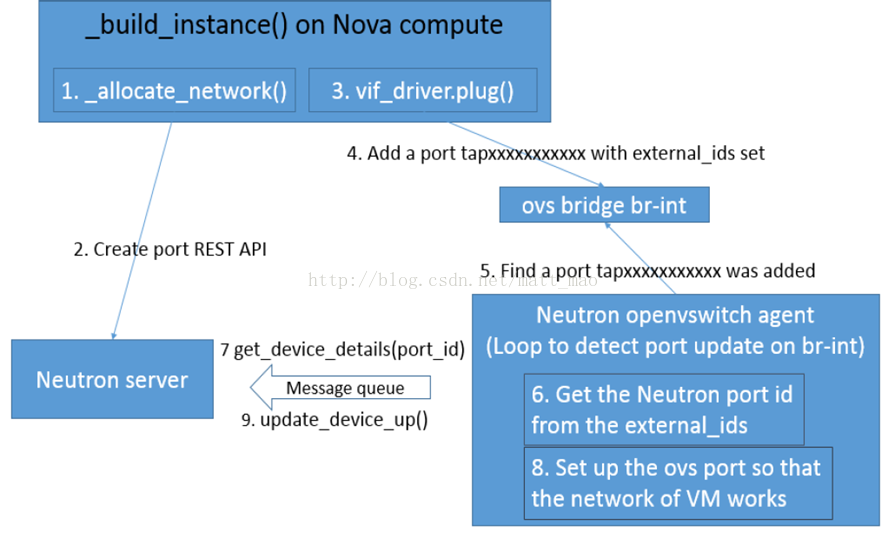
最后看下nova与neutron-openvswitch-agent的交互,这张图片来源于GongYongSheng在香港峰会的PPT:
首先boot虚机时,nova-compute发消息给neutron-server请求创建port。之后,在driver里面在br-int上建立 port后,neutron-openvswitch-port循环检测br-int会发现新增端口,对其设定合适的openflow规则以及 localvlan,最后将port状态设置为ACTIVE。
参考:http://blog.csdn.net/matt_mao/article/details/20706689
Neutron分析(6)—— neutron-openvswitch-agent的更多相关文章
- openstack Neutron分析(3)—— neutron-dhcp-agent源码分析
1.neutron dhcp3个主要部件分别为什么?2.dhcp模块包含哪些内容?3.Dnsmasq配置文件是如何创建和更新的?4.DHCP agent的信息存放在neutron数据库的哪个表中? 扩 ...
- Neutron分析(5)—— neutron-l3-agent中的iptables
一.iptables简介 1.iptables数据包处理流程 以本机为目的的包,由上至下,走左边的路 本机产生的包,从local process开始走左边的路 本机转发的包,由上至下走右边的路 简化流 ...
- Neutron分析(3)—— neutron-l3-agent
一.Layer-3 Networking Extension neutron l3作为一种API扩展,向租户提供了路由和NAT功能. l3扩展包含两种资源: router:在不同内部子网中转发数据包: ...
- Neutron分析(7)—— neutron-l3-agent HA solutions
1. keepalived vrrp/conntrackd High availability features will be implemented as extensions or driver ...
- Neutron分析(2)——neutron-server启动过程分析
neutron-server启动过程分析 1. /etc/init.d/neutron-server DAEMON=/usr/bin/neutron-server DAEMON_ARGS=" ...
- Neutron 理解 (1): Neutron 所实现的虚拟化网络 [How Netruon Virtualizes Network]
学习 Neutron 系列文章: (1)Neutron 所实现的虚拟化网络 (2)Neutron OpenvSwitch + VLAN 虚拟网络 (3)Neutron OpenvSwitch + GR ...
- Neutron 理解 (4): Neutron OVS OpenFlow 流表 和 L2 Population [Netruon OVS OpenFlow tables + L2 Population]
学习 Neutron 系列文章: (1)Neutron 所实现的虚拟化网络 (2)Neutron OpenvSwitch + VLAN 虚拟网络 (3)Neutron OpenvSwitch + GR ...
- Neutron 理解 (8): Neutron 是如何实现虚机防火墙的 [How Neutron Implements Security Group]
学习 Neutron 系列文章: (1)Neutron 所实现的虚拟化网络 (2)Neutron OpenvSwitch + VLAN 虚拟网络 (3)Neutron OpenvSwitch + GR ...
- Neutron 理解 (1): Neutron 所实现的网络虚拟化 [How Neutron Virtualizes Network]
学习 Neutron 系列文章: (1)Neutron 所实现的网络虚拟化 (2)Neutron OpenvSwitch + VLAN 虚拟网络 (3)Neutron OpenvSwitch + GR ...
随机推荐
- 微软官方好用的Office 2003、 Office 2007 或 Office 2010 卸载工具
http://support.microsoft.com/kb/2519420/zh-cn
- URAL 1205 By the Underground or by Foot?(SPFA)
By the Underground or by Foot? Time limit: 1.0 secondMemory limit: 64 MB Imagine yourself in a big c ...
- HTML里的id等属性命名需要注意
提交 $(function(){ $('#submit').click(function(){ $('#form').submit() }) }) 这里的代码无法完成提交,因为id被命名为submit ...
- uploadify上传
一.上传按钮样式 1.1id="show_filebutton"是显示给用户操作按钮,id="filebutton"是flash上传按钮完成用户上传操作.id ...
- JAVA 线程池, 多线程
http://tutorials.jenkov.com/java-util-concurrent/executorservice.html http://howtodoinjava.com/core- ...
- C# 数组,ArrayList与List对象的区别
在C#中,当我们想要存储一组对象的时候,就会想到用数组,ArrayList,List这三个对象了.那么这三者到底有什么样的区别呢? 我们先来了解一下数组,因为数组在C#中是最早出现的. 数组 数组有很 ...
- Floating Action Button(漂浮按钮)
参考:http://blog.csdn.net/pengkv/article/details/46427891 效果图: 步骤一: 在build.gradle添加以下代码,导入包 dependenci ...
- PHP 文件迭代器
使用了SPL的 迭代器, 可以直接对打开的文件进行foreach读取, 类的构造如下 class fileIterator implements Iterator { private $fp; pri ...
- Sql Server 事务隔离级别的查看及更改
根据自身 Sql Server 的情况来自定义 事务隔离级别,将会更加的满足需求,或提升性能.例如,对于逻辑简单的 Sql Server,完全可以使用 read uncommitted 模式,来减少死 ...
- 自动生成XML反序列化的类
原文地址:http://www.cnblogs.com/jaxu/p/3632077.html Visual Sutdio 2013增加了许多新功能,其中很多都直接提高了对代码编辑的便利性.如: ...