
POJ 2528 Mayor's posters(线段树区间染色+离散化或倒序更新)
| Time Limit: 1000MS | Memory Limit: 65536K | |
| Total Submissions: 59239 | Accepted: 17157 |
Description
- Every candidate can place exactly one poster on the wall.
- All posters are of the same height equal to the height of the wall; the width of a poster can be any integer number of bytes (byte is the unit of length in Bytetown).
- The wall is divided into segments and the width of each segment is one byte.
- Each poster must completely cover a contiguous number of wall segments.
They have built a wall 10000000 bytes long (such that there is enough place for all candidates). When the electoral campaign was restarted, the candidates were placing their posters on the wall and their posters differed widely in width. Moreover, the candidates started placing their posters on wall segments already occupied by other posters. Everyone in Bytetown was curious whose posters will be visible (entirely or in part) on the last day before elections.
Your task is to find the number of visible posters when all the posters are placed given the information about posters' size, their place and order of placement on the electoral wall.
Input
Output
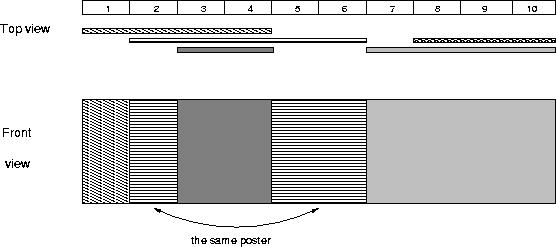
The picture below illustrates the case of the sample input.
Sample Input
1

5

1 4

2 6

8 10

3 4

7 10
Sample Output
4
题目链接:POJ 2528
这题离散化不是很难容易想到我感觉麻烦的是对于query这个函数的查询方式,做了很久的一道题,很经典但是挺坑,数据虽说不是很严,一些不严谨的离散化也可以过,但数据本身应该是正确的。
用single 来表示区间是否单一颜色,最后加入颜色的时候别把颜色0加入即可
离散化我用的方法比较麻烦但感觉比较好理解,先给出现过的所有点排序,然后由于1~2+6~10离散之后会变成1~2 3~4 中间少了一段,因此对排序之后的数组遍历若出现pos[i]-pos[i-1]>1,则在数组末尾加上pos[i]-1(其他在pos[i]~pos[i-1]之间的数任意均可),然后再次对数组算上排序并去重unique。然后用lower_bound把坐标映射离散一下即可。
统计颜色个数,直接从大区间1~pos.size开始查询,直接暴力查询掉所有的叶子节点就行或者判断当前是否有颜色,有颜色就直接返回不用pushdown但是这种做法会超过建树的区间导致color出现0,特判一下0就行。
另外一种来自某kuangbin大牛(膜Orz...)的做法是倒序更新,倒着帖只要当前范围没被全部覆盖就说明张贴成功大,但是更新时要注意,每一次更新必须要pushup到顶端,不然下一次若更新到比较浅的层则会误认为当前区间可更新实际是没有传递信息上来(调试了大半个下午)。
如果用正序写过的推荐尝试一下写逆序更新,速度也比正序快一丢丢
暴力统计代码:
#include <stdio.h>

#include <iostream>

#include <algorithm>

#include <cstdlib>

#include <sstream>

#include <cstring>

#include <bitset>

#include <string>

#include <deque>

#include <stack>

#include <cmath>

#include <queue>

#include <set>

#include <map>

using namespace std;

#define INF 0x3f3f3f3f

#define CLR(x,y) memset(x,y,sizeof(x))

#define FAST_IO ios::sync_with_stdio(false);cin.tie(0);

#define LC(x) (x<<1)

#define RC(x) ((x<<1)+1)

#define MID(x,y) ((x+y)>>1)

typedef pair<int,int> pii;

typedef long long LL;

const double PI=acos(-1.0);

const int N=10010;

struct seg

{

    int l,mid,r;

    bool single;

    int color;

};

struct info

{

    int l,r;

};

seg T[N<<4];

info pos[N];

vector<int>xpos;

set<int>Color;

void init()

{

    xpos.clear();

    Color.clear();

}

void pushdown(int k)

{

    if(T[k].single)

    {

        T[LC(k)].single=T[RC(k)].single=true;

        T[LC(k)].color=T[RC(k)].color=T[k].color;

        T[k].single=false;

    }

}

void build(int k,int l,int r)

{

    T[k].l=l;

    T[k].r=r;

    T[k].mid=MID(l,r);

    T[k].color=0;

    T[k].single=true;

    if(l==r)

        return ;

    build(LC(k),l,T[k].mid);

    build(RC(k),T[k].mid+1,r);

}

void update(int k,int l,int r,int color)

{

    if(l<=T[k].l&&T[k].r<=r)

    {

        T[k].color=color;

        T[k].single=true;

    }

    else

    {

        pushdown(k);

        if(r<=T[k].mid)

            update(LC(k),l,r,color);

        else if(l>T[k].mid)

            update(RC(k),l,r,color);

        else

            update(LC(k),l,T[k].mid,color),update(RC(k),T[k].mid+1,r,color);

    }

}

void query(int k)

{

    if(T[k].l==T[k].r||T[k].single)

    {

        if(T[k].color)

            Color.insert(T[k].color);

        return ;

    }

    else

    {

        pushdown(k);

        query(LC(k));

        query(RC(k));

    }

}

int main(void)

{

    int tcase,n,i;

    scanf("%d",&tcase);

    while (tcase--)

    {

        init();

        scanf("%d",&n);

        for (i=1; i<=n; ++i)

        {

            scanf("%d%d",&pos[i].l,&pos[i].r);

            xpos.push_back(pos[i].l);

            xpos.push_back(pos[i].r);

        }

        sort(xpos.begin(),xpos.end());

        int sz=xpos.size();

        for (i=1; i<sz; ++i)

            if(xpos[i]-xpos[i-1]>1)

                xpos.push_back(xpos[i-1]+1);

        sort(xpos.begin(),xpos.end());

        xpos.erase(unique(xpos.begin(),xpos.end()),xpos.end());

        build(1,1,xpos.size());

        for (i=1; i<=n; ++i)

        {

            pos[i].l=lower_bound(xpos.begin(),xpos.end(),pos[i].l)-xpos.begin()+1;

            pos[i].r=lower_bound(xpos.begin(),xpos.end(),pos[i].r)-xpos.begin()+1;

            update(1,pos[i].l,pos[i].r,i);

        }

        query(1);

        printf("%d\n",Color.size());

    }

    return 0;

}
倒序更新代码:
#include<stdio.h>

#include<iostream>

#include<algorithm>

#include<cstdlib>

#include<sstream>

#include<cstring>

#include<bitset>

#include<string>

#include<deque>

#include<stack>

#include<cmath>

#include<queue>

#include<set>

#include<map>

using namespace std;

#define INF 0x3f3f3f3f

#define CLR(x,y) memset(x,y,sizeof(x))

#define LC(x) (x<<1)

#define RC(x) ((x<<1)+1)

#define MID(x,y) ((x+y)>>1)

typedef pair<int,int> pii;

typedef long long LL;

const double PI=acos(-1.0);

const int N=40010;

const int M=10010;

struct info

{

    int l,r;

}node[M];

struct seg

{

    int l,mid,r;

    int color;

}T[N*8];

int kind;

vector<int>pos;

void pushup(int k)

{

    if(T[LC(k)].color!=-1&&T[RC(k)].color!=-1)

        T[k].color=T[LC(k)].color;

    else

        T[k].color=-1;

}

void build(int k,int l,int r)

{

    T[k].l=l;

    T[k].r=r;

    T[k].mid=MID(l,r);

    T[k].color=-1;

    if(l==r)

        return ;

    build(LC(k),l,T[k].mid);

    build(RC(k),T[k].mid+1,r);

}

bool post(int k,int l,int r,int c)

{

    if(T[k].color!=-1)

        return false;

    if(T[k].l==l&&T[k].r==r)

    {

        T[k].color=c;

        return true;

    }

    else

    {

        bool mix;//就是这里

        if(r<=T[k].mid)

            mix=post(LC(k),l,r,c);//直接return的话就不会pushup了

        else if(l>T[k].mid)

            mix=post(RC(k),l,r,c);

        else

        {

            bool check_left=post(LC(k),l,T[k].mid,c);

            bool check_right=post(RC(k),T[k].mid+1,r,c);

            mix=check_left||check_right;

        }

        pushup(k);

        return mix;

    }

}

void init()

{

    kind=0;

    pos.clear();

}

int main(void)

{

    int tcase,n,i;

    scanf("%d",&tcase);

    while (tcase--)

    {

        scanf("%d",&n);

        init();

        for (i=0; i<n; ++i)

        {

            scanf("%d%d",&node[i].l,&node[i].r);

            pos.push_back(node[i].l);

            pos.push_back(node[i].r);

        }

        sort(pos.begin(),pos.end());

        int SZ=pos.size();

        for (i=1; i<SZ; ++i)

            if(pos[i-1]<pos[i]-1)

                pos.push_back(pos[i]-1);

        sort(pos.begin(),pos.end());

        pos.erase(unique(pos.begin(),pos.end()),pos.end());

        for (i=0; i<n; ++i)

        {

            node[i].l=lower_bound(pos.begin(),pos.end(),node[i].l)-pos.begin()+1;

            node[i].r=lower_bound(pos.begin(),pos.end(),node[i].r)-pos.begin()+1;

        }

        build(1,1,pos.size());

        for (i=n-1; i>=0; --i)//这里循环要改成逆序

            kind+=post(1,node[i].l,node[i].r,i+1);

        printf("%d\n",kind);

    }

    return 0;

}
POJ 2528 Mayor's posters(线段树区间染色+离散化或倒序更新)的更多相关文章
- POJ 2528 Mayor's posters (线段树+区间覆盖+离散化)
题意: 一共有n张海报, 按次序贴在墙上, 后贴的海报可以覆盖先贴的海报, 问一共有多少种海报出现过. 题解: 因为长度最大可以达到1e7, 但是最多只有2e4的区间个数,并且最后只是统计能看见的不同 ...
- POJ.2528 Mayor's posters (线段树 区间更新 区间查询 离散化)
POJ.2528 Mayor's posters (线段树 区间更新 区间查询 离散化) 题意分析 贴海报,新的海报能覆盖在旧的海报上面,最后贴完了,求问能看见几张海报. 最多有10000张海报,海报 ...
- POJ 2528 Mayor's posters (线段树区间更新+离散化)
题目链接:http://poj.org/problem?id=2528 给你n块木板,每块木板有起始和终点,按顺序放置,问最终能看到几块木板. 很明显的线段树区间更新问题,每次放置木板就更新区间里的值 ...
- poj 2528 Mayor's posters 线段树区间更新
Mayor's posters Time Limit: 1 Sec Memory Limit: 256 MB 题目连接 http://poj.org/problem?id=2528 Descript ...
- POJ 2528 Mayor's posters(线段树,区间覆盖,单点查询)
Mayor's posters Time Limit: 1000MS Memory Limit: 65536K Total Submissions: 45703 Accepted: 13239 ...
- POJ 2528 Mayor’s posters (线段树段替换 && 离散化)
题意 : 在墙上贴海报, n(n<=10000)个人依次贴海报,给出每张海报所贴的范围li,ri(1<=li<=ri<=10000000).求出最后还能看见多少张海报. 分析 ...
- POJ 2528 Mayor's posters (线段树,染色问题,离散化要注意)
做这题建议看一下该题的discuss. #include <iostream> #include <stdio.h> #include <string.h> #in ...
- poj 2528 Mayor's posters 线段树+离散化技巧
poj 2528 Mayor's posters 题目链接: http://poj.org/problem?id=2528 思路: 线段树+离散化技巧(这里的离散化需要注意一下啊,题目数据弱看不出来) ...
- POJ 2528 Mayor's posters(线段树+离散化)
Mayor's posters 转载自:http://blog.csdn.net/winddreams/article/details/38443761 [题目链接]Mayor's posters [ ...
随机推荐
- Maven无法引入自定义构件依赖的解决方案
一般情况下,使用如下命令即可将自定义构件安装到本地仓库,供其他项目使用. mvn clean install 但是也有例外,今天我就分享一下我遇到问题,供相同遭遇的同学参考下. 我使用了父POM统一管 ...
- iOS设备通知中心精品推荐消息删除
如要彻底解决这个问题可以通过手机连接PC端91助手—功能大全—文件管理,进入/Library/MobileSubstrate/DynamicLibraries 文件夹,把AppSafety开头的文件都 ...
- 如何关闭ie9烦人的提示信息?
①Q:如何关闭“IE 限制活动内容”的提示? A:去掉“IE 限制活动内容”的提示: 1. 找到IE的“Internet选项”: 2. 选择“高级”选项卡: 3. 在“设置”下,找到子标题“安全”,将 ...
- 建模算法(二)——整数规划
一.概述 1.定义:规划中变量部分或全部定义成整数是,称为整数规划. 2.分类:纯整数规划和混合整数规划. 3.特点: (1)原线性规划有最优解,当自变量限制为整数后: a.原最优解全是整数,那最优解 ...
- linux根分区扩容
Linux 根分区扩容 1.fdisk –l (红线部分为新添加的硬盘) 2.磁盘格式化 3. mkfs.ext3 -T largefile /dev/sde(格式化上面的分区) 4. vgdisp ...
- Bean的前身今世&处理器&Aware
出生: <bean>......</bean> 幼年:BeanDefinition bean的接口定义 小学:GenericBeanDefinition 基础的bean映射 ...
- spring实战二之Bean的自动装配(非注解方式)
Bean的自动装配 自动装配(autowiring)有助于减少甚至消除配置<property>元素和<constructor-arg>元素,让Spring自动识别如何装配Bea ...
- 贪心 Codeforces Round #301 (Div. 2) B. School Marks
题目传送门 /* 贪心:首先要注意,y是中位数的要求:先把其他的都设置为1,那么最多有(n-1)/2个比y小的,cnt记录比y小的个数 num1是输出的1的个数,numy是除此之外的数都为y,此时的n ...
- windows 8 系统部署IIS并发布网站
企业用户可以在已经部署了windows 8 的电脑中通过部署IIS服务器来发布自己公司的企业内部网站实现对企业的网络办公的管理工作. 准备篇 IIS的添加和运行 一.IIS的添加 1.请进入“控制面板 ...
- ZOJ2930 The Worst Schedule(最小割)
题目大概说有n个任务,每个任务可以提前或推迟,提前或推迟各有一定的费用,有的任务一旦推迟另一个任务也必须推迟,问怎么安排任务使花费最少,且最少花费的条件下提前的任务数最多能多少. 问题就是要把各个任务 ...