
【POJ】1556 The Doors(计算几何基础+spfa)
http://poj.org/problem?id=1556
首先路径的每条线段一定是端点之间的连线。证明?这是个坑...反正我是随便画了一下图然后就写了..
然后re是什么节奏?我记得我开够了啊...然后再开大点才a...好囧啊.
#include <cstdio>

#include <cstring>

#include <cmath>

#include <string>

#include <iostream>

#include <algorithm>

#include <queue>

#include <set>

#include <map>

using namespace std;

typedef long long ll;

#define rep(i, n) for(int i=0; i<(n); ++i)

#define for1(i,a,n) for(int i=(a);i<=(n);++i)

#define for2(i,a,n) for(int i=(a);i<(n);++i)

#define for3(i,a,n) for(int i=(a);i>=(n);--i)

#define for4(i,a,n) for(int i=(a);i>(n);--i)

#define CC(i,a) memset(i,a,sizeof(i))

#define read(a) a=getint()

#define print(a) printf("%d", a)

#define dbg(x) cout << (#x) << " = " << (x) << endl

#define error(x) (!(x)?puts("error"):0)

#define rdm(x, i) for(int i=ihead[x]; i; i=e[i].next)

inline const int getint() { int r=0, k=1; char c=getchar(); for(; c<'0'||c>'9'; c=getchar()) if(c=='-') k=-1; for(; c>='0'&&c<='9'; c=getchar()) r=r*10+c-'0'; return k*r; }

const double eps=1e-6;

int dcmp(double x) { return abs(x)<eps?0:(x<0?-1:1); }

struct ipoint { double x, y; };

double icross(ipoint &a, ipoint &b, ipoint &c) {

	static double x1, x2, y1, y2;

	x1=a.x-c.x; y1=a.y-c.y;

	x2=b.x-c.x; y2=b.y-c.y;

	return x1*y2-x2*y1;

}

int ijiao(ipoint &p1, ipoint &p2, ipoint &q1, ipoint &q2) {

	return (dcmp(icross(p1, q1, q2))^dcmp(icross(p2, q1, q2)))==-2 &&

		   (dcmp(icross(q1, p1, p2))^dcmp(icross(q2, p1, p2)))==-2;

}

const int N=1000;

struct dat { int next, to; double w; }e[N<<2];

int ihead[N], cnt;

void add(int u, int v, double w) {

	e[++cnt].next=ihead[u]; ihead[u]=cnt; e[cnt].to=v; e[cnt].w=w;

}

double spfa(int s, int t, int n) {

	static double d[N];

	static int q[N], front, tail, u, v;

	static bool vis[N];

	front=tail=0;

	for1(i, 0, n) vis[i]=0, d[i]=1e99;

	d[s]=0; q[tail++]=s; vis[s]=1;

	while(front!=tail) {

		u=q[front++]; if(front==N) front=0; vis[u]=0;

		rdm(u, i) if(d[v=e[i].to]+eps>d[u]+e[i].w) {

			d[v]=d[u]+e[i].w;

			if(!vis[v]) {

				vis[v]=1;

				if(d[v]<d[q[front]]+eps) {

					--front; if(front<0) front+=N;

					q[front]=v;

				}

				else { q[tail++]=v; if(tail==N) tail=0; }

			}

		}

	}

	return d[t];

}

ipoint p[N], line[N*3][2];

int n, pn, ln;

bool check(ipoint &x, ipoint &y) {

	for1(i, 1, ln) if(ijiao(x, y, line[i][0], line[i][1])) return false;

	return true;

}

double sqr(double x) { return x*x; }

double dis(ipoint &x, ipoint &y) { return sqrt(sqr(x.x-y.x)+sqr(x.y-y.y)); }

int main() {

	while(read(n), n!=-1) {

		ln=0; pn=0;

		++pn; p[pn].x=0; p[pn].y=5;

		++pn; p[pn].x=10; p[pn].y=5;

		static double rx, ry[4];

		while(n--) {

			scanf("%lf", &rx);

			rep(k, 4) scanf("%lf", &ry[k]);

			++ln; line[ln][0]=(ipoint){rx, 0};		line[ln][1]=(ipoint){rx, ry[0]};

			++ln; line[ln][0]=(ipoint){rx, ry[1]};	line[ln][1]=(ipoint){rx, ry[2]};

			++ln; line[ln][0]=(ipoint){rx, ry[3]};	line[ln][1]=(ipoint){rx, 10};

			rep(k, 4) ++pn, p[pn].x=rx, p[pn].y=ry[k];

		}

		for1(i, 1, pn) for1(j, 1, pn) if(i!=j && check(p[i], p[j])) add(i, j, dis(p[i], p[j]));

		printf("%.2f\n", spfa(1, 2, pn));

		memset(ihead, 0, sizeof(int)*(pn+1));

		cnt=0;

	}

	return 0;

}
Description
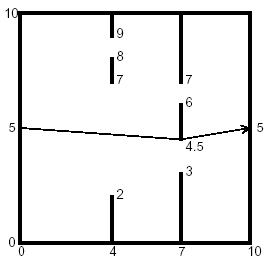
Input
2
4 2 7 8 9
7 3 4.5 6 7
The first line contains the number of interior walls. Then there is a line for each such wall, containing five real numbers. The first number is the x coordinate of the wall (0 < x < 10), and the remaining four are the y coordinates of the ends of the doorways in that wall. The x coordinates of the walls are in increasing order, and within each line the y coordinates are in increasing order. The input file will contain at least one such set of data. The end of the data comes when the number of walls is -1.
Output
Sample Input
1

5 4 6 7 8

2

4 2 7 8 9

7 3 4.5 6 7

-1
Sample Output
10.00

10.06
Source
【POJ】1556 The Doors(计算几何基础+spfa)的更多相关文章
- POJ 1556 - The Doors 线段相交不含端点
POJ 1556 - The Doors题意: 在 10x10 的空间里有很多垂直的墙,不能穿墙,问你从(0,5) 到 (10,5)的最短距离是多少. 分析: 要么直达,要么 ...
- POJ 1556 The Doors 线段交 dijkstra
LINK 题意:在$10*10$的几何平面内,给出n条垂直x轴的线,且在线上开了两个口,起点为$(0, 5)$,终点为$(10, 5)$,问起点到终点不与其他线段相交的情况下的最小距离. 思路:将每个 ...
- POJ 1556 - The Doors - [平面几何+建图spfa最短路]
题目链接:http://poj.org/problem?id=1556 Time Limit: 1000MS Memory Limit: 10000K Description You are to f ...
- poj 1556 The Doors
The Doors Time Limit: 1000 MS Memory Limit: 10000 KB 64-bit integer IO format: %I64d , %I64u Java ...
- POJ 1556 The Doors【最短路+线段相交】
思路:暴力判断每个点连成的线段是否被墙挡住,构建图.求最短路. 思路很简单,但是实现比较复杂,模版一定要可靠. #include<stdio.h> #include<string.h ...
- POJ 1556 The Doors --几何,最短路
题意: 给一个正方形,从左边界的中点走到右边界的中点,中间有一些墙,问最短的距离是多少. 解法: 将起点,终点和所有墙的接触到空地的点存下来,然后两两之间如果没有线段(墙)阻隔,就建边,最后跑一个最短 ...
- POJ 1556 The Doors(线段交+最短路)
The Doors Time Limit: 1000MS Memory Limit: 10000K Total Submissions: 5210 Accepted: 2124 Descrip ...
- poj 1556 The Doors(线段相交,最短路)
The Doors Time Limit: 1000MS Memory Limit: 10000K Total Submissions: 7430 Accepted: 2915 Descr ...
- POJ 1556 The Doors 线段判交+Dijkstra
The Doors Time Limit: 1000MS Memory Limit: 10000K Total Submissions: 6734 Accepted: 2670 Descrip ...
随机推荐
- Rotate bitmap by real angle
tl;dr; Use GDI+ SetWorldTransform With WinAPI's SetWorldTransform you can transform the space of dev ...
- jstack命令详解
jstack用于打印出给定的java进程ID或core file或远程调试服务的Java堆栈信息,如果是在64位机器上,需要指定选项"-J-d64",Windows的jstack使 ...
- MVC ViewBag和ViewData的区别
在MVC3开始,视图数据可以通过ViewBag属性访问,在MVC2中则是使用ViewData.MVC3中保留了ViewData的使用.ViewBag 是动态类型(dynamic),ViewData 是 ...
- php抽象类的简单应用
抽象类也是面向对象中的重要概念,和接口.继承的概念重要性相当,在面向对象的开发中,所有的对象都是通过类来描述的,但是反过来,并不是所有类都是用来描绘对象的,广义上讲如果一个类中没有足够信息来描述一个具 ...
- C#/Java/C/C++基本类型所占大小及表示范围
C/C++的数据类型: 一,整型 Turbo C: [signed] int 2Byte//有符号数,-32768~32767 unsigned int 2Byte //无符号数,只能表示整数 ...
- JSTL分类查询
index.jsp <%@ page language="java" import="java.util.*" pageEncoding="UT ...
- fedora yum 使用代理的方法
配置yum: 编辑/etc/yum.conf添加下列一行: proxy=http://domain/user:passwd@<proxy ip>:80 <proxy ip>:代 ...
- PW试验-----verilog
PWM,脉冲宽度调制.顾名思义,是通过调制脉冲的宽度,即占空比,来实现的.可是使占空比逐渐由最小增加到最大,也可以使占空比由最大减少到最小来实现不同的现象.若用LED灯来显示现象,则可以称作:LED呼 ...
- gitlab安装
[root@localhost ~]# wget https://packages.gitlab.com/install/repositories/gitlab/gitlab-ce/script.rp ...
- (转)云存储:阿里云OSS 、又拍云和 七牛 的比较
阿里OSS:好处就是,那是一套完整的体系,存储,数据库,CDN,服务器,阿里都可以给你全包.缺点,费用对于没有盈利的网站来说太高了,好像定位就是给那些高端客户使用的,而且CDN,OSS的流量是分开收费 ...