
Codeforces Round #464 (Div. 2)
1 second
256 megabytes
standard input
standard output
As you could know there are no male planes nor female planes. However, each plane on Earth likes some other plane. There are nplanes on Earth, numbered from 1 to n, and the plane with number i likes the plane with number fi, where 1 ≤ fi ≤ n and fi ≠ i.
We call a love triangle a situation in which plane A likes plane B, plane B likes plane C and plane C likes plane A. Find out if there is any love triangle on Earth.
The first line contains a single integer n (2 ≤ n ≤ 5000) — the number of planes.
The second line contains n integers f1, f2, ..., fn (1 ≤ fi ≤ n, fi ≠ i), meaning that the i-th plane likes the fi-th.
Output «YES» if there is a love triangle consisting of planes on Earth. Otherwise, output «NO».
You can output any letter in lower case or in upper case.
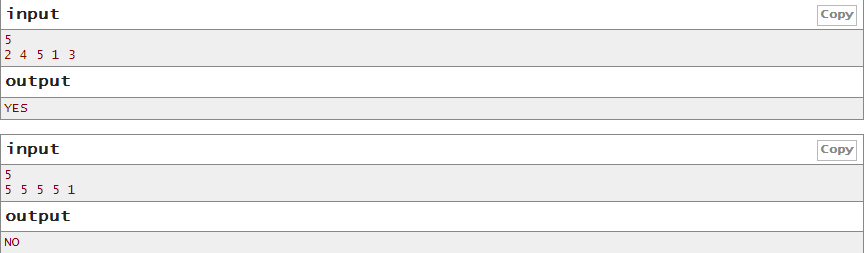
In first example plane 2 likes plane 4, plane 4 likes plane 1, plane 1 likes plane 2 and that is a love triangle.
In second example there are no love triangles.
思路:跑一边tarjin,判断其中是否有点数为3个的强连通分量。
#include<cstdio>

#include<cstring>

#include<iostream>

#include<algorithm>

#define MAXN 5010

using namespace std;

int n,tot,tim,top,ans,sumcol;

int low[MAXN],dfn[MAXN],col[MAXN];

int to[MAXN],net[MAXN],head[MAXN];

int stack[MAXN],vis[MAXN],visstack[MAXN];

void add(int u,int v){

    to[++tot]=v;net[tot]=head[u];head[u]=tot;

}

void tarjin(int now){

    low[now]=dfn[now]=++tim;

    stack[++top]=now;

    vis[now]=;visstack[now]=;

    for(int i=head[now];i;i=net[i])

        if(!vis[to[i]]){

            tarjin(to[i]);

            low[now]=min(low[now],low[to[i]]);

        }

        else if(visstack[to[i]])

            low[now]=min(low[now],dfn[to[i]]);

    if(low[now]==dfn[now]){

        sumcol++;

        col[now]=sumcol;

        while(stack[top]!=now){

            col[stack[top]]=sumcol;

            visstack[stack[top]]=;

            top--;

        }

        top--;

        visstack[now]=;

    }

}

int main(){

    scanf("%d",&n);

    for(int i=;i<=n;i++){

        int x;

        scanf("%d",&x);

        add(i,x);

    }

    for(int i=;i<=n;i++)

        if(!vis[i])    tarjin(i);

    memset(vis,,sizeof(vis));

    for(int i=;i<=n;i++)    vis[col[i]]++;

    for(int i=;i<=sumcol;i++)

        if(vis[i]==)    ans++;

    if(ans)    cout<<"YES";

    else cout<<"NO";

}
2 seconds
256 megabytes
standard input
standard output
Dima has a hamsters farm. Soon N hamsters will grow up on it and Dima will sell them in a city nearby.
Hamsters should be transported in boxes. If some box is not completely full, the hamsters in it are bored, that's why each box should be completely full with hamsters.
Dima can buy boxes at a factory. The factory produces boxes of K kinds, boxes of the i-th kind can contain in themselves ai hamsters. Dima can buy any amount of boxes, but he should buy boxes of only one kind to get a wholesale discount.
Of course, Dima would buy boxes in such a way that each box can be completely filled with hamsters and transported to the city. If there is no place for some hamsters, Dima will leave them on the farm.
Find out how many boxes and of which type should Dima buy to transport maximum number of hamsters.
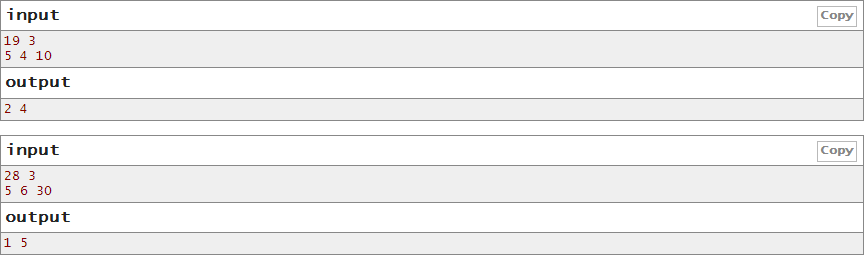
The first line contains two integers N and K (0 ≤ N ≤ 1018, 1 ≤ K ≤ 105) — the number of hamsters that will grow up on Dima's farm and the number of types of boxes that the factory produces.
The second line contains K integers a1, a2, ..., aK (1 ≤ ai ≤ 1018 for all i) — the capacities of boxes.
Output two integers: the type of boxes that Dima should buy and the number of boxes of that type Dima should buy. Types of boxes are numbered from 1 to K in the order they are given in input.
If there are many correct answers, output any of them.
思路:o(k)扫一遍就好了。
错误:minn值取小了,3个变量名重复竟然没看见。
#include<cstdio>

#include<cstring>

#include<iostream>

#include<algorithm>

using namespace std;

long long k,ans,bns,n,minn=;

int main(){

    cin>>n>>k;

    for(int i=;i<=k;i++){

        long long x;cin>>x;

        long long kkk=n%x;

        if(kkk<minn){ minn=kkk;ans=i;bns=x; }

    }

    long long kk=n/bns;

    cout<<ans<<" "<<kk;

}
2 seconds
256 megabytes
standard input
standard output
In distant future on Earth day lasts for n hours and that's why there are n timezones. Local times in adjacent timezones differ by one hour. For describing local time, hours numbers from 1 to n are used, i.e. there is no time "0 hours", instead of it "n hours" is used. When local time in the 1-st timezone is 1 hour, local time in the i-th timezone is i hours.
Some online programming contests platform wants to conduct a contest that lasts for an hour in such a way that its beginning coincides with beginning of some hour (in all time zones). The platform knows, that there are ai people from i-th timezone who want to participate in the contest. Each person will participate if and only if the contest starts no earlier than s hours 00 minutes local time and ends not later than f hours 00 minutes local time. Values s and f are equal for all time zones. If the contest starts at f hours 00 minutes local time, the person won't participate in it.
Help platform select such an hour, that the number of people who will participate in the contest is maximum.
The first line contains a single integer n (2 ≤ n ≤ 100 000) — the number of hours in day.
The second line contains n space-separated integers a1, a2, ..., an (1 ≤ ai ≤ 10 000), where ai is the number of people in the i-th timezone who want to participate in the contest.
The third line contains two space-separated integers s and f (1 ≤ s < f ≤ n).
Output a single integer — the time of the beginning of the contest (in the first timezone local time), such that the number of participants will be maximum possible. If there are many answers, output the smallest among them.
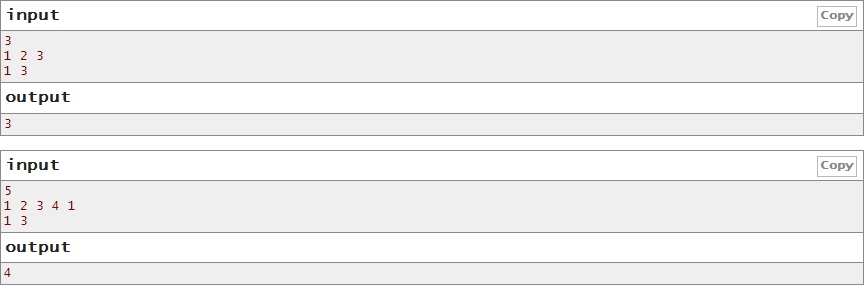
In the first example, it's optimal to start competition at 3 hours (in first timezone). In this case, it will be 1 hour in the second timezone and2 hours in the third timezone. Only one person from the first timezone won't participate.
In second example only people from the third and the fourth timezones will participate.
#include<cstdio>

#include<cstring>

#include<iostream>

#include<algorithm>

#define MAXN 100010

using namespace std;

int a[MAXN];

int n,s,f,ans,sum,maxn;

int main(){

    scanf("%d",&n);

    for(int i=;i<=n;i++)

        scanf("%d",&a[i]);

    scanf("%d%d",&s,&f);

    for(int i=;i<=n;i++){

        int x=i;

        if(x>=s&&x<=f-)    sum+=a[];

        for(int j=;j<n;j++){

            x++;if(x>n)    x=;

            if(x>=s&&x<=f-)    sum+=a[j+];

        }

        if(sum>maxn){ ans=i;maxn=sum; }sum=;

    }

    cout<<ans;

}
暴力
Codeforces Round #464 (Div. 2)的更多相关文章
- Codeforces Round #464 (Div. 2) E. Maximize!
题目链接:http://codeforces.com/contest/939/problem/E E. Maximize! time limit per test3 seconds memory li ...
- Codeforces Round #464 (Div. 2) D. Love Rescue
D. Love Rescue time limit per test2 seconds memory limit per test256 megabytes Problem Description V ...
- Codeforces Round #464 (Div. 2) C. Convenient For Everybody
C. Convenient For Everybody time limit per test2 seconds memory limit per test256 megabytes Problem ...
- Codeforces Round #464 (Div. 2) B. Hamster Farm
B. Hamster Farm time limit per test2 seconds memory limit per test256 megabytes Problem Description ...
- Codeforces Round #464 (Div. 2) A Determined Cleanup
A. Love Triangle time limit per test1 second memory limit per test256 megabytes Problem Description ...
- Codeforces Round #464 (Div. 2) B. Hamster Farm[盒子装仓鼠/余数]
B. Hamster Farm time limit per test 2 seconds memory limit per test 256 megabytes input standard inp ...
- Codeforces Round #464 (Div. 2) A. Love Triangle[判断是否存在三角恋]
A. Love Triangle time limit per test 1 second memory limit per test 256 megabytes input standard inp ...
- Codeforces Round #464 (Div. 2) D题【最小生成树】
Valya and Tolya are an ideal pair, but they quarrel sometimes. Recently, Valya took offense at her b ...
- Codeforces Round #366 (Div. 2) ABC
Codeforces Round #366 (Div. 2) A I hate that I love that I hate it水题 #I hate that I love that I hate ...
随机推荐
- poj1753,Flip Game,ArrayDeque<Node>
Flip Game Time Limit: 1000MS Memory Limit: 65536K Total Submissions: 30449 Accepted: 13232 Descr ...
- Codeforces Round #350 (Div. 2) E. Correct Bracket Sequence Editor 线段树模拟
E. Correct Bracket Sequence Editor Recently Polycarp started to develop a text editor that works o ...
- DNS隧道工具使用 不过其网络传输速度限制较大
DNS隧道工具使用 http://www.freebuf.com/sectool/112076.html http://netsec.ccert.edu.cn/zhengming/2011/11/01 ...
- 软件开发 —— 重构(refactor)
0. 代码坏味道 Large Class,过大的类:Large method,过长的(成员)函数: 1. 基本内涵 在不改变代码外在行为的前提下对代码做出修改,以改进代码的内部结构的过程. -- &l ...
- 【联系】—— Beta 分布与二项分布、共轭分布
1. 伯努利分布与二项分布 伯努利分布:Bern(x|μ)=μx(1−μ)1−x,随机变量 x 取值为 0,1,μ 表示取值为 1 的概率: 二项分布:Bin(m|N,μ)=(Nm)μm(1−μ)N− ...
- 用dom4j解析xml文件并执行增删改查操作
转自:https://www.aliyun.com/jiaocheng/1339446.html xml文件: <?xml version="1.0" encoding=&q ...
- 南海区行政审批管理系统接口规范v0.3(规划) 5.投资项目联合审批系统API 5.1.【uploadFile】证件文书附件上传
- 线段树(1)——点修改&建树
#include<cstdio> #include<algorithm> using namespace std; #define MAX 10000 #define INF ...
- kafka+storm 单机运行
环境: 1.kafka+zookeeper 2.window平台 3.eclipse 设置: 1.kafka和zookeeper安装,另一篇有介绍(https://www.cnblogs.com/51 ...
- js作业
1.一张纸的厚度是0.0001米,将纸对折,对折多少次厚度超过珠峰高度8848米var sum=0;i=0;a=0.0001;for(i=0;i<100;i++){ a=a*2; sum=sum ...