
Logistic Ordinal Regression
sklearn实战-乳腺癌细胞数据挖掘(博客主亲自录制视频教程)
https://study.163.com/course/introduction.htm?courseId=1005269003&utm_campaign=commission&utm_source=cp-400000000398149&utm_medium=share

数据统计分析项目联系QQ:231469242
http://fa.bianp.net/blog/2013/logistic-ordinal-regression/
# -*- coding: utf-8 -*-

"""

Created on Mon Jul 24 09:21:01 2017

@author: toby

"""

# Import standard packages

import numpy as np

# additional packages

from sklearn import metrics

from scipy import linalg, optimize, sparse

import warnings

BIG = 1e10

SMALL = 1e-12

def phi(t):

    ''' logistic function, returns 1 / (1 + exp(-t)) '''

    idx = t > 0

    out = np.empty(t.size, dtype=np.float)

    out[idx] = 1. / (1 + np.exp(-t[idx]))

    exp_t = np.exp(t[~idx])

    out[~idx] = exp_t / (1. + exp_t)

    return out

def log_logistic(t):

    ''' (minus) logistic loss function, returns log(1 / (1 + exp(-t))) '''

    idx = t > 0

    out = np.zeros_like(t)

    out[idx] = np.log(1 + np.exp(-t[idx]))

    out[~idx] = (-t[~idx] + np.log(1 + np.exp(t[~idx])))

    return out

def ordinal_logistic_fit(X, y, alpha=0, l1_ratio=0, n_class=None, max_iter=10000,

                         verbose=False, solver='TNC', w0=None):

    '''

    Ordinal logistic regression or proportional odds model.

    Uses scipy's optimize.fmin_slsqp solver.

    Parameters

    ----------

    X : {array, sparse matrix}, shape (n_samples, n_feaures)

        Input data

    y : array-like

        Target values

    max_iter : int

        Maximum number of iterations

    verbose: bool

        Print convergence information

    Returns

    -------

    w : array, shape (n_features,)

        coefficients of the linear model

    theta : array, shape (k,), where k is the different values of y

        vector of thresholds

    '''

    X = np.asarray(X)

    y = np.asarray(y)

    w0 = None

    if not X.shape[0] == y.shape[0]:

        raise ValueError('Wrong shape for X and y')

    # .. order input ..

    idx = np.argsort(y)

    idx_inv = np.zeros_like(idx)

    idx_inv[idx] = np.arange(idx.size)

    X = X[idx]

    y = y[idx].astype(np.int)

    # make them continuous and start at zero

    unique_y = np.unique(y)

    for i, u in enumerate(unique_y):

        y[y == u] = i

    unique_y = np.unique(y)

    # .. utility arrays used in f_grad ..

    alpha = 0.

    k1 = np.sum(y == unique_y[0])

    E0 = (y[:, np.newaxis] == np.unique(y)).astype(np.int)

    E1 = np.roll(E0, -1, axis=-1)

    E1[:, -1] = 0.

    E0, E1 = map(sparse.csr_matrix, (E0.T, E1.T))

    def f_obj(x0, X, y):

        """

        Objective function

        """

        w, theta_0 = np.split(x0, [X.shape[1]])

        theta_1 = np.roll(theta_0, 1)

        t0 = theta_0[y]

        z = np.diff(theta_0)

        Xw = X.dot(w)

        a = t0 - Xw

        b = t0[k1:] - X[k1:].dot(w)

        c = (theta_1 - theta_0)[y][k1:]

        if np.any(c > 0):

            return BIG

        #loss = -(c[idx] + np.log(np.exp(-c[idx]) - 1)).sum()

        loss = -np.log(1 - np.exp(c)).sum()

        loss += b.sum() + log_logistic(b).sum() \

            + log_logistic(a).sum() \

            + .5 * alpha * w.dot(w) - np.log(z).sum()  # penalty

        if np.isnan(loss):

            pass

            #import ipdb; ipdb.set_trace()

        return loss

    def f_grad(x0, X, y):

        """

        Gradient of the objective function

        """

        w, theta_0 = np.split(x0, [X.shape[1]])

        theta_1 = np.roll(theta_0, 1)

        t0 = theta_0[y]

        t1 = theta_1[y]

        z = np.diff(theta_0)

        Xw = X.dot(w)

        a = t0 - Xw

        b = t0[k1:] - X[k1:].dot(w)

        c = (theta_1 - theta_0)[y][k1:]

        # gradient for w

        phi_a = phi(a)

        phi_b = phi(b)

        grad_w = -X[k1:].T.dot(phi_b) + X.T.dot(1 - phi_a) + alpha * w

        # gradient for theta

        idx = c > 0

        tmp = np.empty_like(c)

        tmp[idx] = 1. / (np.exp(-c[idx]) - 1)

        tmp[~idx] = np.exp(c[~idx]) / (1 - np.exp(c[~idx])) # should not need

        grad_theta = (E1 - E0)[:, k1:].dot(tmp) \

            + E0[:, k1:].dot(phi_b) - E0.dot(1 - phi_a)

        grad_theta[:-1] += 1. / np.diff(theta_0)

        grad_theta[1:] -= 1. / np.diff(theta_0)

        out = np.concatenate((grad_w, grad_theta))

        return out

    def f_hess(x0, s, X, y):

        x0 = np.asarray(x0)

        w, theta_0 = np.split(x0, [X.shape[1]])

        theta_1 = np.roll(theta_0, 1)

        t0 = theta_0[y]

        t1 = theta_1[y]

        z = np.diff(theta_0)

        Xw = X.dot(w)

        a = t0 - Xw

        b = t0[k1:] - X[k1:].dot(w)

        c = (theta_1 - theta_0)[y][k1:]

        D = np.diag(phi(a) * (1 - phi(a)))

        D_= np.diag(phi(b) * (1 - phi(b)))

        D1 = np.diag(np.exp(-c) / (np.exp(-c) - 1) ** 2)

        Ex = (E1 - E0)[:, k1:].toarray()

        Ex0 = E0.toarray()

        H_A = X[k1:].T.dot(D_).dot(X[k1:]) + X.T.dot(D).dot(X)

        H_C = - X[k1:].T.dot(D_).dot(E0[:, k1:].T.toarray()) \

            - X.T.dot(D).dot(E0.T.toarray())

        H_B = Ex.dot(D1).dot(Ex.T) + Ex0[:, k1:].dot(D_).dot(Ex0[:, k1:].T) \

            - Ex0.dot(D).dot(Ex0.T)

        p_w = H_A.shape[0]

        tmp0 = H_A.dot(s[:p_w]) + H_C.dot(s[p_w:])

        tmp1 = H_C.T.dot(s[:p_w]) + H_B.dot(s[p_w:])

        return np.concatenate((tmp0, tmp1))

        import ipdb; ipdb.set_trace()

        import pylab as pl

        pl.matshow(H_B)

        pl.colorbar()

        pl.title('True')

        import numdifftools as nd

        Hess = nd.Hessian(lambda x: f_obj(x, X, y))

        H = Hess(x0)

        pl.matshow(H[H_A.shape[0]:, H_A.shape[0]:])

        #pl.matshow()

        pl.title('estimated')

        pl.colorbar()

        pl.show()

    def grad_hess(x0, X, y):

        grad = f_grad(x0, X, y)

        hess = lambda x: f_hess(x0, x, X, y)

        return grad, hess

    x0 = np.random.randn(X.shape[1] + unique_y.size) / X.shape[1]

    if w0 is not None:

        x0[:X.shape[1]] = w0

    else:

        x0[:X.shape[1]] = 0.

    x0[X.shape[1]:] = np.sort(unique_y.size * np.random.rand(unique_y.size))

    #print('Check grad: %s' % optimize.check_grad(f_obj, f_grad, x0, X, y))

    #print(optimize.approx_fprime(x0, f_obj, 1e-6, X, y))

    #print(f_grad(x0, X, y))

    #print(optimize.approx_fprime(x0, f_obj, 1e-6, X, y) - f_grad(x0, X, y))

    #import ipdb; ipdb.set_trace()

    def callback(x0):

        x0 = np.asarray(x0)

        # print('Check grad: %s' % optimize.check_grad(f_obj, f_grad, x0, X, y))

        if verbose:

        # check that gradient is correctly computed

            print('OBJ: %s' % f_obj(x0, X, y))

    if solver == 'TRON':

        import pytron

        out = pytron.minimize(f_obj, grad_hess, x0, args=(X, y))

    else:

        options = {'maxiter' : max_iter, 'disp': 0, 'maxfun':10000}

        out = optimize.minimize(f_obj, x0, args=(X, y), method=solver,

            jac=f_grad, hessp=f_hess, options=options, callback=callback)

    if not out.success:

        warnings.warn(out.message)

    w, theta = np.split(out.x, [X.shape[1]])

    return w, theta

def ordinal_logistic_predict(w, theta, X):

    """

    Parameters

    ----------

    w : coefficients obtained by ordinal_logistic

    theta : thresholds

    """

    unique_theta = np.sort(np.unique(theta))

    out = X.dot(w)

    unique_theta[-1] = np.inf # p(y <= max_level) = 1

    tmp = out[:, None].repeat(unique_theta.size, axis=1)

    return np.argmax(tmp < unique_theta, axis=1)

def main():

    DOC = """

================================================================================

    Compare the prediction accuracy of different models on the boston dataset

================================================================================

    """

    print(DOC)

    from sklearn import cross_validation, datasets

    boston = datasets.load_boston()

    X, y = boston.data, np.round(boston.target)

    #X -= X.mean()

    y -= y.min()

    idx = np.argsort(y)

    X = X[idx]

    y = y[idx]

    cv = cross_validation.ShuffleSplit(y.size, n_iter=50, test_size=.1, random_state=0)

    score_logistic = []

    score_ordinal_logistic = []

    score_ridge = []

    for i, (train, test) in enumerate(cv):

        #test = train

        if not np.all(np.unique(y[train]) == np.unique(y)):

            # we need the train set to have all different classes

            continue

        assert np.all(np.unique(y[train]) == np.unique(y))

        train = np.sort(train)

        test = np.sort(test)

        w, theta = ordinal_logistic_fit(X[train], y[train], verbose=True,

                                        solver='TNC')

        pred = ordinal_logistic_predict(w, theta, X[test])

        s = metrics.mean_absolute_error(y[test], pred)

        print('ERROR (ORDINAL)  fold %s: %s' % (i+1, s))

        score_ordinal_logistic.append(s)

        from sklearn import linear_model

        clf = linear_model.LogisticRegression(C=1.)

        clf.fit(X[train], y[train])

        pred = clf.predict(X[test])

        s = metrics.mean_absolute_error(y[test], pred)

        print('ERROR (LOGISTIC) fold %s: %s' % (i+1, s))

        score_logistic.append(s)

        from sklearn import linear_model

        clf = linear_model.Ridge(alpha=1.)

        clf.fit(X[train], y[train])

        pred = np.round(clf.predict(X[test]))

        s = metrics.mean_absolute_error(y[test], pred)

        print('ERROR (RIDGE)    fold %s: %s' % (i+1, s))

        score_ridge.append(s)

    print()

    print('MEAN ABSOLUTE ERROR (ORDINAL LOGISTIC):    %s' % np.mean(score_ordinal_logistic))

    print('MEAN ABSOLUTE ERROR (LOGISTIC REGRESSION): %s' % np.mean(score_logistic))

    print('MEAN ABSOLUTE ERROR (RIDGE REGRESSION):    %s' % np.mean(score_ridge))

    # print('Chance level is at %s' % (1. / np.unique(y).size))

    return np.mean(score_ridge)

if __name__ == '__main__':

    out = main()

    print(out)
TL;DR: I've implemented a logistic ordinal regression or proportional odds model. Here is the Python code
The logistic ordinal regression model, also known as the proportional odds was introduced in the early 80s by McCullagh [1, 2] and is a generalized linear model specially tailored for the case of predicting ordinal variables, that is, variables that are discrete (as in classification) but which can be ordered (as in regression). It can be seen as an extension of the logistic regression model to the ordinal setting.
Given X∈Rn×pX∈Rn×p input data and y∈Nny∈Nn target values. For simplicity we assume yy is a non-decreasing vector, that is, y1≤y2≤...y1≤y2≤.... Just as the logistic regression models posterior probability P(y=j|Xi)P(y=j|Xi) as the logistic function, in the logistic ordinal regression we model thecummulative probability as the logistic function. That is,
P(y≤j|Xi)=ϕ(θj−wTXi)=11+exp(wTXi−θj)P(y≤j|Xi)=ϕ(θj−wTXi)=11+exp(wTXi−θj)
where w,θw,θ are vectors to be estimated from the data and ϕϕ is the logistic function defined as ϕ(t)=1/(1+exp(−t))ϕ(t)=1/(1+exp(−t)).
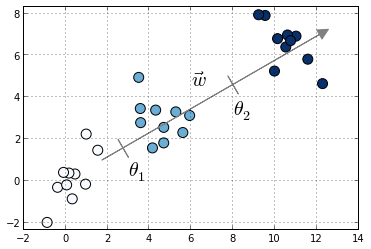
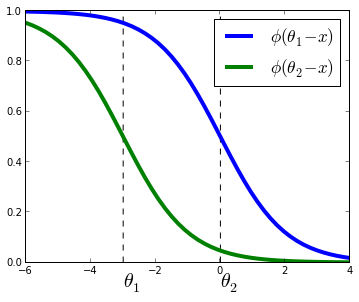 Toy example with three classes denoted in different colors. Also shown the vector of coefficients ww and the thresholds θ0θ0 and θ1θ1
Compared to multiclass logistic regression, we have added the constrain that the hyperplanes that separate the different classes are parallel for all classes, that is, the vector ww is common across classes. To decide to which class will XiXi be predicted we make use of the vector of thresholds θθ. If there are KK different classes, θθ is a non-decreasing vector (that is, θ1≤θ2≤...≤θK−1θ1≤θ2≤...≤θK−1) of size K−1K−1. We will then assign the class jj if the prediction wTXwTX (recall that it's a linear model) lies in the interval [θj−1,θj[[θj−1,θj[. In order to keep the same definition for extremal classes, we define θ0=−∞θ0=−∞ and θK=+∞θK=+∞.
The intuition is that we are seeking a vector ww such that XwXw produces a set of values that are well separated into the different classes by the different thresholds θθ. We choose a logistic function to model the probability P(y≤j|Xi)P(y≤j|Xi) but other choices are possible. In the proportional hazards model 1 the probability is modeled as −log(1−P(y≤j|Xi))=exp(θj−wTXi)−log(1−P(y≤j|Xi))=exp(θj−wTXi). Other link functions are possible, where the link function satisfies link(P(y≤j|Xi))=θj−wTXilink(P(y≤j|Xi))=θj−wTXi. Under this framework, the logistic ordinal regression model has a logistic link function and the proportional hazards model has a log-log link function.
The logistic ordinal regression model is also known as the proportional odds model, because the ratio of corresponding odds for two different samples X1X1 and X2X2 is exp(wT(X1−X2))exp(wT(X1−X2)) and so does not depend on the class jj but only on the difference between the samples X1X1 and X2X2.
Optimization
Model estimation can be posed as an optimization problem. Here, we minimize the loss function for the model, defined as minus the log-likelihood:
L(w,θ)=−n∑i=1log(ϕ(θyi−wTXi)−ϕ(θyi−1−wTXi))L(w,θ)=−∑i=1nlog(ϕ(θyi−wTXi)−ϕ(θyi−1−wTXi))
In this sum all terms are convex on ww, thus the loss function is convex over ww. It might be also jointly convex over ww and θθ, although I haven't checked. I use the function fmin_slsqp in scipy.optimize to optimize LLunder the constraint that θθ is a non-decreasing vector. There might be better options, I don't know. If you do know, please leave a comment!.
Using the formula log(ϕ(t))′=(1−ϕ(t))log(ϕ(t))′=(1−ϕ(t)), we can compute the gradient of the loss function as
∇wL(w,θ)=n∑i=1Xi(1−ϕ(θyi−wTXi)−ϕ(θyi−1−wTXi))∇θL(w,θ)=n∑i=1eyi(1−ϕ(θyi−wTXi)−11−exp(θyi−1−θyi))+eyi−1(1−ϕ(θyi−1−wTXi)−11−exp(−(θyi−1−θyi)))∇wL(w,θ)=∑i=1nXi(1−ϕ(θyi−wTXi)−ϕ(θyi−1−wTXi))∇θL(w,θ)=∑i=1neyi(1−ϕ(θyi−wTXi)−11−exp(θyi−1−θyi))+eyi−1(1−ϕ(θyi−1−wTXi)−11−exp(−(θyi−1−θyi)))
where eiei is the iith canonical vector.
Code
I've implemented a Python version of this algorithm using Scipy'soptimize.fmin_slsqp function. This takes as arguments the loss function, the gradient denoted before and a function that is > 0 when the inequalities on θθ are satisfied.
Code can be found here as part of the minirank package, which is my sandbox for code related to ranking and ordinal regression. At some point I would like to submit it to scikit-learn but right now the I don't know how the code will scale to medium-scale problems, but I suspect not great. On top of that I'm not sure if there is a real demand of these models for scikit-learn and I don't want to bloat the package with unused features.
Performance
I compared the prediction accuracy of this model in the sense of mean absolute error (IPython notebook) on the boston house-prices dataset. To have an ordinal variable, I rounded the values to the closest integer, which gave me a problem of size 506 ×× 13 with 46 different target values. Although not a huge increase in accuracy, this model did give me better results on this particular dataset:
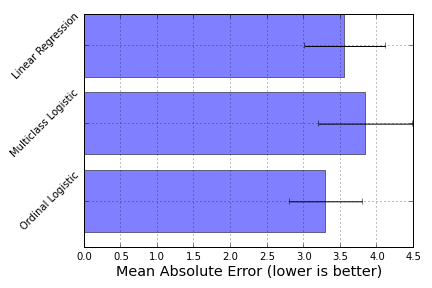
Here, ordinal logistic regression is the best-performing model, followed by a Linear Regression model and a One-versus-All Logistic regression model as implemented in scikit-learn.
python风控评分卡建模和风控常识(博客主亲自录制视频教程)

Logistic Ordinal Regression的更多相关文章
- Logistic/Softmax Regression
辅助函数 牛顿法介绍 %% Logistic Regression close all clear %%load data x = load('ex4x.dat'); y = load('ex4y.d ...
- LOGIT REGRESSION
Version info: Code for this page was tested in SPSS 20. Logistic regression, also called a logit mod ...
- spss
编辑 SPSS(Statistical Product and Service Solutions),“统计产品与服务解决方案”软件.最初软件全称为“社会科学统计软件包” (SolutionsStat ...
- 2016CVPR论文集
http://www.cv-foundation.org/openaccess/CVPR2016.py ORAL SESSION Image Captioning and Question Answe ...
- HAWQ + MADlib 玩转数据挖掘之(一)——安装
一.MADlib简介 MADlib是Pivotal公司与伯克利大学合作的一个开源机器学习库,提供了精确的数据并行实现.统计和机器学习方法对结构化和非结构化数据进行分析,主要目的是扩展数据库的分析能力, ...
- 用SQL玩转数据挖掘之MADlib(一)——安装
一.MADlib简介 MADlib是Pivotal公司与伯克利大学合作的一个开源机器学习库,提供了精确的数据并行实现.统计和机器学习方法对结构化和非结构化数据进行分析,主要目的是扩展数据库的分析能力, ...
- CVPR2016 Paper list
CVPR2016 Paper list ORAL SESSIONImage Captioning and Question Answering Monday, June 27th, 9:00AM - ...
- SPSS统计分析过程包括描述性统计、均值比较、一般线性模型、相关分析、回归分析、对数线性模型、聚类分析、数据简化、生存分析、时间序列分析、多重响应等几大类
https://www.zhihu.com/topic/19582125/top-answershttps://wenku.baidu.com/search?word=spss&ie=utf- ...
- [Machine Learning] Learning to rank算法简介
声明:以下内容根据潘的博客和crackcell's dustbin进行整理,尊重原著,向两位作者致谢! 1 现有的排序模型 排序(Ranking)一直是信息检索的核心研究问题,有大量的成熟的方法,主要 ...
随机推荐
- 《JavaScript》forEach()和map()
js中的forEach()方法只能遍历数组,不能遍历字符串和对象,和$.each()有很多使用上的区别array.forEach(funcion(value,index,arr){},thisValu ...
- SQLyog的基本使用
[简介] SQLyog是mysql数据库的客户端软件 [基本使用] 1.连接mysql数据库 2.SQLyog的页面使用介绍 3.基本的数据库命令 1) use命令 切换数据库 2) unsigned ...
- 【每日scrum】第一次冲刺day3
学习安卓,和小伙伴讨论百度API调用的问题,最后决定自己写地图
- React环境配置(第一个React项目)
使用Webpack构建React项目 1. 使用NPM配置React环境 NPM及React安装自行百度 首先创建一个文件夹,the_first_React 进入到创建好的目录,npm init,然后 ...
- Task 6.2站立会议一
今天大家把这两天查的资料都拿出来整合到了一起,并仔细分析了其中的联系和区别. 因为大家每个人的思路都不一样,有各种各样的想法和不同的意见,所以最终统一意见是很难的一个过程.开始大家认我们可以做一个单独 ...
- 《TCP/IP 详解 卷1:协议》第 9 章:广播和本地组播(IGMP 和 MLD)
我已经懒了,卷一已经是去年年底看完的,但怎么说卷一的坑开了就要填完啊-- 广播和本地组播(IGMP 和 MLD) 引言 有 4 种 IP 地址,单播(unicast).任播(anycast).组播(m ...
- 13种细分类型的TCP重传小结(一张表总结4.4内核所有TCP重传场景)
具体每种重传类型的wireshark示例解说参考前文 来自为知笔记(Wiz)
- SCRUM:周日周一任务实现情况
1.设计.制作欢迎界面 2.对杰龙注册界面进行重设计和规范strings → → →
- BeTa阶段Day4
一.提供当天站立式会议照片一张 二.每个人的工作 1.讨论项目每个成员的昨天进展 刘阳航:优化障碍物生成. 林庭亦:调整难度设置. 郑子熙:改进UI,美化界面. 陈文俊:优化代码结构. 2.讨论项目每 ...
- selenium获取新页面标签页(只弹出一个新页面的切换)
selenium获取新页面标签页(只弹出一个新页面的切换) windows = driver.current_window_handle #定位当前页面句柄 all_handles = driver. ...