
motan源码分析二:使用spi机制进行类加载
在motan的源码中使用了很多的spi机制进行对象的创建,下面我们来具体分析一下它的实现方法。
1.在实际的jar包的\META-INF\services目录中引入相关的文件,例如下图中,我解压了core的jar文件后,获得到的相应文件列表:
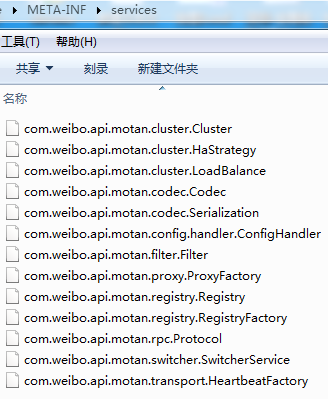
2.以第一节中的ConfigHandler为例来分析,打开上图中的com.weibo.api.motan.config.handler.ConfigHandler文件,文件内容标识着ConfigHandler接口的实现类为:com.weibo.api.motan.config.handler.SimpleConfigHandler
#

#  Copyright 2009-2016 Weibo, Inc.

#

#    Licensed under the Apache License, Version 2.0 (the "License");

#    you may not use this file except in compliance with the License.

#    You may obtain a copy of the License at

#

#        http://www.apache.org/licenses/LICENSE-2.0

#

#    Unless required by applicable law or agreed to in writing, software

#    distributed under the License is distributed on an "AS IS" BASIS,

#    WITHOUT WARRANTIES OR CONDITIONS OF ANY KIND, either express or implied.

#    See the License for the specific language governing permissions and

#    limitations under the License.

#

com.weibo.api.motan.config.handler.SimpleConfigHandler
3.在第一节中,创建ConfigHandler对象的代码是这样的:
ConfigHandler configHandler = ExtensionLoader.getExtensionLoader(ConfigHandler.class).getExtension(MotanConstants.DEFAULT_VALUE);
4.开始进入到实际的加载代码核心部分,首先来看一下类加载器的具体实现:
    public static <T> ExtensionLoader<T> getExtensionLoader(Class<T> type) {

        checkInterfaceType(type);//基础性检查

        ExtensionLoader<T> loader = (ExtensionLoader<T>) extensionLoaders.get(type);//之前是否已经加载过此加载器

        if (loader == null) {

            loader = initExtensionLoader(type);//第一次加载

        }

        return loader;

    }

    private static <T> void checkInterfaceType(Class<T> clz) {

        if (clz == null) {

            failThrows(clz, "Error extension type is null");

        }

        if (!clz.isInterface()) {

            failThrows(clz, "Error extension type is not interface");

        }

        if (!isSpiType(clz)) {

            failThrows(clz, "Error extension type without @Spi annotation");

        }

    }

    public static synchronized <T> ExtensionLoader<T> initExtensionLoader(Class<T> type) {

        ExtensionLoader<T> loader = (ExtensionLoader<T>) extensionLoaders.get(type);

        if (loader == null) {

            loader = new ExtensionLoader<T>(type);//新创建一个加载器

            extensionLoaders.putIfAbsent(type, loader);

            loader = (ExtensionLoader<T>) extensionLoaders.get(type);

        }

        return loader;

    }
5.下面我们将进入到加载器的内部,分析具体的实现:
    private ExtensionLoader(Class<T> type) {

        this(type, Thread.currentThread().getContextClassLoader());//使用当前线程的类加载器做为加载器,type为ConfigHandler接口

    }

    public T getExtension(String name) {

        checkInit();//检查是否初始化

        if (name == null) {

            return null;

        }

        try {

            Spi spi = type.getAnnotation(Spi.class);

            if (spi.scope() == Scope.SINGLETON) {

                return getSingletonInstance(name);//返回唯一的对象

            } else {

                Class<T> clz = extensionClasses.get(name);

                if (clz == null) {

                    return null;

                }

                return clz.newInstance();//重新创建对象

            }

        } catch (Exception e) {

            failThrows(type, "Error when getExtension " + name, e);

        }

        return null;

    }

    private synchronized void loadExtensionClasses() {

        if (init) {

            return;

        }

        extensionClasses = loadExtensionClasses(PREFIX);//加载相关的类

        singletonInstances = new ConcurrentHashMap<String, T>();

        init = true;

    }

    private ConcurrentMap<String, Class<T>> loadExtensionClasses(String prefix) {

        String fullName = prefix + type.getName();//全名为:jar包名+\META-INF\services\com.weibo.api.motan.config.handler.ConfigHandler文件里的类

        List<String> classNames = new ArrayList<String>();

        try {

            Enumeration<URL> urls;

            if (classLoader == null) {

                urls = ClassLoader.getSystemResources(fullName);

            } else {

                urls = classLoader.getResources(fullName);

            }

            if (urls == null || !urls.hasMoreElements()) {

                return new ConcurrentHashMap<String, Class<T>>();

            }

            System.out.println("fullname:"+fullName);

            while (urls.hasMoreElements()) {

                URL url = urls.nextElement();

                System.out.println("url:"+url.getFile());

                parseUrl(type, url, classNames);

            }

        } catch (Exception e) {

            throw new MotanFrameworkException(

                    "ExtensionLoader loadExtensionClasses error, prefix: " + prefix + " type: " + type.getClass(), e);

        }

        for(String classN : classNames){

            System.out.println("class:"+classN);

        }

        return loadClass(classNames);

    }
6.在parseUrl方法中进行文件的内容读取,并在loadClass中完成类的加载
    private void parseUrl(Class<T> type, URL url, List<String> classNames) throws ServiceConfigurationError {

        InputStream inputStream = null;

        BufferedReader reader = null;

        try {

            inputStream = url.openStream();

            reader = new BufferedReader(new InputStreamReader(inputStream, MotanConstants.DEFAULT_CHARACTER));

            String line = null;

            int indexNumber = 0;

            while ((line = reader.readLine()) != null) {

                indexNumber++;

                parseLine(type, url, line, indexNumber, classNames);//读取到类的名称:com.weibo.api.motan.config.handler.SimpleConfigHandler

            }

        } catch (Exception x) {

            failLog(type, "Error reading spi configuration file", x);

        } finally {

            try {

                if (reader != null) {

                    reader.close();

                }

                if (inputStream != null) {

                    inputStream.close();

                }

            } catch (IOException y) {

                failLog(type, "Error closing spi configuration file", y);

            }

        }

    }

    private ConcurrentMap<String, Class<T>> loadClass(List<String> classNames) {

        ConcurrentMap<String, Class<T>> map = new ConcurrentHashMap<String, Class<T>>();

        for (String className : classNames) {

            try {

                Class<T> clz;

                if (classLoader == null) {

                    clz = (Class<T>) Class.forName(className);//装载类:com.weibo.api.motan.config.handler.SimpleConfigHandler

                } else {

                    clz = (Class<T>) Class.forName(className, true, classLoader);

                }

                checkExtensionType(clz);

                String spiName = getSpiName(clz);

                if (map.containsKey(spiName)) {

                    failThrows(clz, ":Error spiName already exist " + spiName);

                } else {

                    map.put(spiName, clz);

                }

            } catch (Exception e) {

                failLog(type, "Error load spi class", e);

            }

        }

        return map;

    }
motan类加载的知识点总结:
1.使用jdk的spi规范,在\META-INF\services中添加实际的使用类描述,从而实现类与类之间的完全解耦;
2.类加载器使用的是当前线程的类加载器;
3.motan的类加载器可以支持单例和多例两种模式;
4.motan中大量使用了spi的类加载方式。
motan源码分析二:使用spi机制进行类加载的更多相关文章
- dubbo源码分析01:SPI机制
一.什么是SPI SPI全称为Service Provider Interface,是一种服务发现机制,其本质是将接口实现类的全限定名配置在文件中,并由服务加载器读取配置文件.这样可以在运行时,动态为 ...
- Solr4.8.0源码分析(19)之缓存机制(二)
Solr4.8.0源码分析(19)之缓存机制(二) 前文<Solr4.8.0源码分析(18)之缓存机制(一)>介绍了Solr缓存的生命周期,重点介绍了Solr缓存的warn过程.本节将更深 ...
- 十、Spring之BeanFactory源码分析(二)
Spring之BeanFactory源码分析(二) 前言 在前面我们简单的分析了BeanFactory的结构,ListableBeanFactory,HierarchicalBeanFactory,A ...
- 多线程之美8一 AbstractQueuedSynchronizer源码分析<二>
目录 AQS的源码分析 该篇主要分析AQS的ConditionObject,是AQS的内部类,实现等待通知机制. 1.条件队列 条件队列与AQS中的同步队列有所不同,结构图如下: 两者区别: 1.链表 ...
- Java ArrayList源码分析(含扩容机制等重点问题分析)
写在最前面 这个项目是从20年末就立好的 flag,经过几年的学习,回过头再去看很多知识点又有新的理解.所以趁着找实习的准备,结合以前的学习储备,创建一个主要针对应届生和初学者的 Java 开源知识项 ...
- Fresco 源码分析(二) Fresco客户端与服务端交互(1) 解决遗留的Q1问题
4.2 Fresco客户端与服务端的交互(一) 解决Q1问题 从这篇博客开始,我们开始讨论客户端与服务端是如何交互的,这个交互的入口,我们从Q1问题入手(博客按照这样的问题入手,是因为当时我也是从这里 ...
- Solr4.8.0源码分析(18)之缓存机制(一)
Solr4.8.0源码分析(18)之缓存机制(一) 前文在介绍commit的时候具体介绍了getSearcher()的实现,并提到了Solr的预热warn.那么本文开始将详细来学习下Solr的缓存机制 ...
- 框架-springmvc源码分析(二)
框架-springmvc源码分析(二) 参考: http://www.cnblogs.com/leftthen/p/5207787.html http://www.cnblogs.com/leftth ...
- java-通过 HashMap、HashSet 的源码分析其 Hash 存储机制
通过 HashMap.HashSet 的源码分析其 Hash 存储机制 集合和引用 就像引用类型的数组一样,当我们把 Java 对象放入数组之时,并非真正的把 Java 对象放入数组中.仅仅是把对象的 ...
随机推荐
- HDU5317
题意:定义一个数K,最小质因数形式为K = a*b*c形式(如12 = 2*2*3),相同只取一个(所以12只能取2,3两个,既F[12]=2)给L,R区间,找出区间内最大的F[x](L<=x& ...
- 简单实现图片间的切换动画 主要用到ViewPager
简单实现图片间的切换动画 主要用到ViewPagerViewPager是android扩展包v4包中的类,这个类可以让用户左右切换当前的view.ViewPager类需要一个PagerAdapter适 ...
- (转帖) 如何將值delay n個clock? (SOC) (Verilog)
来源:http://www.cnblogs.com/oomusou/archive/2009/06/15/verilog_dly_n_clk.html /* (C) OOMusou 2009 http ...
- B/S 獲取客戶端Mac地址
<%@ Page Language="C#" AutoEventWireup="true" CodeBehind="WebForm2.aspx. ...
- /root/.bashrc与/etc/profile的异同
要搞清bashrc与profile的区别,首先要弄明白什么是交互式shell和非交互式shell,什么是loginshell 和non-loginshell. 交互式模式就是shell等待你的输入,并 ...
- Building,Packaging,Deploying,and Administering Applications and Types
在我们进入章节之前,我们讨论一下生成.打包和部署你的应用程序和应用程序类型必须的步骤.在这章里,我关注的是如何为你的应用程序的用途生成程序集.在第三章,"共享程序集合和强命名程序集" ...
- maven在mac上的入门使用
首先博主也是在入门学习,在学习maven时遇到了不少问题.查资料时发现网上maven的使用大多是win的,所以我打算写点maven在mac入门使用的笔记,希望可以帮助到跟我一样有困难的你们. 1.ht ...
- 嵌入式开发(一) Ubuntu12.04下搭建交叉编译环境
操作系统:Ubuntu12.04 AMD64位 交叉编译环境:arm-Linux gcc版本4.4.3 前言: 首先理解一下交叉编译的意思.我们要给嵌入式设备写应用程序,但是又不能在嵌入式设备上完成所 ...
- Mybatis3.0防止SQL注入
一.什么是SQL注入 引用搜狗百科: SQL注入,就是通过把SQL命令插入到Web表单提交或输入域名或页面请求的查询字符串,最终达到欺骗服务器执行恶意的SQL命令,比如很多影视网站泄露VIP会员密码大 ...
- underscorejs-each学习
2.1 each 2.1.1 语法: _.each(list, iteratee, [context]) 2.1.2 说明: 依次对集合的所有元素进行某种操作,原样返回list.接收3个参数,list ...