
[转]Compact Normal Storage for Small G-Buffers
http://aras-p.info/texts/CompactNormalStorage.html
- Intro
- Baseline: store X&Y&Z
- Method 1: X&Y
- Method 3: Spherical Coordinates
- Method 4: Spheremap Transform
- Method 7: Stereographic projection
- Method 8: Per-pixel View Space
- Performance Comparison
- Quality Comparison
- Changelog
Intro
Various deferred shading/lighting approaches or image postprocessing effects need to store normals as part of their G-buffer. Let’s figure out a compact storage method for view space normals. In my case, main target is minimalist G-buffer, where depth and normals are packed into a single 32 bit (8 bits/channel) render texture. I try to minimize error and shader cycles to encode/decode.
Now of course, 8 bits/channel storage for normals can be not enough for shading, especially if you want specular (low precision & quantization leads to specular “wobble” when camera or objects move). However, everything below should Just Work (tm) for 10 or 16 bits/channel integer formats. For 16 bits/channel half-float formats, some of the computations are not necessary (e.g. bringing normal values into 0..1 range).
If you know other ways to store/encode normals, please let me know in the comments!
Various normal encoding methods and their comparison below. Notes:
- Error images are: 1-pow(dot(n1,n2),1024) and abs(n1-n2)*30, where n1 is actual normal, andn2 is normal encoded into a texture, read back & decoded. MSE and PSNR is computed on the difference (abs(n1-n2)) image.
- Shader code is HLSL. Compiled into ps_3_0 by d3dx9_42.dll (February 2010 SDK).
- Radeon GPU performance numbers from AMD’s GPU ShaderAnalyzer 1.53, using Catalyst 9.12 driver.
- GeForce GPU performance numbers from NVIDIA’s NVShaderPerf 2.0, using 174.74 driver.
Note: there was an error!
Original version of my article had some stupidity: encoding shaders did not normalize the incoming per-vertex normal. This resulted in quality evaluation results being somewhat wrong. Also, if normal is assumed to be normalized, then three methods in original article (Sphere Map, Cry Engine 3 and Lambert Azimuthal) are in fact completely equivalent. The old version is still available for the sake of integrity of the internets.
Test Playground Application
Here is a small Windows application I used to test everything below: NormalEncodingPlayground.zip(4.8MB, source included).
It requires GPU with Shader Model 3.0 support. When it writes fancy shader reports, it expects AMD’s GPUShaderAnalyzer and NVIDIA’s NVShaderPerf to be installed. Source code should build with Visual C++ 2008.
Baseline: store X&Y&Z
Just to set the basis, store all three components of the normal. It’s not suitable for our quest, but I include it here to evaluate “base” encoding error (which happens here only because of quantization to 8 bits per component).
Encoding, Error to Power, Error * 30 images below. MSE: 0.000008; PSNR: 51.081 dB.


| Encoding | Decoding |
|---|---|
half4 encode (half3 n, float3 view) |
half3 decode (half4 enc, float3 view) |
ps_3_0 |
ps_3_0 |
1 ALU |
2 ALU, 1 TEX |
Method #1: store X&Y, reconstruct Z
Used by Killzone 2 among others (PDF link).
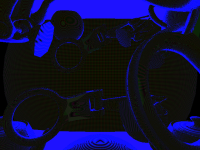
Encoding, Error to Power, Error * 30 images below. MSE: 0.013514; PSNR: 18.692 dB.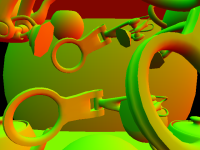

Pros:
|
Cons:
|
| Encoding | Decoding |
|---|---|
half4 encode (half3 n, float3 view) |
half3 decode (half2 enc, float3 view) |
ps_3_0 |
ps_3_0 |
1 ALU |
7 ALU, 1 TEX |
Method #3: Spherical Coordinates
It is possible to use spherical coordinates to encode the normal. Since we know it’s unit length, we can just store the two angles.
Suggested by Pat Wilson of Garage Games: GG blog post. Other mentions: MJP’s blog, GarageGames thread, Wolf Engel’s blog, gamedev.net forum thread.
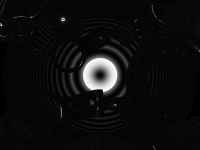
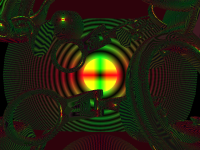
Encoding, Error to Power, Error * 30 images below. MSE: 0.000062; PSNR: 42.042 dB.
Pros:
|
Cons:
|
| Encoding | Decoding |
|---|---|
#define kPI 3.1415926536f |
half3 decode (half2 enc, float3 view) |
ps_3_0 |
ps_3_0 |
26 ALU |
17 ALU, 1 TEX |
Method #4: Spheremap Transform
Spherical environment mapping (indirectly) maps reflection vector to a texture coordinate in [0..1] range. The reflection vector can point away from the camera, just like our view space normals. Bingo! See Siggraph 99 notes for sphere map math. Normal we want to encode is R, resulting values are (s,t).
If we assume that incoming normal is normalized, then there are methods derived from elsewhere that end up being exactly equivalent:
- Used in Cry Engine 3, presented by Martin Mittring in “A bit more Deferred” presentation (PPT link, slide 13). For Unity, I had to negate Z component of view space normal to produce good results, I guess Unity’s and Cry Engine’s coordinate systems are different. The code would be:
half2 encode (half3 n, float3 view)

{

    half2 enc = normalize(n.xy) * (sqrt(-n.z*0.5+0.5));

    enc = enc*0.5+0.5;

    return enc;

}

half3 decode (half4 enc, float3 view)

{

    half4 nn = enc*half4(2,2,0,0) + half4(-1,-1,1,-1);

    half l = dot(nn.xyz,-nn.xyw);

    nn.z = l;

    nn.xy *= sqrt(l);

    return nn.xyz * 2 + half3(0,0,-1);

} - Lambert Azimuthal Equal-Area projection (Wikipedia link). Suggested by Sean Barrett in comments for this article. The code would be:
half2 encode (half3 n, float3 view)

{

    half f = sqrt(8*n.z+8);

    return n.xy / f + 0.5;

}

half3 decode (half4 enc, float3 view)

{

    half2 fenc = enc*4-2;

    half f = dot(fenc,fenc);

    half g = sqrt(1-f/4);

    half3 n;

    n.xy = fenc*g;

    n.z = 1-f/2;

    return n;

}
Encoding, Error to Power, Error * 30 images below. MSE: 0.000016; PSNR: 48.071 dB.


Pros:
|
Cons:
|
| Encoding | Decoding |
|---|---|
half4 encode (half3 n, float3 view) |
half3 decode (half2 enc, float3 view) |
ps_3_0 |
ps_3_0 |
4 ALU |
8 ALU, 1 TEX |
Method #7: Stereographic Projection
What the title says: use Stereographic Projection (Wikipedia link), plus rescaling so that “practically visible” range of normals maps into unit circle (regular stereographic projection maps sphere to circle of infinite size). In my tests, scaling factor of 1.7777 produced best results; in practice it depends on FOV used and how much do you care about normals that point away from the camera.
Suggested by Sean Barrett and Ignacio Castano in comments for this article.
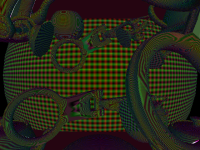
Encoding, Error to Power, Error * 30 images below. MSE: 0.000038; PSNR: 44.147 dB.

Pros:
|
Cons:
|
| Encoding | Decoding |
|---|---|
half4 encode (half3 n, float3 view) |
half3 decode (half4 enc, float3 view) |
ps_3_0 |
ps_3_0 |
5 ALU |
7 ALU, 1 TEX |
Method #8: Per-pixel View Space
If we compute view space per-pixel, then Z component of a normal can never be negative. Then just store X&Y, and compute Z.
Suggested by Yuriy O’Donnell on Twitter.
Encoding, Error to Power, Error * 30 images below. MSE: 0.000134; PSNR: 38.730 dB.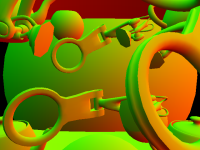


Pros:
|
Cons:
|
| Encoding | Decoding |
|---|---|
float3x3 make_view_mat (float3 view) |
|
ps_3_0 |
ps_3_0 |
17 ALU |
21 ALU, 1 TEX |
Performance Comparison
GPU performance comparison in a single table:
| #1: X & Y | #3: Spherical | #4: Spheremap | #7: Stereo | #8: PPView | |||
|---|---|---|---|---|---|---|---|
| Encoding, GPU cycles | |||||||
| Radeon HD2400 | 1.00 | 17.00 | 3.00 | 4.00 | 11.00 | ||
| Radeon HD5870 | 0.50 | 0.95 | 0.50 | 0.50 | 0.80 | ||
| GeForce 6200 | 1.00 | 12.00 | 4.00 | 2.00 | 12.00 | ||
| GeForce 8800 | 7.00 | 43.00 | 12.00 | 12.00 | 24.00 | ||
| Decoding, GPU cycles | |||||||
| Radeon HD2400 | 1.00 | 17.00 | 3.00 | 4.00 | 11.00 | ||
| Radeon HD5870 | 0.50 | 0.95 | 0.50 | 1.00 | 0.80 | ||
| GeForce 6200 | 4.00 | 7.00 | 6.00 | 4.00 | 12.00 | ||
| GeForce 8800 | 15.00 | 23.00 | 15.00 | 12.00 | 29.00 | ||
| Encoding, D3D ALU+TEX instruction slots | |||||||
| SM3.0 | 1 | 26 | 4 | 5 | 17 | ||
| Decoding, D3D ALU+TEX instruction slots | |||||||
| SM3.0 | 8 | 18 | 9 | 8 | 22 | ||
Quality Comparison
Quality comparison in a single table. PSNR based, higher numbers are better.
| Method | PSNR, dB |
|---|---|
| #1: X & Y | 18.629 |
| #3: Spherical | 42.042 |
| #4: Spheremap | 48.071 |
| #7: Stereographic | 44.147 |
| #8: Per pixel view | 38.730 |
Changelog
- 2010 03 25: Added Method #8: Per-pixel View Space. Suggested by Yuriy O’Donnell.
- 2010 03 24: Stop! Everything before was wrong! Old article moved here.
- 2009 08 12: Added Method #7: Stereographic projection. Suggested by Sean Barrett and Ignacio Castano.
- 2009 08 12: Optimized Method #5, suggested by Steve Hill.
- 2009 08 08: Added power difference images.
- 2009 08 07: Optimized Method #4: Sphere map. Suggested by Irenee Caroulle.
- 2009 08 07: Added Method #6: Lambert Azimuthal Equal Area. Suggested by Sean Barrett.
- 2009 08 05: Added Method #5: Cry Engine 3. Suggested by Steve Hill.
- 2009 08 05: Improved quality of Method #3a: round values in texture LUT.
- 2009 08 05: Added MSE and PSNR values for all methods.
- 2009 08 04: Added Method #3a: Spherical Coordinates w/ texture LUT.
- 2009 08 04: Method #1: 1-dot(n.xy,n.xy) is slightly better than 1-n.x*n.x-n.y*n.y (better pipelining on NV and ATI). Suggested by Arseny “zeux” Kapoulkine.
[转]Compact Normal Storage for Small G-Buffers的更多相关文章
- DirectX11 With Windows SDK--36 延迟渲染基础
前言 随着图形硬件变得越来越通用和可编程化,采用实时3D图形渲染的应用程序已经开始探索传统渲染管线的替代方案,以避免其缺点.其中一项最流行的技术就是所谓的延迟渲染.这项技术主要是为了支持大量的动态灯光 ...
- Hierarchical Storage structure
1.hierarchical storage structure This notion of inserting a smaller, faster storage device (e.g ...
- SQLiteSpy - A fast and compact GUI database manager for SQLite
http://www.yunqa.de/delphi/doku.php/products/sqlitespy/index SQLiteSpy is a fast and compact GUI dat ...
- free -g 说明
free -g 说明: free -g -/+ buffers/cache 说明: buffer 写缓存,表示脏数据写入磁盘之前缓存一段时间,可以释放.sync命令可以把buffer强制写入硬盘 ca ...
- Method and Apparatus for Providing Highly-Scalable Network Storage for Well-Gridded Objects
An apparatus comprising a plurality of storage nodes comprising a plurality of corresponding storage ...
- Flexible implementation of a system management mode (SMM) in a processor
A system management mode (SMM) of operating a processor includes only a basic set of hardwired hooks ...
- [MySQL Reference Manual]14 InnoDB存储引擎
14 InnoDB存储引擎 14 InnoDB存储引擎 14.1 InnoDB说明 14.1.1 InnoDB作为默认存储引擎 14.1.1.1 存储引擎的趋势 14.1.1.2 InnoDB变成默认 ...
- UBIFS FAQ and HOWTO
转:http://www.linux-mtd.infradead.org/faq/ubifs.html UBIFS FAQ and HOWTO Table of contents How do I e ...
- C++开源库集合
| Main | Site Index | Download | mimetic A free/GPL C++ MIME Library mimetic is a free/GPL Email lib ...
随机推荐
- Spring+MyBatis实践—中文乱码
多种中文乱码问题及解决: jsp页面乱码 表单提交乱码 URL中文参数乱码 1.jsp页面乱码解决(2步): 新建jsp页面: <%@ page language="java" ...
- [杂题]URAL1822. Hugo II's War
看懂题意的请直接跳过下一坨! 本人有表达障碍! ========================================== 题意: (题意真的很难很难懂啊!!! 去他娘的**) 有一个王国 ...
- C#博文搜集
1. abstract (抽象类) 参考1 2. interface (接口) 参考1 3. 委托 C#委托学习
- Android fragment 回调函数改进
由于fragment的onResume()等回调的调用时机与Activity不一样,导致用起来比较麻烦,所以我重新封装了一下回调函数,十分简单. 使用时只需要继承此基类,使用onFragmentXXX ...
- Android 内核初识(5)Zygote进程
简介 Zygote本身是一个Native的应用程序,和驱动.内核等均无关系.Zygote是由init进程根据init.rc文件中的配置项而创建的. zygote最初的名字叫“app_process”, ...
- bzoj2281
有思维难度的好题这种题我们一般可以先从部分分考虑30%的分数k=2也就是黑白各一个不难发现如果初始黑白棋子相邻那必然是先手必败态否则一定是先手必胜那么30分的部分分是很容易拿到的,组合数学如果有多个棋 ...
- 一步步写STM32 OS【二】环境搭建
一.安装IAR for ARM6.5 二.新建工程 1.选择处理器:STM32F407VG,暂不使用FPU 2.必要的路径配置和宏定义 3.使用SWO重定向IO输出 4.使用ST-LINK仿真器 5. ...
- 关于css样式的看法
1.通常有两种方式,第一种是直接写在页面标签中,通过属性style,另一种是通过标签选择器赋样式 第一种方式,就是每一个标签都需要写一遍样式,同时没有做到样式和内容的分离,不方便以后的样式替换,主题的 ...
- LightOJ 1138 Trailing Zeroes (III) 打表
就是统计5,然后当时因为发现最多有8000w个5的倍数,然后8000w/100,是80w,打表,二分找 然后我看网上的都是直接二分找,真是厉害 #include <cstdio> #inc ...
- [NOIP1998]最大数
1998年NOIP全国联赛提高组 题目描述 设有n个正整数 (n<=20), 将它们连接成一排, 组成一个最大的多位整数.例如: n=3时, 3个整数13, 312, 343连接成的最大整数为 ...