
《Unix/Linux系统编程》第十周学习笔记
《Unix/Linux系统编程》第十周学习笔记
块设备I/O和缓冲区管理
解释块设备I/O的原理和I/O缓冲的优点
I/O缓冲区:内核中的一系列NBUF缓冲区用作缓冲区缓存。每个缓冲区用一个结构体表示
typdef struct buf{

    struct buf *next_free;	//freelist pointer

    struct buf *next_dev;	//dev_list pointer

    int dev,blk;	        //assigned disk block;

    int opcode;	        //READ|WRITE

    int dirty;	                //buffer data modified

    int async;	                //ASYNC write flag

    int valid;	                //buffer data valid

    int busy;	                //buffer is in use

    int wanted;		//some process needs this buffer

    struct, semaphore lock=l ;	//buffer locking semaphore; value=L

    struct semaphore iodone=0;	//for process to wait for I/O completion;

    char buf[BLKSIZE];	        //block data area

} BUFFER;

BUFFER buf[NBUF], *freelist; // NBUF buffers and free buffer list
介绍Unix的缓冲区管理算法
I/O缓冲区:内核中的一系列NBUF 缓冲区用作缓冲区缓存。每个缓冲区用一个结构体表示。
typdef struct buf[

struct buf*next__free;// freelist pointer

struct buf *next__dev;// dev_list pointer int dev.,blk;

// assigmed disk block;int opcode;

// READ|wRITE int dirty;

// buffer data modified

int async;

// ASYNC write flag int valid;

//buffer data valid int buay;

// buffer is in use int wanted;

// some process needs this buffer struct semaphore lock=1; /

// buffer locking semaphore; value=1

struct semaphore iodone=0;// for process to wait for I/0 completion;// block data area char buf[BLKSIZE];)

} BUFFER;

BUFFER buf[NBUF],*freelist;// NBUF buffers and free buffer list
利用信号量设计新的缓冲区管理算法,以提高I/O缓冲区的缓存效率和性能
信号量的主要优点是:

  (1)计数信号量可用来表示可用资源的数量,例如:空闲缓冲区的数量。

  (2)当多个进程等待一个资源时,信号量上的V操作只会释放一个等待进程,该进程不必重试,因为它保证拥有资源。

使用信号量的缓冲区管理算法

  1.保证数据一致性;

  2.良好的缓存效果;

  3.高效率:没有重试循环,没有不必要的进程“唤醒”

  4.无死锁和饥饿。
介绍简单的PV算法及其特点
PV算法
BUFFER *getb1k(dev,blk):

while(1){

(1). P(free);

//get a free buffer first

if (bp in dev_1ist){

(2). if (bp not BUSY){

remove bp from freelist;P(bp);

// lock bp but does not wait

(3).return bp;

// bp in cache but BUSY V(free);

// give up the free buffer

(4).P(bp);

// wait in bp queue

return bp;v

// bp not in cache,try to create a bp=(dev,blk)

(5).bp = frist buffer taken out of freelist;P(bp);

// lock bp,no wait

(6).if(bp dirty){

awzite(bp);

// write bp out ASYNC,no wait

continue;

// continue from (1)

(7).reassign bp to(dev,blk);1/ mark bp data invalid,not dir return bp;-

// end of while(1);

brelse(BUFFER *bp),

{

(8).iF (bp queue has waiter)( V(bp); return; ]

(9).if(bp dirty && free queue has waiter){ awrite(bp);zeturn;}(10).enter bp into(tail of) freelist;V(bp);V(free);

}
实践内容
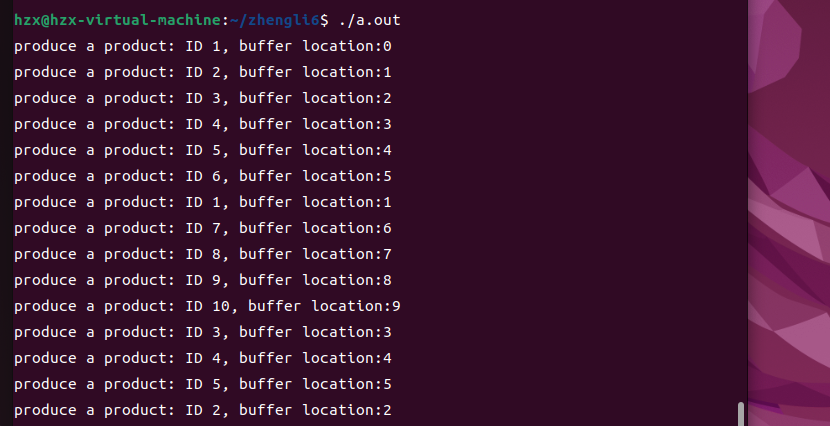
生产者消费者进程冲突问题
#include <stdio.h>

#include <pthread.h>

#include <stdlib.h>

#include <unistd.h>

#define N 100

#define true 1

#define producerNum  10

#define consumerNum  5

#define sleepTime 1000

typedef int semaphore;

typedef int item;

item buffer[N] = {0};

int in = 0;

int out = 0;

int proCount = 0;

semaphore mutex = 1, empty = N, full = 0, proCmutex = 1;

void * producer(void * a){

    while(true){

        while(proCmutex <= 0);

        proCmutex--;

        proCount++;

        printf("produce a product: ID %d, buffer location:%d\n",proCount,in);

        proCmutex++;

        while(empty <= 0){

            printf("buffer is full\n");

        }

        empty--;

        while(mutex <= 0);

        mutex--;

        buffer[in] = proCount;

        in = (in + 1) % N;

        mutex++;

        full++;

        sleep(sleepTime);

    }

}

void * consumer(void *b){

    while(true){

        while(full <= 0){

            printf("buffer is empty\n");

        }

        full--;

        while(mutex <= 0);

        mutex--;

        int nextc = buffer[out];

        buffer[out] = 0;//消费完将缓冲区设置为0

        out = (out + 1) % N;

        mutex++;

        empty++;

        printf("produce a product: ID %d, buffer location:%d\n", nextc,out);

        sleep(sleepTime);

    }

}

int main()

{

    pthread_t threadPool[producerNum+consumerNum];

    int i;

    for(i = 0; i < producerNum; i++){

        pthread_t temp;

        if(pthread_create(&temp, NULL, producer, NULL) == -1){

            printf("ERROR, fail to create producer%d\n", i);

            exit(1);

        }

        threadPool[i] = temp;

    }//创建生产者进程放入线程池

    for(i = 0; i < consumerNum; i++){

        pthread_t temp;

        if(pthread_create(&temp, NULL, consumer, NULL) == -1){

            printf("ERROR, fail to create consumer%d\n", i);

            exit(1);

        }

        threadPool[i+producerNum] = temp;

    }//创建消费者进程放入线程池

    void * result;

    for(i = 0; i < producerNum+consumerNum; i++){

        if(pthread_join(threadPool[i], &result) == -1){

            printf("fail to recollect\n");

            exit(1);

        }

    }//运行线程池

    return 0;

}
《Unix/Linux系统编程》第十周学习笔记的更多相关文章
- 《Linux内核分析》第一周学习笔记
<Linux内核分析>第一周学习笔记 计算机是如何工作的 郭垚 原创作品转载请注明出处 <Linux内核分析>MOOC课程http://mooc.study.163.com/c ...
- 《Linux内核分析》第二周学习笔记
<Linux内核分析>第二周学习笔记 操作系统是如何工作的 郭垚 原创作品转载请注明出处 <Linux内核分析>MOOC课程http://mooc.study.163.com/ ...
- linux内核分析第五周学习笔记
linux内核分析第五周学习笔记 标签(空格分隔): 20135328陈都 陈都 原创作品转载请注明出处 <Linux内核分析>MOOC课程http://mooc.study.163.co ...
- Linux内核分析第三周学习笔记
linux内核分析第三周学习笔记 标签(空格分隔): 20135328陈都 陈都 原创作品转载请注明出处 <Linux内核分析>MOOC课程http://mooc.study.163.co ...
- Linux内核分析第六周学习笔记——分析Linux内核创建一个新进程的过程
Linux内核分析第六周学习笔记--分析Linux内核创建一个新进程的过程 zl + <Linux内核分析>MOOC课程http://mooc.study.163.com/course/U ...
- Linux 内核分析第八周学习笔记
Linux 内核分析第八周学习笔记 zl + 原创作品转载请注明出处 + <Linux内核分析>MOOC课程http://mooc.study.163.com/course/USTC-10 ...
- Linux内核分析第七周学习笔记——Linux内核如何装载和启动一个可执行程序
Linux内核分析第七周学习笔记--Linux内核如何装载和启动一个可执行程序 zl + 原创作品转载请注明出处 + <Linux内核分析>MOOC课程http://mooc.study. ...
- linux内核分析第六周学习笔记
LINUX内核分析第六周学习总结 标签(空格分隔): 20135328陈都 陈都 原创作品转载请注明出处 <Linux内核分析>MOOC课程 http://mooc.study.163.c ...
- 20135320赵瀚青LINUX内核分析第三周学习笔记
赵瀚青原创作品转载请注明出处<Linux内核分析>MOOC课程http://mooc.study.163.com/course/USTC-1000029000 概述 本周是学习的主要是构造 ...
- Linux内核分析——第八周学习笔记20135308
第八周 进程的切换和系统的一般执行过程 一.进程切换的关键代码switch_to分析 1.进程调度与进程调度的时机分析 (1)进程分类 第一种分类 I/O-bound:等待I/O CPU-bound: ...
随机推荐
- chrome浏览器通知与语音播放
HTML5 Web Notification 语法 https://developer.mozilla.org/zh-CN/docs/Web/API/notification 如果浏览器支持Web N ...
- python_列表和元组的转换
1, 通过list函数将元组的数据获取到,保存到新定义的列表里面.备注:元组的数据不会更改. info_tuple = ("小明", 24, 1.75) info_list = l ...
- pytorch学习笔记(6)--神经网络非线性激活
如果神经元的输出是输入的线性函数,而线性函数之间的嵌套任然会得到线性函数.如果不加非线性函数处理,那么最终得到的仍然是线性函数.所以需要在神经网络中引入非线性激活函数. 常见的非线性激活函数主要包括S ...
- Linux基础第十一章:日志文件及如何使用rsyslog搭建小型日志服务器
一.日志文件 1.日志作用 2.常用日志 3.日志级别 二.Rsyslog日志处理系统 1.使用Rsyslog创建日志有点 2.Rsyslog配置文件解析 3.使用rsyslog将ssh服务的日志单独 ...
- Kubernetes--Ingress资源
Ingress资源 Kubernetes提供了两种内建的云端负载均衡机制(cloud load balancing)用于发布公共应用,一种是工作于传输层的Service资源,它实现的是"TC ...
- Spring入门之IoC 的概念和作用(02)
2.1 程序的耦合和解耦 2.1.1 程序的耦合耦合性(Coupling),也叫耦合度,是对模块间关联程度的度量.耦合的强弱取决于模块间接口的复杂性.调用模块的方式以及通过界面传送数据的多少.模块间的 ...
- JLink OB SWI 取代串口打印的方式
1:debug的串口被占用 2:从Keil 迁移到的LINUX下开发. 3:手上只有JLinkOB,(4线:CLK,SWIO,GND,RST) 4:设备只引出了4线(SWO 没接出) 环境: JLin ...
- yii 自定义form样式适应现成模板
需求:想使用下边的样式但是使用yii中的表单样式会 <?= $form->field($model, 'attribute_code')->textInput()->label ...
- 1903021126 申文骏 Java 第三周作业 编写代码及运行
项目 内容 课程班级博客链接 19级信计班(本) 作业要求链接 第三周作业要求 博客名称 1903021126 申文骏 Java 第三周作业 编写代码及运行 要求 每道题要有题目,代码(使用插入代码, ...
- 04 ajax执行php并传递参数
做这个事情之前要导入jQuery js的方式 _this.value1 = "abc"; _this.value2 = 1; $.ajax({ url: 'xxxxxx.php', ...