
WPF整理-使用逻辑资源
"Traditional application resources consist of binary chunks of data, typically representing things such as icons, bitmaps, strings, and XML. In fact, the .NET framework provides
generic support for these through the ResourceManager class.
WPF is no different—binary resources play an important role in a typical application.
However, WPF goes a lot further with another kind of resource: logical resources.
These are objects, any objects, which can be shared and used in a multitude of locations
throughout the application; they can even be accessed across assemblies. Some
of WPF's features, such as implicit (automatic) styles and type-based data templates,
rely on the logical resources system."
传统的资源一般是指大块的二进制资源,典型的如图片、xml文件等,.NET提供了ResourceManager类来管理这些资源。而WPF引进了另一种形式的资源-logical resources(逻辑资源),它可以是任何需要共享的对象。WPF的许多特性也都依赖逻辑资源系统。
“These objects are typically placed inside a
ResourceDictionary and located at runtime using a hierarchical search.”
下面通过一个例子,说明为什么需要logical resource、如何在XAML中及Code behind file中访问logical resource。
1.为什么需要Logical Resource?
假如我们需要为一个rectangle的Fill属性赋一个LinearGradientBrush值。通常实现如下:
        <Rectangle Height="100" Stroke="Red">

            <Rectangle.Fill>

                <LinearGradientBrush >

                    <GradientStop Offset="0.3" Color="Green"/>

                    <GradientStop Offset="0.8" Color="Brown"/>

                </LinearGradientBrush>

            </Rectangle.Fill>

        </Rectangle>
假如,现在我们另外还有1个Rectangle需要同样的Brush,当然我们可以Copy上面的<Rectangle.Fill>...</Rectangle.Fill>,这样可以满足需求,但是这样的Copy很让人头疼。
Logical resource能够解决这个问题。
2.定义logical resource
我们可以把上面的Brush放到Window.Resources中,如下:
    <Window.Resources>

        <LinearGradientBrush x:Key="brush1">

            <GradientStop Offset="0.3" Color="Green"/>

            <GradientStop Offset="0.8" Color="Yellow"/>

        </LinearGradientBrush>

    </Window.Resources>
注意以下2点:
a.“Every element (deriving from FrameworkElement) has a Resources property of type
ResourceDictionary. This means that every element can have resources associated with
it.”
每个element都有Resources属性。
b.“The Resources property is a dictionary.In XAML, the x:Key attribute must be specified (most of the time; exceptions to this rule
will be discussed in relation to styles and data templates).”
在XAML中x:key必须声明,style和data templates有些例外(x:Type)。
3.在XAML中使用
添加完成后,我们可以在XAML中通过StaticResource(后面介绍DynamicResource)这个markup extension,很方便的使用这个logical resource
<Rectangle Height="100" Fill="{StaticResource brush1}"/>
4.在Code Behind File中使用
如为下面的Ellipse赋Fill值
<Ellipse x:Name="ellipse2" Stroke="Red" StrokeThickness="20" Height="100" />
我们有两种方法获取这个Resource。
方法a:通过FrameworkElement.FindResource ,此方法在找不到的时候放回null,因此最好加个null判断。
Brush brush1 = (Brush)ellipse2.FindResource("brush1");

if (brush1 != null)

{

   ellipse2.Fill = brush1;

}
方法b.是资源可以通过它的索引直接获得。由于我们知道定义资源的是哪个element,我们可以直接使用element.Resources["name"]获得。本例定义的是Window的资源,因此是:
Brush brush = (Brush)this.Resources["brush1"];
5.Logical Resource是如何匹配的?
如上面的
<Rectangle Height="100" Fill="{StaticResource brush1}"/>
“This causes a search from the current element (the Rectangle) up the element tree, looking
for a resource with the key brush1; if found, its associated object is used as the property's
value. If not found on any element up to the root Window, the search continues within the
resources of Application (typically located in the App.xaml file). If not found even there,
a runtime exception is thrown. This is depicted in the following diagram:”
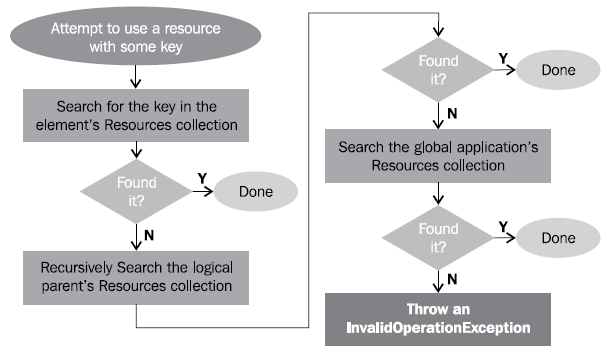
附:完整的XAML和Code Behind File如下:
<Window x:Class="UsingLogicalResources.MainWindow"

        xmlns="http://schemas.microsoft.com/winfx/2006/xaml/presentation"

        xmlns:x="http://schemas.microsoft.com/winfx/2006/xaml"

        Title="MainWindow" Height="350" Width="525">

    <Window.Resources>

        <LinearGradientBrush x:Key="brush1">

            <GradientStop Offset="0.3" Color="Green"/>

            <GradientStop Offset="0.8" Color="Yellow"/>

        </LinearGradientBrush>

    </Window.Resources>

    <StackPanel>

        <Rectangle Height="100" Stroke="Red">

            <Rectangle.Fill>

                <LinearGradientBrush >

                    <GradientStop Offset="0.3" Color="Green"/>

                    <GradientStop Offset="0.8" Color="Brown"/>

                </LinearGradientBrush>

            </Rectangle.Fill>

        </Rectangle>

        <Ellipse x:Name="ellipse2" Stroke="Red" StrokeThickness="20" Height="100" />

        <Rectangle Height="100" Fill="{StaticResource brush1}"/>

    </StackPanel>

</Window>
using System;

using System.Collections.Generic;

using System.Linq;

using System.Text;

using System.Threading.Tasks;

using System.Windows;

using System.Windows.Controls;

using System.Windows.Data;

using System.Windows.Documents;

using System.Windows.Input;

using System.Windows.Media;

using System.Windows.Media.Imaging;

using System.Windows.Navigation;

using System.Windows.Shapes;

namespace UsingLogicalResources

{

    /// <summary>

    /// Interaction logic for MainWindow.xaml

    /// </summary>

    public partial class MainWindow : Window

    {

        public MainWindow()

        {

            InitializeComponent();

            //Brush brush1=(Brush)this.Resources["brush1"];

            Brush brush1 = (Brush)ellipse2.FindResource("brush1");

            if (brush1 != null)

            {

                ellipse2.Fill = brush1;

            }

        }

    }

}
运行,如下: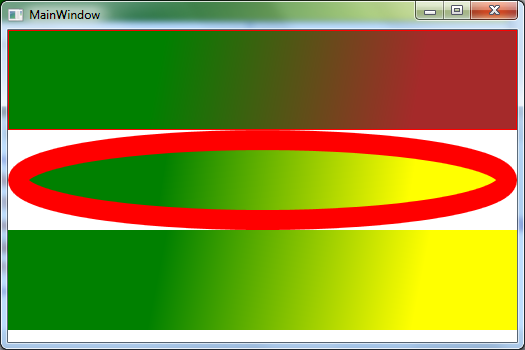
WPF整理-使用逻辑资源的更多相关文章
- WPF整理-二进制资源和内容
WPF中的Binary Resource(二进制资源)是相对于前面所说的Logical resource(逻辑资源)而说的,一般指Image.XML文件等. 注意:这里说的是Resource" ...
- WPF教程九:理解WPF中的对象资源
在WPF中,所有继承自FrameworkElement的元素都包含一个Resources属性,这个属性就是我们这篇要讲的资源. 这一篇讲解的资源是不是上一篇的程序集资源(那个是在编译过程中打包到程序集 ...
- WPF整理-Style
"Consistency in a user interface is an important trait; there are many facets of consistency, ...
- WPF整理-XAML构建后台类对象
1.XAML 接触WPF的第一眼就是XAML---XAML是用来描绘界面的.其实不然! "Actually, XAML has nothing to do with UI. It's mer ...
- 【转载】国外程序员整理的Java资源大全
以下转载自: 推荐!国外程序员整理的Java资源大全中文版 https://github.com/akullpp/awesome-java英文版 Java 几乎是许多程序员们的入门语言,并且也是 ...
- WPF之神奇的资源
原文:WPF之神奇的资源 WPF中的资源有两种,一种称为"程序集资源"(assembly resource),另一种称为"对象资源"(object resour ...
- WPF整理-使用用户选择主题的颜色和字体
“Sometimes it's useful to use one of the selected colors or fonts the user has chosen in theWindows ...
- WPF整理-自定义一个扩展标记(custom markup extension)
"Markup extensions are used to extend the capabilities of XAML, by providing declarativeoperati ...
- WPF整理-XAML访问静态属性
"XAML provides an easy way to set values of properties—type converters and the extended propert ...
随机推荐
- Silicon C8051F340之时钟系统
一.背景 做个记录,以备下次快速开发. 二.正文 C8051F340有一个可编程内部高频振荡器.一个可编程内部低频振荡器.一个外部振荡器驱动电路 和一个4倍时钟乘法器.其中可编程内部高频振荡器在系统复 ...
- JS跨域(ajax跨域、iframe跨域)解决方法及原理详解(jsonp)
这里说的js跨域是指通过js在不同的域之间进行数据传输或通信,比如用ajax向一个不同的域请求数据,或者通过js获取页面中不同域的框架中(iframe)的数据.只要协议.域名.端口有任何一个不同,都被 ...
- 什么是CGI、FastCGI、PHP-CGI、PHP-FPM、Spawn-FCGI?
什么是CGI CGI全称是“公共网关接口”(Common Gateway Interface),HTTP服务器与你的或其它机器上的程序进行“交谈”的一种工具,其程序须运行在网络服务器上. CGI可以用 ...
- 7.2WebApi2中的全局异常处理
现在在WebApi中还没有一种简单的方式去记录或者处理全局的异常.一些未处理的异常可以处理通过异常过滤器,但有大量的异常是异常过滤器不能处理的.例如: 从控制器的构造函数引发的异常. 从消息处理程序引 ...
- UVA2636
理解;类似我们离散的命题 因为只有一个是坏的 超过一个人说你坏 你一定就是坏的 有人说你对 你就对了 分为两种情况 1.说你对的是好的 他的判断是正确的 2.说你对的人 是坏的 他的判断是错误 ...
- espcms简约版的表单,提示页,搜索列表页
模板/lib/form.html <script type="text/javascript" src="{%$rootdir%}js/My97DatePicker ...
- jstl catch if choose标签
catch标签: catch标签用来处理异常 属性: * var :用来出现异常保存到的变量. 代码: <c:catch var="e"> <% int i = ...
- .NET LINQ查询操作中的类型关系
LINQ 查询操作中的类型关系 若要有效编写查询,您应该了解完整的查询操作中的变量类型是如何全部彼此关联的. 如果您了解这些关系,就能够更容易地理解文档中的 LINQ 示例和代码示例. 另外 ...
- Linux运维(3年以内)
1.精通shell编程,熟练应用awk,sed,grep,strace,tcpdump等常用命令; 2.精通windows server,linux,mssql,mysql,熟悉网络,cisco,ju ...
- DIV+CSS 清除浮动方法总结
DIV+CSS 清除浮动是页面布局中常见的问题,相信各位高手也都有自己的方法,今天在这里对常见的几种方法进行总结(PS:谈不上是原创,这里是我自己做的归纳总结,也是我自己内化的过程),希望对您能够有所 ...