
PyTorch Tutorials 3 Neural Networks
%matplotlib inline
Neural Networks
使用torch.nn包来构建神经网络。
上一讲已经讲过了autograd,nn包依赖autograd包来定义模型并求导。
一个nn.Module包含各个层和一个forward(input)方法,该方法返回output。
例如:
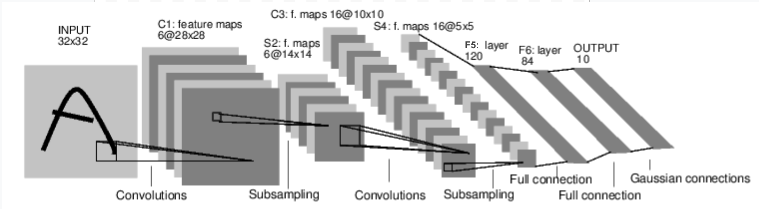
它是一个简单的前馈神经网络,它接受一个输入,然后一层接着一层地传递,最后输出计算的结果。
神经网络的典型训练过程如下:
- 定义包含一些可学习的参数(或者叫权重)神经网络模型;
- 在数据集上迭代;
- 通过神经网络处理输入;
- 计算损失(输出结果和正确值的差值大小);
- 将梯度反向传播会网络的参数;
- 更新网络的参数,主要使用如下简单的更新原则:
weight = weight - learning_rate * gradient
定义网络
开始定义一个网络:
import torch

import torch.nn as nn

import torch.nn.functional as F

class Net(nn.Module):

    def __init__(self):

        super(Net, self).__init__()

        # 1 input image channel, 6 output channels, 5x5 square convolution

        # kernel

        self.conv1 = nn.Conv2d(1, 6, 5)

        self.conv2 = nn.Conv2d(6, 16, 5)

        # an affine operation: y = Wx + b

        self.fc1 = nn.Linear(16 * 5 * 5, 120)

        self.fc2 = nn.Linear(120, 84)

        self.fc3 = nn.Linear(84, 10)

    def forward(self, x):

        # Max pooling over a (2, 2) window

        x = F.max_pool2d(F.relu(self.conv1(x)), (2, 2))

        # If the size is a square you can only specify a single number

        x = F.max_pool2d(F.relu(self.conv2(x)), 2)

        x = x.view(-1, self.num_flat_features(x))

        x = F.relu(self.fc1(x))

        x = F.relu(self.fc2(x))

        x = self.fc3(x)

        return x

    def num_flat_features(self, x):

        size = x.size()[1:]  # all dimensions except the batch dimension

        num_features = 1

        for s in size:

            num_features *= s

        return num_features

net = Net()

print(net)
Net(

  (conv1): Conv2d(1, 6, kernel_size=(5, 5), stride=(1, 1))

  (conv2): Conv2d(6, 16, kernel_size=(5, 5), stride=(1, 1))

  (fc1): Linear(in_features=400, out_features=120, bias=True)

  (fc2): Linear(in_features=120, out_features=84, bias=True)

  (fc3): Linear(in_features=84, out_features=10, bias=True)

)
在模型中必须要定义 forward 函数,backward
函数(用来计算梯度)会被autograd自动创建。
可以在 forward 函数中使用任何针对 Tensor 的操作。
net.parameters()返回可被学习的参数(权重)列表和值
params = list(net.parameters())

print(len(params))

print(params[0].size())  # conv1's .weight
10

torch.Size([6, 1, 5, 5])
测试随机输入32×32。
注:这个网络(LeNet)期望的输入大小是32×32,如果使用MNIST数据集来训练这个网络,请把图片大小重新调整到32×32。
input = torch.randn(1, 1, 32, 32)

out = net(input)

print(out)
tensor([[ 0.1470, -0.0240,  0.0103,  0.0705,  0.0650, -0.0010, -0.0083,  0.0556,

         -0.0686, -0.0675]], grad_fn=<AddmmBackward>)
将所有参数的梯度缓存清零,然后进行随机梯度的的反向传播:
net.zero_grad()

out.backward(torch.randn(1, 10))
Note
``torch.nn`` 只支持小批量输入。整个 ``torch.nn``
包都只支持小批量样本,而不支持单个样本。
例如,``nn.Conv2d`` 接受一个4维的张量,

``每一维分别是sSamples * nChannels * Height * Width(样本数*通道数*高*宽)``。

如果你有单个样本,只需使用 ``input.unsqueeze(0)`` 来添加其它的维数</p></div>
在继续之前,我们回顾一下到目前为止用到的类。
回顾:
torch.Tensor:一个用过自动调用backward()实现支持自动梯度计算的 多维数组 ,
并且保存关于这个向量的梯度 w.r.t.nn.Module:神经网络模块。封装参数、移动到GPU上运行、导出、加载等。nn.Parameter:一种变量,当把它赋值给一个Module时,被 自动 地注册为一个参数。autograd.Function:实现一个自动求导操作的前向和反向定义,每个变量操作至少创建一个函数节点,每一个Tensor的操作都回创建一个接到创建Tensor和 编码其历史 的函数的Function节点。
重点如下:
- 定义一个网络
- 处理输入,调用backword
还剩:
- 计算损失
- 更新网络权重
损失函数
一个损失函数接受一对 (output, target) 作为输入,计算一个值来估计网络的输出和目标值相差多少。
译者注:output为网络的输出,target为实际值
nn包中有很多不同的损失函数。
nn.MSELoss是一个比较简单的损失函数,它计算输出和目标间的均方误差,
例如:
output = net(input)

target = torch.randn(10)  # 随机值作为样例

target = target.view(1, -1)  # 使target和output的shape相同

criterion = nn.MSELoss()

loss = criterion(output, target)

print(loss)
tensor(0.7241, grad_fn=<MseLossBackward>)
现在,如果您使用它的.grad_fn属性沿着loss的方向向后移动,您将看到一个计算图,如下所示:
::
input -> conv2d -> relu -> maxpool2d -> conv2d -> relu -> maxpool2d

      -> view -> linear -> relu -> linear -> relu -> linear

      -> MSELoss

      -> loss
So, when we call loss.backward(), the whole graph is differentiated
w.r.t. the loss, and all Tensors in the graph that has requires_grad=True
will have their .grad Tensor accumulated with the gradient.
For illustration, let us follow a few steps backward:
print(loss.grad_fn)  # MSELoss

print(loss.grad_fn.next_functions[0][0])  # Linear

print(loss.grad_fn.next_functions[0][0].next_functions[0][0])  # ReLU
<MseLossBackward object at 0x0000001FCC3CEEB8>

<AddmmBackward object at 0x0000001FCC3CEBE0>

<AccumulateGrad object at 0x0000001FCC3CEEB8>
反向传播
调用loss.backward()获得反向传播的误差。
但是在调用前需要清除已存在的梯度,否则梯度将被累加到已存在的梯度。
现在,我们将调用loss.backward(),并查看conv1层的偏差(bias)项在反向传播前后的梯度。
net.zero_grad()     # 清除梯度

print('conv1.bias.grad before backward')

print(net.conv1.bias.grad)

loss.backward()

print('conv1.bias.grad after backward')

print(net.conv1.bias.grad)
conv1.bias.grad before backward

tensor([0., 0., 0., 0., 0., 0.])

conv1.bias.grad after backward

tensor([-0.0024,  0.0044, -0.0027,  0.0066, -0.0034,  0.0067])
如何使用损失函数
稍后阅读:
nn包,包含了各种用来构成深度神经网络构建块的模块和损失函数,完整的文档请查看here。
剩下的最后一件事:
- 新网络的权重
更新权重
在实践中最简单的权重更新规则是随机梯度下降(SGD):
``weight = weight - learning_rate * gradient``
我们可以使用简单的Python代码实现这个规则:
    learning_rate = 0.01

    for f in net.parameters():

        f.data.sub_(f.grad.data * learning_rate)
但是当使用神经网络是想要使用各种不同的更新规则时,比如SGD、Nesterov-SGD、Adam、RMSPROP等,PyTorch中构建了一个包torch.optim实现了所有的这些规则。
使用它们非常简单:
import torch.optim as optim

# create your optimizer

optimizer = optim.SGD(net.parameters(), lr=0.01)

# in your training loop:

optimizer.zero_grad()   # zero the gradient buffers

output = net(input)

loss = criterion(output, target)

loss.backward()

optimizer.step()    # Does the update
.. Note::
  Observe how gradient buffers had to be manually set to zero using

  ``optimizer.zero_grad()``. This is because gradients are accumulated

  as explained in `Backprop`_ section.
PyTorch Tutorials 3 Neural Networks的更多相关文章
- PyTorch教程之Neural Networks
我们可以通过torch.nn package构建神经网络. 现在我们已经了解了autograd,nn基于autograd来定义模型并对他们有所区分. 一个 nn.Module模块由如下部分构成:若干层 ...
- pytorch -- CNN 文本分类 -- 《 Convolutional Neural Networks for Sentence Classification》
论文 < Convolutional Neural Networks for Sentence Classification>通过CNN实现了文本分类. 论文地址: 666666 模型图 ...
- Training Deep Neural Networks
http://handong1587.github.io/deep_learning/2015/10/09/training-dnn.html //转载于 Training Deep Neural ...
- Hacker's guide to Neural Networks
Hacker's guide to Neural Networks Hi there, I'm a CS PhD student at Stanford. I've worked on Deep Le ...
- Introduction to Deep Neural Networks
Introduction to Deep Neural Networks Neural networks are a set of algorithms, modeled loosely after ...
- 神经网络指南Hacker's guide to Neural Networks
Hi there, I'm a CS PhD student at Stanford. I've worked on Deep Learning for a few years as part of ...
- 卷积神经网络Convolutional Neural Networks
Convolutional Neural Networks NOTE: This tutorial is intended for advanced users of TensorFlow and a ...
- 第十四章——循环神经网络(Recurrent Neural Networks)(第一部分)
由于本章过长,分为两个部分,这是第一部分. 这几年提到RNN,一般指Recurrent Neural Networks,至于翻译成循环神经网络还是递归神经网络都可以.wiki上面把Recurrent ...
- 3D Graph Neural Networks for RGBD Semantic Segmentation
3D Graph Neural Networks for RGBD Semantic Segmentation 原文章:https://www.yuque.com/lart/papers/wmu47a ...
随机推荐
- javascript动态添加html节点
之前一直没怎么接触需要动态添加和删除html节点的项目,这次项目中用到了,也学习了. 在一个<table id="tab">标签中添加一个<tr id=" ...
- C# 中写得很不错的一段代码摘出来
private void LikeMyworkEvent(EditedImg img, bool islike) //点赞自己的作品 { if (ApplicationModel.userInfo ! ...
- 【TestNG】使用代码方式调用TestNG用例执行
TestNG的用例除了直接运行之外,还可以使用代码来调用,这样做的好处在于我们可以将其嵌入其他代码中,来执行这些TestNG用例,方法如下: 1.直接调用用例类 范例:定义了两个测试用例类为Depen ...
- 第二篇:Python基本知识
这一篇我们简单的介绍一下Python学习的基本知识-->Python文件是如何运行.Python文件打开通常会有两行注释,那么这两行注释是什么:上篇提到的字节码,这些字节码都存储在哪?即pyc文 ...
- (转)Java锁性能提高有哪些机制?
转自:https://forum.idevfun.io/t/topic/235/2 Java 中,Synchronized是通过对象内部的一个叫做监视器锁(monitor)来实现的.但是监视器锁本质又 ...
- Jfinal事务操作
添加删除更新均可用以下事务 import java.sql.Connection; import java.sql.SQLException; import com.jfinal.plugin.act ...
- G1垃圾收集器设计目标与改良手段【纯理论】
在之前已经详细对CMS垃圾回收器进行了学习,今天准备要学习另一个全新的垃圾收集器---G1(Garbage First Collector 垃圾优先的收集器),说是一种全新的,其实G1垃圾收集器已经出 ...
- android:duplicateParentState属性使用场景
对于这个属性的使用也是在偶然的时候发现的,之前从未使用它,所以有必要阐述一下它的用法,什么场景会要用它这个属性,在我不知道之前这个属性之前,也同样能实现效果,但是当我知道它的存在之后,我肯定在某种场景 ...
- 操作socket笔记
网络编程 1.tcp协议 #tcpserver #单纯一对一发 tcp = socket.socket(socket.AF_INET, socket.SOCK_STREAM) # 创建tcp套接字 参 ...
- 图片处理:html文本获取图片Url,判断图片大小,存数据库
1.从html文本获取图片Url /** * html文本中取出url链接 */ public class Url { public static void main(String[] args) { ...