
Table类
Interpreter类,
class Interpreter: public CC_INTERP_ONLY(CppInterpreter) NOT_CC_INTERP(TemplateInterpreter) {

  public:

  // Debugging/printing

  static InterpreterCodelet* codelet_containing(address pc)     { return (InterpreterCodelet*)_code->stub_containing(pc); }

#ifdef TARGET_ARCH_x86

# include "interpreter_x86.hpp"

#endif

};
看这俩个宏
#ifdef CC_INTERP

#define CC_INTERP_ONLY(code) code

#define NOT_CC_INTERP(code)

#else

#define CC_INTERP_ONLY(code)

#define NOT_CC_INTERP(code) code

#endif // CC_INTERP
啥也没干就是继承了,俩个类 CppInterpreter 和 TemplateInterpreter
说起来有点逗,java 是子类实现接口,这c++可好,子类继承了两个父类
class DispatchTable VALUE_OBJ_CLASS_SPEC {

 public:

  enum { length = 1 << BitsPerByte };                 // an entry point for each byte value (also for undefined bytecodes)

 private:

  address _table[number_of_states][length];           // dispatch tables, indexed by tosca and bytecode

 public:

  // Attributes

  EntryPoint entry(int i) const;                      // return entry point for a given bytecode i

  void       set_entry(int i, EntryPoint& entry);     // set    entry point for a given bytecode i

  address*   table_for(TosState state)          { return _table[state]; }

  address*   table_for()                        { return table_for((TosState)0); }

  int        distance_from(address *table)      { return table - table_for(); }

  int        distance_from(TosState state)      { return distance_from(table_for(state)); }

  // Comparison

  bool operator == (DispatchTable& y);                // for debugging only

};

class TemplateInterpreter: public AbstractInterpreter {

  friend class VMStructs;

  friend class InterpreterMacroAssembler;

  friend class TemplateInterpreterGenerator;

  friend class InterpreterGenerator;

  friend class TemplateTable;

  // friend class Interpreter;

 public:

  enum MoreConstants {

    number_of_return_entries  = number_of_states,               // number of return entry points

    number_of_deopt_entries   = number_of_states,               // number of deoptimization entry points

    number_of_return_addrs    = number_of_states                // number of return addresses

  };

 protected:

  static address    _throw_ArrayIndexOutOfBoundsException_entry;

  static address    _throw_ArrayStoreException_entry;

  static address    _throw_ArithmeticException_entry;

  static address    _throw_ClassCastException_entry;

  static address    _throw_WrongMethodType_entry;

  static address    _throw_NullPointerException_entry;

  static address    _throw_exception_entry;

  static address    _throw_StackOverflowError_entry;

  static address    _remove_activation_entry;                   // continuation address if an exception is not handled by current frame

#ifdef HOTSWAP

  static address    _remove_activation_preserving_args_entry;   // continuation address when current frame is being popped

#endif // HOTSWAP

#ifndef PRODUCT

  static EntryPoint _trace_code;

#endif // !PRODUCT

  static EntryPoint _return_entry[number_of_return_entries];    // entry points to return to from a call

  static EntryPoint _earlyret_entry;                            // entry point to return early from a call

  static EntryPoint _deopt_entry[number_of_deopt_entries];      // entry points to return to from a deoptimization

  static EntryPoint _continuation_entry;

  static EntryPoint _safept_entry;

  static address    _return_3_addrs_by_index[number_of_return_addrs];     // for invokevirtual   return entries

  static address    _return_5_addrs_by_index[number_of_return_addrs];     // for invokeinterface return entries

  static DispatchTable _active_table;                           // the active    dispatch table (used by the interpreter for dispatch)

  static DispatchTable _normal_table;                           // the normal    dispatch table (used to set the active table in normal mode)

  static DispatchTable _safept_table;                           // the safepoint dispatch table (used to set the active table for safepoints)

  static address       _wentry_point[DispatchTable::length];    // wide instructions only (vtos tosca always)

 public:

  // Initialization/debugging

  static void       initialize();

  // this only returns whether a pc is within generated code for the interpreter.

  static bool       contains(address pc)                        { return _code != NULL && _code->contains(pc); }

 public:

  static address    remove_activation_early_entry(TosState state) { return _earlyret_entry.entry(state); }

#ifdef HOTSWAP

  static address    remove_activation_preserving_args_entry()   { return _remove_activation_preserving_args_entry; }

#endif // HOTSWAP

  static address    remove_activation_entry()                   { return _remove_activation_entry; }

  static address    throw_exception_entry()                     { return _throw_exception_entry; }

  static address    throw_ArithmeticException_entry()           { return _throw_ArithmeticException_entry; }

  static address    throw_WrongMethodType_entry()               { return _throw_WrongMethodType_entry; }

  static address    throw_NullPointerException_entry()          { return _throw_NullPointerException_entry; }

  static address    throw_StackOverflowError_entry()            { return _throw_StackOverflowError_entry; }

  // Code generation

#ifndef PRODUCT

  static address    trace_code    (TosState state)              { return _trace_code.entry(state); }

#endif // !PRODUCT

  static address    continuation  (TosState state)              { return _continuation_entry.entry(state); }

  static address*   dispatch_table(TosState state)              { return _active_table.table_for(state); }

  static address*   dispatch_table()                            { return _active_table.table_for(); }

  static int        distance_from_dispatch_table(TosState state){ return _active_table.distance_from(state); }

  static address*   normal_table(TosState state)                { return _normal_table.table_for(state); }

  static address*   normal_table()                              { return _normal_table.table_for(); }

  // Support for invokes

  static address*   return_3_addrs_by_index_table()             { return _return_3_addrs_by_index; }

  static address*   return_5_addrs_by_index_table()             { return _return_5_addrs_by_index; }

  static int        TosState_as_index(TosState state);          // computes index into return_3_entry_by_index table

  static address    return_entry  (TosState state, int length);

  static address    deopt_entry   (TosState state, int length);

  // Safepoint support

  static void       notice_safepoints();                        // stops the thread when reaching a safepoint

  static void       ignore_safepoints();                        // ignores safepoints

  // Deoptimization support

  // Compute the entry address for continuation after

  static address deopt_continue_after_entry(methodOop method,

                                            address bcp,

                                            int callee_parameters,

                                            bool is_top_frame);

  // Deoptimization should reexecute this bytecode

  static bool    bytecode_should_reexecute(Bytecodes::Code code);

  // Compute the address for reexecution

  static address deopt_reexecute_entry(methodOop method, address bcp);

};
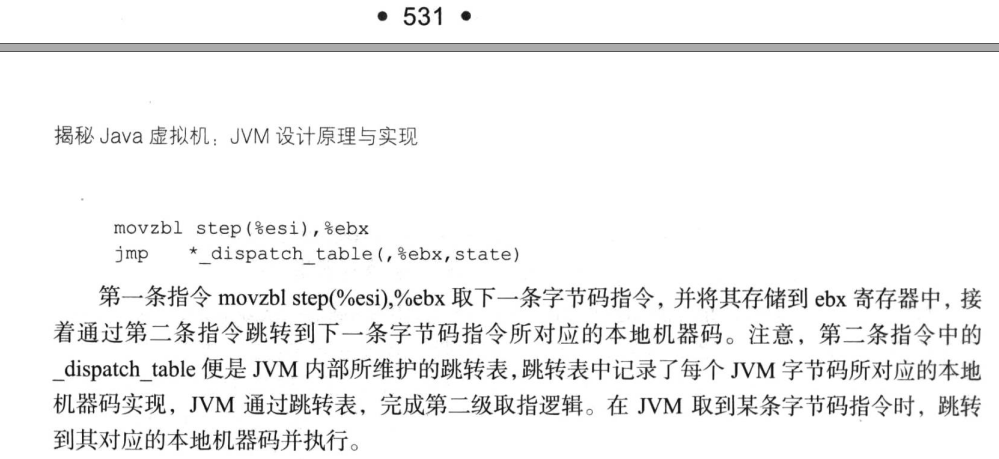
这里就看到真身了, jmp(Address(rscratch1, rbx, Address::times_8));
  bind(no_safepoint);

  lea(rscratch1, ExternalAddress((address)table));

  bind(dispatch);

  jmp(Address(rscratch1, rbx, Address::times_8));
这里将table地址给了 rscratch1

先看下执行一个add的字节码指令
     private static int add(int a, int b) {

        int c=a+b;

        int d=c+9;

        return  d;

    }

 0 iload_0

 1 iload_1

 2 iadd

 3 istore_2

 4 iload_2

 5 bipush 9

 7 iadd

 8 istore_3

 9 iload_3

10 ireturn
执行流程是 先得到
iload_0 ==>
iload_1==>
iadd
那就先取iload_0的指令地址,在dispatch_table表的某项,都值 jmp *(读到的值), 就跳到了 iload_1 对应的汇编指令去执行
形成了一个table表,从这个地址开始偏移00 代表 nop 这个指令的汇编指令地址
*table==>开始
*table+0x00
| 地址 | 内容 | |
| *table+0x00 |
0x0000000002cb6f40 |
nop |
| *table+0x8 |
0x0000000002cb6fc0 |
aconst_null |
| *table+0x10 |
0x0000000002cb7040 |
iconst_m1 |
| *table+0x18 |
0x0000000002cb70c0 |
iconst_0 |
----------------------------------------------------------------------

nop  0 nop  [0x0000000002cb6f40, 0x0000000002cb6fa0]  96 bytes

  0x0000000002cb6f40: push   %rax

  0x0000000002cb6f41: jmpq   0x0000000002cb6f70

  0x0000000002cb6f46: sub    $0x8,%rsp

  0x0000000002cb6f4a: vmovss %xmm0,(%rsp)

  0x0000000002cb6f4f: jmpq   0x0000000002cb6f70

  0x0000000002cb6f54: sub    $0x10,%rsp

  0x0000000002cb6f58: vmovsd %xmm0,(%rsp)

  0x0000000002cb6f5d: jmpq   0x0000000002cb6f70

  0x0000000002cb6f62: sub    $0x10,%rsp

  0x0000000002cb6f66: mov    %rax,(%rsp)

  0x0000000002cb6f6a: jmpq   0x0000000002cb6f70

  0x0000000002cb6f6f: push   %rax

  0x0000000002cb6f70: movzbl 0x1(%r13),%ebx

  0x0000000002cb6f75: inc    %r13

  0x0000000002cb6f78: movabs $0x667c43f0,%r10

  0x0000000002cb6f82: jmpq   *(%r10,%rbx,8)

  0x0000000002cb6f86: xchg   %ax,%ax

  0x0000000002cb6f88: add    %al,(%rax)

  0x0000000002cb6f8a: add    %al,(%rax)

  0x0000000002cb6f8c: add    %al,(%rax)

  0x0000000002cb6f8e: add    %al,(%rax)

  0x0000000002cb6f90: add    %al,(%rax)

  0x0000000002cb6f92: add    %al,(%rax)

  0x0000000002cb6f94: add    %al,(%rax)

  0x0000000002cb6f96: add    %al,(%rax)

  0x0000000002cb6f98: add    %al,(%rax)

  0x0000000002cb6f9a: add    %al,(%rax)

  0x0000000002cb6f9c: add    %al,(%rax)

  0x0000000002cb6f9e: add    %al,(%rax)

----------------------------------------------------------------------

aconst_null  1 aconst_null  [0x0000000002cb6fc0, 0x0000000002cb7020]  96 bytes

  0x0000000002cb6fc0: push   %rax

  0x0000000002cb6fc1: jmpq   0x0000000002cb6ff0

  0x0000000002cb6fc6: sub    $0x8,%rsp

  0x0000000002cb6fca: vmovss %xmm0,(%rsp)

  0x0000000002cb6fcf: jmpq   0x0000000002cb6ff0

  0x0000000002cb6fd4: sub    $0x10,%rsp

  0x0000000002cb6fd8: vmovsd %xmm0,(%rsp)

  0x0000000002cb6fdd: jmpq   0x0000000002cb6ff0

  0x0000000002cb6fe2: sub    $0x10,%rsp

  0x0000000002cb6fe6: mov    %rax,(%rsp)

  0x0000000002cb6fea: jmpq   0x0000000002cb6ff0

  0x0000000002cb6fef: push   %rax

  0x0000000002cb6ff0: xor    %eax,%eax

  0x0000000002cb6ff2: movzbl 0x1(%r13),%ebx

  0x0000000002cb6ff7: inc    %r13

  0x0000000002cb6ffa: movabs $0x667c3bf0,%r10

  0x0000000002cb7004: jmpq   *(%r10,%rbx,8)

  0x0000000002cb7008: add    %al,(%rax)

  0x0000000002cb700a: add    %al,(%rax)

  0x0000000002cb700c: add    %al,(%rax)

  0x0000000002cb700e: add    %al,(%rax)

  0x0000000002cb7010: add    %al,(%rax)

  0x0000000002cb7012: add    %al,(%rax)

  0x0000000002cb7014: add    %al,(%rax)

  0x0000000002cb7016: add    %al,(%rax)

  0x0000000002cb7018: add    %al,(%rax)

  0x0000000002cb701a: add    %al,(%rax)

  0x0000000002cb701c: add    %al,(%rax)

  0x0000000002cb701e: add    %al,(%rax)

----------------------------------------------------------------------

iconst_m1  2 iconst_m1  [0x0000000002cb7040, 0x0000000002cb70a0]  96 bytes

  0x0000000002cb7040: push   %rax

  0x0000000002cb7041: jmpq   0x0000000002cb7070

  0x0000000002cb7046: sub    $0x8,%rsp

  0x0000000002cb704a: vmovss %xmm0,(%rsp)

  0x0000000002cb704f: jmpq   0x0000000002cb7070

  0x0000000002cb7054: sub    $0x10,%rsp

  0x0000000002cb7058: vmovsd %xmm0,(%rsp)

  0x0000000002cb705d: jmpq   0x0000000002cb7070

  0x0000000002cb7062: sub    $0x10,%rsp

  0x0000000002cb7066: mov    %rax,(%rsp)

  0x0000000002cb706a: jmpq   0x0000000002cb7070

  0x0000000002cb706f: push   %rax

  0x0000000002cb7070: mov    $0xffffffff,%eax

  0x0000000002cb7075: movzbl 0x1(%r13),%ebx

  0x0000000002cb707a: inc    %r13

  0x0000000002cb707d: movabs $0x667c1bf0,%r10

  0x0000000002cb7087: jmpq   *(%r10,%rbx,8)

  0x0000000002cb708b: nopl   0x0(%rax,%rax,1)

  0x0000000002cb7090: add    %al,(%rax)

  0x0000000002cb7092: add    %al,(%rax)

  0x0000000002cb7094: add    %al,(%rax)

  0x0000000002cb7096: add    %al,(%rax)

  0x0000000002cb7098: add    %al,(%rax)

  0x0000000002cb709a: add    %al,(%rax)

  0x0000000002cb709c: add    %al,(%rax)

  0x0000000002cb709e: add    %al,(%rax)

----------------------------------------------------------------------

iconst_0  3 iconst_0  [0x0000000002cb70c0, 0x0000000002cb7120]  96 bytes

  0x0000000002cb70c0: push   %rax

  0x0000000002cb70c1: jmpq   0x0000000002cb70f0

  0x0000000002cb70c6: sub    $0x8,%rsp

  0x0000000002cb70ca: vmovss %xmm0,(%rsp)

  0x0000000002cb70cf: jmpq   0x0000000002cb70f0

  0x0000000002cb70d4: sub    $0x10,%rsp

  0x0000000002cb70d8: vmovsd %xmm0,(%rsp)

  0x0000000002cb70dd: jmpq   0x0000000002cb70f0

  0x0000000002cb70e2: sub    $0x10,%rsp

  0x0000000002cb70e6: mov    %rax,(%rsp)

  0x0000000002cb70ea: jmpq   0x0000000002cb70f0

  0x0000000002cb70ef: push   %rax

  0x0000000002cb70f0: xor    %eax,%eax

  0x0000000002cb70f2: movzbl 0x1(%r13),%ebx

  0x0000000002cb70f7: inc    %r13

  0x0000000002cb70fa: movabs $0x667c1bf0,%r10

  0x0000000002cb7104: jmpq   *(%r10,%rbx,8)

  0x0000000002cb7108: add    %al,(%rax)

  0x0000000002cb710a: add    %al,(%rax)

  0x0000000002cb710c: add    %al,(%rax)

  0x0000000002cb710e: add    %al,(%rax)

  0x0000000002cb7110: add    %al,(%rax)

  0x0000000002cb7112: add    %al,(%rax)

  0x0000000002cb7114: add    %al,(%rax)

  0x0000000002cb7116: add    %al,(%rax)

  0x0000000002cb7118: add    %al,(%rax)

  0x0000000002cb711a: add    %al,(%rax)

  0x0000000002cb711c: add    %al,(%rax)

  0x0000000002cb711e: add    %al,(%rax)
这样就解释清楚了,这个table是什么为什么通过dispatch_table 取指_表 能获得指令
Table类的更多相关文章
- Windows Azure Table storage 之 动态Table类 DynamicTableEntity
在一般情况下,当我们在.net中使用Azure table storage的时候都会为该表建立一个TableEntity的派生类,如下所示. public class CustomerEntity : ...
- ASP.Net:Table类的使用
在做Asp.Net的时候,很多情况下数据的绑定都是使用GridView或者我之前提到的ListView,但是这两个适合用于数据的绑定,而有些时候,数据需要在后台进行处理,例如数据据内地某一条数据的特殊 ...
- Table 类(数据表基类)
只修改数据表某条记录的部分字段(究极进化): public class TableHelper { private Dictionary<string, object> temp; pub ...
- Selenium Webdriver——Table类封装
WebTable.java import java.util.List; import org.openqa.selenium.By; import org.openqa.selenium.WebEl ...
- SQLAlchemy Table(表)类方式 - Table类和Column类
Table 构造方法 Table(name, metadata[, *column_list][, **kwargs]) 参数说明: name 表名 metadata 元数据对象 column_lis ...
- 基于Java使用Flink读取CSV文件,针对批处理,多表联合两种方式Table类和Join方法的实现数据处理,再入CSV文件
Maven依赖 源头 <dependencies> <dependency> <groupId>org.projectlombok</groupId> ...
- bootstrap panel 和table的使用
一.HTML中的页面内容 <div class="col-sm-12"> <!-- <div class="m-b-md" style= ...
- 关于SWT中的表格(TableViewer类)
JFace是SWT的扩展.它提供了一组功能强大的界面组件.其中包含表格,树,列表.对话框,向导对话框等. 表格是一种在软件系统中很常用的数据表现形式.特别是基于数据库的应用系统.表格更是不可缺少的界面 ...
- 排版-标题及table
排版-标题 在标题中还可以包含small标签,可以用来标记副标题 副标题灰色,比主标题小 <h1>我是标题 <small>我是小标题</small></ ...
随机推荐
- Spring Boot WebFlux-01——WebFlux 快速入门实践
第01课:WebFlux 快速入门实践 Spring Boot 2.0 spring.io 官网有句醒目的话是: BUILD ANYTHING WITH SPRING BOOT Spring Boot ...
- IDEA2020.2版本设置类和方法的自定义注释模板
IDEA是目前普遍使用的Java开发编辑器,添加自定义的注释模板,一方面便捷好用,另外一方面可以规范开发.IDEA中设置模板分两种:1.创建Java类的注释,2.方法的注释. 一.Java类的注释模板 ...
- C#中使用ffmpeg合并视频
首先将最新的ffmpeg.exe放到debug路径下,下载地址 http://www.ffmpeg.org/download.html 然后调用此方法 public void CombineMp4Wi ...
- hive学习笔记之三:内部表和外部表
欢迎访问我的GitHub https://github.com/zq2599/blog_demos 内容:所有原创文章分类汇总及配套源码,涉及Java.Docker.Kubernetes.DevOPS ...
- ES6学习笔记之数组
1.拓展运算符 含义 拓展运算符是三个点(...),功能是将数组或类数组对象展开成一系列用逗号隔开的值.如下面代码: console.log(...[1, 2, 3]); //1 2 3 consol ...
- Linux mlocate源码分析:updatedb
在Linux的文件查找命令中,mlocate提供的locate命令在单纯进行路径名名查找时有着显著的效率优势,因为mlocate预先对磁盘文件进行扫描并存储到一个数据库文件中,查找时只需要检索数据库而 ...
- Keepalive介绍及工作原理
注:keepalive和Nginx和高可用没有关联. 1.什么是高可用,为什么要设计高可用? 1.两台业务系统启动着相同的服务,如果有一台故障,另一台自动接管,我们将国称之为高可用.2.系统可用率算法 ...
- MySQL数据库快速入门与应用实战(阶段一)
MySQL数据库快速入门与应用实战(阶段一) 作者 刘畅 时间 2020-09-02 实验环境说明: 系统:centos7.5 主机名 ip 配置 slavenode3 172.16.1.123 4核 ...
- 如何使用「mkvtoolnix」和「GoldWave」仅保留视频中左、右声道的其中一个声道?
为什么要这样做? 我手上有一部电视剧的视频文件(.rmvb),每个视频文件都是"国/粤双语"的,与其他双语视频的两种语言的音频保存在两个音轨上不同,我这里的视频文件的双语是分别保存 ...
- Docker安装rabbitMQ主从
环境准备 Centos 7.5虚拟机三台: 192.168.102.128 192.168.102.130 192.168.102.131 以上虚拟机统一安装docker环境 三台机器分别配置如下所示 ...