
Netty源码分析--内存模型(上)(十一)
前两节我们分别看了FastThreadLocal和ThreadLocal的源码分析,并且在第八节的时候讲到了处理一个客户端的接入请求,一个客户端是接入进来的,是怎么注册到多路复用器上的。那么这一节我们来一起看下客户端接入完成之后,是怎么实现读写操作的?我们自己想一下,应该就是为刚刚读取的数据分配一块缓冲区,然后把channel中的信息写入到缓冲区中,然后传入到各个handler链上,分别进行处理。那Netty是怎么去分配一块缓冲区的呢?这个就涉及到了Netty的内存模型。
当然,我们在第一节的时候,就详细了讲解了NIO的ByteBuffer。但是操作起来及其的繁琐,比如我们从写转到读,要必须执行flip()方法。因此,Netty看不下去了,自己写了一个ByteBuf。这里也简单看下这个ByteBuf吧,看看方便在哪里?看下ByteBuf的javadoc
 * {@link ByteBuf} provides two pointer variables to support sequential

 * read and write operations - {@link #readerIndex() readerIndex} for a read

 * operation and {@link #writerIndex() writerIndex} for a write operation

 * respectively.  The following diagram shows how a buffer is segmented into

 * three areas by the two pointers:

 *

 * <pre>

 *      +-------------------+------------------+------------------+

 *      | discardable bytes |  readable bytes  |  writable bytes  |

 *      |                   |     (CONTENT)    |                  |

 *      +-------------------+------------------+------------------+

 *      |                   |                  |                  |

 *      0      <=      readerIndex   <=   writerIndex    <=    capacity

 * </pre>
上面英文的大体意思就是, 说ByteBuf提供了两个指针变量去支持读和写操作。 readerIndex 是针对读操作, writerIndex 是针对写操作, 上面的图就是又这个两个指针分割成的三部分。左边是读过的区域,可以认为是作废的区域,中间是写完但是没有读的区域,右边是待写的区域。 readerIndex 代表 读到的位置, writerIndex 代表写到的位置, capacity 最大容量。再看一个图,理解一个方法。
 * <pre>

 *  BEFORE discardReadBytes()   // 执行 discardReadBytes() 方法之前 , 假如是下面这样

 *

 *      +-------------------+------------------+------------------+

 *      | discardable bytes |  readable bytes  |  writable bytes  |

 *      +-------------------+------------------+------------------+

 *      |                   |                  |                  |

 *      0      <=      readerIndex   <=   writerIndex    <=    capacity

 *

 *

 *  AFTER discardReadBytes()  // 执行之后 , 写索引 =- 读索引 ; 读索引变成 0

 *

 *      +------------------+--------------------------------------+

 *      |  readable bytes  |    writable bytes (got more space)   |

 *      +------------------+--------------------------------------+

 *      |                  |                                      |

 * readerIndex (0) <= writerIndex (decreased)        <=        capacity

 * </pre>
 * <pre>

 *  BEFORE clear()  // 执行clear()方法之前假如是下面这样

 *

 *      +-------------------+------------------+------------------+

 *      | discardable bytes |  readable bytes  |  writable bytes  |

 *      +-------------------+------------------+------------------+

 *      |                   |                  |                  |

 *      0      <=      readerIndex   <=   writerIndex    <=    capacity

 *

 *

 *  AFTER clear() // 执行之后  读索引和写索引都会变成0 , 那么整个缓冲区都会变成可写区域。

 *

 *      +---------------------------------------------------------+

 *      |             writable bytes (got more space)             |

 *      +---------------------------------------------------------+

 *      |                                                         |

 *      0 = readerIndex = writerIndex            <=            capacity

 * </pre>
ByteBuf 先介绍到这, 有个读写索引之后,就会方便很多,不需要再执行flip类似的操作。
我们继续按照之前的节奏来debug, 我们先启动服务端,然后启动一个客户端。 断点打在哪里呢? 就先打在NioEventLoop的 processSelectedKey() 方法处理accept和read操作的那个判断那里。就是下面这里

public final void read() {

            final ChannelConfig config = config(); // channel的配置,前面涉及到了,不说了

            if (shouldBreakReadReady(config)) {

                clearReadPending();

                return;

            }

            final ChannelPipeline pipeline = pipeline(); // 获取channel对应的pipeline

            final ByteBufAllocator allocator = config.getAllocator(); // 获取缓冲区分配器 ,这里是PooledByteBufAllocator

            final RecvByteBufAllocator.Handle allocHandle = recvBufAllocHandle(); // 获取之前在创建channel配置器的时候传入的AdaptiveRecvByteBufAllocator,创建时候的代码如下图

            allocHandle.reset(config); // 重置一些变量

            ByteBuf byteBuf = null;

            boolean close = false;

            try {

                do {

                    byteBuf = allocHandle.allocate(allocator); // 这里是重点,分配缓冲区,后面铺开讲。

                    allocHandle.lastBytesRead(doReadBytes(byteBuf)); // 将channel中的数据读取到刚刚申请的缓冲区中,然后对刚刚读取的字节数进行一下记录,方便下一次对获取缓冲区的大小进行动态的调节

                    if (allocHandle.lastBytesRead() <= 0) { // 没有读取到数据,则释放缓冲区

                        // nothing was read. release the buffer.

                        byteBuf.release();

                        byteBuf = null;

                        close = allocHandle.lastBytesRead() < 0;

                        if (close) {

                            // There is nothing left to read as we received an EOF.

                            readPending = false;

                        }

                        break;

                    }

                    allocHandle.incMessagesRead(1); // 读取的总信息++

                    readPending = false;

                    pipeline.fireChannelRead(byteBuf); // handler链表开始执行channelRead方法。

                    byteBuf = null;

                } while (allocHandle.continueReading());

                allocHandle.readComplete();

                pipeline.fireChannelReadComplete(); // handler链表开始执行channelReadComplete方法。

                if (close) {

                    closeOnRead(pipeline);

                }

            } catch (Throwable t) {

                handleReadException(pipeline, byteBuf, t, close, allocHandle);

            } finally {

                // Check if there is a readPending which was not processed yet.

                // This could be for two reasons:

                // * The user called Channel.read() or ChannelHandlerContext.read() in channelRead(...) method

                // * The user called Channel.read() or ChannelHandlerContext.read() in channelReadComplete(...) method

                //

                // See https://github.com/netty/netty/issues/2254

                if (!readPending && !config.isAutoRead()) {

                    removeReadOp();

                }

            }

        }

    }
创建channel配置类的时候传入的AdaptiveRecvByteBufAllocator()

上面重要的地方,我们展开来讲,先看 PooledByteBufAllocator 。我们跟下去。发现这个分配器其实是给了一个默认的实例

继续跟下去,我们看到了一段静态代码块,那么我们直接debug看下

根据配置,给到了一个池化的分配器。继续进去,进入到了 PooledByteBufAllocator 的构造函数。

发现创建了一个线程级别的 PoolThreadLocalCache , 并且传入了true ,代表所有的线程都使用Cache。 既然看到了这里,就直接看着这个缓存是啥。
final class PoolThreadLocalCache extends FastThreadLocal<PoolThreadCache> {  // 继承了 FastThreadLocal, 存储的内容是 PoolThreadCache 。上节我们刚刚一起看了这个,这里就很舒服了。

        private final boolean useCacheForAllThreads;

        PoolThreadLocalCache(boolean useCacheForAllThreads) {

            this.useCacheForAllThreads = useCacheForAllThreads;

        }

        @Override

        protected synchronized PoolThreadCache initialValue() {    // 在执行get方法的时候会执行initialValue()方法,来初始化数据。

            final PoolArena<byte[]> heapArena = leastUsedArena(heapArenas); // 堆内存Arena; 这里涉及到PoolArena ,我们后面会重点讲, 这里是比较所有PoolArena看下哪个被使用最少,找到最少那个,
                                                                            // 使得线程均等使用Arena。

            final PoolArena<ByteBuffer> directArena = leastUsedArena(directArenas); // 直接内存Arena;  原理跟上面一样

            Thread current = Thread.currentThread();

            if (useCacheForAllThreads || current instanceof FastThreadLocalThread) { // 线程是FastTreadLocalTread 这里在NioEventLoop初始化的时候线程就被封装过了。

                return new PoolThreadCache(                                          // 创建一个PoolTreadCache实例

                        heapArena, directArena, tinyCacheSize, smallCacheSize, normalCacheSize,

                        DEFAULT_MAX_CACHED_BUFFER_CAPACITY, DEFAULT_CACHE_TRIM_INTERVAL);

            }

            // No caching so just use 0 as sizes.

            return new PoolThreadCache(heapArena, directArena, 0, 0, 0, 0, 0);

        }

        @Override

        protected void onRemoval(PoolThreadCache threadCache) { // 释放的时候,为子类提供的空方法

            threadCache.free();

        }

        private <T> PoolArena<T> leastUsedArena(PoolArena<T>[] arenas) {

            if (arenas == null || arenas.length == 0) {

                return null;

            }

            PoolArena<T> minArena = arenas[0];

            for (int i = 1; i < arenas.length; i++) {

                PoolArena<T> arena = arenas[i];

                if (arena.numThreadCaches.get() < minArena.numThreadCaches.get()) {

                    minArena = arena;

                }

            }

            return minArena;

        }

    }
再继续说 PoolThreadCache 就说不下去了,一会再说,然后我们先看一个模型,涉及到的名词有:PoolArena 、 Chunk、 Page、 subPage。
先看Chunk的模型,使用了和jemalloc一样的分配算法,伙伴分配算法。

看上面的图,把Chunk分割成了2048个Page, chunk 的大小是 16M, 那么 每个Page 就是 8k, 树的每个最左子节点 编号都是 2 的 层数 次方, 比如 11 层 第一个就是 2 ^ 11 = 2048 。
当然 page 的大小是 8k, 那么能不能更加细粒度呢? 当然可以,那就是subPage, 最小单位,不能再分,最小切分单位为16B, 当然这里 page 是怎么划分成subPage的呢? 其实是根据该Page第一次分配的大小决定的,比如 第一次是 16B, 那么 就会被切分成 8k / 16B = 512 个SubPage, 如果第一次是 32B, 分成 8k / 32B = 256 个SubPage。
当然根据分配的请求大小,我们分为几个级别:
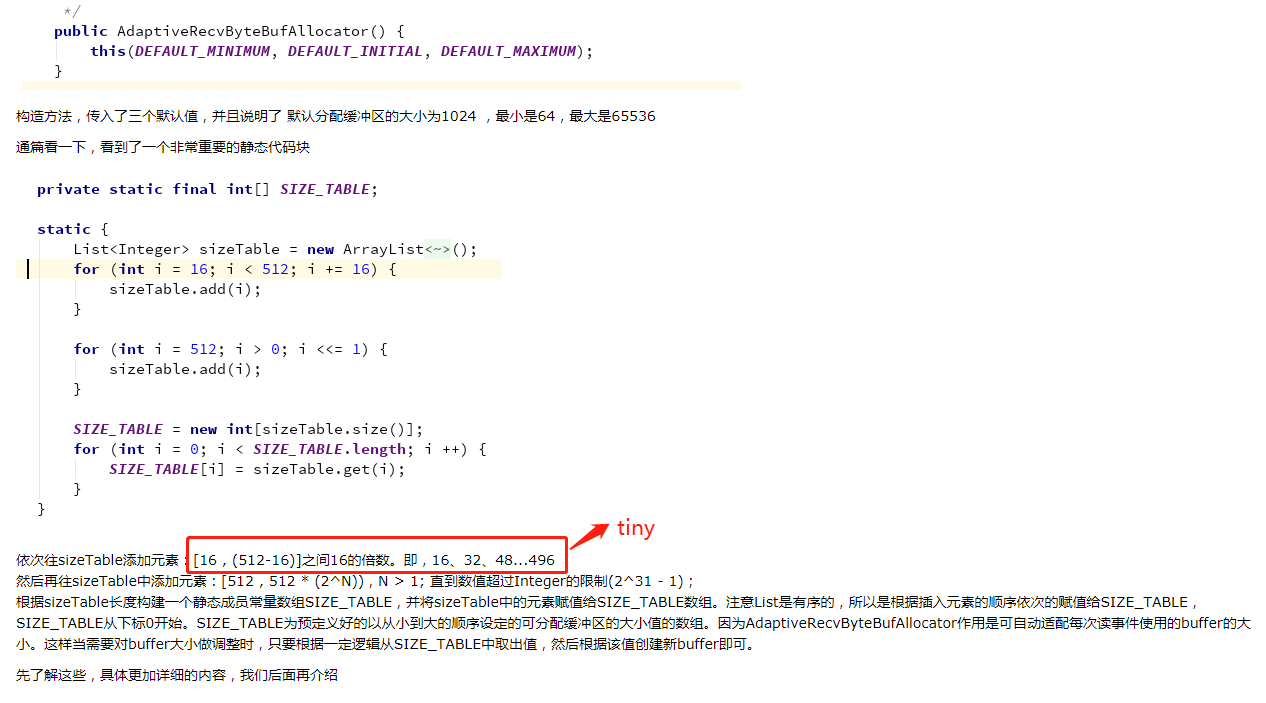
Tiny : < 512B的请求 分为 16 32 48 64 ....
Small : 512B <= 且 < 8K(PageSize)的请求
Normal : 8K <= 且 <= 16MB(ChunkSize)的请求
Huge : > 16MB(ChunkSize)的请求
好了,大概知道这么一个模型之后,我们继续看 PooledByteBufAllocator 的构造方法,
 public PooledByteBufAllocator(boolean preferDirect, int nHeapArena, int nDirectArena, int pageSize, int maxOrder,

                                   int tinyCacheSize, int smallCacheSize, int normalCacheSize,

                                   boolean useCacheForAllThreads, int directMemoryCacheAlignment) {

         super(preferDirect);

         threadCache = new PoolThreadLocalCache(useCacheForAllThreads); // 创建一个Cache实例,但是这里并没有调用initialValue()方法

         this.tinyCacheSize = tinyCacheSize;  // 512 这个其实是tiny缓存队列的长度, 后面我们在说PoolThreadCache时会再介绍

         this.smallCacheSize = smallCacheSize; // 256 small队列长度

         this.normalCacheSize = normalCacheSize; // 64  normal队列长度

         chunkSize = validateAndCalculateChunkSize(pageSize, maxOrder); // 计算chunk大小 , 其中maxOrder 就是上面模型的层数 11 , 那么chunkSize 其实就是 pageSize 左移 11位 ,

                                                                        // 也就是 8192 * 2^11 = 16M

         if (nHeapArena < 0) {

             throw new IllegalArgumentException("nHeapArena: " + nHeapArena + " (expected: >= 0)");

         }

         if (nDirectArena < 0) {

             throw new IllegalArgumentException("nDirectArea: " + nDirectArena + " (expected: >= 0)");

         }

         if (directMemoryCacheAlignment < 0) {

             throw new IllegalArgumentException("directMemoryCacheAlignment: "

                     + directMemoryCacheAlignment + " (expected: >= 0)");

         }

         if (directMemoryCacheAlignment > 0 && !isDirectMemoryCacheAlignmentSupported()) {

             throw new IllegalArgumentException("directMemoryCacheAlignment is not supported");

         }

         if ((directMemoryCacheAlignment & -directMemoryCacheAlignment) != directMemoryCacheAlignment) {

             throw new IllegalArgumentException("directMemoryCacheAlignment: "

                     + directMemoryCacheAlignment + " (expected: power of two)");

         }

         int pageShifts = validateAndCalculatePageShifts(pageSize); //  2 ^ 13 = 8192 也就是pageSize 这里的pageShifts = 13, 这里怎么算的呢,看下面的方法

         if (nHeapArena > 0) { // 堆内存区域竞技场数组个数

             heapArenas = newArenaArray(nHeapArena);

             List<PoolArenaMetric> metrics = new ArrayList<PoolArenaMetric>(heapArenas.length);

             for (int i = 0; i < heapArenas.length; i ++) {

                 PoolArena.HeapArena arena = new PoolArena.HeapArena(this,

                         pageSize, maxOrder, pageShifts, chunkSize,

                         directMemoryCacheAlignment);

                 heapArenas[i] = arena;

                 metrics.add(arena);

             }

             heapArenaMetrics = Collections.unmodifiableList(metrics);

         } else {

             heapArenas = null;

             heapArenaMetrics = Collections.emptyList();

         }

         if (nDirectArena > 0) { // 直接内存竞技场数组个数

             directArenas = newArenaArray(nDirectArena); // 创建 PoolArena 数组 大小 8

             List<PoolArenaMetric> metrics = new ArrayList<PoolArenaMetric>(directArenas.length);

             for (int i = 0; i < directArenas.length; i ++) {

                 PoolArena.DirectArena arena = new PoolArena.DirectArena(

                         this, pageSize, maxOrder, pageShifts, chunkSize, directMemoryCacheAlignment); // 实例化 PoolArena ,一会我们详细说这个

                 directArenas[i] = arena;

                 metrics.add(arena);

             }

             directArenaMetrics = Collections.unmodifiableList(metrics);  // 一些信息的测度统计,忽略不看这个

         } else {

             directArenas = null;

             directArenaMetrics = Collections.emptyList();

         }

         metric = new PooledByteBufAllocatorMetric(this);

65 }

 private static int validateAndCalculatePageShifts(int pageSize) {

     if (pageSize < MIN_PAGE_SIZE) {

         throw new IllegalArgumentException("pageSize: " + pageSize + " (expected: " + MIN_PAGE_SIZE + ")");

     }

     if ((pageSize & pageSize - 1) != 0) {

         throw new IllegalArgumentException("pageSize: " + pageSize + " (expected: power of 2)");

     }

     // Logarithm base 2. At this point we know that pageSize is a power of two.

     return Integer.SIZE - 1 - Integer.numberOfLeadingZeros(pageSize);  //   Integer.numberOfLeadingZeros  该方法的作用是返回无符号整型i的最高非零位前面的0的个数,包括符号位在内;

     //  比如说,8192的二进制表示为 0000 0000 0000 0000 0010 0000 0000 0000  java的整型长度为32位。那么这个方法返回的就是 18  ,那么整个方法 结果就是 32 - 1 - 18 = 13

 }
上面既然提到了堆内存和堆外直接内存,也就是大家说的Netty的零拷贝。
1、Netty的接收和发送采用直接内存,就是使用堆外直接内存进行Socket读写,不需要进行字节缓冲区的二次拷贝。如果使用传统的堆内存进行Socket读写,JVM会将堆内存Buffer拷贝一份到直接内存中,然后才写入Socket中。相比于堆外直接内存,消息在发送过程中多了一次缓冲区的内存拷贝。
2. Netty提供了组合Buffer对象,可以聚合多个ByteBuffer对象,用户可以像操作一个Buffer那样方便的对组合Buffer进行操作,避免了传统通过内存拷贝的方式将几个小Buffer合并成一个大的Buffer。
3. Netty的文件传输采用了transferTo方法,它可以直接将文件缓冲区的数据发送到目标Channel,避免了传统通过循环write方式导致的内存拷贝问题。
跟我们理解的操作系统的这种普通零拷贝还不一样, 我觉得Netty的这种零拷贝完全是在用户空间的,当然这只是我自己的理解,不一定正确。
关于 AdaptiveRecvByteBufAllocator ,我在 Netty源码分析--创建Channel(三) 最后有明确说明,所以这里贴出来给大家回顾一下。
上面说到了,实例化PoolArena, 那我们就继续看这个的构造函数
protected PoolArena(PooledByteBufAllocator parent, int pageSize,

          int maxOrder, int pageShifts, int chunkSize, int cacheAlignment) {

        this.parent = parent;

        this.pageSize = pageSize; // 根据上面的分析,这个是8192

        this.maxOrder = maxOrder; // chunk 满二叉树高度 11

        this.pageShifts = pageShifts; // 用于辅助计算的 13  ===> 2 ^ 13 = 8192

        this.chunkSize = chunkSize; // 16M  chunk 大小

        directMemoryCacheAlignment = cacheAlignment; // 对齐基准

        directMemoryCacheAlignmentMask = cacheAlignment - 1; // 用于对齐内存

        subpageOverflowMask = ~(pageSize - 1); // -8192 用于判断 是否是 tiny 和 small

        tinySubpagePools = newSubpagePoolArray(numTinySubpagePools);  // subPage 双向链表  numTinySubpagePools = 32 为啥是32呢? 上面提到是16为单位递增,那么就是 512/16 = 512 >>> 4 = 32

        for (int i = 0; i < tinySubpagePools.length; i ++) {

            tinySubpagePools[i] = newSubpagePoolHead(pageSize); // 初始化链表

        }

        numSmallSubpagePools = pageShifts - 9; // 13 - 9 = 4

        smallSubpagePools = newSubpagePoolArray(numSmallSubpagePools); // subPage 双向链表 numSmallSubpagePools = 4 也可以理解为 512 << 4 = 8192(Small最大值)  所以是 4

        for (int i = 0; i < smallSubpagePools.length; i ++) {

            smallSubpagePools[i] = newSubpagePoolHead(pageSize); // 初始化链表

        }

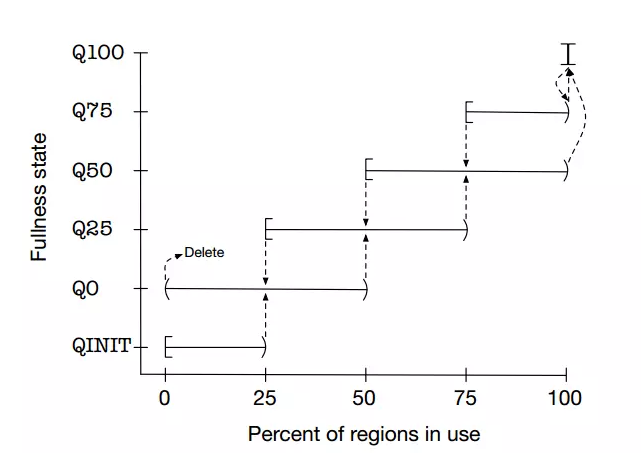
        q100 = new PoolChunkList<T>(this, null, 100, Integer.MAX_VALUE, chunkSize); // chunk的链表 随着chunk使用率在这几个链表下转义,具体看底下我百度到的图

        q075 = new PoolChunkList<T>(this, q100, 75, 100, chunkSize);

        q050 = new PoolChunkList<T>(this, q075, 50, 100, chunkSize);

        q025 = new PoolChunkList<T>(this, q050, 25, 75, chunkSize);

        q000 = new PoolChunkList<T>(this, q025, 1, 50, chunkSize);

        qInit = new PoolChunkList<T>(this, q000, Integer.MIN_VALUE, 25, chunkSize);

        q100.prevList(q075);

        q075.prevList(q050);

        q050.prevList(q025);

        q025.prevList(q000);

        q000.prevList(null);

        qInit.prevList(qInit);

        List<PoolChunkListMetric> metrics = new ArrayList<PoolChunkListMetric>(6);

        metrics.add(qInit);

        metrics.add(q000);

        metrics.add(q025);

        metrics.add(q050);

        metrics.add(q075);

        metrics.add(q100);

        chunkListMetrics = Collections.unmodifiableList(metrics);

    }
为了提高内存分配效率并减少内部碎片,jemalloc算法将Arena切分为小块Chunk,根据每块的内存使用率又将小块组合为以下几种状态:QINIT,Q0,Q25,Q50,Q75,Q100。Chunk块可以在这几种状态间随着内存 使用率的变化进行转移,内存使用率和状态转移可参见下图:

说完上面的,还记得上面说的这段吗?我们从这里进入,


猜测下一次会分配多大内存,这里默认是1024

刚刚说了 直接内存和 堆内存,这里Netty默认走的是直接内存分支
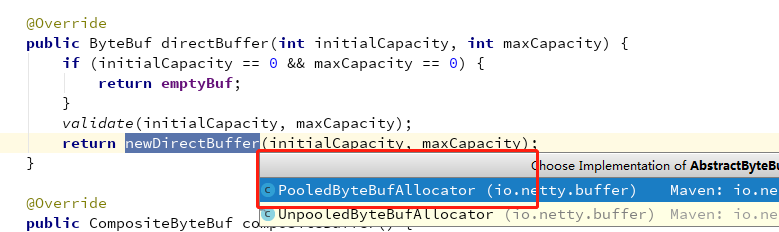
根据上面的分析,这里是进入一个池化的分配器
 protected ByteBuf newDirectBuffer(int initialCapacity, int maxCapacity) {

         PoolThreadCache cache = threadCache.get();// 获取缓存,这里的get方法会调用初始化方法 initialValue() ,会实例化 PoolThreadCache

         PoolArena<ByteBuffer> directArena = cache.directArena; // 获取直接内存竞技场

         final ByteBuf buf;

         if (directArena != null) { // 肯定不为空

             buf = directArena.allocate(cache, initialCapacity, maxCapacity); // 分配方法

         } else {

             buf = PlatformDependent.hasUnsafe() ?

                     UnsafeByteBufUtil.newUnsafeDirectByteBuf(this, initialCapacity, maxCapacity) :

                     new UnpooledDirectByteBuf(this, initialCapacity, maxCapacity);

         }

         return toLeakAwareBuffer(buf);

     }
上面多次提到 PoolThreadCache ,那就分析一下, 先看构造方法
    PoolThreadCache(PoolArena<byte[]> heapArena, PoolArena<ByteBuffer> directArena,

                    int tinyCacheSize, int smallCacheSize, int normalCacheSize,

                    int maxCachedBufferCapacity, int freeSweepAllocationThreshold) {

        if (maxCachedBufferCapacity < 0) { // 这个是最大缓存容量大小 这里默认是32K,后面我们解释一下为啥会有这个限制

            throw new IllegalArgumentException("maxCachedBufferCapacity: "

                    + maxCachedBufferCapacity + " (expected: >= 0)");

        }

        this.freeSweepAllocationThreshold = freeSweepAllocationThreshold; // 分配次数的阈值

        this.heapArena = heapArena;

        this.directArena = directArena;

        if (directArena != null) {

            tinySubPageDirectCaches = createSubPageCaches(

                    tinyCacheSize, PoolArena.numTinySubpagePools, SizeClass.Tiny); // 创建subPage缓存数组 ,tinyCacheSize = 512 , PoolArena.numTinySubpagePools = 32

            smallSubPageDirectCaches = createSubPageCaches(

                    smallCacheSize, directArena.numSmallSubpagePools, SizeClass.Small); // 创建subPage缓存数组 ,smallCacheSize = 256, PoolArena.numSmallSubpagePools = 4

            numShiftsNormalDirect = log2(directArena.pageSize); // 2 ^ 13 = 8192  这里是 13

            normalDirectCaches = createNormalCaches(

                    normalCacheSize, maxCachedBufferCapacity, directArena); // 创建Normal缓存数组 , normalCacheSize = 64 , maxCachedBufferCapacity = 32K

            directArena.numThreadCaches.getAndIncrement();

        } else {

            // No directArea is configured so just null out all caches

            tinySubPageDirectCaches = null;

            smallSubPageDirectCaches = null;

            normalDirectCaches = null;

            numShiftsNormalDirect = -1;

        }

        if (heapArena != null) {

            // Create the caches for the heap allocations

            tinySubPageHeapCaches = createSubPageCaches(

                    tinyCacheSize, PoolArena.numTinySubpagePools, SizeClass.Tiny);

            smallSubPageHeapCaches = createSubPageCaches(

                    smallCacheSize, heapArena.numSmallSubpagePools, SizeClass.Small);

            numShiftsNormalHeap = log2(heapArena.pageSize);

            normalHeapCaches = createNormalCaches(

                    normalCacheSize, maxCachedBufferCapacity, heapArena);

            heapArena.numThreadCaches.getAndIncrement();

        } else {

            // No heapArea is configured so just null out all caches

            tinySubPageHeapCaches = null;

            smallSubPageHeapCaches = null;

            normalHeapCaches = null;

            numShiftsNormalHeap = -1;

        }

        // Only check if there are caches in use.

        if ((tinySubPageDirectCaches != null || smallSubPageDirectCaches != null || normalDirectCaches != null

                || tinySubPageHeapCaches != null || smallSubPageHeapCaches != null || normalHeapCaches != null)

                && freeSweepAllocationThreshold < 1) {

            throw new IllegalArgumentException("freeSweepAllocationThreshold: "

                    + freeSweepAllocationThreshold + " (expected: > 0)");

        }

    }
解释一下 tinyCacheSize = 512,smallCacheSize = 256,normalCacheSize = 64 是什么呢? 每一个Cache中都有一个ByteBuf内存空间队列,那么这三个数就是Tiny\Small\Normal 对应的队列长度。一会就能看见
    private static <T> MemoryRegionCache<T>[] createSubPageCaches(

            int cacheSize, int numCaches, SizeClass sizeClass) {

        if (cacheSize > 0 && numCaches > 0) {

            @SuppressWarnings("unchecked")

            MemoryRegionCache<T>[] cache = new MemoryRegionCache[numCaches]; // 创建 MemoryRegionCache 数组,Tiny\Small 数组大小是  32\4

            for (int i = 0; i < cache.length; i++) {

                // TODO: maybe use cacheSize / cache.length

                cache[i] = new SubPageMemoryRegionCache<T>(cacheSize, sizeClass); // 初始化

            }

            return cache;

        } else {

            return null;

        }

    }
private static <T> MemoryRegionCache<T>[] createNormalCaches(
        int cacheSize, int maxCachedBufferCapacity, PoolArena<T> area) {
    if (cacheSize > 0 && maxCachedBufferCapacity > 0) {
        int max = Math.min(area.chunkSize, maxCachedBufferCapacity); // 32K 和 16m 取小的 那就是 32K
        int arraySize = Math.max(1, log2(max / area.pageSize) + 1); // 32K 就是 8 k -> 16k -> 32 k 那么 arraySize = 3

        @SuppressWarnings("unchecked")
        MemoryRegionCache<T>[] cache = new MemoryRegionCache[arraySize];
        for (int i = 0; i < cache.length; i++) {
            cache[i] = new NormalMemoryRegionCache<T>(cacheSize);
        }
        return cache;
    } else {
        return null;
    }
}
   MemoryRegionCache(int size, SizeClass sizeClass) {

       this.size = MathUtil.safeFindNextPositivePowerOfTwo(size); // 对Size进行对齐, tiny = 512  Small = 256

       queue = PlatformDependent.newFixedMpscQueue(this.size); // 创建队列,长度是Size

       this.sizeClass = sizeClass; // 记录类型

   }
MPSC(Multiple Producer Single Consumer)队列即多个生产者单一消费者队列,之所以使用这种类型的队列是因为:ByteBuf的分配和释放可能在不同的线程中,这里的多生产者即多个不同的释放线程,这样才能保证多个释放线程同时释放ByteBuf时所占空间正确添加到队列中。
这个队列我简单画个图理解一下
Tiny 的队列 :
Queue : Tiny 16B ==> Buf1 - Buf2 - Buf3 - Buf4 ... - Buf512
Tiny 32B ==> Buf1 - Buf2 - Buf3 - Buf4 ... - Buf512
...
Tiny 496B ==> Buf1 - Buf2 - Buf3 - Buf4 ... - Buf512
Small 的队列
Queue : Small 512B ==> Buf1 - Buf2 - Buf3 - Buf4 ... - Buf256
Small 1024B ==> Buf1 - Buf2 - Buf3 - Buf4 ... - Buf256
Small 2048B ==> Buf1 - Buf2 - Buf3 - Buf4 ... - Buf256
Small 4096B ==> Buf1 - Buf2 - Buf3 - Buf4 ... - Buf256
Normal 的队列
Queue : Normal 8K ==> Buf1 - Buf2 - Buf3 - Buf4 ... - Buf64
Normal 16K ==> Buf1 - Buf2 - Buf3 - Buf4 ... - Buf64
Normal 32K ==> Buf1 - Buf2 - Buf3 - Buf4 ... - Buf64
不知道我画明白了没有。缓存的数组创建好了。大家想一下这个数据是什么时候放进去呢?肯定是ByteBuf用完后然后放在这个里面,再看下这个类里面,看到一个add方法。
在add方法上打个断点,然后我们启动一个客户端, 看下方法栈是怎么流转的。

断点进来了,我们继续往上找。

前一步是PoolArena的free方法。
再往前找,找到一些熟悉的类,方便我们分析

我是找到了这个

在handler 的channelRead方法中进行了release释放。从这个地方一直往里跟就会到刚刚看到的free方法。那我们也就清楚了,就是handler处理完成后,就释放内存。
至于为什么是 MessageToMessageDecoder 这个handler ,是因为 我的 ProtobufEncoder 继承了它。
分析了放入的时机,那我们就看下是怎么放入的吧。
    boolean add(PoolArena<?> area, PoolChunk chunk, long handle, int normCapacity, SizeClass sizeClass) {

        MemoryRegionCache<?> cache = cache(area, normCapacity, sizeClass); // 获取缓存对应的数组

        if (cache == null) {

            return false;

        }

        return cache.add(chunk, handle); //  添加到队列中

    }

    private MemoryRegionCache<?> cache(PoolArena<?> area, int normCapacity, SizeClass sizeClass) {

        switch (sizeClass) {

        case Normal:

            return cacheForNormal(area, normCapacity);

        case Small:

            return cacheForSmall(area, normCapacity);

        case Tiny:

            return cacheForTiny(area, normCapacity);

        default:

            throw new Error();

        }

    }

    private MemoryRegionCache<?> cacheForSmall(PoolArena<?> area, int normCapacity) {

        int idx = PoolArena.smallIdx(normCapacity); // 获取数组下标  比如  1024 就是 下边为 1 , 512 是 0 , 2048 是 2

        if (area.isDirect()) {

            return cache(smallSubPageDirectCaches, idx);

        }

        return cache(smallSubPageHeapCaches, idx);

    }

    private MemoryRegionCache<?> cacheForNormal(PoolArena<?> area, int normCapacity) {

        if (area.isDirect()) {

            int idx = log2(normCapacity >> numShiftsNormalDirect);

            return cache(normalDirectCaches, idx);

        }

        int idx = log2(normCapacity >> numShiftsNormalHeap);

        return cache(normalHeapCaches, idx);

    }

    private static <T> MemoryRegionCache<T> cache(MemoryRegionCache<T>[] cache, int idx) {

        if (cache == null || idx > cache.length - 1) {

            return null;

        }

        return cache[idx]; // 根据数组下标,获取对应Cache

    }
        public final boolean add(PoolChunk<T> chunk, long handle) {

            Entry<T> entry = newEntry(chunk, handle); // 新建ENTRY

            boolean queued = queue.offer(entry); // 添加队列

            if (!queued) { // 如果队列满了,直接回收,不缓存

                // If it was not possible to cache the chunk, immediately recycle the entry

                entry.recycle();

            }

            return queued;

        }
好了,添加的这个说完了,还有一个问题,大家想一下这么多缓存是什么时候释放的呢??

PoolThreadLocalCache 是 继承于 FastThreadLocal ,上一节我们看了FastThreadLocal的源码。最后的时候讲了是怎么清除数据,防止内存泄漏的,就是通过remove方法。 也就是线程生命周期结束的时候,会通过remove方法进行释放。
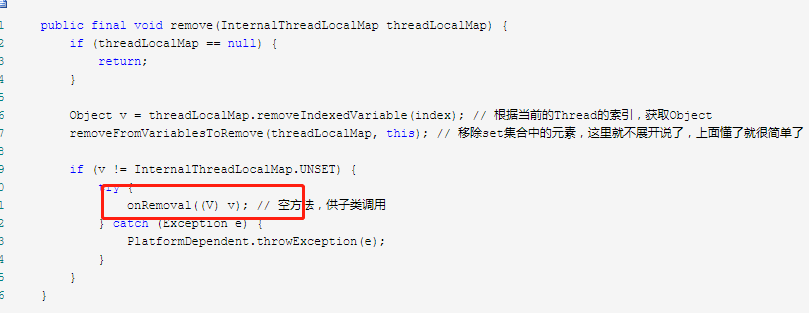
提供了onRemoval方法供子类重写,那就看下是怎么重写的。
        protected void onRemoval(PoolThreadCache threadCache) {

            threadCache.free();

        }
    void free() {

        // As free() may be called either by the finalizer or by FastThreadLocal.onRemoval(...) we need to ensure

        // we only call this one time.

        if (freed.compareAndSet(false, true)) {

            int numFreed = free(tinySubPageDirectCaches) +

                    free(smallSubPageDirectCaches) +

                    free(normalDirectCaches) +

                    free(tinySubPageHeapCaches) +

                    free(smallSubPageHeapCaches) +

                    free(normalHeapCaches);

            if (numFreed > 0 && logger.isDebugEnabled()) {

                logger.debug("Freed {} thread-local buffer(s) from thread: {}", numFreed,

                        Thread.currentThread().getName());

            }

            if (directArena != null) {

                directArena.numThreadCaches.getAndDecrement();

            }

            if (heapArena != null) {

                heapArena.numThreadCaches.getAndDecrement();

            }

        }

    }
对所有的数组进行释放,具体的free过程就不一起看了,比较简单。ok, 下一节我们看下重点的分配方法。
buf = directArena.allocate(cache, initialCapacity, maxCapacity);
Netty源码分析--内存模型(上)(十一)的更多相关文章
- Netty源码分析--内存模型(下)(十二)
这一节我们一起看下分配过程 PooledByteBuf<T> allocate(PoolThreadCache cache, int reqCapacity, int maxCapacit ...
- Netty源码分析--Reactor模型(二)
这一节和我一起开始正式的去研究Netty源码.在研究之前,我想先介绍一下Reactor模型. 我先分享两篇文献,大家可以自行下载学习. 链接:https://pan.baidu.com/s/1Uty ...
- Netty源码分析第5章(ByteBuf)---->第7节: page级别的内存分配
Netty源码分析第五章: ByteBuf 第六节: page级别的内存分配 前面小节我们剖析过命中缓存的内存分配逻辑, 前提是如果缓存中有数据, 那么缓存中没有数据, netty是如何开辟一块内存进 ...
- Netty源码分析第5章(ByteBuf)---->第8节: subPage级别的内存分配
Netty源码分析第五章: ByteBuf 第八节: subPage级别的内存分配 上一小节我们剖析了page级别的内存分配逻辑, 这一小节带大家剖析有关subPage级别的内存分配 通过之前的学习我 ...
- Netty源码分析-- 处理客户端接入请求(八)
这一节我们来一起看下,一个客户端接入进来是什么情况.首先我们根据之前的分析,先启动服务端,然后打一个断点. 这个断点打在哪里呢?就是NioEventLoop上的select方法上. 然后我们启动一个客 ...
- netty源码分析之揭开reactor线程的面纱(二)
如果你对netty的reactor线程不了解,建议先看下上一篇文章netty源码分析之揭开reactor线程的面纱(一),这里再把reactor中的三个步骤的图贴一下 reactor线程 我们已经了解 ...
- Netty源码分析第3章(客户端接入流程)---->第1节: 初始化NioSockectChannelConfig
Netty源码分析第三章: 客户端接入流程 概述: 之前的章节学习了server启动以及eventLoop相关的逻辑, eventLoop轮询到客户端接入事件之后是如何处理的?这一章我们循序渐进, 带 ...
- Netty源码分析第3章(客户端接入流程)---->第2节: 处理接入事件之handle的创建
Netty源码分析第三章: 客户端接入流程 第二节: 处理接入事件之handle的创建 上一小节我们剖析完成了与channel绑定的ChannelConfig初始化相关的流程, 这一小节继续剖析客户端 ...
- Netty源码分析第5章(ByteBuf)---->第1节: AbstractByteBuf
Netty源码分析第五章: ByteBuf 概述: 熟悉Nio的小伙伴应该对jdk底层byteBuffer不会陌生, 也就是字节缓冲区, 主要用于对网络底层io进行读写, 当channel中有数据时, ...
随机推荐
- 「玩转Python」突破封锁继续爬取百万妹子图
前言 从零学 Python 案例,自从提交第一个妹子图版本引来了不少小伙伴的兴趣.最近,很多小伙伴发来私信说,妹子图不能爬了!? 趁着周末试了一把,果然爬不动了,爬下来的都是些 0kb 的假图片,然后 ...
- Lake Counting-C++
Description Due to recent rains, water has pooled in various places in Farmer John's field, which is ...
- AT173 単位:题解
题目链接:https://www.luogu.org/problemnew/show/AT173 分析: 首先,我们可以做如下排序: sort(a+1,a+1+n); 因为题目告诉我们了要出席最少的次 ...
- 新手小白快速登天日记之安装python以及环境变量和pycharm解释器较为详细教程
Python解释器安装及环境变量配置 Python官方网站:www.python.org 首先打开这个网址,找到downloads选择,因为我是Windows所以下载windows的,因电脑而异 然后 ...
- 【转】Spring事务详解
1.事务的基本原理 Spring事务的本质其实就是数据库对事务的支持,使用JDBC的事务管理机制,就是利用java.sql.Connection对象完成对事务的提交,那在没有Spring帮我们管理事务 ...
- sql server还原数据库(请选择用于还原的备份集)
还原数据库的时候明明选择了备份集,还是提示未选择还原的备份集 后来查了下,是因为我本地有两个数据库(2008R2和2014),对应的两个数据库实例.而还原bak是sqlserver2014的备份,我默 ...
- mysql 不同版本下 group by 组内排序的差异
最近发现网上找的 group by 组内排序语句在不同的mysql版本中结果不一样. 建表语句: SET FOREIGN_KEY_CHECKS=0; -- ---------------- ...
- Linux基础之快照克隆、Xshell优化、Linux历史
今天主要分享4个Linux基础知识,第一个知识是虚拟机快照,第二个是虚拟机克隆,第三个是优化Xshell,第四个是简述Linux历史. 先分享第一个知识——虚拟机快照. 1.4)虚拟机快照 虚拟机快照 ...
- tp3 的前端内置标签
Volist 标签 volist标签通常用于查询数据集(select 方法),对于查询出来的结果数组进行遍历输出. 首先赋值: $User = M("User"); $list = ...
- 01-k8s 架构
原文地址:https://github.com/kubernetes/kubernetes/blob/release-1.3/docs/design/architecture.md Kubernete ...