
Stars(树状数组+线段树)
Stars
Time Limit: 2000/1000 MS (Java/Others) Memory Limit: 65536/32768 K (Java/Others)
Total Submission(s): 6676 Accepted Submission(s): 2659
often examine star maps where stars are represented by points on a
plane and each star has Cartesian coordinates. Let the level of a star
be an amount of the stars that are not higher and not to the right of
the given star. Astronomers want to know the distribution of the levels
of the stars.
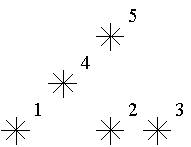
For
example, look at the map shown on the figure above. Level of the star
number 5 is equal to 3 (it's formed by three stars with a numbers 1, 2
and 4). And the levels of the stars numbered by 2 and 4 are 1. At this
map there are only one star of the level 0, two stars of the level 1,
one star of the level 2, and one star of the level 3.
You are to write a program that will count the amounts of the stars of each level on a given map.
first line of the input file contains a number of stars N
(1<=N<=15000). The following N lines describe coordinates of stars
(two integers X and Y per line separated by a space,
0<=X,Y<=32000). There can be only one star at one point of the
plane. Stars are listed in ascending order of Y coordinate. Stars with
equal Y coordinates are listed in ascending order of X coordinate.
output should contain N lines, one number per line. The first line
contains amount of stars of the level 0, the second does amount of stars
of the level 1 and so on, the last line contains amount of stars of the
level N-1.
1 1
5 1
7 1
3 3
5 5
2
1
1
0
 #include<iostream>

 #include<cstdio>

 #include<cstring>

 #include<algorithm>

 #include<queue>

 #include<stack>

 #include<vector>

 using namespace std;

 const int INF=0x3f3f3f3f;

 //#define LOCAL

 const int MAXM=;

 const int MAXN=;

 /*struct Node{

     int x,y;

 };*/

 int tree[MAXM+],ans[MAXN];//,die[MAXN];

 //Node dt[MAXN];

 /*int cmp(Node a,Node b){

     if(a.y!=b.y){

         return a.y<b.y;

     }

     else return a.x<b.x;

 }*/

 int lowbit(int x){

     return x&(-x);

 }

 void update(int x){

     while(x<=MAXM){

         tree[x]++;

         x+=lowbit(x);

     }

 }

 int SUM(int x){

     int temp=;

     while(x>){

         temp+=tree[x];

         x-=lowbit(x);

     }

     return temp;

 }

 /*int erfen(int l,int r,int x){

     int mid;

     while(l<=r){

         mid=(l+r)>>1;

         if(die[mid]>x)r=mid-1;

         else l=mid+1;

     }

     return l;

 }*/

 int main(){

 /*    #ifdef LOCAL

     freopen("data.in","r",stdin);

     freopen("data.out","w",stdout);

     #endif*/

     int N;

     int a;

     while(~scanf("%d",&N)){

         memset(tree,,sizeof(tree));

         memset(ans,,sizeof(ans));

         for(int i=;i<N;i++){

             scanf("%d%*d",&a);

             a++;

             ans[SUM(a)]++;update(a);

         //    scanf("%d%d",&dt[i].x,&dt[i].y);

         }

         //sort(dt,dt+N,cmp);

     /*    for(int i=0;i<N;i++){

             die[i]=SUM(dt[i].x);

             update(dt[i].x);

         }

         sort(die,die+N);

          for(int i=0;i<N;i++){

              int temp=0,t=erfen(0,N-1,i);

          //    printf("%d**%d**%d\n",die[t-1],i,t);

                  temp=t;

              ans[i]=temp;

             // printf("%d\n",ans[i]);

          }*/

          for(int i=;i<N;i++){

          /*    if(i){

                  printf(" ");

              }*/

          //    printf("%d",i==0?ans[i]:ans[i]-ans[i-1]);

          printf("%d\n",ans[i]);

          }

     }

     return ;

 }
刚开始写的也ac了:
 #include<iostream>

 #include<cstdio>

 #include<cstring>

 #include<algorithm>

 #include<queue>

 #include<stack>

 #include<vector>

 using namespace std;

 const int INF=0x3f3f3f3f;

 //#define LOCAL

 const int MAXM=;

 const int MAXN=;

 struct Node{

     int x,y;

 };

 int tree[MAXM+],die[MAXN],ans[MAXN];

 Node dt[MAXN];

 /*int cmp(Node a,Node b){

     if(a.y!=b.y){

         return a.y<b.y;

     }

     else return a.x<b.x;

 }*/

 int lowbit(int x){

     return x&(-x);

 }

 void update(int x){

     while(x<=MAXM){

         tree[x]++;

         x+=lowbit(x);

     }

 }

 int SUM(int x){

     int temp=;

     while(x){

         temp+=tree[x];

         x-=lowbit(x);

     }

     return temp;

 }

 int main(){

     #ifdef LOCAL

     freopen("data.in","r",stdin);

     freopen("data.out","w",stdout);

     #endif

     int N;

     while(~scanf("%d",&N)){

         for(int i=;i<N;i++){

             scanf("%d%d",&dt[i].x,&dt[i].y);

             dt[i].x++;

         }

         //sort(dt,dt+N,cmp);

         memset(tree,,sizeof(tree));

         for(int i=;i<N;i++){

             die[i]=SUM(dt[i].x);

             update(dt[i].x);

         }

         sort(die,die+N);

          for(int i=,j=;i<N;i++){

              int temp=;

              while(die[j]==i){

                  j++;temp++;

              }

              ans[i]=temp;

          }

          for(int i=;i<N;i++){

              //if(i)printf(" ");

              printf("%d\n",ans[i]);

          }

         // puts("");

     }

     return ;

 }
刚开始发现超时改成二分找了,更快点的最后也ac了:
 #include<iostream>

 #include<cstdio>

 #include<cstring>

 #include<algorithm>

 #include<queue>

 #include<stack>

 #include<vector>

 using namespace std;

 const int INF=0x3f3f3f3f;

 //#define LOCAL

 const int MAXM=;

 const int MAXN=;

 struct Node{

     int x,y;

 };

 int tree[MAXM+],die[MAXN],ans[MAXN];

 Node dt[MAXN];

 /*int cmp(Node a,Node b){

     if(a.y!=b.y){

         return a.y<b.y;

     }

     else return a.x<b.x;

 }*/

 int lowbit(int x){

     return x&(-x);

 }

 void update(int x){

     while(x<=MAXM){

         tree[x]++;

         x+=lowbit(x);

     }

 }

 int SUM(int x){

     int temp=;

     while(x){

         temp+=tree[x];

         x-=lowbit(x);

     }

     return temp;

 }

 int erfen(int l,int r,int x){

     int mid;

     while(l<=r){

         mid=(l+r)>>;

         if(die[mid]>x)r=mid-;

         else l=mid+;

     }

     return l;

 }

 int main(){

     #ifdef LOCAL

     freopen("data.in","r",stdin);

     freopen("data.out","w",stdout);

     #endif

     int N;

     while(~scanf("%d",&N)){

         for(int i=;i<N;i++){

             scanf("%d%d",&dt[i].x,&dt[i].y);

             dt[i].x++;

         }

         //sort(dt,dt+N,cmp);

         memset(tree,,sizeof(tree));

         for(int i=;i<N;i++){

             die[i]=SUM(dt[i].x);

             update(dt[i].x);

         }

         sort(die,die+N);

         for(int i=;i<N;i++){

              int temp=,t=erfen(,N-,i);

          //    printf("%d**%d**%d\n",die[t-1],i,t);

                  temp=t;

              ans[i]=temp;

             // printf("%d\n",ans[i]);

          }

          for(int i=;i<N;i++){

              //if(i)printf(" ");

            printf("%d\n",i==?ans[i]:ans[i]-ans[i-]);

          }

         // puts("");

     }

     return ;

 }
线段树来一发:
 #include<iostream>

 #include<cstdio>

 #include<cstring>

 #include<algorithm>

 #include<queue>

 #include<stack>

 #include<vector>

 using namespace std;

 const int INF=0x3f3f3f3f;

 const int MAXN=;

 #define L tree[root].l

 #define R tree[root].r

 #define S tree[root].sum

 #define lson root<<1,l,mid

 #define rson root<<1|1,mid+1,r

 struct Node{

     int l,r,sum;

 };

 Node tree[MAXN<<];

 int res[MAXN>>];

 int ans;

 void build(int root,int l,int r){

     L=l;R=r;

     S=;

     if(l==r)return;

     int mid=(l+r)>>;

     build(lson);

     build(rson);

 }

 void update(int root,int x){

     if(L==x&&R==x){

         S++;

         return;

     }

     int mid=(L+R)>>;

     if(mid>=x)update(root<<,x);

     else update(root<<|,x);

     S=tree[root<<].sum+tree[root<<|].sum;

 }

 void query(int root,int x){

     if(L>=&&R<=x){

         ans+=S;

         return;

     }

     int mid=(L+R)>>;

     if(mid>=)query(root<<,x);

     if(mid<x)query(root<<|,x);

 }

 int main(){

     int N,a;

     while(~scanf("%d",&N)){

         build(,,MAXN-);

         memset(res,,sizeof(res));

         for(int i=;i<N;i++){

         scanf("%d%*d",&a);

         a++;

         ans=;

         query(,a);

         res[ans]++;

         update(,a);

         }

         for(int i=;i<N;i++)printf("%d\n",res[i]);

     }

     return ;

 }
Stars(树状数组+线段树)的更多相关文章
- 洛谷P2414 阿狸的打字机 [NOI2011] AC自动机+树状数组/线段树
正解:AC自动机+树状数组/线段树 解题报告: 传送门! 这道题,首先想到暴力思路还是不难的,首先看到y有那么多个,菜鸡如我还不怎么会可持久化之类的,那就直接排个序什么的然后按顺序做就好,这样听说有7 ...
- 树状数组 && 线段树应用 -- 求逆序数
参考:算法学习(二)——树状数组求逆序数 .线段树或树状数组求逆序数(附例题) 应用树状数组 || 线段树求逆序数是一种很巧妙的技巧,这个技巧的关键在于如何把原来单纯的求区间和操作转换为 求小于等于a ...
- hdu1394(枚举/树状数组/线段树单点更新&区间求和)
题目链接:http://acm.hdu.edu.cn/showproblem.php?pid=1394 题意:给出一个循环数组,求其逆序对最少为多少: 思路:对于逆序对: 交换两个相邻数,逆序数 +1 ...
- hdu 1166:敌兵布阵(树状数组 / 线段树,入门练习题)
敌兵布阵 Time Limit: 2000/1000 MS (Java/Others) Memory Limit: 65536/32768 K (Java/Others)Total Submis ...
- hdu 5147 Sequence II【树状数组/线段树】
Sequence IITime Limit: 5000/2500 MS (Java/Others) Memory Limit: 32768/32768 K (Java/Others) Problem ...
- 数据结构--树状数组&&线段树--基本操作
随笔目的:方便以后对树状数组(BIT)以及基本线段树的回顾 例题链接:http://acm.hdu.edu.cn/showproblem.php?pid=1166 例题:hdu 1166 敌兵布阵 T ...
- BZOJ_1901_&_ZJU_2112_Dynamic_Rankings_(主席树+树状数组/线段树+(Treap/Splay))
描述 http://www.lydsy.com/JudgeOnline/problem.php?id=1901 给出一个长度为n的数列A,有m次询问,询问分两种:1.修改某一位置的值;2.求区间[l, ...
- BZOJ 3333 排队计划 树状数组+线段树
题目大意:给定一个序列.每次选择一个位置,把这个位置之后全部小于等于这个数的数抽出来,排序,再插回去,求每次操作后的逆序对数 首先我们每一次操作 对于这个位置前面的数 因为排序的数与前面的数位置关系不 ...
- 第十四个目标(dp + 树状数组 + 线段树)
Problem 2236 第十四个目标 Accept: 17 Submit: 35 Time Limit: 1000 mSec Memory Limit : 32768 KB Probl ...
- Curious Robin Hood(树状数组+线段树)
1112 - Curious Robin Hood PDF (English) Statistics Forum Time Limit: 1 second(s) Memory Limit: 64 ...
随机推荐
- windows下载安装requests
1.下载地址:https://github.com/kennethreitz/requests 2.解压缩后,cd requests 3.安装 python setup.py install
- Linux 内核无线子系统
Linux 内核无线子系统 浅谈 Linux 内核无线子系统 Table of Contents 1. 全局概览 2. 模块间接口 3. 数据路径与管理路径 4. 数据包是如何被发送? 5. 谈谈管理 ...
- Android自定义View研究--View中的原点坐标和XML中布局自定义View时View触摸原点问题
这里只做个汇总~.~独一无二 文章出处:http://blog.csdn.net/djy1992/article/details/9715047 Android自定义View研究--View中的原点坐 ...
- ora-01031:insufficient privileges 解决方案
sqlplus /as sysdba 连补上,ora-01031的解决方法: (1)检查sqlnet.ora是否包含这句话:SQLNET.AUTHENTICATION_SERVICES=(NTS),没 ...
- python中判断readline读到文件末尾
fp = open('somefile.txt') while True: line = fp.readline() if not line: #等价于if line == "": ...
- java中的上传下载----ajaxFileUpload+struts2
文件上传在项目中应该是非常常见的,而且很多时候,上传文件都只是一个小页面中的一个功能,要求在实现文件上传的前提下不刷新页面.而一般情况下将客户端的文件包装成网络地址传递到服务器端然后通过流来进行文件传 ...
- c#读取xml文件配置文件Winform及WebForm-Demo具体解释
我这里用Winform和WebForm两种为例说明怎样操作xml文档来作为配置文件进行读取操作. 1.新建一个类,命名为"SystemConfig.cs".代码例如以下: < ...
- BoundsChecker使用
转载:http://www.cnitblog.com/qiuyangzh/archive/2005/07/14/975.html 1 前言 我在本文中具体介绍了測试工具NuMega Devpart ...
- C实例--推断一个字符串是否是回文数
回文是指顺读和反读内容均同样的字符串.比如"121","ABBA","X"等. 本实例将编写函数推断字符串是否是回文. 引入两个指针变量,開 ...
- Error pulling origin: error: The following untracked working tree files would be overwritten by...
git在pull时,出现这样的错误的时候,可能非常多人进进行stash.相关stash的请看:Error pulling origin: error: Your local changes to th ...