
Learn ZYNQ Programming(1)
GPIO LED AND KEY:
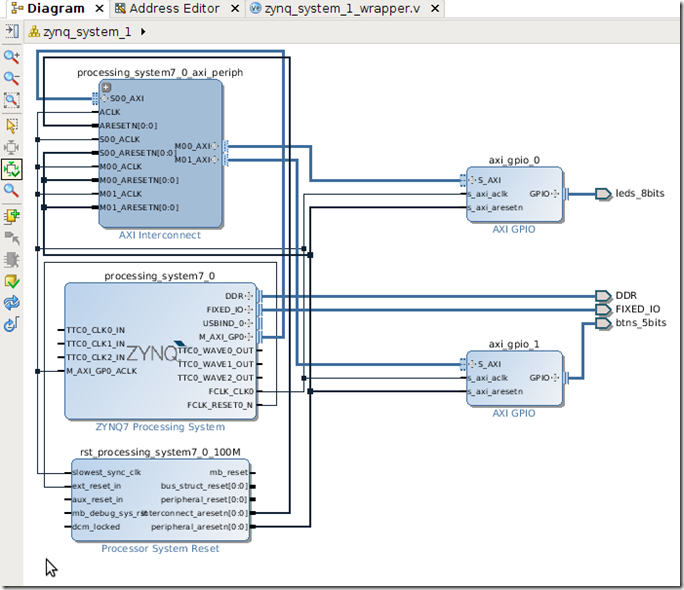
part1:gpio leds and gpio btns combination. (include 1~4)
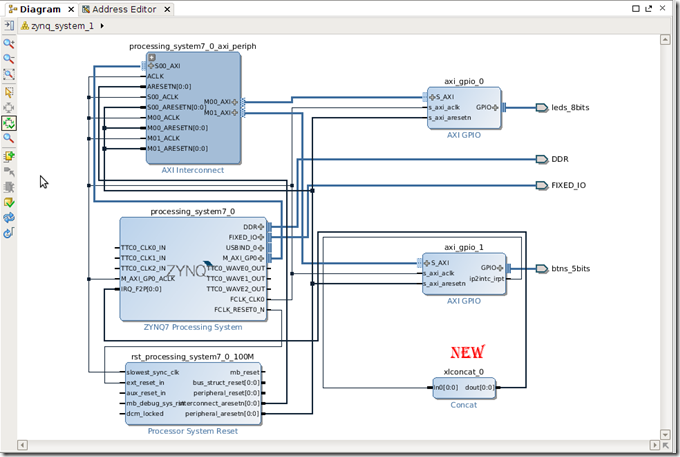
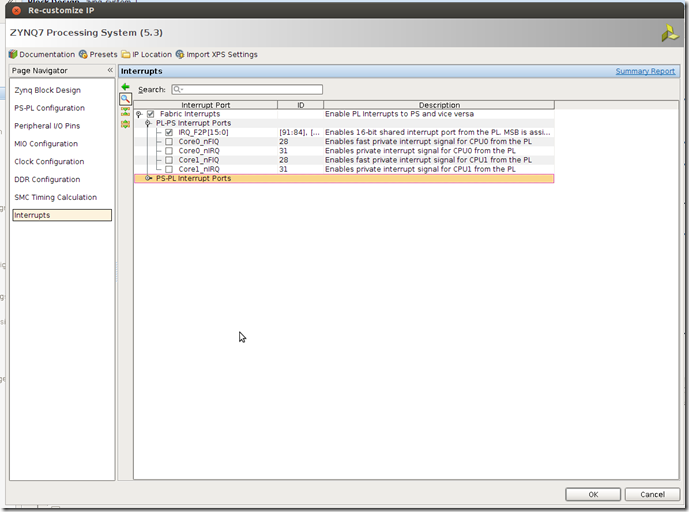
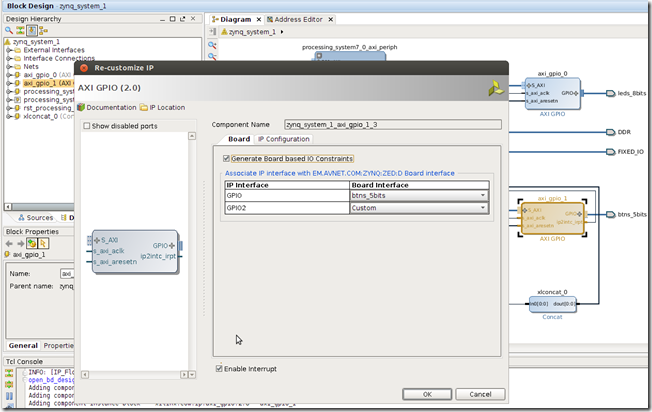
part2:use gpio btns interrupt to trigger led on and off. (include 5, 6, 7)
part3:some useful tips. (include 8)
my vivado & sdk projects ( ready to download):
my driver package ( ready to download):
(1)Block Design:
(2)Constraints:
set_property PACKAGE_PIN T22 [get_ports {leds_8bits_tri_o[0]}]

set_property IOSTANDARD LVCMOS33 [get_ports {leds_8bits_tri_o[0]}]

set_property PACKAGE_PIN T21 [get_ports {leds_8bits_tri_o[1]}]

set_property IOSTANDARD LVCMOS33 [get_ports {leds_8bits_tri_o[1]}]

set_property PACKAGE_PIN U22 [get_ports {leds_8bits_tri_o[2]}]

set_property IOSTANDARD LVCMOS33 [get_ports {leds_8bits_tri_o[2]}]

set_property PACKAGE_PIN U21 [get_ports {leds_8bits_tri_o[3]}]

set_property IOSTANDARD LVCMOS33 [get_ports {leds_8bits_tri_o[3]}]

set_property PACKAGE_PIN V22 [get_ports {leds_8bits_tri_o[4]}]

set_property IOSTANDARD LVCMOS33 [get_ports {leds_8bits_tri_o[4]}]

set_property PACKAGE_PIN W22 [get_ports {leds_8bits_tri_o[5]}]

set_property IOSTANDARD LVCMOS33 [get_ports {leds_8bits_tri_o[5]}]

set_property PACKAGE_PIN U19 [get_ports {leds_8bits_tri_o[6]}]

set_property IOSTANDARD LVCMOS33 [get_ports {leds_8bits_tri_o[6]}]

set_property PACKAGE_PIN U14 [get_ports {leds_8bits_tri_o[7]}]

set_property IOSTANDARD LVCMOS33 [get_ports {leds_8bits_tri_o[7]}]

set_property PACKAGE_PIN P16 [get_ports {btns_5bits_tri_i[0]}]

set_property IOSTANDARD LVCMOS25 [get_ports {btns_5bits_tri_i[0]}]

set_property PACKAGE_PIN N15 [get_ports {btns_5bits_tri_i[2]}]

set_property IOSTANDARD LVCMOS25 [get_ports {btns_5bits_tri_i[2]}]

set_property PACKAGE_PIN T18 [get_ports {btns_5bits_tri_i[4]}]

set_property IOSTANDARD LVCMOS25 [get_ports {btns_5bits_tri_i[4]}]

set_property PACKAGE_PIN R18 [get_ports {btns_5bits_tri_i[3]}]

set_property IOSTANDARD LVCMOS25 [get_ports {btns_5bits_tri_i[3]}]

set_property PACKAGE_PIN R16 [get_ports {btns_5bits_tri_i[1]}]

set_property IOSTANDARD LVCMOS25 [get_ports {btns_5bits_tri_i[1]}]
(3) Standalone Program
#include <stdio.h>

#include "platform.h"

#include "xil_io.h"

#include "xgpio.h"

#include "xparameters.h"

//void print(char *str);

int main()

{

    init_platform();

    print("Hello World\n\r");

    u32 btn_data;

    //XGpio

    //btn_data = Xil_In32(0x41200000);

      //      printf("data is xxx %d\n",btn_data);

    Xil_Out32(0x41200000 , 0x08);

    sleep(1);

    //Xil_Out32(0x41200000 , 0x00);

    while(1){

        //Xil_Out32(0x41210000 , 0x00000000);

        btn_data = Xil_In32(0x41210000);

        //if(btn_data & 0x01){

            //Xil_Out32(0x41210000 , 0x01);

        sleep(1);

        printf("data is %ld\n",btn_data);

        //}

        /*if(btn_data & 0x00000001)

            Xil_Out32(0x41200000 , 0x01);

        if(btn_data & 0x00000002)

            Xil_Out32(0x41200000 , 0x02);

        if(btn_data & 0x00000004)

            Xil_Out32(0x41200000 , 0x04);

        if(btn_data & 0x00000008)

            Xil_Out32(0x41200000 , 0x08);

            */

    }

    //sleep(1);

    return 0;

}
(4) Linux Driver:
#include <linux/module.h>

#include <linux/version.h>

#include <linux/kernel.h>

#include <linux/init.h>

#include <linux/fs.h>

#include <linux/cdev.h>

#include <linux/delay.h>

#include <linux/spinlock.h>

#include <linux/device.h>

#include <linux/types.h>

#include <linux/ioctl.h>

#include <asm/io.h>

#include <asm/uaccess.h>

#include <asm/atomic.h>

#include <linux/wait.h>

#include <linux/cdev.h>

#define DEVICE_NAME "gpio_dev"

#define LED_PHY_ADDR 0x41200000

#define KEY_PHY_ADDR 0X41210000

/*

#define ULTRASONIC_IOC_MAGIC 'Z'

#define LED_SHUTDOWN _IOR(ULTRASONIC_IOC_MAGIC, 0, int)

#define LED_OPEN _IOR(ULTRASONIC_IOC_MAGIC, 1, int)

#define GET_KEY_STATUS _IOR(ULTRASONIC_IOC_MAGIC, 2, int)

*/

static unsigned long led_addr = 0;

static unsigned long key_addr = 0;

static struct class* gpio_class = NULL;

static struct device* gpio_device = NULL;

static int gpio_major = 0;

//arg means the led number, cmd controls it on or off

static ssize_t gpio_ioctl(struct file *file, unsigned int cmd, unsigned long arg)

{

        //printk("fun(gpio_ioctl):");

        u32 status = 0xff;

        int ret;

        switch(cmd){

                case 0:

                case 1:

                        //if(arg > 8)

                        //      return -EINVAL;

                        status = ioread32(led_addr);

                        if(0 == cmd)

                                status &=  ~(0x1 << arg);

                        else if(1 == cmd)

                                status |= (0x1 << arg);

                        iowrite32(status,led_addr);

                        //printk("debug1 cmd= %d\n",cmd);

                        return 0;

                case 3:

                        //printk("debug3 cmd=%d\n",cmd);

                        status = ioread32(key_addr);

                        ret = __put_user(status, (u32 *)arg);

                        printk("key print = 0x%x\n",status);

                        return 0;

                default:

                        printk("default cmd=%d\n",cmd);

                        return -EINVAL;

        }

}

/*

static ssize_t key_read(struct file *file,u32  __user *buf, size_t count, loff_t *ppos)

{

        u32 data;

        int ret = 0;

        data = ioread32(key_addr);

        ret = __put_user(data, (u32 *)buf);

        printk("key print = 0x%x\n",data);

        return (sizeof(u32));

}

*/

static struct file_operations gpio_fops = {

        .owner = THIS_MODULE,

        .unlocked_ioctl = gpio_ioctl,

//      .read = key_read,

};

static int __init gpio_init(void)

{

        int ret;

        printk("debug0");

        ret = register_chrdev(0,DEVICE_NAME, &gpio_fops);

        if(ret < 0)

        {

                printk("gpio: can't get major number\n");

                return ret;

        }

        printk("debug1");

        gpio_major = ret;

        gpio_class = class_create(THIS_MODULE, "gpio_class");

        if(IS_ERR(gpio_class))

        {

                printk("gpio: failed in creating class\n");

                unregister_chrdev(gpio_major, DEVICE_NAME);

                return -1;

        }

        printk("debug2");

        gpio_device = device_create(gpio_class,NULL,MKDEV(gpio_major,0),NULL,DEVICE_NAME);

        if(IS_ERR(gpio_device))

        {

                printk("gpio: failed in creating device!\n");

                unregister_chrdev(gpio_major, DEVICE_NAME);

                class_unregister(gpio_class);

                class_destroy(gpio_class);

                return -1;

        }

        led_addr = (unsigned long) ioremap(LED_PHY_ADDR, sizeof(u32));

        key_addr = (unsigned long) ioremap(KEY_PHY_ADDR, sizeof(u32));

/*

        iowrite32(0x00,led_addr);

        mdelay(100);

        iowrite32(0xff,led_addr);

*/

        printk("gpio installed successfully!");

        return 0;

}

static void __exit gpio_exit(void)

{

/*

        iowrite32(0x00,led_addr);

        mdelay(100);

        iowrite32(0xff,led_addr);

*/

        device_destroy(gpio_class,MKDEV(gpio_major, 0));

        class_unregister(gpio_class);

        class_destroy(gpio_class);

        unregister_chrdev(gpio_major,DEVICE_NAME);

        printk("gpio module exit!");

}

module_init(gpio_init);

module_exit(gpio_exit);

MODULE_AUTHOR("seg");

MODULE_LICENSE("GPL");
(5) Linux App:
#include <stdio.h>

#include <stdlib.h>

#include <unistd.h>

#include <sys/ioctl.h>

#include <sys/types.h>

#include <sys/stat.h>

#include <fcntl.h>

#include <sys/select.h>

#include <sys/time.h>

static int led_fd;

int main(void)

{

        int i;

        // open device

        led_fd = open("/dev/gpio_dev", 0);

        if (led_fd < 0) {

                perror("open device gpio_dev error!\n");

                exit(1);

        }

        printf("Please look at the leds\n");

        // led all off

        ioctl(led_fd, 1, 0);

        ioctl(led_fd, 1, 1);

        ioctl(led_fd, 1, 2);

        ioctl(led_fd, 1, 3);

        ioctl(led_fd, 1, 4);

        ioctl(led_fd, 1, 5);

        ioctl(led_fd, 1, 6);

        ioctl(led_fd, 1, 7);

        for(i=0;i<2;i++)

        {

                ioctl(led_fd, 0, 0);

                usleep(50000);

                ioctl(led_fd, 0, 1);

                usleep(50000);

                ioctl(led_fd, 0, 2);

                usleep(50000);

                ioctl(led_fd, 0, 3);

                usleep(50000);

                ioctl(led_fd, 0, 4);

                usleep(50000);

                ioctl(led_fd, 0, 5);

                usleep(50000);

                ioctl(led_fd, 0, 6);

                usleep(50000);

                ioctl(led_fd, 0, 7);

                usleep(50000);

                // led off one by one

                ioctl(led_fd, 1, 0);

                usleep(50000);

                ioctl(led_fd, 1, 1);

                usleep(50000);

                ioctl(led_fd, 1, 2);

                usleep(50000);

                ioctl(led_fd, 1, 3);

                usleep(50000);

                ioctl(led_fd, 1, 4);

                usleep(50000);

                ioctl(led_fd, 1, 5);

                usleep(50000);

                ioctl(led_fd, 1, 6);

                usleep(50000);

                ioctl(led_fd, 1, 7);

                usleep(50000);

        }

        while(1)

        {

                unsigned int key = 0;

                //printf("original = %d , %x",key,key);

                ioctl(led_fd, 3, &key);

                printf("key = %d\n",key);

                for(i=0;i<8;i++)

                        ioctl(led_fd,0,i);

                if(key & (0x01<<0))

                        ioctl(led_fd, 1, 0);

                else if(key & (0x01<<1))

                        ioctl(led_fd, 1, 1);

                else if(key & (0x01<<2))

                        ioctl(led_fd, 1, 2);

                else if(key & (0x01<<3))

                        ioctl(led_fd, 1, 3);

                else if(key & (0x01<<4))

                        ioctl(led_fd, 1, 4);

                else{}

                usleep(1000000);

        }

        close(led_fd);

        return 0;

}
(5)Hardware Interrupt Vivado Project
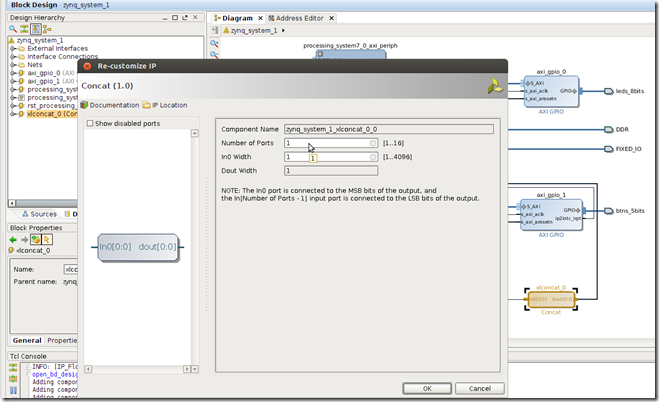
(6)Hardware Interrupt SDK Project
#include "xparameters.h"

#include "xgpio.h"

#include "xil_exception.h"

#include "xscugic.h"

/************************** Constant Definitions *****************************/

#define LED_ADDR 0x41200000

#define KEY_ADDR 0X41210000

#define GPIO_DEVICE_ID        XPAR_AXI_GPIO_1_DEVICE_ID

#define INTC_GPIO_INTERRUPT_ID    XPAR_FABRIC_GPIO_1_VEC_ID

 #define INTC_DEVICE_ID    XPAR_SCUGIC_0_DEVICE_ID

 #define INTC        XScuGic

 #define INTC_HANDLER    XScuGic_InterruptHandler

#define GPIO_ALL_LEDS        0xFFFF

#define GPIO_ALL_BUTTONS    0xFFFF

/*

 * The following constants define the GPIO channel that is used for the buttons

 * and the LEDs. They allow the channels to be reversed easily.

 */

#define BUTTON_CHANNEL     1    /* Channel 1 of the GPIO Device */

#define LED_CHANNEL     2    /* Channel 2 of the GPIO Device */

#define BUTTON_INTERRUPT XGPIO_IR_CH1_MASK  /* Channel 1 Interrupt Mask */

/*

 * The following constant is used to wait after an LED is turned on to make

 * sure that it is visible to the human eye.  This constant might need to be

 * tuned for faster or slower processor speeds.

 */

#define LED_DELAY     1000000

/**************************** Type Definitions *******************************/

typedef struct

{

    u32 ButtonMask;     /* The bit corresponding to the button */

    u32 LedMask;     /* The bit corresponding to the LED */

} MapButtonTable;

/************************** Function Prototypes ******************************/

int MapButton2Led(u32 Buttons, u32 *ButtonFoundPtr);

void SequenceLeds();

void GpioIsr(void *InstancePtr);

int SetupInterruptSystem();

/************************** Variable Definitions *****************************/

static XGpio Gpio; /* The Instance of the GPIO Driver */

static INTC Intc; /* The Instance of the Interrupt Controller Driver */

volatile int InterruptCount; /* Count of interrupts that have occured */

int main(void)

{

    int Status;

    SequenceLeds();

    /* Initialize the GPIO driver. If an error occurs then exit */

    Status = XGpio_Initialize(&Gpio, GPIO_DEVICE_ID);

    if (Status != XST_SUCCESS) {

        return XST_FAILURE;

    }

    /*

     * Perform a self-test on the GPIO.  This is a minimal test and only

     * verifies that there is not any bus error when reading the data

     * register

     */

    XGpio_SelfTest(&Gpio);

    /*

     * Setup the interrupts such that interrupt processing can occur. If

     * an error occurs then exit

     */

    Status = SetupInterruptSystem();

    if (Status != XST_SUCCESS) {

        return XST_FAILURE;

    }

    printf("in the loop:\n");

    while (1) {

    }

    return XST_SUCCESS;

}

void SequenceLeds()

{

    u32 led = 0x01;

    u32 out = 0x0;

    int i;

    for (i = 0; i < 8; i++) {

        out = led << i;

        Xil_Out32(LED_ADDR, out);

        sleep(1);

    }

    Xil_Out32(LED_ADDR, 0x00);

}

/********************************************************************************************************************************************************/

void GpioIsr(void *InstancePtr)

{

    XGpio *GpioPtr = (XGpio *)InstancePtr;

    u32 Led;

    u32 LedState;

    u32 Buttons;

    u32 ButtonFound;

    u32 ButtonsChanged = 0;

    static u32 PreviousButtons;

    printf("Enter GpioIsr!\n");

    /*

     * Disable the interrupt

     */

    XGpio_InterruptDisable(GpioPtr, BUTTON_INTERRUPT);

    /* Keep track of the number of interrupts that occur */

    InterruptCount++;

    Xil_Out32(LED_ADDR,0x00);

    ButtonsChanged = Xil_In32(KEY_ADDR);

    printf("BUTTON:%d;",ButtonsChanged);

    //while (ButtonsChanged != 0) {

        /*

         * Determine which button changed state and then get

         * the current state of the associated LED

         */

         printf("SET_LED=%d",ButtonsChanged);

         Xil_Out32(LED_ADDR,ButtonsChanged);

//         LedState = Xil_In32(LED_ADDR) & Led;

         /*

          * Clear the button that is being processed so that it is

          * done and others can be handled also

          */

//         ButtonsChanged &= ~ButtonFound;

         /* Toggle the state of the LED */

//         if (LedState) {

//             Xil_Out32(LED_ADDR,LedState & ~Led);

//         } else {

//             Xil_Out32(LED_ADDR,Led);

//         }

//     }

     /* Clear the interrupt such that it is no longer pending in the GPIO */

     (void)XGpio_InterruptClear(GpioPtr, BUTTON_INTERRUPT);

     /*

      * Enable the interrupt

      */

     XGpio_InterruptEnable(GpioPtr, BUTTON_INTERRUPT);

}

int SetupInterruptSystem()

{

    int Result;

    INTC *IntcInstancePtr = &Intc;

    XScuGic_Config *IntcConfig;

    /*

     * Initialize the interrupt controller driver so that it is ready to

     * use.

     */

    IntcConfig = XScuGic_LookupConfig(INTC_DEVICE_ID);

    if (NULL == IntcConfig) {

        return XST_FAILURE;

    }

    Result = XScuGic_CfgInitialize(IntcInstancePtr, IntcConfig,

                    IntcConfig->CpuBaseAddress);

    if (Result != XST_SUCCESS) {

        return XST_FAILURE;

    }

    XScuGic_SetPriorityTriggerType(IntcInstancePtr, INTC_GPIO_INTERRUPT_ID,

                    0xA0, 0x3);

    /*

     * Connect the interrupt handler that will be called when an

     * interrupt occurs for the device.

     */

    Result = XScuGic_Connect(IntcInstancePtr, INTC_GPIO_INTERRUPT_ID,

                 (Xil_ExceptionHandler)GpioIsr, &Gpio);

    if (Result != XST_SUCCESS) {

        return Result;

    }

    printf("XST_SUCCESS");

    /*

     * Enable the interrupt for the GPIO device.

     */

    XScuGic_Enable(IntcInstancePtr, INTC_GPIO_INTERRUPT_ID);

    /*

     * Enable the GPIO channel interrupts so that push button can be

     * detected and enable interrupts for the GPIO device

     */

    XGpio_InterruptEnable(&Gpio, BUTTON_INTERRUPT);

    XGpio_InterruptGlobalEnable(&Gpio);

    /*

     * Initialize the exception table and register the interrupt

     * controller handler with the exception table

     */

    Xil_ExceptionInit();

    Xil_ExceptionRegisterHandler(XIL_EXCEPTION_ID_INT,

             (Xil_ExceptionHandler)INTC_HANDLER, IntcInstancePtr);

    /* Enable non-critical exceptions */

    Xil_ExceptionEnable();

    return XST_SUCCESS;

}
(7) Interrupt driver edition
#include <linux/module.h>

#include <linux/version.h>

#include <linux/kernel.h>

#include <linux/init.h>

#include <linux/fs.h>

#include <linux/cdev.h>

#include <linux/delay.h>

#include <linux/spinlock.h>

#include <linux/device.h>

#include <linux/types.h>

#include <linux/ioctl.h>

#include <asm/io.h>

#include <asm/uaccess.h>

#include <asm/atomic.h>

#include <linux/wait.h>

#include <linux/cdev.h>

#include <linux/interrupt.h>

#include <asm/signal.h>

#include <linux/gpio.h>

#include <linux/irq.h>

#define DEVICE_NAME "gpio_dev"

#define GPIO_BASEADDR 0x41200000

#define LED_PHY_ADDR 0x41200000

#define KEY_PHY_ADDR 0X41210000

#define INTERRUPT_ID 91

#define IRQ_MASK 0x1

#define IRQ_DEVICE_ID 0

#define XGPIO_GIE_OFFSET	0x11C /**< Glogal interrupt enable register */

#define XGPIO_ISR_OFFSET	0x120 /**< Interrupt status register */

#define XGPIO_IER_OFFSET	0x128 /**< Interrupt enable register */

#define XGPIO_GIE_GINTR_ENABLE_MASK 0x80000000

//#define is_keypad_irq() (!(inb(IRQ_STAT_ADDR) & IRQ_MASK))

//#define disable_irq()    (iowrite32(IRQ_DIST_BASEADDR+XGPIO_IER_OFFSET,ioread32(IRQ_DIST_BASEADDR+XGPIO_IER_OFFSET) & ~IRQ_MASK))

//#define enable_irq()      (iowrite32(IRQ_DIST_BASEADDR+XGPIO_IER_OFFSET,ioread32(IRQ_DIST_BASEADDR+XGPIO_IER_OFFSET) | IRQ_MASK))

//#define clear_irq()      (iowrite32(KEY_PHY_ADDR+XGPIO_IER_OFFSET,ioread32(KEY_PHY_ADDR+XGPIO_IER_OFFSET) & IRQ_MASK))

static unsigned long led_addr = 0;

static unsigned long key_addr = 0;

static struct class* gpio_class = NULL;

static struct device* gpio_device = NULL;

static int gpio_major = 0;

typedef struct {

        dev_t dev_no;

	u32 IsReady;

	int InterruptPresent;

	u32 BaseAddress;

//      spinlock_t lock;

        atomic_t lock;

} KEY_DEV;

static KEY_DEV keydev;

//arg means the led number, cmd controls it on or off

static ssize_t gpio_ioctl(struct file *file, unsigned int cmd, unsigned long arg)

{

	//printk("fun(gpio_ioctl):");

	u32 status = 0xff;

	int ret;

	switch(cmd){

		case 0:

		case 1:

			//if(arg > 8)

			//	return -EINVAL;

			status = ioread32(led_addr);

			if(0 == cmd)

				status &=  ~(0x1 << arg);

			else if(1 == cmd)

				status |= (0x1 << arg);

			iowrite32(status,led_addr);

			return 0;

		case 3:

			status = ioread32(key_addr);

			ret = __put_user(status, (u32 *)arg);

			printk("key print = 0x%x\n",status);

			return 0;

		default:

			printk("default cmd=%d\n",cmd);

			return -EINVAL;

	}

}

static void InterruptClear()

{

        u32 val;

        val = ioread32(key_addr + XGPIO_ISR_OFFSET);

        iowrite32(val & IRQ_MASK,key_addr + XGPIO_ISR_OFFSET);

        printk("int cleared");

}

static irqreturn_t key_interrupt(int irq, void *dev_id, struct pt_regs *regs)

{

	u32 status = 0xff;

	//disable_irq(INTERRUPT_ID);

//	disable_irq();

	status = ioread32(key_addr);

	iowrite32(status,led_addr);

	printk("key print = 0x%x\n",status);

//	clear_irq();

	//enable_irq(INTERRUPT_ID);

//	enable_irq();

	InterruptClear();

	return 0;

}

static void InterruptEnable()

{

	//from stand alone program

	//XGpio_InterruptEnable(&Gpio, BUTTON_INTERRUPT);

	//XGpio_InterruptGlobalEnable(&Gpio);

	u32 val;

	printk("debug1 read addr = %lx\n",key_addr+XGPIO_IER_OFFSET);

	//			  0x128

	val = ioread32(key_addr + XGPIO_IER_OFFSET);

	printk("debug2 val=%lx\n",val);

	//                   0x128                  0x1

	iowrite32(val | IRQ_MASK,key_addr + XGPIO_IER_OFFSET);

	printk("debug3 ");

	//		     0x11c            0x80000000

	iowrite32(XGPIO_GIE_GINTR_ENABLE_MASK,key_addr + XGPIO_GIE_OFFSET);

}

static int key_open(struct inode *inode, struct file *filp)

{

        int ret;

	printk("open!\n");

	InterruptEnable();

	printk("interrupt Enabled!\n");

	ret = request_irq(INTERRUPT_ID, key_interrupt,IRQF_TRIGGER_RISING, DEVICE_NAME, &keydev);

	if(ret)

	{

		printk("could not register interrupt!");

		return ret;

	}

	//disable_irq(INTERRUPT_ID);

	//enable_irq(INTERRUPT_ID);

//	enable_irq();

	printk("register interrupt success!\n");

	return 0;

}

static struct file_operations gpio_fops = {

	.owner = THIS_MODULE,

	.unlocked_ioctl = gpio_ioctl,

	.open = key_open,

//	.read = key_read,

};

static int __init gpio_init(void)

{

	int ret;

	ret = register_chrdev(0,DEVICE_NAME, &gpio_fops);

	if(ret < 0)

	{

		printk("gpio: can't get major number\n");

		return ret;

	}

	gpio_major = ret;

	gpio_class = class_create(THIS_MODULE, "gpio_class");

	if(IS_ERR(gpio_class))

	{

		printk("gpio: failed in creating class\n");

		unregister_chrdev(gpio_major, DEVICE_NAME);

		return -1;

	}

	gpio_device = device_create(gpio_class,NULL,MKDEV(gpio_major,0),NULL,DEVICE_NAME);

	if(IS_ERR(gpio_device))

	{

		printk("gpio: failed in creating device!\n");

		unregister_chrdev(gpio_major, DEVICE_NAME);

		class_unregister(gpio_class);

		class_destroy(gpio_class);

		return -1;

	}

	led_addr = (unsigned long) ioremap(LED_PHY_ADDR, sizeof(u32));

	key_addr = (unsigned long) ioremap(KEY_PHY_ADDR, sizeof(u32));

/*

	iowrite32(0x00,led_addr);

	mdelay(100);

	iowrite32(0xff,led_addr);

*/

	printk("gpio installed successfully!\n");

	return 0;

}

static void __exit gpio_exit(void)

{

/*

	iowrite32(0x00,led_addr);

	mdelay(100);

	iowrite32(0xff,led_addr);

*/

	device_destroy(gpio_class,MKDEV(gpio_major, 0));

	class_unregister(gpio_class);

	class_destroy(gpio_class);

	unregister_chrdev(gpio_major,DEVICE_NAME);

	printk("gpio module exit!");

}

module_init(gpio_init);

module_exit(gpio_exit);

MODULE_AUTHOR("seg");

MODULE_LICENSE("GPL");
(8) Useful Tips for write linux driver
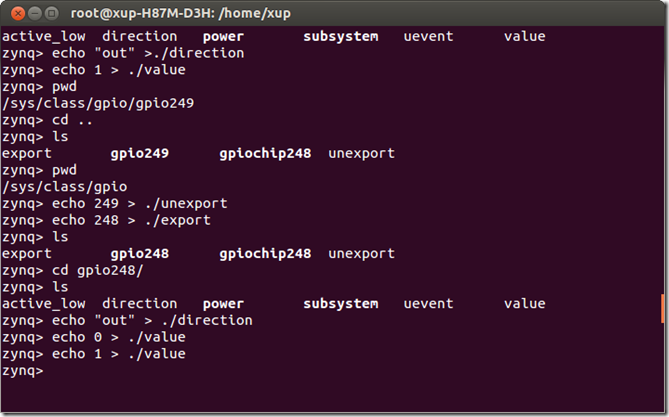
Part1: we can use commands below to test gpio led.
cd /sys/class/gpio/

echo 248 > ./export

cd gpio248/

echo "out" > ./direction

echo 1 > ./value
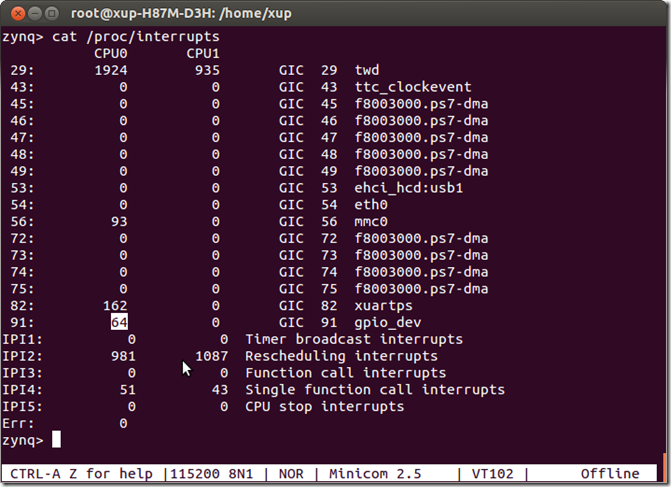
Part2: we can use commands below to see interrupts status.
cat /proc/interrupts

cat /proc/stat
Learn ZYNQ Programming(1)的更多相关文章
- The best way to learn a programming language
The best way to learn a programming language is to write a lot of code and read a lot of code.
- Learn ZYNQ(10) – zybo cluster word count
1.配置环境说明 spark:5台zybo板,192.168.1.1master,其它4台为slave hadoop:192.168.1.1(外接SanDisk ) 2.单节点hadoop测试: 如果 ...
- Learn ZYNQ (9)
创建zybo cluster的spark集群(计算层面): 1.每个节点都是同样的filesystem,mac地址冲突,故: vi ./etc/profile export PATH=/usr/loc ...
- Learn ZYNQ (8)
在zed的PS端运行spark(已成功): (1)设置uboot为sd卡启动rootfs: "sdboot=if mmcinfo; then " \ ...
- Learn ZYNQ (3)
移植android3.3到ZedBoard follow doc:Android移植Guide1.3.pdf follow website: http://elinux.org/Zedboard_An ...
- Learn ZYNQ (7)
矩阵相乘的例子 参考博客:http://blog.csdn.net/kkk584520/article/details/18812321 MatrixMultiply.c typedef int da ...
- Teach Yourself Programming in Ten Years
Teach Yourself Programming in Ten Years——用十年教会自己编程 作者:Peter Norvig 译者:刘海粟 本文原文为:http://norvig.com/21 ...
- Learn golang: Top 30 Go Tutorials for Programmers Of All Levels
https://stackify.com/learn-go-tutorials/ What is Go Programming Language? Go, developed by Google in ...
- Learn nodejs: Tutorials for Programmers of All Levels, 程序员每个阶段的示例
https://stackify.com/learn-nodejs-tutorials/ What is Node.js? Node.js can be defined as a dynamic, c ...
随机推荐
- C#部分的总结
经过本次考试暴露出一些问题,面对一些概念性和文字性的基础知识,仍然不够细心,出现各种不应该的错误, 虽然平时学习中,实际操作写代码比较顺利,但基础知识和概念仍不可少,这在将来面试上也是重要的一部分.在 ...
- telnet时显示:允许更多到 telnet 服务器的连接。请稍候再试
telnet时显示:允许更多到 telnet 服务器的连接.请稍候再试 解决办法: windows自带telnet服务器默认的最大连接数为2,要想修改该设置,可以在命令行键入tlntadmn c ...
- js-面向对象的程序设计,函数表达式
面向对象的程序设计: 1.属性类型:数据属性.访问器属性 数据属性:wirtable:false –只读:如果尝试为它赋值,会忽略 Configurable:false—不能从对象中删除属性 在调用O ...
- Java与.NET随笔
.NET与Java,因这两种技术的相似性,总是会让人拿来做比较,并且总有人想让二者一分高下,最后得出孰优孰劣的结论.由于本人先用.NET,后转Java,现在.NET与Java二者并用,所以对二者间的差 ...
- Sleep函数的真正用意
转自:http://blog.csdn.net/boyuejiang/article/details/8908333 关于VOID Sleep(DWORD dwMilliseconds);函数,许多人 ...
- iOS 获取当前用户的用户路径并写入文件
NSString *path = [[@"~" stringByExpandingTildeInPath] stringByAppendingString: @"/tmp ...
- HowTo:使用数据流读写消息
本文主要演示使用TPL 数据流库从数据流块(dataflow block)读写消息. 提供了同步方法和异步方法. 主要使用BufferBlock,其既能作为message source,有能作为m ...
- block和split的理解
两者是从不同的角度来定义的:HDFS以固定大小的block为基本单位存储数据(分布式文件系统,实际存储角度,物理存储单位),而MapReduce以split作为处理单位(编程模型角度,逻辑单位). 对 ...
- Thread 的使用
对于Thread 的使用,我要注意的是我经常忽略".start()".之前由于在android开发中,如果是使用网络加载的功能,这个部分需要新增线程,不能在主线程使用. 然后注意要 ...
- Linq to DataTable 左连接
所先创建2个DataTable并对其赋值,来进行模拟. DataTable dt1 = new DataTable(); dt1.Columns.Add("ID", typeof( ...